This episode is sponsored by Betterhelp.
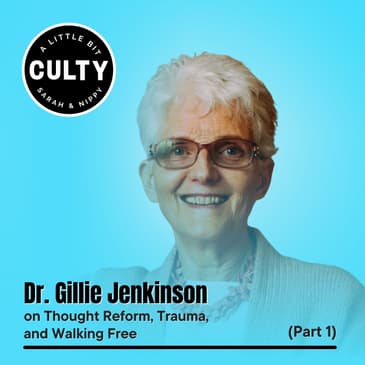
Dr. Gillie Jenkinson—the OG, the GOAT, and the GG of cult recovery work (she needed a definition, we provided several)—finally makes her long-overdue debut on A Little Bit Culty. She’s a therapist, cult survivor, and the author of Walking Free from the Trauma of Coercive, Cultic and Spiritual Abuse, and this first part is all about how she got in.
It started in 1970s London: a posh English boarding school girl who grew up in Uganda, wanted to marry a lord, and had no particular ambition or sense of direction. A persistent friend with a sulking habit got her to a meeting, an emotional experience convinced her it was real, and suddenly she was a radicalized born-again Christian baptized in the Leicester Square fountain with a police officer conveniently looking the other way. From there it was a slow drift—au pair jobs, city moves, counseling from a fellowship—until she found herself living in community houses with the Love of God group, a Bible-based cult founded by a charismatic opera singer from Birmingham School of Music.
What followed was seven years of escalating control, a second leader who brought in physical beatings with a bamboo cane framed as spiritual discipline, and a psychological prison so complete that leaving never once crossed her mind. The cult imploded on its own—and she got out with her future husband Tony, whom she'd been secretly carpooling with—but the cult stayed in her for another 14 years through a series of churches that knew, as she puts it, "fuck all" about cult recovery. Part 2 brings the work, the book, and the brilliance she's built from all of it—stay tuned.
Pick up Dr. Gillie Jenkinson’s book, Walking Free from the Trauma of Coercive, Cultic and Spiritual Abuse, follow her on Facebook or LinkedIn, and follow Hope Valley Counselling at hopevalleycounselling.com or on Facebook.
Trigger warning: This episode contains frank discussion of physical abuse, religious coercion, and psychological imprisonment.
Also…let it be known that:
The views and opinions expressed on A Little Bit Culty do not necessarily reflect the official policy or position of the podcast. Any content provided by our guests, bloggers, sponsors or authors are of their opinion and are not intended to malign any religion, group, club, organization, business, individual, anyone or anything. Nobody’s mad at you, just don’t be a culty fuckwad.
Buy the A Little Bit Culty book on Amazon or order a signed copy.
Check out our amazing sponsors
Join A Little Bit Culty on Patreon
Get poppin’ fresh ALBC Swag
Support the pod and smash this link
Check out our cult awareness and recovery resources
Watch Sarah's TED Talk and buy her memoir, Scarred
CREDITS:
Executive Producers: Sarah Edmondson & Anthony Ames
Production Partner: Citizens of Sound
Co-Creator: Jess Tardy
Audio production: Will Retherford
Production Coordinator: Lesli Dinsmore
Writer: Sandra Nomoto
Social media team: Eric Skwarzynski and Brooke Keane
Theme Song: “Cultivated” by Jon Bryant co-written with Nygel Asselin
SUPPORT OUR SPONSORS:
Don’t let stigma stand in the way of support. Start therapy with BetterHelp. Sign up and get 10% off at BetterHelp.com/culty.
See Privacy Policy at https://art19.com/privacy and California Privacy Notice at https://art19.com/privacy#do-not-sell-my-info.
[00:00:00] Ornode gibt es seit 2013. Wir stellen Fahrradbekleidung her. Der größte Vorteil von Shopify für mich ist, dass wir für die Unternehmensverwaltung keine technischen Vorkenntnisse brauchen. Wir können alles über das Backend und das Frontend steuern und so quasi im Vorbeigehen den Onlineshop betreiben. Wäre Shopify Fahrradzubehör, dann wäre die Plattform das eigentliche Fahrrad. Sie ist einfach die Grundlage. Unser ganzes Geschäft läuft über Shopify. Starte jetzt deinen kostenlosen Test auf Shopify.com.
[00:00:30] Wenn du nicht kommst oder nicht kommst, um zu einer Live Book Events zu kommen, was du mit deinem Kalender machen? Wir haben Fragen. Wir haben wir uns auf. Wir haben uns auf die Banyan Books und Sounds. Und mein Herz ist so voll. Ein Herz ist so voll. Huge shout-out to Nathan, die von Fort St. John mit der besten hand-made wooden cutting-deie-art mit einem kleinen Kulti-artemangrabenen. Wer hat das? Danke, Nathan. Wir sind so honored und all die Unterstützung we hatten last night. Danke, Vancouver, für schon wieder zu machen uns so lieben.
[00:00:57] but you still have three chances to come hang out with us. July 21st, casual book signing at Massey Books. July 23rd, another book signing, meet and greet at Indigo Park Royal in North Van. And finally, July 24th at the Canadian Memorial Center for Peace's Great Hall. Listen, July 24th is a big one. It is our launch. It'll be our last Canadian event for a while, and we're turning it into a live A Little Bit Culty podcast, complete with an audience Q&A. So if you've ever wanted to
[00:01:23] be part of the conversation or ask us that question in person that you've been saving, this is your moment. Do not sleep on this one. This is a ticketed event. If you've already picked up a copy of the book, amazing. Just send us a proof of purchase and we'll send you a code for a free ticket because the tickets do include a copy of the book. If you're coming as a couple, you don't have to pay twice. Just DM us and we'll hook you up. Come and laugh, cry, ask questions, get your book signed, meet fellow cult survivors and cult curious and all around lovely humans, including some of my
[00:01:51] friends and family who'll be there. It's going to be glorious. Honestly, we can't wait to see you or meet you, whatever the case may be. And if you're not in Vancouver, stay tuned for your local events and be in touch if you want us to come to your city. We'll figure something out. Thanks everybody for the support. And don't forget, also the book is now on Audible, narrated by us. We are so proud of this and can't wait to share it with you. See y'all soon. This podcast is for informational purposes only and should not be considered legal, medical or mental health advice. The views and opinions
[00:02:21] expressed do not necessarily reflect the official policy or position of the podcast and are not intended to malign any religion, group, club, organization, business, individual, anyone or anything. I'm Sarah Edmondson. And I'm Anthony Nippy Ames. And this is A Little Bit Culty. We woke up
[00:02:46] from a cult and that journey was captured in The Vow on HBO and in my memoir, Scarred. Now in this podcast, we break down the shame and secrets that make these experiences so destructive with honest conversations on how seemingly benign groups can cross into the cultiverse and how to spot and recover from trouble if it happens to you. Each week, we bring in experts, survivors, and whistleblowers to explore red flags, resilience, and even share a few laughs because sometimes you gotta laugh. Subscribe to our Patreon for early and ad-free listening, some live Q&A and exclusive
[00:03:14] content at patreon.com slash a little bit culty. Welcome to season eight of A Little Bit Culty. Welcome back to A Little Bit Culty, everybody. Today's guest is Dr. Gillie Jenkinson, an accredited psychotherapist, international speaker, and author who spent more than 30 years helping people heal
[00:03:40] from coercive, cultic, and spiritual abuse. Sarah tries to call her the goat, doesn't really land. You'll see. That'll make sense later. She's also a survivor herself, which gives her work that rare combination of clinical depth and lived experience, plus the very refreshing ability to talk about recovery without making it sound like a mysterious side quest. She's also hilarious. A sinner. She's a sinner. We had a lot of fun with Gillie, and I think you're going to enjoy it.
[00:04:07] Part one is hearing about her story. As you know, this is a survivor-focused podcast, her story in and out of a cult. And part two is more about her healing journey and her award-winning book, which is Walking Free from the Trauma of Coercive, Cultic, and Spiritual Abuse. This lays out the walking free model, which shows that healing usually happens in four phases and is possible with the right psychoeducation, support, and understanding. We will be digging into what
[00:04:35] actually helps former members recover and how the pseudo-identity created in a high-control group gets untangled, and why Gillie's work has become such a game-changer for therapists and survivors alike. Here's part one with the goat, Dr. Gillie Jenkinson.
[00:05:08] Well, first of all, let me just say welcome, Gillie Jenkinson. I feel like this is so way overdue because you're kind of like the goat in this space. Do you know what the goat means? Is this a term that has made it over to London? Very insulting, the goat. It does. It does. And they first started coming out with that about 10 years ago. I was like, why would you call him the goat? This is where you could also... Well, the goat means greatest
[00:05:35] of all time. It's an acronym. It's an acronym. Well... Yeah. Okay. Thank you. It's a term used by the young people these days to describe someone. That's why I don't know it. Listen, I feel the same way, but it basically describes someone who's like the original. You've been around from the beginning and we... It's more the greatest of all time. And the original. OG. Have you heard the
[00:06:00] term OG? Uh, go on. It's like original gangster or something else. This is so funny. Gangster granny. Okay. You're the... Yeah, yeah. I'm the GJ. Well, it's been long overdue and I apologize it's taken so long to figure out that we need to have you on the podcast. You know, you're one of the original people in this space. And you're a name that I've heard before by other people we've interviewed, but we've just never connected.
[00:06:27] So now we're finally connecting and it's so lovely to meet you. Thank you. And I have your book. I had scarred. Someone very kindly gave it to me at a ICSA conference. And so I have that and, and, and then my little bit culty arrived today. Woohoo. Amazing. Amazing. I'm sorry I didn't get to you sooner. I blame Amazon for that, but at least you have it. But now that we've met and when we have
[00:06:56] your book, Walking Free, which is beautiful and very satisfying to hold, I wish I'd known about this sooner because we would have put it as a resource in a little bit culty under the healing section, but in the second edition we will. And I'm actually have a list of all the things to add to the second edition, which we missed and we missed so many things. Yeah. Thank you. Yeah, absolutely. Because, you know, as you, I know you flipped through the PDF, we have a section
[00:07:21] on healing and some of the things that helped us, but this is like the, no, it's a step by step, the expanded accordion aspect of the healing on steroids. Yeah. Yes. On drugs? Not on drugs. Not on drugs. We'll get into the book. Yeah. And we did say earlier that you're allowed to swear and you said that you're more apt to say feck off. Fuck. Fuck. Fuck off. Yeah.
[00:07:50] Anybody who knows me well is okay. Here we go. Well, I guess it's meant to be that, that we would do this podcast together because anyone who knows me well knows that I have a potty mouth. In fact, my friends call me a trucker princess because I'm a princess, but I also cuss a lot. So there you go. Exactly. So we are going to have so much fun today. You've been doing podcasts, been doing interviews, been telling your story for so long and it might be a little bit boring for you,
[00:08:19] but we're going to try to find the gems that you haven't shared before and just have a good time. We're very casual here on a little bit culty. That's cool. Chili, the goat, the OG, GG, DJ. You were in a cult many years ago, in a religious cult. Just give us a little bit, whatever you want to say. What was going on for you? Where were you in your life that you heard about this cult? How did you get hooked?
[00:08:47] So it happened a long time ago in the seventies. It was a Bible-based group. And when I was around 18, I became a born again Christian and I wasn't really searching. And I think in some ways
[00:09:12] was kind of pressured into becoming a Christian, actually. Somebody, this lovely woman, she decided that I was ready and should become a Christian. And I really wanted to just smoke and drink and do what I was doing because I was about 17. Boys, blah, blah, blah. And free love? Was this free love? Were you a hippie a little bit?
[00:09:39] I wasn't. No, not really. I went to British boarding school. I grew up in Africa. So I was a bit, probably a bit square. I wasn't really a cool hippie. But I had my, you know, I wanted to do normal things that teenagers do. And she kind of just kept a hold of me and she'd sort of sulk if I wouldn't go to the meetings and that sort of thing. And I, I mean, I've written about it in my book
[00:10:08] as well, my story a bit, and I've spoken about it, but I kind of capitulated and gave in. And I think it, you know how it is, because I've been looking at, you know, at the vow and some of your kind of processes, how convincing it is at the doorway as you're going in. There's so much that convinces you. There was so much that emotionally moved me and being emotionally moved
[00:10:37] made me feel that it was real. And that was true. And, and so I, I kind of made a commitment. There's obviously a whole lot of stuff around that, but I stepped into another world. You know, I grew up as quite a posh English girl. I went to boarding school. I traveled from Uganda back to England for school. And I have said this elsewhere that my main aim in life was to marry a Lord.
[00:11:06] And that's partly because I was sort of in touch with people like that. Like I, I knew people like that. And my family sort of identified somewhere. Yes. You're going, woo. I'm sorry. I just have to tell you something really quickly. Editors, please don't edit this out because it might seem random, but I just think it's very funny. My dad is British. Yeah. His dad is a Lord. So when his dad died, he's a Lord, which makes me honorable, right? Yeah. And he went to Eaton.
[00:11:36] Oh, there you go. And he also went to Uganda. Oh no. What's his name? His name's Lord Sanford or Jim Edmondson, my dad. He's actually been on the podcast as a guest because he dabbled in NXIVM. I just feel like you two need to meet. I'm not saying you need to get married, but I just feel like you two need to have a conversation. Yeah. So he's taken as well, but I just feel like you should meet because you've had a very similar life experience.
[00:12:02] Yeah. I'm not honorable and, but yeah, I had a lot of contact with, okay. Fancy people. But yeah, a family friend was a Hungarian countess and, but married out of, she married a British major. So she lost her title and she was happy with that, but, but because of those contacts,
[00:12:28] but, you know, I was thinking about it and I think because seriously leaving boarding school in that era, I didn't really have an ambition for myself and I didn't have an aim. So I went to the Queen's Secretarial College in Knightsbridge or Kensington and then I became a secretary because
[00:12:56] that was kind of the aspiration that I had at that time. And I didn't know about myself, but actually I'm very determined. I'm actually more intelligent than I ever thought I was because I thought I was stupid. And, and so I think that there was like a gap for me that somehow going into
[00:13:21] the church gave me not so much ambition, but a mission, I suppose, or a something. A structure. Yeah. A structure, but also a passion because I didn't have a passion. I didn't know where I was going and it did create that structure and that passion for me. And I, I kind of realized that
[00:13:46] quite recently, weirdly, that actually that probably was a vulnerability for me that somebody could step in and give me a passion that I hadn't, you know, in school and things you would hope that they would give you enough of a, of an education and enough of a inspiration to make you think you could do more than, you know, there's nothing wrong with being a secretary. I mean, it's a great skill that I can
[00:14:14] use now, but there was a lot more that I could have done and I've ended up doing stuff now. Yeah. Schools could do a better job of helping students elicit more about what they want. Yeah. Rather than teaching them what to think. I agree. Yeah. And so, yeah. And also teaching me to be a good girl, you know, you've got to be obedient
[00:14:38] in these settings. So that's kind of setting me up for being a good girl in the church and, and then sort of becoming, you know, just sort of giving into this myth of the authority figure and that the leaders know better than everybody else, rather than helping people to think for themselves and really grapple with truth or things. Yeah.
[00:15:07] And so interesting also that you've been doing this work, which we're going to get into later for so many years. And you just recently have gotten that extra nugget of that situational vulnerability. Totally relate to that. I feel like every time we interview somebody, I have a, another awareness and it's like an, it's a constant unfolding, isn't it? Yeah, it really is. Especially like we need to raise awareness of ourselves. It's interesting,
[00:15:35] you know, we live in ourselves. And so you need to be able to do that. I do find it really helpful making those connections. Yeah. I mean, either you have a schooling system that facilitates it, or you're going to run into something in life that's going to be at a cataclysmic event that's going to reveal it to you. So, you know, you know, an interface with reality, unfortunately or fortunately.
[00:16:03] Yeah. Yeah. Okay. So you have this boarding school experience and you have the situational vulnerabilities that set you up for success to be recruited. What did you think you were signing up for? Like, what was the, you thought you were joining a community, a church? Like, how would you have described it at the time? Like, what was the, what was the sales pitch? Well, it was that I was a sinner, that I was going to hell and that I needed to be saved.
[00:16:29] And so I got saved and that then created a sense in me of safety, I suppose, of I'm now not going to hell. But it wasn't, it wasn't like that was the end of the story. It was then I had to maintain that status in case if I stepped out of line, then maybe I'd go back, be going to hell again.
[00:16:59] So it wasn't a sort of, you've made this decision and then you're now safe. Although I thought I was. And so the way that people use Christian theology then became the controlling tool, the belief system, the gun to my head. If you don't obey, then you're sinning and then you'll be in trouble.
[00:17:25] And, but I mean, I didn't really understand what I was fully stepping into. I hadn't got a clue. I didn't know about church culture. I grew up going, we went to the local church in Uganda. Occasionally we weren't church goers. We would have said we were Christians, but not by this
[00:17:47] definition. And then, so I kind of, I got involved with the church and I started going to church regularly and we had quite a lot of fun around it. We'd go around. And I got baptised in Leicester Square in the fountain. We were all in a sort of, it probably looked like a hippie like prayer meeting. And then we got in a taxi, went to Leicester Square,
[00:18:14] got rid of the police officers, said, oh, well, I'm going to walk down the road here. Because we said, can we go in the water? He said, absolutely not. But I'm walking off down the road. So I won't be able to see what you do more or less. So he was supportive of the baptism. Well, he, he turned a blind eye. It was just, it was fun. It was fun. We played music on the streets. We played guitars, singing nice songs, that sort of thing. So we had fun.
[00:18:43] And, but I was very radicalised. I was fully in that world, which was quite concerning to my family. And I, at that time, I went to different churches. I worked for a Christian travel agent. And then I actually lost the job at the Christian travel agent.
[00:19:05] And I became an au pair. And I moved from London to the Midlands. And it kind of was, I, you know, having looked back on my story, it was the beginning of me beginning to move away from my family, who were all based down south of England. And then sort of, kind of, in terms of me being a Christian
[00:19:31] and how they lived their lives, this great chasm was opening up because they were quite concerned with how passionate I was about this and how I told my grandmother, who was actually Lady Burley. She, my grandfather was knighted. So it wasn't quite the same. I'd forgotten about that. I told her she was going to hell. It didn't go down very well. No. I mean, it's quite funny when I look back.
[00:20:00] Before we hear from our sponsors, just a quick reminder. Our book, A Little Bit Culty, Navigating Cults, Control and Coercion is officially out and available on Amazon. Signed pre-orders have closed, but you can still get your copy today. This book is the culmination of five years of conversations, interviews and research. Everything we've learned about how people get pulled into high control groups and how to avoid, escape or heal from them.
[00:20:25] If you've been listening to the podcast and want a deeper go-to resource, this is it. Available now on Amazon in print and as an e-book for Kindle. And yes, the audio book is coming soon, narrated by us. Just search A Little Bit Culty and grab your copy. Do it. Thanks, everybody.
[00:20:50] Your space should feel like you. And if it currently looks like a college dorm room mixed with stuff I inherited from people I don't even know and maybe Facebook Marketplace, well, that's a budget problem, not a taste problem. Enter Wayfair, which understands that good design doesn't require selling a kidney. We've used Wayfair every time we need a refresh. I'm always amazed how easy it is to order and the deliveries are fast and seamless and the quality is superb. Friends, if you're wanting to replace an
[00:21:16] item in your home, Wayfair should be your first stop. Yes, we order from Wayfair all the time and honestly, you should too. Wayfair Verified is basically their team of product nerds hand-testing everything with a 10-point inspection. So you're not buying some chair that looks great in photos, but feels like sitting on a bag of regrets. Everything's in one place. Seating, grills, lighting, storage, rugs. No more bouncing between 17 stores trying to find pieces that actually vibe together instead of looking like a ransom note. And Assembly, they handle delivery, installation,
[00:21:43] putting it all together. You just pick stuff and they deal with the soul-crushing instruction manuals written by people who hate joy. Plus, 20 million five-star reviews means you're seeing real people in real homes, not some magazine fantasy. Real feedback from real humans who aren't professional stylists. Ready to upgrade your home for way less? Head to Wayfair.com right now to shop all things home and get your space ready for less. That's W-A-Y-F-A-I-R dot com. Happy shopping! Wayfair, every style, every home. Summer wardrobes are so weird because
[00:22:13] you end up wearing like five pieces on repeat while everything else just sits there, quietly judging you. So why not make those five pieces actually great? That's the whole thing about quints. They nail elevated essentials, the kind of stuff that feels intentional without requiring a PhD in styling or a second mortgage. Their linen pants, for example, start at 32 bucks and become your summer uniform. Soft denim, organic cotton sweaters for layering when evenings cool down. Simple pieces that work together because they were designed that way. Not because you got lucky.
[00:22:43] And I love their 14 karat gold jewelry. The kind of thing that makes even the most effortless outfit feel like you actually tried. Which you didn't, but nobody needs to know that. Everything's 50 to 80% less than other brands because they skip the middleman and work directly with ethical factories. So you're paying for quality, not some brand's fancy marketing budget. I've been loving all of their basics for my summer travel. I have this cute crossbody black leather purse that matches my little black backpack, which sometimes my kids wear and then I wear and we all look cute in it.
[00:23:11] I also have an awesome super soft matching sweatshirt and joggers that I've worn for every single leg of my flight, including the six hours from Halifax to Vancouver because they're kind of like pajamas, but they're also elevated. So I still look like I'm not traveling in my PJs. And they've also got incredible home stuff, bedding, kitchen essentials, furniture. Basically, Quints gets that you want your whole life to feel intentional without actually having to work that hard at it. Make your summer wardrobe feel easier. Go to quints.com slash culty for free shipping on your order and
[00:23:40] 365 day returns now available in Canada too. That's q-u-i-n-c-e dot com slash culty for free shipping and 365 day returns. Quints.com slash culty. There are things in life you absolutely do not want to be transparent about. Your swimsuit, your search history, that time you cried watching a commercial, but your wireless bill, transparency is everything. Which is why Mint Mobile is basically a breath of
[00:24:04] fresh air in an industry built on confusion and gotchas. No hidden fees, no introductory rates that explode after three minutes, no mysterious charges that make you question your life choices. Just straightforward, 15 bucks a month, all plans, even unlimited, high-speed data, unlimited talk and text on T-Mobile's 5G network. That's it. That's the whole thing. You bring your current phone, keep your number, pick a 3, 6, or 12-month plan, and suddenly you're not hemorrhaging money on
[00:24:34] wireless anymore. Sign up online and boom, you're done. I know it sounds too good to be true because we've all been trained by carriers to expect the rug pull, but nope, just actually $15. Honestly, my only regret is spending years overpaying when this existed the whole time. To get your new wireless plan for just 15 bucks a month, go to mintmobile.com slash culty. That's mintmobile.com slash culty. Cut your wireless bill to 15 bucks a month at mintmobile.com slash culty. That's it.
[00:25:00] There's no catch. Upfront payment of $45 for three months, $90 for six months, or $180 for 12 months. Plan required, $15 per month equivalent. Taxes and fees extra. Initial plan term only, greater than 50 gigabytes, may slow when network is busy, includes up to 20 gigabytes hotspot. Capable devices required.
[00:25:20] Availability, speed, and coverage varies. Cementmobile.com. Thank you for listening. Now, let's dive back into the cultiverse. But, you know, it's not the sort of thing you do, dear. So I'm getting really involved in this. And then I became an au pair, and that was then
[00:25:48] the doorway that took me into what became the cult. So all of this time, if I'm being clear at all, that this sort of steps, you know, kind of going to different churches and then eventually moving to the Midlands and then moving from one city to another city in order to get some counselling.
[00:26:11] And I ended up, I went to this fellowship, and in the fellowship, they gave me some counselling. And then, honestly, that really was the beginning of the cult. Because from the very first moment that I
[00:26:33] joined, they kind of started to change my sense of myself and my identity. And I lived in one of the households for a short time, and I wasn't being paid. And I wasn't, sorry, I wasn't, I wasn't in a job.
[00:26:55] So they were putting me up for a while. And then within probably weeks of that time, they decided to set up in community. So they had a number of community houses. Eventually, there were probably six or seven. But there was the first house was number six. And I ended up going to number six. And we lived in
[00:27:20] common. It's a sort of Christian principle, you share everything. You know, we're the radical Christians, we're the ones who do it properly. And that was the beginning of the cult. So what started as a fellowship, then became the Love of God community. And we ended up with a number of community houses. So it sounds like it's organic at this point, and not very, were you processed systematically? Like,
[00:27:48] did they know what they were doing? Or was it something that kind of was organically going on? Yeah, it's a good point. No, I don't think they knew what they were doing. I think it was, yeah, I think it sort of evolved. It evolved from this fellowship, then into the community. And it was founded by a guy who was an opera singer, who was at the Birmingham School of
[00:28:15] Music, who kind of, I guess he had some charisma, I don't know, but something was happening for them. Before I joined, there was already something happening, a bit of a movement. And a revival, something like that. And so people were gathering around him. And then I kind of came
[00:28:37] into that slipstream, really. And then we set up, you know, in community. And that lasted for seven years. Before we get into sort of the red flags and things that weren't working, what was keeping you in? Like, what was good about it? Like, there was community, you, I'm guessing you felt purposeful. What were some of the things that you liked?
[00:29:00] Yeah, having others, friends around my age. So early 20s, very naive. We were all very naive. The worship was fun because the guy was a singer. He sang beautifully. He created songs. And there was quite a high level of creativity. There was a dance group, which we did these dances.
[00:29:27] We created these big robes. We sewed on sequins. There was that level of, just on a very small level. Like spectacle. Spectacle. Yeah. I mean, look, you've been involved with Hollywood. This is nothing on that level. But it was a little bit
[00:29:49] colourful compared to, you know, some of the churches. I mean, yeah, I mean, it's a good question. What did I like about it? I sort of feel like I was very disconnected from myself, really. The person I am now is definitely not the person that I was back then. And I kind of went along with things, I think.
[00:30:15] But it wasn't horrible in the very early days. And I worked as a temporary secretary. So I did do some work in the, probably in the first year or so, because I'd done the secretarial course. So I could do that kind of work. And all my money went into the community. But a new leader came in after about being there. Gosh, it's hard.
[00:30:41] I can't remember exactly the number of years. But then things really started to go downhill. And that's when the coercive control and the sort of thought reforming started to happen. And he really took over from the founder, broke the founder, who also was problematic. But he really was broken by this guy.
[00:31:09] And then the real abuse started to happen. It was awful. I'm happy to talk about it. Whatever you feel comfortable. Well, reading your book, I'm thinking, my goodness, I read the first chapter of Scarred.
[00:31:23] And I thought, you know, it's just absolutely terrible and shocking. And kind of what you're describing, which I have to say to you, is a really courageous and incredibly difficult thing to do to revisit these things, isn't it?
[00:31:45] And I just sort of really, you know, just really struck by articulating what happened. I was struck by your courage. That's, I suppose, what I wanted to say. Thank you for saying that. Within our group. Yeah, you're welcome. And I kind of could relate to it because in, in after about, I was involved for about seven years. And as you said, it just slowly evolved.
[00:32:14] My, my, my involvement with the church just slowly evolved. I wasn't fully in touch with myself. I wasn't approaching it as I would now. And I was naive. I didn't know people would want to abuse you or hurt you. I was taught Christian, a perverted version of Christian theology that God wants to break you.
[00:32:41] So you can abuse somebody till the cows come home if God wants to break you because you're never going to call it abuse. You're always going to think there's a reason and a rationale for this happening. And this second leader, after a while, brought in physical beatings with a bamboo cane. And these beatings were for six.
[00:33:08] And I, it was, you'll know what I mean. It was terrifying, absolutely terrifying. And, you know, it was like living in some kind of gothic horror. You know, you, I'm sure you know what I mean. Just reading your book, you know, that it's like, oh, and I was really lost to myself.
[00:33:37] I mean, completely. And I never occurred to me that I could leave. Never, ever. Never, not in all those years. Did it occur to me that I could walk out that door? Because I could. I wasn't in a physical prison. I was in a psychological prison. And that I could have gone to the police. I could have said, I could have gone the next day, said, this is what happened.
[00:34:01] But actually, and you said this, you know, in a little bit culty, you know, actually the result was trauma bond. And that you're more attached to them, not less attached to them after this trauma because, or after this abuse. Because then they were kind to me, you know, because I was beaten because of sin. And then, which I didn't sin. I didn't do anything. I ever did a thing.
[00:34:30] I dared, hardly dared breathe at that time. I was terrified. Julie, I can see you sinning. Julie. Can you? Well, yeah. These days, but those days. You were a good girl. I was such a good girl. I mean, I was a terrified girl. I was way beyond good girl by that time. And as you say, I'd already been, you know, I was sort of brought up to be a good girl.
[00:34:58] I'll take that as a compliment, by the way. Yes. It was. Of course it is. Thank you. So that's the heavy bit. So leaving, like you, it's PTSD and it's like, what do I do now? What the fuck am I going to do now? Let's take a little break from the cultiverse. Here's a word from our sponsors.
[00:35:52] Thank you, sponsors. We couldn't do it without you. Now let's get back to the show. With the structure of our podcast, we try to just draw out a couple of, you know, obviously those are, the beatings are a huge. First of all, I'm so sorry. I'm so sorry that happened to you. And also red flag of like, this isn't good, but you don't see it as bad yet because you're still indoctrinated. Was there any other little moments that you had that it could even be something small and then maybe you put on the shelf before you left?
[00:36:21] Any other moments that were, that you couldn't see yet as, you know, for what they were? Or, you know, I don't think there were. Or at least I haven't remembered them. And I've thought, I mean, I'm telling you, I've thought long and hard. I've had 25 years of therapy and exit counselling and worked on myself endlessly.
[00:36:46] I went to Belize near the end of the cult because it did disband. It didn't continue. It imploded really. And I suppose I started to see, but that was really at the very, six years in, it was near the end. But my father was a veterinary officer and he went to Belize and he was interested in cattle ranching.
[00:37:14] And I went and joined him for about a month and the chain started to fall away because I wasn't in that, I wasn't in the influence, under the influence of it. And I wrote, but I didn't think of leaving. I still didn't think of leaving. And I wrote to the leader because there were no emails back then.
[00:37:38] And we talked about the late 70s and I wrote and said, I'd like to live in a different household than the one I lived in. And he wrote back and I wish I still had this letter saying how I'd betrayed them and betrayed the household. And I needed to get back now.
[00:37:58] And, you know, I think just he was probably alarmed by me beginning to think for myself and actually in such a small way exerting something that I wanted to do. And so he had to really slam down on me. And I wish I'd show my father, but I didn't.
[00:38:20] And it was such a, and I think I do remember this feeling of it, me sort of caving in again of something beginning to blossom and break through and then something being kind of crushed again. And I went back, but it disbanded probably within about nine months anyway. So something was happening. So you didn't leave, it disbanded and that was how you got out? Yeah, exactly. Exactly.
[00:38:49] I guess beating people for sins will do that. I mean, it can. Your group also reminds me a little bit of the group in Holy Hell with the performances. Do you remember? Did you ever see that movie? I don't remember. No, it came out before the vow. It was called Holy Hell and it was about a cult in California and Austin. And there was, there's a lot of performances and sequence and that's why, but it wasn't Christian.
[00:39:18] Just more about the robes and the stuff. Anyway. Okay. So you, but you met your husband there. Yes. He arrived. He came about two years before the end and we became good friends, but there was no sinning going on. I can assure you, Missy. I can assure you that we were still very good children. I believe you. And, and, but so I worked by this time for a solicitors firm in the center of Birmingham.
[00:39:47] And my husband, Tony also worked at the tax office in the center of Birmingham. And so we'd share cars, we'd have car shares to go into town and it would often be him and me sharing the car, probably with others as well. But we'd often eat for lunch and chat and we got to know each other.
[00:40:09] We became friends and I thought he was like really sweet and kind within that setting. There was no tension there. I remember walking back and we met somewhere in the middle of town and the concierge of his office building saying, when are you getting married? You know, to the two of us, I guess. I don't know if we linked arms.
[00:40:38] I was like, oh, because if you eat this magical thinking, if you think it, they're going to hear it. The cult will hear these thoughts and then they're going to cause trouble. You know, you'll be in trouble for being too close or they don't want people to be close because they want to control you. And if two people are close, they might start talking about, actually, we don't like this. Right.
[00:41:08] You had to keep that hidden. Yeah. But that lucky for you, it imploded. Yeah. And you got out together. And then how soon after did you get married and figure out that you needed exit counselling? So we, yeah, that came a lot later. We left and got married within about three months because by now we were late 20s and we didn't have anywhere to live. We could have gone home, but, you know, we didn't want to go home back to our parents.
[00:41:37] That wasn't, these days you're more likely to do that. But in those days that you just didn't, you didn't do that really. So we had to find somewhere to live. Tony lived with my boss, I think, who was a solicitor. I think he went to his house and I lived with another couple who'd left the cult previously and they put me up for a while. And then we had Tony's family had saved some money for him or something.
[00:42:06] But somehow we managed to get a house together and we got married in the March following. I think the cult imploded around November, December and we got married around March. For you. Yeah, thank you. And it was such a relief to get out of a household of all these random people or people that you had such a complex history with, really. Correct. Yeah. And then, yeah.
[00:42:36] But we kept going to church still, you see, for another 14 years. So, you know, you hear all the time people saying it's one thing getting out of the cult, another getting the cult out of you.
[00:42:50] And the cult just stayed there like landmine, basically, triggering me off, triggering Tony off too, I guess, for about 14 years until we hit a crisis in yet another church that we joined. And finally, I started to come to myself.
[00:43:12] Finally, what I would call my authentic self or authentic identity and actually just thinking, I don't have to put up with this anymore. I'm not putting up with this abuse anymore. And I started to wake up, as they say. We left. And that's when I started training as a counsellor. That was in 1995. So up until 1995, you didn't even have a, like, you weren't calling that group a cult or anything like that yet. Like this, that was sort of buried.
[00:43:41] We used the term and we joined a church who said we understand how to help people who've been in cult. But look, it was back in the 70s. Nobody. Nowadays, there's so much stuff available. There was nothing. And they didn't know. They knew fuck all about cult. Absolutely. Fuck all.
[00:44:02] And their answer to being in a cult was join our church and come and do evangelization, which was just like, you know, that was the last thing we needed. So it just stayed frozen inside, causing fear, triggers. You know, the whole package was just going on all the time. And unfortunately... You haven't processed it yet.
[00:44:32] We really just hadn't processed anything. And just carried on, you know, sending out Christmas newsletters, telling sort of praise the Lord newsletters. Now looking back, thinking, oh my gosh. With the family thinking, oh God, not another of these newsletters. You know, like just such a completely different person to the person I am now. It's a bit, it's a little embarrassing, isn't it?
[00:45:02] There you go. Hindsight has that. Yeah. Well, if you have clarity, if you have clarity on what you were doing, looking back with embarrassment is a sign of the fact that you've evolved it. If you're not looking back with embarrassment, it probably means you didn't evolve it yet. So... I mean, thanks. Yeah, that's probably true. Because I have my cringe moments every now and then. Do you? Oh my God. I said this. Oh my God. What a jerk. Yeah.
[00:45:32] Yeah. Well, Gillie, we're similar in that we, you know, that we both have this silver lining of A, that we got out, but B, that we met our husbands. Yes, exactly. Right? You also, and that we managed to stay together. Yeah. That's when the sinning really began. Well, thanks. He's really in sinning, isn't he? He's really, this is his big thing right now. No, but... Sinner. But also that we stayed together, you're right, because most, many don't.
[00:46:02] Yeah, it's exactly. Yeah. So why don't we do this? Why don't we take a quick break and we'll come back for part two and hear about your book and all the work that you do now and we'll get into the healing and brilliance in the aftermath. Is that interesting what I've said? Is that... Yeah. Yeah, yeah, yeah. Yeah. It'll set up the second part. We try to stick true to our format where we can, is that this is a survivor-focused podcast and hearing people's... Yes, I see. Yeah. Yeah, stories. And trust me, I get it.
[00:46:32] I've been saying now, I've done like a couple hundred interviews at this point, and I'm like, I don't want to talk about the branding. I don't want to talk about how I got in and out of NXIVM. I want to talk about what I'm doing now, you know? Something else, yeah. Yeah. So I get it. It can be boring and sometimes also triggering to rehash. I do say to some people, you know, even though I'm nine years out, to really explain all the steps of how I got branded is really traumatic. So I just don't even want to. And that's been a boundary for me.
[00:47:02] So... I mean, it's not traumatic. I appreciate you. And I hope it wasn't boring. Maybe it's not. No, it wasn't boring. I love hearing people's cult journey in and out. And it also gives you the, you know, the street cred to explain what you're doing now and why you decided to... Which is robust. It's robust. Yeah. Thank you.
[00:47:43] We hope you're enjoying A Little Bit Culty. If so, please do show us some love. Drop a rating or leave a review. Hit subscribe on Apple, Spotify, or wherever you listen. And subscribe to our Patreon at patreon.com slash a little bit culty. Even better, send this episode to someone who needs it. Maybe they're in a cult. Maybe they're just a little bit susceptible. Or maybe they just love a good story. Spread the word. Spread the love. Thanks for listening. And see you next time. A Little Bit Culty is a Trace 120 production.
[00:48:09] Executive produced by Sarah Edmondson and Anthony Nippy Ames in collaboration with producer Will Rutherford at Citizens of Sound. Our co-creator is Jess Temple Tardy. Our production coordinator is Leslie Dinsenbor. Writing by Sandra Nomoto and social media marketing by Eric Swarczynski and Brooke Keane. Our theme song Cultivated is by the artists John Bryant and Nigel Aslan.