
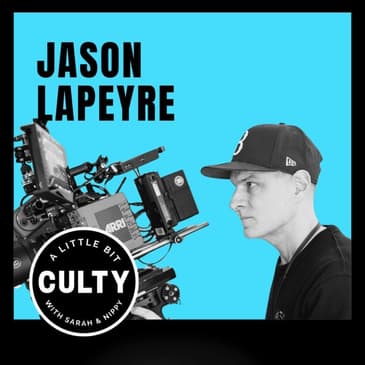
This episode is sponsored by BetterHelp. Visit betterhelp.com/CULTY to get started today. Remember the Hare Krishnas? The ones with the shaved heads and orange robes who used to chant and panhandle at airports? What started as a movement promoting inner peace and material detachment descended into chaos, corruption, and crime.
In this week’s episode, Sarah and Nippy sit down with filmmaker Jason Lapeyre, director of the new documentary Monkey on a Stick: Murder, Madness, and the Hare Krishnas. Together, they explore the movement’s descent into a shocking underworld of abuse, drug smuggling, and even murder during the 1970s and 80s.
Jason shares the heartbreaking realities of Hare Krishna boarding schools, the dangerous power dynamics within the group, and how charismatic leaders exploited followers while living in opulence. This conversation is a deep dive into the human cost of unchecked authority, religious corruption, and legal loopholes that allowed perpetrators like Keith Ham to evade justice.
Be sure to check out Monkey on a Stick: Murder, Madness, and the Hare Krishnas streaming on AMC+ and Sundance NOW in the US, or Apple TV+ and Youtube Premium in Canada.
Trigger Warning: This episode discusses child abuse, sexual assault, and violence.
And don’t miss next week’s episode featuring Nori Muster, whose personal experience with the Hare Krishna movement was also spotlighted in Monkey on a Stick.
Also… let it be known that:
The views and opinions expressed on A Little Bit Culty do not necessarily reflect the official policy or position of the podcast. Any content provided by our guests, bloggers, sponsors or authors are of their opinion and are not intended to malign any religion, group, club, organization, business individual, anyone or anything. Nobody’s mad at you, just don’t be a culty fuckwad.
Check out our lovely sponsors
Join ‘A Little Bit Culty’ on Patreon
Get poppin’ fresh ALBC Swag
Support the pod and smash this link
Cult awareness and recovery resources
Watch Sarah’s TEDTalk
CREDITS:
Executive Producers: Sarah Edmondson & Anthony Ames
Production Partner: Amphibian.Media
Writer & Co-Creator: Jess Tardy
Associate producers: Amanda Zaremba and Matt Stroud of Amphibian.Media
Audio production: Red Caiman Studios
Theme Song: “Cultivated” by Jon Bryant co-written with Nygel Asselin
See Privacy Policy at https://art19.com/privacy and California Privacy Notice at https://art19.com/privacy#do-not-sell-my-info.
[00:00:00] This podcast is for informational purposes only and should not be considered legal, medical, or mental health advice. The views and opinions expressed do not necessarily reflect the official policy or position of the podcast and are not intended to malign any religion, group, club, organization, business, individual, anyone, or anything. I'm Sarah Edmondson.
[00:00:25] And I'm Anthony Nippy Ames. And this is A Little Bit Culty. Cult's are commonplace now. From fandoms to fads, we're examining them all. We look at what happens when things that seem like a great thing at first go bad. Every week we chat with survivors, experts, and whistleblowers for real culty stories told directly by the people who lived through them. Because we want you to learn a few things that we've had to learn the hard way.
[00:00:49] For example, if you think you're too smart to get sucked into something culty, you might be prime recruitment material. And who knows? You could already be in a cult. If you're not aware of your programming, you're probably being programmed. So keep listening to find out. We'll talk about all sorts of topics on the show, but be aware, this podcast might contain stories that could be alarming to some of our listeners. So please check our show notes for more detailed descriptions and take care of yourself.
[00:01:15] Subscribe to our Patreon for Thursday bonus episodes, Q&A, and all sorts of exclusive content. That's patreon.com slash a little bit culty. Welcome to season seven of A Little Bit Culty. Welcome back everybody to this week's episode of A Little Bit Culty.
[00:01:43] Hello everyone. When someone says Hare Krishna, you might picture orange robes, shaved heads, and people chanting in airports. You might remember a guru from India who repackaged Eastern philosophy for white Westerners. Yet another hippie religion that came up in the 60s, but there's more to the Hare Krishna movement than orange robes and peace and love. Turns out it has a seriously fucked up history full of abuse and corruption. Our guest today, Jason LaPere, made a new documentary about that history.
[00:02:12] It's called Monkey on a Stick, Murder, Madness, and the Hare Krishnas. He's here to tell us what happens when gurus are handed godlike power over their followers. The scandal went public decades ago, but Monkey on a Stick really digs into how deep those problems went. We're talking abusive children, drug running, murder. Oh, yeah, there's a beheading in there too. Run-of-the-mill cult talk. This is probably a good place to drop a trigger warning. Hare Krishna has kind of faded from the public eye, but it's still kicking, surprisingly.
[00:02:43] Besides getting into the past, Jason is also going to fill us in on what's been going on with them recently. His doc is great. Definitely check it out. And in the meantime, let's welcome Jason to our show. Jason LaPere, welcome to A Little Bit Culty.
[00:03:11] Thank you. So glad to be here. Thanks, guys. Welcome. We're very excited and we're also very honored we got to have a little sneak peek of your film, which we enjoyed thoroughly. Thank you. And we'll be highly recommending to our audience who naturally will go nuts for it. So let's just start from the beginning. Tell us a little bit about you and how you got into filmmaking and then why this project? Sure. Yeah, thank you. Thank you. So, yeah, I was an army brat, you know, like I grew up all over the place. My dad was in the Canadian military.
[00:03:41] We got posted to some wild places like Pakistan and India and Germany. And it was a it was a wild way to grow up. You know, like I have this very distinct memory of they would have like family picnic day. And then after lunch, all the kids would get to fire a machine gun, like fire blanks out of a machine gun. And that was like the exercise for kids, you know. So, yeah, it was different.
[00:04:05] But certainly I think that's something that made, you know, that kind of like travel and having to make new friends all the time and, you know, integrate into new communities all the time. It just made me very interested in people and and stories and certainly had something to do with me becoming a filmmaker. And and so, yeah, my background is actually in dramatic films. I've directed a couple of feature films that I wrote and directed myself. And I've always been very drawn to genre filmmaking. My first film was a crime film called Cold-Blooded.
[00:04:35] My second film is a kind of a war film called I Declare War. It's about a bunch of kids in the woods imagining that they're playing a game of war, but they're pretending they have real weapons. It's a bit autobiographical. And so what was super fun about it was we we shot it and sort of sound designed it as if it was a war movie. So my favorite review of the film called it Stand By Me Meets Full Metal Jacket. That's awesome. Yeah. Check it out. So that was really fun.
[00:05:01] And but but, you know, right from the beginning, I had always been interested in nonfiction stuff as well. You know, like I never saw drama and documentary as like different things. All my favorite filmmakers made both, you know, like Spike Lee and Richard Linklater. And it was never something that was off the table for me. And I had also done a bunch of, you know, nonfiction writing in just as I sort of worked my way up the ladder to try and become a filmmaker. And and one of the first things I wrote about was the Krishnas.
[00:05:27] So I had read this book years ago, like in 2000, maybe it just given to me by a friend. And it just tore through my whole circle of friends, including Alain Mastai, a good friend of both of ours, who's a screenwriter now. And thank you, Alain, for introducing us, by the way. A little shout out to Alain Mastai. Thank you. So the book is called Monkey on a Stick, Murder, Madness and the Hare Krishnas.
[00:05:51] And to that point, my understanding of the Hare Krishnas and having lived in India for a year, I had a sort of a passing familiarity with Hinduism, of course, and Indian culture and Indian religion. And my understanding of the Hare Krishnas, I think, was like most people's who had heard of it, which is that it was a religious practice that was centered on peace and meditation and the abandonment of the material world.
[00:06:15] And I thought that was a pretty great philosophy as someone raised in Western materialist with firsthand exposure to like a colonization and, you know, like being moved all over these army bases. So when I read the book and the book details how in the 70s and 80s, the Krishna consciousness movement in the West basically descended into a criminal enterprise. And the people who were in charge of the movement were engaged in the most amoral practices imaginable.
[00:06:44] And essentially, the movement turned into a cult. And this just had not registered for me. You know, maybe I was a bit too young at the time. I wasn't tracking that particular news. Most of it was happening in the U.S. and I was in Canada. So the book blew my mind. And it was an epic, you know, and the characters in it were fascinating and comical as well.
[00:07:04] Like that was another thing that really struck me about the book was that the juxtaposition of these peaceful image of a guru with the violence and criminality and sort of wanton excess of their behavior was funny to me, you know, at the time, like on first impression. No, it has a comical flair to it. Certainly their personas are comical. They wouldn't be taken seriously anywhere else. Right.
[00:07:31] Right. Only to unquestioning followers would it not be comical, I think. So, yeah. So I read the book and, you know, this was before I had even made a feature. So I just kind of like bookmarked it in my mind and was like, boy, that would make a great movie someday. And, you know, years later when I was kind of able to, after I had done some television and I had worked in sort of the true crime genre a little bit, did I return to it? And I just approached the authors and I pitched them this idea for a documentary.
[00:08:01] And I was also at the time and I still think it would be a great dramatic TV series idea as well. Like, especially since I read the book, you know, the golden age of television happened and I was watching shows like Mad Men and The Sopranos and just thinking this could be that. So, yeah. I mean, that's how I discovered the story. Sorry. And just I skipped over one part. I had published an article about it.
[00:08:26] I visited the Hare Krishna temple in Toronto, which had like a welcome weekend and discovered a very friendly and welcoming and open community there. But when I asked questions about the past, they kind of just did a bit of hand waving and they were like, well, yeah, there were some dark days. But anyway, have some more doll, you know, because free meals are a big part of the community there, which at first I thought, well, this is so wonderful. This is there's this is so pure and so untainted.
[00:08:55] There can't be anything wrong with free meals. But, you know, once I started making the film and I'm jumping ahead a little bit here, so feel free to stop me. But, you know, talking to Nori, she was like, you know, that's a recruiting tool, you know, like free meals. Who needs free meals? Vulnerable people, you know, people who need food, who don't have money for food. And so it is a form of love bombing. And look, if I have one thing to say about Krishna consciousness, it's that there's nothing wrong with the religious belief. There's nothing wrong with the practice.
[00:09:22] But the organization, the formal organization, which is called ISKCON, the International Society for Krishna Consciousness, in the 70s and 80s did fly off the rails, you know, without question. But so, yeah, this idea of free meals, it's a double edged sword, you know, like on the one hand, it is. It's charity. It's a Christian value as well as, you know, this Hindu value. But I think it did get exploited to maybe take advantage of people who are in a vulnerable place as well.
[00:09:50] Do you think everyone there, you always need good people to usher in bad ideas, right? And how many of the people in the culture really believe that they were exploiting vulnerable people? Yeah, I mean, yeah, Nori can speak to this much better than I can. But certainly, you know, I believe that 95% or more of the people who are in Krishna consciousness, even then, even in the 70s and 80s, were there to seek a relationship with God.
[00:10:18] You know, these are innocent people who knew nothing about what was going on. And, you know, as you see in the film, it's the leadership that is really abusing their position and people at the very top that are sort of losing the plot in terms of the goals of the organization. And really fostering an environment that is more cult-like than it is church-like. This is somewhat tangential.
[00:10:45] Have you seen the documentary Flock of Dodos? No, I don't know about that. What is that? It came out in 2005. And it's about a Dover, Pennsylvania court case that explores putting warning labels on biology books and getting creationism into the classroom. It's religious. The ideology is religious, obviously. And it goes in and explores all those areas. And the documentary filmmaker is interviewing one person at the church.
[00:11:11] And he's like, the line that I remembered, and I watched this in 2005, 2006. It's like, I'm sure on the grassroots level, everything is pure. But the higher up the food chain you get, it becomes more clandestine. Right. And that's where the abuses happen. And I think that's... You remember that line from 2005? Well... I think he's got a bit of a Rain Man quality for recollection. Yeah, I do. I am a little bit... I'm an excellent driver. But you said something in the beginning where you're talking about drama and documentaries kind of being the same.
[00:11:40] I do watch documentaries for drama. Existence and reality are dramatic enough. So I do... Yeah. Yeah, no, it's true. I feel like I'm also being informed. Right. I don't think documentary has more of a claim on the truth than drama does. And that's kind of... It's funny. That's kind of the idea that people have about documentaries. They're like, well, this is reality and drama is just made up. But honestly, I just think you can get truth from either one. And anyone who's made a documentary, you guys know, it's so constructed. It's so artificial.
[00:12:09] You do multiple takes of someone's answer. And sometimes you ask them to do something again. Or as soon as you choose to include something and exclude something else, you're manufacturing a story. Hmm. And I actually do have a lot of questions about your creative process with the film. But before we get to that, can you just give us a little bit... And we'll dive more into this with Nori as well in terms of her personal journey. But you mentioned that people were looking for a connection to God or relationship with God. What was the promise?
[00:12:37] Or was it just that with people who joined ISKCON? The core beliefs of Krishna consciousness resonate with me so strongly. Like, I think that they are really profound and beautiful ideas. And as one of the followers explains in the film, it's basically the idea that we are not our body. You know, the body is a core idea at the heart of Krishna consciousness.
[00:13:01] And the idea is that this is a temporary existence and that your spirit is something that is not temporary. And so you want to focus on improving and heightening or raising your consciousness to a level where it can continue past your body. And so the way that you do that is by chanting. And in Krishna consciousness, when you chant, you are just saying the name of God. That sort of iconic Hare Krishna, Hare Krishna, Krishna Krishna, Hare Hare chant.
[00:13:30] That's just the name of God. And by doing that, Krishna consciousness followers believe they are becoming closer to God. And it also involves giving up your connection to the material world. And this is another thing that I think is so beautiful and interesting. You know, I'm not sure I believe it myself, but it's such an interesting way to look at the world. And that is the idea that the world is an illusion, that everything around us is just, they call it Maya, which means illusion.
[00:13:59] And the only thing that's real is God, you know. So when you, you know, part of Western culture and you see the way people, you know, chase wealth and fame and glory and all these things. And it's easy to get on board with. There's a great line in the documentary where one of the followers says, you know, when he joined in the late 60s, he would just look out his window and he couldn't help but be struck by the idea that the world was insane. You know, and it's like relatable. It's like, this is the reason it's still here, I think.
[00:14:27] And so the idea of like an alternative to that madness of, you know, the day-to-day rush is pretty appealing, I think. Yeah, I totally relate to that. I mean, those were kind of the pivotal, one of the pivotal cornerstones with NXIVM as well is to separate yourself from materialism and to be in the what is they called it. Interesting. And they didn't use the word God because they wanted it to be non-religious.
[00:14:52] And I think that certainly what little I know about other, you know, organizations and cults like this is you really do see the same ideas, you know, in different forms. But, you know, like there's a poetry to Krishna consciousness, you know, that I thought that I continue to think is really beautiful. And the other big part of it, you know, and we really tried to work this into the structure of the film is this idea of like cyclical existence.
[00:15:17] You know, like if there's one sort of profound insight that Hinduism has as a religion, I think it's this idea of karma and cycles and coming back and returning. And, you know, compared to like a Christian worldview or a Western worldview that's more maybe linear, I thought that was really interesting. And, you know, like obviously when the abuses started happening, that all went out the window.
[00:15:41] But as an appeal, as a way in, you know, like I can see why very intelligent people were drawn to this belief system. It's like it's like philosophically profound. Any system like this, I'm sure. Yeah, the playbook is the same. The playbook is the same. But like, you know, with that beautiful philosophy, with the backdrop of the craziness of the late 60s, early 70s, and some amazing free doll. I mean, I'm in. Right? I'm in. I'm in. Who wouldn't be in? I'd check it out, but I wouldn't.
[00:16:11] I'm the one who is constantly like with Osho. People describe it at the beginning. I'm like, that sounds amazing. I'm sold. Because that's my value, like especially the community. But I think, you know, one of the things we see also is a consistency when we ask our survivor guests, you know, what were some of the red flags that you start seeing along the way?
[00:16:29] And for me as a viewer, one of my big red flags with watching your documentary is the juxtaposition between the truth of that philosophy, like living without attachment to materialism, but it's pretty rugged next to the extravagance of the leaders. Materialistic. The materialistic palace. The palace, yeah. The palace of the leaders. And like that is such a vast hypocrisy. How do you think that's justified by people who are in it? Yeah. Well, I mean, it's the same thing in the Catholic Church.
[00:16:57] You know, the first time I went to the Vatican, I was like, this is a palace made out of gold. Like, wasn't Jesus into like poverty or something? But, you know, it's important to note that the guy who founded the movement in the West was not a super materialist guy. You know, he embodied a lot of the beliefs, both good and bad, but mostly good, I think.
[00:17:19] You know, he's a complicated figure, but Prabhupada, who is the guy who founded the movement, was someone who did live a very unmaterialistic worldview. But it's so interesting. In so many ways, the story is about like the Eastern values he brought to America colliding with the Western values of America. And in many ways, the Western values won.
[00:17:44] So after he passed away, and as John Huebner, the co-author of the book and one of the key interviews in the film, you know, this is a guy who is just a very insightful human being. And he says, when Prabhupada passed away in 77, this was the crisis moment for the movement.
[00:18:02] And these young white men who took over the movement, who are all in their 20s, and as someone observes in the film, most of whom had never held a job before, were then basically told they were gods on earth and they were to lead the movement. How did that happen? How did those clowns take over? That is still a source of great controversy in the movement.
[00:18:25] And the story, the official story, is that on his deathbed, Prabhupada sort of designated them as the leaders of the movement. And what came out after some investigation by a whistleblower who was then murdered, Steve Bryant, he exposed that he had never explicitly said, I want you to take over the movement. He had told them, at best, the interpretation was he wanted them to be administrators for the movement and that the power should not reside in them.
[00:18:55] But of course, they emerged from his deathbed room and said, yeah, Prabhupada said we're God now. So, you know, I'm going to take like Australia and Germany, and this guy's going to have like the Western US and Hawaii. So they literally like divided up the world like a bunch of gangsters standing around a map of, you know, the earth. So anyway, it's a pretty good story. So yeah, so the materialism thing, how was it justified by, you know, how was it enabled?
[00:19:25] That puts too much responsibility on the followers. How was it permitted by the followers? I mean, they had been told by their religious leaders that their leaders were representatives of God on earth. And it was just, this is faith. This is faith. It's irrational. I mean, this is a really important point to make about the film. The film is not coming after faith. You know what I mean?
[00:19:49] The film attempts to be an exploration of faith and why humans need to be led. You know, why do we have this thing in us that wants to look up to other human beings? And this is at the core of all cult movements. And I'm not immune to this just because I don't particularly, like I consider myself an agnostic. But I'm a filmmaker, right? So, you know, my gods were like Billy Wilder and Roman Polanski and, you know, James Cameron.
[00:20:16] But, you know, like maybe I should take a second look at Roman Polanski. You know, like I need to think critically about my leaders too. And so that's what the film is really a plea for is like to try to temper your faith with some critical thinking. And, but that, that wasn't happening in the seventies and eighties as these gurus were driving Mercedes Benzes and packing like homemade Uzis and selling drugs to raise money for the movement.
[00:20:44] You know, that was definitely one of the other red flags. I mean, yes, the hypocrisy of the accommodations and the materialism thing, but just the, this is so common with every cult we look at. The ends justify the means mentality. It's okay to do illegal things if it's for the benefit of our group. And when they're exploiting the principles that they're pretending to uphold. So they're going out and they're franchising Hare Krishna's message, but not embodying it.
[00:21:12] So to your point, Western ideals meet Eastern ideals. It immediately got marketed and not marketed in line with the principles marketed to exploit them. Yeah. And you've hit upon the kind of the core flaw in what happened, you know? And I mean, I think there are two, the film kind of takes the position that there are two sort of fatal flaws in the movement that can be traced directly back to the founder, Prabhupada.
[00:21:37] And as much as the guys who inherited the movement were the ones who committed the abuses, in many ways, they were just enacting these two core principles. And the two core principles are that Prabhupada believed that men were superior to women, were biologically superior to women. And he said, and the way he justified that was by saying that women's brains weighed less, which is just science, obviously. That's sarcasm, everyone. And then the other core flaw was that the ends justified the means.
[00:22:04] And so I'm going to tell you a story that didn't make the final cut, but I really wish it could have because it's so perfectly illustrates the hypocrisy. So basically, Prabhupada had realized when he came to the West that drug use was a big problem in America in the late 60s and early 70s. And he said, we're going to eradicate drug addiction in America by getting people to join Hare Krishna. So in order to do that, we need to build more temples in order to draw people to Krishna consciousness.
[00:22:33] Where are we going to get the money to build these temples? Well, let's sell hash. So they were selling hash to raise money to build temples to get people to join Hare Krishna to end drug addiction. Did I hear this right in your film that they actually were the ones that brought hash to California? Yeah, I mean, John is an investigative reporter who was working in Santa Cruz. He was investigating this as early as the mid 70s.
[00:23:00] And in his opinion, the Krishnas were the first organization to set up a connection between Pakistan and the US to bring hash oil into America. And they would use their Krishna consciousness, you know, status as a cover, you know, like standing in an airport in a dhoti. We did not really at that time did not make you a target for like getting shaken down by customs or whatever.
[00:23:27] And they would run the drugs to Canada with our friendly lax like border security. They would fly from Pakistan to Vancouver. And then in Vancouver, they would like mail the hash to, you know, Berkeley and LA and all the temples in California. And then they would fly from Vancouver back to California without the drugs. So. Hey, Kalti listeners.
[00:23:53] As you probably know, Nippy and I are working on a manuscript for our first book together. And as you probably also know, maintaining control is important to us. That's why we've decided to produce our book with the Self-Publishing Agency or TSPA. Unlike traditional publishing, where you're often left waiting for months or even years to get your story out, the Self-Publishing Agency lets you take control of your timeline. You'll have complete creative freedom with insights and guidance from pros in the publishing world.
[00:24:22] So if you're like us and you have a story or a message that's burning to be told, we highly recommend TSPA as your go-to partner. They offer everything you need from expert editing and eye-catching cover design to marketing and distribution strategies that really make a difference. They make the entire process seamless and inspiring so you can focus on what matters most. Telling your story. Go to theselfpublishingagency.com.
[00:24:45] That's theselfpublishingagency.com to start your very own publishing journey today. Enjoy. This podcast wouldn't even exist without our amazing, supportive, generous patrons. Come find us on Patreon. We are at patreon.com slash a littlebitculti.
[00:25:10] Go there for bonus episodes, live Q&As with past guests, exclusive content, and lots of other goodies. Subscribe now and help us keep this podcast going. That's patreon.com slash a littlebitculti. And now, a brief message from our Little Bit Culti sponsors. And remember, when you support our sponsors, you're supporting this podcast. You've heard from our sponsors. Now let's get back to a little bitculti. Shall we?
[00:25:41] Okay. Okay. So I don't want to, like, give away your whole movie. I know. I'm hesitant to cover everything because we want our audience to watch it. Which, by the way, the screener that you sent us, is it going to be a movie of that length? Or is it going to be a series? Or what is it? Yeah. So it had an interesting rollout. So basically, the screener that you guys watched is the feature film version, the theatrical version. And there is a TV cut. And that's going to be on AMC Plus in the U.S.
[00:26:09] and also Sundance Now, which are owned by the same company. So Americans can watch it there. The TV cut is slightly different. I'm not as much of a fan. So if you are able to watch the theatrical version, it's a little more of a creative documentary. There are these segments where we kind of do, we ask people questions about spirituality and faith and God. And there's kind of an array of sort of man on the street, person on the street interviews.
[00:26:34] And then there's this really wonderful creative flourish, in my opinion, at the end where one of the interview subjects meets the actor portraying them in a dramatic recreation. And that's not in the TV cut, unfortunately. But yeah, I mean, 95% the same. Would there be a bit of a Polanski influence on this film? Like, I'm just getting, like, there feels, you definitely took some creative, you know, it's not just talking heads. There's interviews and creative imagery, creative imagery to tell the story.
[00:27:04] And great music, by the way. Yeah, thank you. That's the scores by Todor Kobukov, who's composed the score for three of my films now. And there's also some wonderful licensed music in the film, which I was really happy about. I'm not sure I would point to Polanski directly, although obviously I'm a fan. But certainly I leaned into my background as a dramatic filmmaker, because I wanted the dramatic recreations to be impactful and hard-hitting. And I wanted people to feel like they were watching a movie, because that's what the book does. It's all from the book.
[00:27:32] The book uses the sort of rhetorical device of dramatic recreations to tell the story. And it's interesting. At the time, the book was heavily criticized, especially by the Krishnas, for being false for that. Because it uses this device of almost reading like a fictional account in certain scenes of what's happening, people said, well, that's just made up.
[00:27:56] Despite the fact that it's all heavily footnoted, utterly backed up with intensive research by the authors, John Huebner and Lindsay Gruson. And for me, that's what I loved about the book, because I thought that stuff was so impactful. And it just felt more truthful, because it was more shocking and more gripping. And so the film just sort of takes that idea from the book and puts it into sort of movie form. Which works, by the way. Yeah.
[00:28:25] Yeah, it definitely works. Tell us about the film's title. What does the metaphor mean? Yeah, yeah, for sure. So it's the title of the book. And as John explains, and John and Lindsay explain in the book and in the movie, in India, when a banana plantation owner has a problem with monkeys coming onto the banana plantation and stealing monkeys, the way they deal with that is they capture one of the monkeys and they kill it and they impale it on a stick. And they put it out in the plantation as a warning to the other monkeys.
[00:28:55] And John thought that was an apt metaphor for what the Krishnas did to the whistleblower who was trying to expose the gurus who were leading the movement in the 70s and 80s. And this was a man named Steve Bryant, who had read Prabhupada's letters before he died and realized that the gurus had completely misinterpreted what he had intended to happen to the movement, and that they had all had very questionable backgrounds.
[00:29:22] And so as he attempted to get the word out about this, he was killed basically like two blocks from the L.A. temple, you know, very visible to the community. This is another really interesting component of the Krishna community is that there's like a neighborhood in Los Angeles that is like the Krishna neighborhood. And they saw it? It was inevitable.
[00:29:43] I mean, it was like within spitting distance of basically at Watsika and I can't remember what the cross street is, but on Watsika Avenue in Los Angeles, there's like a couple of city blocks where there's like a temple and a community center and a bunch of houses. And there's like a couple hundred Krishnas that have like a little neighborhood in Los Angeles. And Bryant was murdered, you know, within a stone's throw of that. And so it was definitely a signal, you know, like a sign to the other followers.
[00:30:12] Did it work? I think it did. I mean, yes and no. It worked because no other whistleblowers came forward, but it didn't work in the sense that it attracted the attention of the LAPD. And so when the LAPD investigated and they connected it to other investigations that were happening around the country, especially one that was happening in West Virginia, where the largest sort of isolated Krishna community is, it's called Nuvrindaban.
[00:30:41] And that really had come to resemble kind of our classical understanding of like a Jonestown-esque sort of isolated community run by one person, totally separated from society. So when the West Virginia investigation connected with the LAPD investigation, you know, it ultimately led to a RICO indictment. Like that's how extensive the criminal activity had become, that they were indicted under the same law that the mafia was indicted under.
[00:31:10] And his name was Keith. Am I right? Is that the issue? Moms, stop calling your kids Keith. You can't name someone Keith now. You just can't. Sorry to all our Keith listeners. So yeah, so Keith Hamm is probably the worst. Bad name. And also like, no, I mean, I don't care if it's disrespectful. He just looks gross. He just looks pervy to me. Yeah, that's not just... You can disrespect him. Permission to disrespect him. I just looked at him and I was like, he's the grossest.
[00:31:40] Well, I'm going to stay away from that one. But to be the grossest in that group of humans is a pretty remarkable achievement. And yes, I think he was the grossest. And he was a megalomaniac. And he believed that the laws of man and morality did not apply to him. And he abused his power as grossly as any of them did. And I don't think there's any line he didn't cross.
[00:32:08] And again, you know, like this was another question I had for John, and I'm not sure we ever landed on an answer. But it's what is with when cult leaders find themselves in a position of absolute power? Why does it always come back to child molestation? Like why is this? Seriously. It is the question of all... We did our 200th episode recently. And I was kind of reflecting. And I was like, it's amazing how so many of these come down to abusing children sexually.
[00:32:37] Like I just don't... I'm so shocked at how rampant it is. I mean, I guess we're in a niche group too, where we're probably going to see it more. Because this is where if you're going to abuse children, you might go. So I make allowance for that. But even if that's true, there's a large segment of our culture where this is going on. And it's very disturbing. It's very disturbing. And yeah, I mean, does it have something to do with being wounded as a child psychically that turns you into the kind of person that seeks power?
[00:33:04] Like, I don't know, but it is disturbingly prevalent. And yeah, so Keith Hamm, that was, you know, the worst of his abuses was... But again, it's important to note that it was something that was happening throughout the movement. Certainly in the 70s and 80s, it was sort of formally condoned. And that's really what led to the thing that broke the back of that version of ISKCON, was the children of the movement as a group.
[00:33:33] And we're talking about hundreds and hundreds of people who were born into the movement, launching a class action lawsuit in which they exposed how child abuse and child sexual abuse was actually part of the operation of the movement at that time. It's a feature of it, almost. I don't know if you know this, but that whole tactic of claiming bankruptcy so you don't have to pay everybody was also done by the Boy Scouts, which we've also covered here on the podcast. Oh, interesting.
[00:34:03] I did not know that. Yeah. Yeah. Nory only touches on it very briefly, and she can talk more about it in her interview with you, but that was, you know, unfortunately it was not seen as a victory by the children because the perception there was that ISKCON was using bankruptcy court to avoid responsibility, like moral responsibility for what had happened. And so that was not entirely satisfactory. Although my opinion is that the public perception of it was that it was essentially an admission of guilt. You know, that's just my opinion.
[00:34:32] Yeah, that's true. And I guess part of the playbook. Is he, is Keith also the one who was responsible for the guru that got beheaded or that was a different person? Nope. That was a different person. That was another one of these horrible actors. Red flag. Yeah. Straight to the horror. Yeah. So the guru who got beheaded was a guy named Jayatirtha. His real, his birth name was James ML.
[00:34:58] And he had been the guru in London for a really long time. And his, you know, great transgression was that he was an acid head, you know, since the earliest days, he was someone who would drop acid and then chant Hare Krishna. And this was seen amongst his followers as like that he had had this elevated spirituality and, you know, these, these like six hour long, you know, manic chanting and dancing sessions
[00:35:25] were that he had special access to Krishna in some way. And so he was kicked out eventually for just, in addition to doing drugs, he was having sex with his female followers and just sort of flaunting his authority and abusing his position. And it got so egregious that he eventually was kicked out by the other gurus, but then he just started a smaller cult. You know, he founded a group called the Peace Krishnas in London.
[00:35:53] And one of his followers who, again, the details were pretty spotty around this event. But the people I interviewed said that this follower had mental illness, that there was psychosis combined with rampant LSD use. And it drove this person to perceive that Jayatirtha was possessed by a demon and that he needed to be killed in order to remove the possession.
[00:36:20] And that in order to prevent the demon from returning to his dead body, that this person needed to behead Jayatirtha to prevent that from happening. It's gruesome. Yeah. Imagine LSD had something to do with that. Yeah. And he was one of the, was it 12 gurus who took over? It was 11 gurus. 11. That in and of itself, this isn't something we get into the film because there wasn't time.
[00:36:45] But I think that's really funny to me as well, because I think clearly they were trying to have 12 to sort of evoke the 12 followers, like the apostles. Couldn't find the 12. But they couldn't share the power. They couldn't find another. Like, in my opinion, I think they probably looked around and they were like, nah, we don't want the 12th cut of the power. So they stuck it to 11. 11 has no significance in Krishna consciousness or Hinduism or anything.
[00:37:12] So yeah, he was one of the 11 gurus until he got kicked out. Were they all corrupt? That's a really good question. And Noria is better qualified than me to answer it. But I did ask, I have asked her that. And many people have asked that. And the answer I have heard is yes, that to some degree, all 11 of them engaged in either illegal and or immoral behavior.
[00:37:35] And the sort of lightest version of corruption that I've heard is using drug money as kind of like operating funds, sort of knowingly using drug money as part of your operating budget. But yeah, I mean, certainly of the 11, when you go down the list, more of them than less were engaged in pretty awful behavior.
[00:37:59] And it seems like the second wave after he died and elected these 11 so-called gurus, as you said at the beginning of the interview, everything goes off the rails and we're not going to cover everything because we want people to watch the movie. So other murders, other drugs, guns, crazy shit. But I do think it's important to talk about the Hare Krishna boarding schools and... Yeah, for sure. And just sort of shine some light there. What's important for people to know?
[00:38:26] So the boarding school system was established by the founder and it was called the Guru Kula system. And the idea was that in order to achieve true Krishna consciousness and remove yourself from the material world, the devotees were going to give their kids a head start by removing them from like the Western school system and learning Krishna consciousness from a very young age. But even over and above whether or not that's a good idea, the system was set up in a very
[00:38:57] haphazard, unsupervised, unregulated way. And the people who were put in charge of the Guru Kulas had no training. As Maria Ekstrand is one of our interview subjects. She was not a devotee per se, but she was part of the organization for about 20 years. And she was ultimately kicked out of the organization for writing a book that criticized the movement's perception of women. But she says that the people that ran the Guru Kulas had no training in education. They had no training in pedagogy.
[00:39:23] They had no understanding of what was normal or abnormal in child behavior. And then another one of our interview subjects, Srimad, says that the teachers were chosen when they weren't any good at any other jobs, when they weren't good at physical labor or accounting or anything that was required to run a temple. So the sort of least able devotees were put in charge of schools. And it was just a powder keg for things to go wrong. And they did go wrong.
[00:39:53] And there was physical abuse. And then what that transformed into, metastasized into, was bad actors in the movement seeing the Guru Kulas as an opportunity to engage in bad behavior. And I think whether it's conscious or not, you know, if people have malicious tendencies to want to victimize children and you see an opportunity to get into a position of authority over children, I think that's one of the things that happened in the movement.
[00:40:21] And it had just tragic, tragic consequences. And we don't go into a ton of detail about it in the documentary. And our editor very wisely made the point that like, we don't have to hit this point a hundred times, like we just have to say it once. But the fact is there are hundreds of instances of child sexual abuse in the movement as a direct result of these schools being set up as being separate from society, having no oversight and no sort of outside regulation.
[00:40:50] Have you seen Breath of Fire about Kundalini and Yogi Bhajan? I've heard about it, but I haven't seen it yet. Yeah, you'll see some stark parallels, especially the boarding school and kids sent away to boarding schools in India also, and a lot of physical and sexual abuse. Right, right. That's the part I left out, you know, was that it was the founder's idea that not only were the kids to be removed from society, they were to be removed from their parents.
[00:41:15] You know, this is really the fatal flaw, was that the idea that the relationship between parents and children was a material relationship and hindered your relationship to God. And this is just, in my opinion, an unjustifiable idea. So, you know, so much got cut out of the film that makes me sad because there were so many great stories. But there was one story Srimad told about how he was in one of these boarding schools and
[00:41:44] his friends, their parents would come to visit, like for the first time in a year, and the kids wouldn't recognize their parents. And it's just, you know, it brought tears to my eyes. For more background on what brought us here, check out Sarah's page turning memoir. It's called Scarred, The True Story of How I Escaped NXIVM, The Cult That Bound My Life. It's available on Amazon, Audible, and at most bookstores. Highly recommend, of course, because she's my wife.
[00:42:11] And now, a brief message from our Little Bit Culti sponsors. Remember, when you support our sponsors, you support our podcast. Break time's over, people. Let's get back to this episode of A Little Bit Culti. It's a good one. It's horrific. And I do think this is part of the playbook. Keith was sort of developing this with a rainbow program to have kids be raised from,
[00:42:37] if not birth, at three months to have caregivers teaching different languages. Like, to be cared for by someone of another culture completely in that language. So they could be rainbow children and it'd be multicultural. But I think it was to cut the bond. Wow. Cut the bond. Oh, absolutely. Yeah. Right. And then also, you'll appreciate this as a Canadian, definitely a dark stain on Canadian history. Do you know much or have you heard anything about the Grenville Christian College in Brockville, Ontario? No.
[00:43:07] I didn't either until I read this book that was sent to me to do a podcast episode. I'm like, how did I not know this as a Canadian? It's a Christian college that was infiltrated by like a Jesuit cult from America that was based in Cape, I think Cape Cod. This girl was raised by her parents were teachers at the school. She was a staff kid. And it was like, they called it adulterous to have a relationship with your parents. You couldn't have any connection or praise or relationship other than like strictly, like, and it fucked her up.
[00:43:37] It's called Born and Raised by Beth Granger. Okay. And yeah, she's Canadian. And I think it needs to be either a series or a movie and I think you should make it. We are doing an episode with her coming soon on Libby Culty and her book's phenomenal. But yeah, same thing, part of the playbook. Like, and so much of what we do in this podcast is like make the connections and show the similarities. I would ask your personal journey. What was it like? And what has been your takeaway?
[00:44:06] And what do you want viewers to take away from it? And how do you feel about it? And what was it like mentally? Making this film. Yeah. Yeah. It was incredible. It was such a rewarding experience. And of the films that I've made, the documentaries, I do try to approach them in a way in which I'm working with the people that the film is about in order to try to give them a platform to speak rather than telling a story about someone, you know.
[00:44:31] And Nori Muster was very much the person who had lived through the movement, had this fascinating angle on everything that happened because she had been both one of the public relations people for the organization and was the co-editor of the organization's newspaper. And so she had this very specific and very unusual perspective on everything that had happened
[00:44:57] as someone who was in, you know, contributing to covering up the criminal behavior and keeping it from the devotees. And but someone who had gotten out and had such a clear eyed perspective on everything that had happened. And so I've become great friends with Nori as a result of making this film. And, you know, we had the same goals for making the film, which was not to denigrate Hinduism or even Krishna consciousness, but just to talk about the abuse of power and how religious
[00:45:23] movements turn into cults and why people need leadership and the nature of human faith. And so, you know, my experience in making this film was not trying to give anyone answers. Like if after 5000 years, we don't have answers for these things, our documentary wasn't going to provide them. So we just wanted to ask interesting questions. And she was my gateway into that world.
[00:45:50] Most of the people that are in the film are a result of her introducing me to them and and her convincing those people to trust me as someone who wasn't just interested in making an exploitive true crime documentary. And so, yeah, it's been pretty wonderful. And, you know, we had the theatrical release of the film in Canada and, you know, people came out to see the film who were current and former members of ISKCON. Oh, wow. And so that led to some pretty interesting Q&A sessions.
[00:46:19] There was not any postility, but there was, you know, it's funny, the criticism that always gets waved around by people to sort of justify or excuse everything that happened, even today, is that, well, this happened a long time ago and things are better now. But the irony of that, and I'm stealing this idea from one of the YouTube comments on the trailer, Hinduism happened a long time ago, too. That's a 5000 year old religion, you know, but that's still valid and still worth talking about.
[00:46:49] So these things that happened just 40 or 50 years ago, I think are also still valid and worth talking about and just should serve as a warning. Yeah. Do the people who are still loyal to ISKCON or still practicing members, is that their main justification that happened a long time ago? We don't do that anymore? Is that what they say? Yes. And the other excuse that is returned to again and again and again, and it's so interesting because it's the first in the film we show the sort of development and presentation of
[00:47:18] this idea for the first time, which is the bad apples theory. You know, this is just a handful of bad apples. There's nothing wrong with the organization. You can't blame a whole religion, which is a rhetorical sidestep because nobody is blaming the whole religion. We're blaming the people who committed murder. There's an ecosystem where people can come in, behave like this, get in positions of power, and it's hurting your cause and your religion. You should at least be interested in how that happened. Yes. Not just the apple. It's the crate.
[00:47:47] Let's look at the crate. That's right. Now, listen, it must be said that ISKCON exists to this day and in fact has more members than ever before. It's much more of an ongoing concern in India these days than it is in the West, although there are still a very, there are 50 temples in Canada and the US. There's a temple in downtown Toronto at Avenue and DuPont, and there's one in Burnaby as well. Now, the people who go to ISKCON temples these days tend to be more South Asian than maybe
[00:48:17] like white folks or hippies, ex-hippies. And my understanding is that they have largely addressed the issues of corruption that were problematic in the 70s and 80s. Having said that, as we say in the closing titles of the film, there are currently, I think, just over 100 what they call initiating gurus who are kind of the authority figures in the movement. And in 2024, of those 100 plus initiating gurus, there is one woman.
[00:48:46] And that doesn't seem to me like an organization that's really reflecting sort of a contemporary worldview. And that's just my personal opinion. I guess she has a bigger brain to be able to allow it to. She must have tipped the scales with that brain of hers. So, yeah, the film doesn't go into the sort of modern incarnation of ISKCON in very much detail, but they are still around. And here's another sort of interesting factor that didn't make the film.
[00:49:15] My understanding is that the vast majority of new ISKCON members are from the Ukraine. And that gives me pause as well. And I wonder to what degree that that's the organization sort of taking advantage of an opportunity where people are desperate and in need of meaning, in need of community. And look, those are things that all people need at certain times. And you just hope that it doesn't lead to an abuse of that kind of authority.
[00:49:45] It gives me that icky feeling. Right. Like a diabolical, like, oh, here's an opportunity to exploit. Right. Free meals again, sort of. Yeah. Exactly. Ugh. Well, I personally was mad at the end to read that. I mean, if it's better, great. I'm glad that it's better. But still, I'm skeptical that it will last if it is better. But also, I was really upset to see that Keith Hamm got, was it an appeal that he got?
[00:50:13] Like, he got put in jail for Rico and all of those things that we've talked about and things we haven't. And you've got to see in the film. But how did he get off? And oh, by the way. Yeah. Dershowitz. Did you know that he also came to Keith's defense? Did he? Yeah. What's with this guy? Color me unsurprised. What's with this guy? What's going on with this guy? Was he just paid to, like, defend gross pedophiles? Like, what? I don't understand. I know. That's his brand, I guess. Weird choice. I know.
[00:50:42] That was such a hilarious connection to the present for me, was to see him pop up in the story. But it is ultimately unjust, I think, what happened to Keith Hamm. And what happened was he was found guilty at his first trial, but the conviction was overturned by Alan Dershowitz. And the way it was overturned was that Dershowitz successfully argued that the introduction of
[00:51:07] the child molestation evidence at the trial had, quote, unfairly prejudiced the jury against him, unquote. Which I still can't really wrap my head around. See, that is such a bullshit legal loophole. That's a legitimate prejudice, though. Yeah. Yeah. Yeah. Like, like. Right? Your honor. Your honor. What are we talking about here? Just because my client. This is why we're here. Yeah. Murdered a bunch of people. You can't call him a killer. I know it defies rationality.
[00:51:36] But anyway, he was retried on a smaller charge and was convicted and sent. And so his sentence was 20 years. But what so my understanding is that he served eight of those years, I think, and then was released from prison for poor health, which, again, I don't know how that's a thing, but it happened. And then he moved to India, where he was worshipped as a guru by people who probably didn't know
[00:52:05] about all of his background. Yeah. And was essentially treated like a guru, like a god on earth, and then lived like another 10 years with his poor health. So it's awful. And his shrine, or whatever it is, his burial place, is to this day treated as a holy site by Indian ISKCON members, which is gross. Yeah, that made me mad.
[00:52:32] So absolutely, in my opinion, he evaded justice. I don't know how he got released from prison citing poor health and then lived another eight years or whatever it was. So that seems pretty cosmically unfair. Yeah, that's a legal thriller right there. Wow. Well, I know we've covered so much, and we're going to do more with Nori in part two of the ISKCON extravaganza. So thank you also for introducing us to Nori.
[00:53:01] Yes, thanks, Jason. That was great. No problem. And given, you know, the feedback from current loyalists, as we call them, with NXIVM, the people who are still loyal, who say this happened so long ago, given that it apparently happened so long ago and never happens now, why do you think this is important? I think ultimately the story is about a pretty primal human need that is never going to change. And that's a need for leadership, and it's a need for guidance.
[00:53:26] And it's evolutionarily, maybe it has something to do with being raised by parents, but people do seek this kind of guidance in their lives, whether it's religious or non-religious. And the film is just a plea to people to think critically about the people that they take leadership from. And even that's a double-edged sword, because, you know, I see a lot of conspiracy theorists who believe in wacky things saying the same thing. Think critically about what you're being told is the truth.
[00:53:53] So it's a slippery, difficult thing that's never really going to get solved. But look, if your guru is abusing children and committing murder and selling drugs to build temples, maybe take a look in the mirror. Did any of your opinions vastly change or your perspective shift on either Hare Krishna or cults in general in making this doc? I mean, I certainly learned a lot about Hinduism, and I certainly learned a lot about Krishna consciousness, and that was very educational.
[00:54:23] When I was a kid, I was raised Anglican, and I was an altar boy in the Anglican church. And then when I got older, I sort of, as a teenager, I cynically decided I was an atheist and that there was no such thing as God. But then now that I'm like 50, I don't feel the same way. And I think the closest I could express it is to say that I just don't know.
[00:54:48] And when it comes to a belief in God, you know, it's really hard for me to believe that 95% of the world, which is the number I've heard, that 95% of humans believe in some higher power of some kind. It's really hard for me to believe that 95% of the world is just wrong. I totally agree. I've never heard it put that way. That's so good. You know, I'm not sure if I can say that I learned something, but I just have this really
[00:55:14] profound appreciation for people who do seek a relationship with God. And I just really want to try to warn people not to allow that to, you know, let them be victimized by people who are looking to abuse that, you know, search. You know, one of the things I think when some people hear that statistic, they go, oh, 95% of our population might be susceptible to some sort of, you know, it depends how you look at it. I think a lot of people go, oh, this is, this is a numbers game because most people believe
[00:55:43] in something. Yeah. Has it changed your lens of the world? Like, are you more skeptical of people in leadership or are you more open to God experiences like, or a bit of both? Yeah, I, I don't know. I mean, I, from day one, I have always been a bit of an anti-authoritarian. Maybe that was like being raised in the military and fighting with my dad or something, but I'm always pretty skeptical of people in positions of power.
[00:56:11] I have a natural tendency to root for the underdog and people who are powerless. That's like a storyteller empathy thing too, I think. There's a woman in the film named Alma and she's someone who was, she was the top fundraiser for the LA temple and she's not in this con anymore, but she is a follower of Krishna. And she is the most spiritually sincere person I've ever met.
[00:56:35] Like I met her on a zoom and I was bowled over by the sincerity of her faith. And it was, it was healing. It was healing, like in a zoom, it was rewarding to, to meet her, you know? And I just absolutely knew immediately I wanted her in the film. I can't deny the power of something like that, even though I can't rationally explain it. So I don't know if that answers the question. Yeah. I think it does. Anything we miss that you want people to know?
[00:57:03] No, just that, you know, like I said, if you see the film on, I'm imagining most people are going to see it on AMC plus or on Sundance now. If you saw that and you liked it and you wanted more, try to seek out the theatrical version, which has a little bit more, in my opinion, a little bit more interesting, a little more creative approach to the material. It's very creative. Very well done. Again, thanks to Elan for introducing us and making this happen. And after this, we're interviewing Nori. So thank you for that introduction. And that was great, Jason. Really appreciate your time.
[00:57:33] Thanks so much, guys. Really appreciate you giving a platform for the movie. And I hope it brings a lot of eyeballs to the, to the doc. Do you like what you hear on a little bit culty? Then please do give us a rating, a review and subscribe on iTunes, Spotify, or wherever you listen. Or even better, share this episode with someone who you think needs to hear it. Maybe they're in a cult. Maybe they're a little bit susceptible. Just share the love. Thanks.
[00:58:04] Thank you so much for being here, Jason. We cover a lot of gurus on the show, but this story has to be one of the most loco. Wouldn't you say? Definitely. For listeners who want to learn more, make sure to check out Monkey on a Stick and our next episode with Hare Krishna survivor, Nori Muster. We'll make sure to put Jason's website in our show notes in case you want to find his other movies. Thank you so much for listening. Let us know what you think in our comments and see everyone on our next episode. Bye-bye. Bye.
[00:59:05] Bye.