
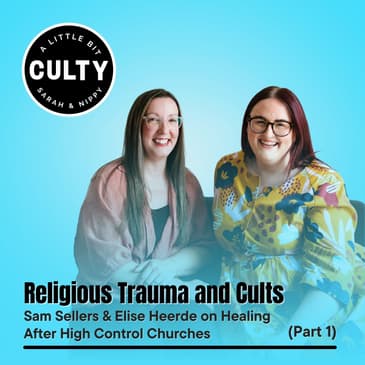
Sam Sellers and Elise Heerde of Religious Trauma and Cults bring the receipts on growing up in high-control faith worlds, with Sam from the Brethren Christian Church, an independent off-shoot of the Exclusive Brethren, and Elise from the Pentecostal Church & New Apostolic Reformation. They talk about how those systems can start out feeling like belonging with a side of certainty, then slowly turn into “wait, this is weird” when obedience, fear, and authority start doing the heavy lifting.
Sam shares how a strict, male-led church, predestination, and a not-so-subtle pressure to comply eventually collided with her own growing sense that the whole thing was, frankly, spiritually and emotionally bonkers. Elise gets into hell trauma, hearing-from-God hierarchy, and the painful realization that being told not to trust yourself is a pretty solid recipe for losing the plot.
It’s a funny, sharp, and deeply honest conversation about religious trauma, queer identity, control, and the long road back to your own brain. Stay tuned for Part 2 of our conversation on Thursday.
Follow Religious Trauma and Cults at religioustraumaandcults.com, Sam’s website and podcast at anchoredcounsellingservices.com.au and Elise’s website and books at eliseheerde.com.
And to follow the Victorian Parliamentary inquiry into the recruitment and impact of cults and other fringe groups submission: https://religioustraumaandcults.com/victorian-cult-inquiry-submission
Trigger warning: This episode contains frank discussion of coercive control, religious trauma, sexual assault, homophobia, emotional and spiritual abuse, and family/community rejection.
Also…let it be known that:
The views and opinions expressed on A Little Bit Culty do not necessarily reflect the official policy or position of the podcast. Any content provided by our guests, bloggers, sponsors or authors are of their opinion and are not intended to malign any religion, group, club, organization, business, individual, anyone or anything. Nobody’s mad at you, just don’t be a culty fuckwad.
Buy the A Little Bit Culty book on Amazon or order a signed copy.
Check out our amazing sponsors
Join A Little Bit Culty on Patreon
Get poppin’ fresh ALBC Swag
Support the pod and smash this link
Check out our cult awareness and recovery resources
Watch Sarah's TED Talk and buy her memoir, Scarred
CREDITS:
Executive Producers: Sarah Edmondson & Anthony Ames
Production Partner: Citizens of Sound
Co-Creator: Jess Tardy
Audio production: Will Retherford
Production Coordinator: Lesli Dinsmore
Writer: Sandra Nomoto
Social media team: Eric Skwarzynski and Brooke Keane
Theme Song: “Cultivated” by Jon Bryant co-written with Nygel Asselin
SUPPORT OUR SPONSORS:
Don’t let stigma stand in the way of support. Start therapy with BetterHelp. Sign up and get 10 percent off at BetterHelp.com/culty.
See Privacy Policy at https://art19.com/privacy and California Privacy Notice at https://art19.com/privacy#do-not-sell-my-info.
[00:00:00] Summer is basically a full wardrobe audit where everything gets exposed. My underwear drawer? Complete disaster. So I finally said enough is enough, and I'm so glad we found MeUndies. And let me tell you, my old underwear is officially unemployed. I love every single MeUndies I've ever received, and the best news is that all of them have been Nippy approved, so that is the best endorsement. The second you, or Nippy, touches the fabric, you're like, oh, this is what comfort feels like. Buttery soft, breathable, the kind that doesn't dig, bunch, or write up like it has a personal vendetta against you.
[00:00:30] Comfortable all day. And the prints? They're so fun, and my drawer is something I genuinely look forward to opening. Which is kind of wild to say about underwear, but here we are. Who knew? Their ultramodal fabric doesn't make you want to rip it off the second you get home. They've got everything from classic black basics to fun seasonal prints that make you smile when you open that drawer. Sizes extra small to 4XL, so everyone gets something that actually fits. And plot twist, they source everything sustainably and actually care about their workers, which is nice when you're supporting a company. Not happy with your first pair? It's on them.
[00:00:59] 30-day guarantee, zero judgment, zero hassle. I doubt that's going to happen, though, because they've sold over 30 million pairs with 90,000 five-star reviews, which means I'm not the only person who had an underwear drawer crisis and decided to fix it. Go us!
[00:01:12] Right now, as a listener of our show, you can get up to 50% off their subscribe and save deal. And if you don't love it, you get your money back at meandies.com slash culti. Promo code culti. That's up to 50% off their subscribe and save deal. And if you don't love it, you get your money back at meandies.com slash culti. Promo code culti.
[00:01:30] AllNote gibt es seit 2013. Wir stellen Fahrradbekleidung her. Der größte Vorteil von Shopify für mich ist, dass wir für die Unternehmensverwaltung keine technischen Vorkenntnisse brauchen. Wir können alles über das Backend und das Frontend steuern und so quasi im Vorbeigehen den Onlineshop betreiben. Wäre Shopify Fahrradzubehör, dann wäre die Plattform das eigentliche Fahrrad. Sie ist einfach die Grundlage. Unser ganzes Geschäft läuft über Shopify. Starte jetzt deinen kostenlosen Test auf shopify.com.
[00:01:59] This podcast is for informational purposes only and should not be considered legal, medical, or mental health advice. The views and opinions expressed do not necessarily reflect the official policy or position of the podcast and are not intended to malign any religion, group, club, organization, business, individual, anyone, or anything. I'm Sarah Edmondson.
[00:02:27] And I'm Anthony Nippy Ames. And this is A Little Bit Culti. We woke up from a cult. And that journey was captured in The Vow on HBO and in my memoir, Scarred. Now in this podcast, we break down the shame and secrets that make these experiences so destructive with honest conversations on how seemingly benign groups can cross into the cultiverse and how to spot and recover from trouble if it happens to you. Each week, we bring in experts, survivors, and whistleblowers to explore red flags, resilience, and even share a few laughs because sometimes you gotta laugh.
[00:02:55] Subscribe to our Patreon for early and ad-free listening, some live Q&A, and exclusive content at patreon.com slash a littlebitculti. Welcome to Season 8 of A Little Bit Culti. Welcome back, everybody, to this week's episode of A Little Bit Culti.
[00:03:24] What happens when you leave a high-control group and instead of a soft landing, you get crickets? What if the support you need doesn't exist? Not in your country, not in your healthcare system, and not even in the conversation. In this episode, we're talking with Sam Sellers and Elise Hurd, co-founders of the Religious Trauma Collective, a.k.a. the only game in town when it comes to cult recovery support in Australia and O.T. Roa, New Zealand. I hope I'm saying that right.
[00:03:49] Both bring lived experience of high-control religion, plus actual professional chops in therapy and trauma-informed care. And when they realized the cupboard was bare for survivors in their region, they said, cool, guess we'll just build the whole thing ourselves. We get into what it really takes to create support from scratch, why so many survivors don't clock their experience as culty until way later, and how courts of control loves to hide in plain sight. We also talk about the reality that mainstream mental health is often not ready for this conversation.
[00:04:19] It's honest, it's eye-opening, and might just have you rethinking what support is supposed to look like, especially when the people who need it the most are the ones creating it. Part one is their personal stories, as usual, and part two is the aftermath, and what they have done to heal and help others. Here's part one with Sam and Elise.
[00:04:53] Sam and Elise, welcome to Lubbock Culty. Thank you. We're so happy to be here. So happy to have you here. What time is it right now in New Zealand? We're in Australia. Oh my God, let me start that again. Shit balls. No, mistakes are great. They're human. That's okay. Everybody gets us confused. Just as everybody confuses US and Canada, everybody confuses Australia and New Zealand. It's fine. No, I know the difference. I just thought that you were in New Zealand. Actually, when we met, you didn't know the difference between Canada and the US.
[00:05:22] I had to teach you that. That's true. I didn't know. But listen. We're just exposing all of those things. I think what I thought is because we've recently been covering how many cults are in New Zealand and Australia. First of all, what's up with that? You're a little bit human. I'm a little bit human. Yeah. Sidebar. Yeah. You know that we have a new book out, right? Yes. Yes. Yes, we do. Which we'll make sure you get a copy of later. But the printer sent them to us in a box on the side.
[00:05:49] Luckily, the title itself of the book was accurate. A little bit culty. But the box sticker said, A Little Bit Cuntly. Which? That's a great title. Yeah, it really is. Which is a title I presented. I was like, why don't we just call it A Little Bit Cunty? And Sarah would go. I mean, look, I'd read both. It's a little aggressive. Yeah. It's a little aggressive. Maybe we'll do a part two. Anyway, you've reached out to us from Australia. And we think that's great because, you know, we've got to work together.
[00:06:19] Was that your? Yeah, that was my. Was it terrible? That was great. No, I had to check. I had to check. How many people say, what is it about the shrimps on the barbie? You do that one. Shrimp on the barbie? Yeah. Does that like, you're like, ugh. Like, buh. That's like, I guess that's our version of America. You know? It's not any worse than thinking that everybody rides on kangaroos to school. That was great. And drinks Foster. Yeah. Yeah. I had an Australian buddy who rode crew in college.
[00:06:48] And he's like the Foster thing. He said, Foster's Australian for stupid. Because nobody really drank Foster's down there. And I was like, oh, okay. No. I also just want to know, do Australians actually cook a lot of shrimps on barbecue? Like, how did that come up? Like, who puts shrimps on the barbecue? Wouldn't it fall through the cracks? That's what I want to know. Sarah, I think they go against the perpendicular. I mean, yeah. And I don't think either of us are great to ask because neither of us cook. So we're probably not. Even if they are cooking them, we're not. Yeah.
[00:07:17] And I'm not aiding him. No, neither. Well, I'm glad that we covered this really important information. We're going to kick this podcast off strong. It's got a warm up. It's been a minute. It's been a minute. But you're here for other reasons. You two are experts in another arena. Religious trauma. And we're going to get into what you've done with your lives. Or as we say in a little bit culty, like turning your shit lemons into lemonade, right? How you've turned it all around. But before we get into that, tell us a little bit about yourselves.
[00:07:45] What groups, religions, cults were you in? And let's start with you, Sam. Tell us a little bit about yourself. And were you born into a religion? Did you choose it? Tell us all about it. Well, I guess it depends on your definition of choice. I was the ripe old age of 12. So I'm not sure that we can make well-informed decisions at the age of 12. I think that's safe. Yes. So I, you know, joined, I guess is probably the best word.
[00:08:14] I joined a fairly conservative church at age 12, typical, you know, teenager, lots of emotion. And my high school religious teacher saw an opportunity and took it. And so I landed in a pretty conservative, not the type of church that you would think a teenager is going to fall into. Not the sort of loud, happy, clappy Pentecostal flavor. Elise will cover that one.
[00:08:44] But much more of the, so a lot of people know the Plymouth Brethren Christian Church or the exclusive brethren. I fell into the open, non-exclusive version of that. So we were allowed to talk to other people, but we still had all of the fundamental ideology attached to it. Okay. And so when you signed up at the ripe old age of 12, what did you think you were signing up for? Like what was your hook? Was it you signing up or was it someone else signing you up? Well, the teacher you said, right? Yeah. Yeah. Yeah. I think it was a little bit of both.
[00:09:13] I grew up with an absent father for the first decade of my life. And then when he came into the mix was incredibly emotionally and psychologically abusive. And so the hook for me was this eternal, omnipotent father God who was going to replace the really shitty earthly one that I had. Got it. That sounds great. It turned out that one wasn't great either. But that's, yeah. At the time, that was what was being dangled.
[00:09:42] And that's what it was for you. In hindsight, do you think that's how you were targeted? Or that's something that you... Yeah, absolutely. I was a sad teenage girl who basically spent most of her lunchtimes crying to the teacher. And so there was a huge level of vulnerability for the scripture teacher to essentially what I used to refer to as like she showed me the love of God. And so she absolutely saw a vulnerability.
[00:10:10] And I don't necessarily think that she did it with any ill intent. But I think she saw a sad 12-year-old and thought, I had the thing that will help fix this for her. That's great. So her intent was she felt like she was giving you something good. Yeah. And for a while. It kind of was something good for a while. Yeah. So... Yeah, tell us about that too. Because it's important to see how it gets you. What was good before the red flags? Yeah, I think a lot of it was good.
[00:10:38] I basically had an instant second family who I was probably closer to than my own family at the time. I had heavy amounts of suicide ideation as a teenager. I firmly believe that being in that community for all its shittiness that came down the track kept me alive as a teenager. And I won't ever, you know, mistake that as like a good thing. And so, yeah, there was huge amounts of belonging.
[00:11:03] There was huge amounts of just connectedness with what I thought was, you know, the beauty of the divine and something bigger and grander and greater than myself. And I liked being able to do all of the things. I have raging ADHD, so having like a million things to do for the community was great. Until it wasn't. Right. Well, so it sounds like it was just better than the alternative, right? And you had offered some stability that you didn't have. Yeah, absolutely.
[00:11:34] Oh my gosh. Yes. Yeah. I mean, it was great to go. Ironically, it was a landing space and did it like stunt a lot of things like purity culture, ideology and conservative worldviews and things like that. Absolutely minimized my worldview growing up. But it wasn't all bad while I was in high school. And okay, so we'll come back to you in a second to find out what. High school is kind of a place where the wheels can fall off. And if you're in a conservative atmosphere, I guess.
[00:12:03] I mean, there's upsides and downsides to conservatism. One of them is your worldview becomes pretty narrow. Yes. Yeah, absolutely. Yeah. And we have to like say this on repeat. We're not trying to show the good in order to whitewash, you know, to like. No, no, but you have to understand. Yeah. It humanizes the decision to be in it.
[00:12:52] Yeah. Your story kind of goes to waste because you're not able to really share your wisdom. So that's a vital part in the whole process. And we keep beating this drum also of like the situational vulnerability. You know, the situation you were in with your home life and you're. Pretty clear. Yeah, it's pretty clear. And we're seeing it even now with like natural disasters, cults sweeping in and providing stability or even a roof over someone's head.
[00:13:21] It can be the reason somebody joins a community or a collective. Your collective is good. Your collective is good. We're going to be clear on that. We just covered a community called the collective. So that's why I had it in my head with Danny Wrench. Anyway, so. OK, so we're going to come back to you in a second, Sam, and hear about, you know, some of the red flags and when things start to go bad. So let's skip to our second guest, Elise. Tell us about what you were part of. Did you join or were your parents? Were you born into it?
[00:13:51] Yes. So I was born into it. I was born into a Pentecostal charismatic faith and church and have always been part of that kind of church, even though I moved around a little bit once I got married. But yeah, very much grew up in that. Went through children's church. I was at a public school, but always my mission at the public school was I am there to get people to church. Like my job is to get people saved.
[00:14:20] And as an extreme introvert with hardly any friends, that was horrific. I grew up with very much the belief that hell was a very real place. That was a place of conscious eternal torment. Was constantly terrified of the rapture happening. I have a whole lot of hell trauma, which is why the first book that I wrote is called Holy Hell, Saved So Hard I Needed Therapy. Because that was a real fear of mine.
[00:14:49] And it was something that kept me in for a very long time. So I ended up in a mega church in Australia, quite high up in leadership. I was running their Bible college in the state that I'm from until things went horribly wrong.
[00:15:37] Before we hear from our sponsors, just a quick reminder. Available now on Amazon in print and as an e-book for Kindle. And yes, the audio book is coming soon, narrated by us. Just search a little bit culty and grab your copy. Do it. Thanks, everybody.
[00:16:19] There are things in life you absolutely do not want to be transparent about. Your swimsuit, your search history, that time you cried watching a commercial, but your wireless bill? Transparency is everything. Which is why Mint Mobile is basically a breath of fresh air in an industry built on confusion and gotchas. No hidden fees. No introductory rates that explode after three minutes. No mysterious charges that make you question your life choices. Just straightforward, 15 bucks a month. All plans. Even unlimited.
[00:16:48] High-speed data. Unlimited talk and text on T-Mobile's 5G network. That's it. That's the whole thing. You bring your current phone. Keep your number. Pick a 3, 6, or 12-month plan. And suddenly, you're not hemorrhaging money on wireless anymore. Sign up online, and boom, you're done. I know it sounds too good to be true because we've all been trained by carriers to expect the rug pull. But nope, just actually $15. Honestly, my only regret is spending years overpaying when this existed the whole time.
[00:17:16] To get your new wireless plan for just 15 bucks a month, go to mintmobile.com slash culty. That's mintmobile.com slash culty. Cut your wireless bill to 15 bucks a month at mintmobile.com slash culty. That's it. There's no catch. Upfront payment of $45 for 3 months, $90 for 6 months, or $180 for 12 months. Plan required, $15 per month equivalent. Taxes and fees extra. Initial plan term only. Greater than 50 gigabytes. May slow when network is busy. Includes up to 20 gigabytes hotspot.
[00:17:46] Capable devices required. Availability, speed, and coverage varies. C-Mobile.com Think about how absolutely bonkers it is that we work, then just wait. Then eventually get paid. Like we collectively agree to this insane deal. Meanwhile, you can get literally anything else instantly. A pizza in 30 minutes? Done. A book? Ordered. But your own money that you already earned? Sorry, you have to wait two weeks like it's 1987.
[00:18:14] Earn In's been fixing this for over a decade. Access up to $150 a day of money you've already earned. Up to $1,000 between paychecks. Optional tips? Standard transfers in one to two days with no mandatory fees. Experienced transfers are just $399 to $599. Five million people have already made the switch, which means the old way is starting to genuinely look weird. When I was living in New York, I had to wait 90 days to get my paycheck. Download Earn In on the App Store or Google Pay.
[00:18:42] Spelled like earning money without the G. Type in a little bit culty under podcast when you sign up. It'll really help the show. Earn In is a financial technology company, not a bank. Access limits are based on your earnings and risk factors. Standard cash outs take one to two business days with no mandatory fees. Expedited transfers available for a fee. Tips are voluntary and don't affect the service. Available in select states. Terms and restrictions apply. Visit earnin.com for full details. Your space should feel like you.
[00:19:11] And if it currently looks like a college dorm room mixed with stuff I inherited from people I don't even know and maybe Facebook Marketplace, well, that's a budget problem, not a taste problem. Enter Wayfair, which understands that good design doesn't require selling a kidney. We've used Wayfair every time we need a refresh. I'm always amazed how easy it is to order and the deliveries are fast and seamless and the quality is superb. Friends, if you're wanting to replace an item in your home, Wayfair should be your first stop. Yes, we order from Wayfair all the time and honestly, you should too.
[00:19:40] Wayfair Verified is basically their team of product nerds hand testing everything with a 10-point inspection. So you're not buying some chair that looks great in photos but feels like sitting on a bag of regrets. Everything's in one place. Seating, grills, lighting, storage, rugs. No more bouncing between 17 stores trying to find pieces that actually vibe together instead of looking like a ransom note. And assembly? They handle delivery, installation, putting it all together. You just pick stuff and they deal with the soul-crushing instruction manuals written by people who hate joy.
[00:20:07] Plus, 20 million five-star reviews means you're seeing real people in real homes, not some magazine fantasy. Real feedback from real humans who aren't professional stylists. Ready to upgrade your home for way less? Head to Wayfair.com right now to shop all things home and get your space ready for less. That's W-A-Y-F-A-I-R dot com. Happy shopping! Wayfair, every style, every home.
[00:20:49] Sponsor Breaks Den, back for more culty stories. What a cliffhanger. And I realized that as you were talking about your Pentecostal church and those beliefs, we didn't do that with Sam. So I was reminding, putting a bookmark that Sam, I want to hear a little bit more about like what the beliefs were. But for people who don't understand what Pentecostal is, you just explained how, but what's the overarching like belief and what makes it different from kind of like standard Christianity? Yes.
[00:21:47] And I think that's what I'm saying. I think that's what I'm saying. I'm saying, well, God has given me this authority. I am now the apostle. You need to honor that. And even though they teach you that you also have direct access to hear from God, it's funny how often they tell you that you're wrong and they've actually heard something different. And you kind of need to follow that.
[00:22:07] And the beliefs in the church really started with, in order to even belong here, you need to start from the point of fundamentally believing that you are inherently broken, sinful, evil, just because you were born and you're human. So how did they convince you of that? For me, that's what I was taught from when I was born, basically. So I never knew anything different.
[00:22:33] And so what we would be teaching other people that we would be trying to bring into the church was essentially looking for that vulnerability that they feel like something is wrong in their life. There's something missing. And that missing piece is God and that you need to understand that you're broken and he's the only answer. You're going to love our new book. There's a chapter about having a direct line to God. And then also like specifically the FLDS church.
[00:23:02] And by the way, he told me to marry your 12-year-old daughter, but that's a separate. I have actually read the book and I did giggle at that point. Did you have the book already? Yeah, I've already read it. Yeah. Wow. Did we send it to you or did you got it? No, I've got – yeah, I got the Kindle version. Oh, great. I'm so glad. I was quick on it. You were quick. That's amazing. That's right now? Yeah, the Kindle's out. The Audible's not out yet. Yeah. We're learning. All right.
[00:23:32] So hold on. What happened when people pushed back? Like I imagine like if you were to approach me like now and – Well, you're a little more – You're a little more – Well, I mean – A little more mute. You know – And I didn't know. How would you convince me of that? And then if I started pushing back, what were the apparatuses in place that would make me obedient? How would that work? Yes. So if you were pushing back, that was the enemy.
[00:23:57] That was Satan trying to get control of you because he doesn't want you to be saved. He doesn't want you to be different. And so that's like – Like that's either Satan or it's your flesh because we were always taught our emotions were bad. Our heart was deceitful above all else. So you could never trust yourself. So they would teach you to not trust yourself. So any kind of pushback was just – that was just stopping you from reaching something really good. So your conscience is evil. Yes.
[00:24:27] And slight tangent. I feel like we've talked about this in other podcasts, but I still can't wrap my head around it. But like I'm imagining myself being in this type of environment and then having this feeling that's like counter to what's being taught. And if I express that, I'm saying, okay, well, that's Satan. But I'm like, I guess how do you know – like there's just no intuition. There's no – I guess my question is if they say like, well, I heard from God. Did you ever think like, but what if that's Satan? You know what I mean?
[00:24:55] Like how – you just don't think that. No, because it's too dangerous to think that because then you're starting to trust yourself again. And if you're just trusting yourself and not the leaders that were put in charge, then that feels too dangerous. So you kind of – you don't even question that. In short, it's an immediate assault on your intuition. Yes. On your intuition, on your self-trust, on – yeah, just being able to care for yourself. Yeah, because your flesh is bad.
[00:25:24] Your body is bad. Everything's bad. Yeah. Yeah, that's where it started from. Yeah. Your humanity is bad. Okay. And you were there till what age? I was there until I was 33. So about four years ago, three, four years ago. Oh, wow. Jesus Christ. Yeah. Yeah. I know. Elise is a new savior. I've got mad pattern recognition over here.
[00:25:55] Okay. We're going to come back to figure out how you got out. But let's start – go back to Sam for a second. We didn't really cover what are the main beliefs of your church. Do we want to share? Is there anything that's important to know that's – that, like, in terms of what informs your religious trauma work now? Yeah. I mean, we very much had a literal interpretation of the Bible. It was the inherent inspired word of God. So what it said, like, you took as gospel, literally.
[00:26:25] Very heavy on complementarian. So, like, men are in charge in every facet, in every place. Women's place was in the kitchen or in the Sunday school place, basically. It wasn't even until probably, like, five or six years into being in the church that the women could even pray or speak publicly. And so it was very heavy on male headship. And, like – How was that enforced? It just was.
[00:26:54] You just knew. It was like – there was very – I was a part of quite a small church. So on a good day, there was about 100 people, max. It was a family church. So what I – like, they literally pretty much – like, I want to say about 80% of the church were all probably related to one another in some way. And so they had all grown up in it. It was baked into all of their – into the water, basically. And so it was assumed very quickly. You could literally see it.
[00:27:23] The women barely spoke in public. Only the men were ever up on stage. The only woman that you would have seen in front of the congregation was the woman playing the keyboard. But that was kind of it. And it was because she was the only woman for a good decade who ever played the keyboard. So it was kind of it. Yeah, not hugely – like, we had the hell doctrine, but not huge on the rapture, like Elise said.
[00:27:47] But yeah, big on, like, very sort of, like, conservative gender ideology would have been the biggest – the biggest thing in terms of how they ran their church was that the men were in charge in every way, shape, and form. Got it. Okay, so you – and so tell us about some of the – like, do you have a moment where you joined when you were 12? It was a safe haven at first. Can you think of a couple moments or specific incidents that you had red flags and you didn't
[00:28:16] really know what you were looking at or – yeah, you do. Okay, tell us. The first red flag was probably – I did what was known as year 13, which is not the year 13 I think you guys are used to, but it was referred to as the gospel gap year with a particular organization. So I basically did some theology courses and went on a mission trip overseas to Fiji and we had to do a lot of walk-up evangelism while we were over there, which was not something that I enjoyed doing.
[00:28:44] We had been hammered – yeah, unsurprising – but we had been hammered into us to not drink anything that was not bottled water because you could get sick. You also were just not allowed to say no in this group. If you said no, then there was – like your heart was hardened. There was something inherently wrong with you. You were inhibiting the spreading of the word of the kingdom and all of that sort of thing. And I knew that I had walk-up evangelism and I knew that the only way that I was going to
[00:29:14] get out of that was to be unwell. And so I found myself in a pool the night before and I thought, I'm in a body of water that is not bottled. And I thought, what better way to get – and I knew that it wasn't necessarily guaranteed, but I was like, what the heck, I'm going to risk it. So I drank the pool water and then I spent the next 48 hours vomiting violently. And so that was probably the first moment where I went, oh, I had to physically make myself unwell to be able to get out of something.
[00:29:42] I couldn't just simply say no here because I would have been interrogated if I did. So that was probably the first moment of a few. But you had the meta-awareness that you did that. Yeah. At the time, yeah. I just knew that it was the only way that I could get out. And I don't know that I had the language of like, this is really problematic or this is like really controlling or anything like that.
[00:30:10] I just thought, I can't say no and yet I don't want to do it. So how do I get out of doing it? I was still like 17. Yeah. Yeah. I was 17 turning 18 at this point. So. Seb, you just reminded me of something which happens a lot in the podcast that I've forgotten about, which is that I didn't like doing our mission statement, our 12-point mission statement. I mean, Nippy was less obedient than me, so he would just like not be there. I would mime it and make fun of it while I was doing it. He was a bit of a class clown.
[00:30:39] I, however, would hide in the bathroom. Often I was running late, so I'd be putting on my makeup. But my plan would be if I, if somebody would catch me, I would say that I was having like diarrhea or something because I should, because I was like hiding in the toilet because I didn't really want to do it. Yeah. I forgot about that. So thank you for helping me. Remember. You were just like giving gifts. Just get, you're a gift giver. Just a giver of memories. Okay, great. Do you have another one that comes to mind of another moment that was. Yeah.
[00:31:07] I mean, I can either go with another mini moment or I can go with the moment. Do you want more mini and then the moment? Mini moment? Great. Yeah. Yeah. Yeah. A mini moment would be, I got taught a specific topic same year, but slightly later in the year. I got taught a very specific doctrine. I had been taught it before. This was not new knowledge, but it was never taught so explicitly as what it was here, which was the doctrine of predestination, which is basically that everything and everyone is predestined by God.
[00:31:37] And I kind of looked at that and went, well, then what is the fucking point? Like, what is the point of prayer? What is the point of evangelizing? I was in a non-Christian family at the time and, and I was having my lecturers say to me that if God has predestined them to hell, then nothing you say and do will ever change that. Like it is what it is basically. And I was like, well, then again, what is the point here?
[00:32:07] And I went back to my, to my elders of the church and went around in circles and I got very stock standard. You know, God works in mysterious ways. His ways are higher. All of that sort of like jargon. And I was at a particular elder's home and his wife came over to me and said, why don't we just leave the academic stuff to the men and we'll go and have a cup of tea? And I thought, oh, absolutely not.
[00:32:34] And so at that point it was like a mini moment, but I still, I, in that moment was like kind of done and I was like, I walked out for two, a two year break before I came back. And yeah, I was like, I'm not being a part of something where you essentially want me to have a lobotomy and have no brain. Even cult podcasts need sponsors. Check out these must-haves.
[00:32:59] We protect literally everything. Our health, our cars, our phones. We've got plans and insurance and warranties for days, but your home, your biggest investment, we just hope nothing breaks. Which is hilarious because things absolutely break. Your plumbing gives up.
[00:33:30] Your HVAC decides 2 a.m. is the perfect time to quit. Your electrical system has a moment. And your regular homeowner's insurance? Yeah, that doesn't cover any of that stuff. Suddenly, you're panicking, Googling contractors at midnight, hoping you don't get completely fleeced. As homeowners, there's nonstop challenges. Faucets breaking, ice machines breaking right before your son's baseball tournament. It's a nonstop challenge. Enter HomeServe. It's basically a subscription for your home.
[00:33:58] For as little as $4.99 a month, they've got your back when things go wrong. No more panicking and searching. You call their 24-7 hotline, they connect you with a local contractor from their network of 2,600 and the repair gets handled. Just pick up the plan that fits your needs and budget and you're covered. They've been doing this for over 20 years with nearly 4.5 million customers who rate them 4.8 out of 5. A plus BBB rating. They're the real deal.
[00:34:25] So you can actually start protecting your biggest investment. Join the millions of customers who trust HomeServe. For 50% less your first year, go to homeserve.com slash culty. That's homeserve.com slash culty for 50% less. Savings compared to renewal price. Void in Florida. Summer wardrobes are so weird because you end up wearing like five pieces on repeat while everything else just sits there quietly judging you. So why not make those five pieces actually great? That's the whole thing about quints.
[00:34:54] They nail elevated essentials, the kind of stuff that feels intentional without requiring a PhD in styling or a second mortgage. Their linen pants, for example, start at $32 and become your summer uniform. Soft denim. Organic cotton sweaters for layering when evenings cool down. Simple pieces that work together because they were designed that way. Not because you got lucky. And I love their 14 karat gold jewelry. The kind of thing that makes even the most effortless outfit feel like you actually tried. Which you didn't, but nobody needs to know that.
[00:35:23] Everything's 50 to 80% less than other brands because they skip the middleman and work directly with ethical factories. So you're paying for quality, not some brand's fancy marketing budget. I've been loving all of their basics for my summer travel. I have this cute crossbody black leather purse that matches my little black backpack, which sometimes my kids wear and then I wear and we all look cute in it. I also have an awesome super soft matching sweatshirt and joggers that I've worn for every single leg of my flight, including the six hours from Halifax to Vancouver because they're kind of like pajamas, but they're also elevated.
[00:35:52] So I still look like I'm not traveling in my PJs. And they've also got incredible home stuff, bedding, kitchen essentials, furniture. Basically, Quince gets that you want your whole life to feel intentional without actually having to work that hard at it. Make your summer wardrobe feel easier. Go to quince.com slash culty for free shipping on your order and 365 day returns. Now available in Canada too. That's q-u-i-n-c-e dot com slash culty for free shipping and 365 day returns.
[00:36:21] Quince.com slash culty. Thank you for listening. Now let's dive back into the cultiverse. Mm-hmm. So it sounds like you, yeah, you really felt the disparity between, like that's just such an inconsistent thing to teach people. Like we have to save everybody, but it's already determined.
[00:36:51] But also your curiosity is what's driving it too, which is. Yes. Yeah. Like that's a really. It's a hard thing. It's a hard thing to squash in people. It's why certain governments don't work. You're squashing the human spirit. But it's like, it's so, it's such a, that's such a like very specific, not consistent thing to teach people. Like it's just does not make sense if you think about it for even a second. Yeah. No. And what did the men come up with when you followed up with them? When they were. After tea.
[00:37:21] Yeah. No, I didn't get a chance to follow up with them after that point because yeah. Funny that. And I just got, I basically just kept getting word salad and just, you know, circular thinking just send me. And I think they thought that they could do that because I was just, you know, the lonely woman who would eventually stop asking questions and she'd shut up. And they didn't really know me very well at that point. I don't think. Right. They underestimated you. Yeah. You said that was a mini moment.
[00:37:49] Tell us about the final, the final straw and in your exit. Yes. So I left for two years and then I went back in good fashion two years later for probably I would say another two years where I was all in again. And the, probably the biggest thing that I haven't mentioned about my story is that I'm queer and being queer in these spaces does not mix. And. Did you know this at the time? Yes. So nobody in my community, I originally put, I identify as like, I don't know.
[00:38:19] Attracted to all genders. And so I used to just sort of lean in more to my attraction to men and was just like, I'll just forget about the rest. Like, I don't need, I can just ignore that. I can just get away. At least I'm, I kind of just counted myself as lucky. I was like, well, at least I'm attracted to men. Like that bodes well for me here. Maybe I'll just find a decent guy who will come along and will make that easier for me. That didn't happen.
[00:38:45] And the way that queer people were spoken about in the church was less than favorable at a minimum and at times cruel and heavy on like predatory language. And so it was never a safe space to even acknowledge that there was anything that was not heterosexuality completely. So then when I was like mid twenties, I looked across the room at a course that I was doing
[00:39:12] and immediately was drawn to a woman there and fell in love. And I'm married to her to this day. Oh my goodness. Which is lovely, except I lost everybody because of it in the process. Right. And so three months after we started dating, I did what was the right thing to do, which was I went to my elders and I disclosed my relationship. Like it was something that I had to confess to them.
[00:39:38] And I had anticipated that, that I would be stepped down from ministry. And I was because I was explicitly told that I was not able to be, I was not allowed to be around the children anymore because again, predatory language. And I was then told that if I wanted to be a part of the church, that I needed to have weekly Bible studies with one of the elders to come back into right living and fellowship with them.
[00:40:06] And I basically said, hard pass. Thanks. And left. Yeah. Cheers. And yes. And I had everybody but three people completely cut me off and basically act as though I had never existed in their world would walk past me in the street like I had never, they didn't know me. And I was a complete stranger to them.
[00:40:31] And then a couple of years later after that, my wife and I, well, she proposed and we were then in there in the last three remaining people who were in my world from the church that I was in to them, we were then defying the sanctity of marriage. And in pretty horrific fashion, when I was supposed to be, you know, proposing like bridesmaid
[00:40:54] proposals as one does, it told me that basically they, they wouldn't be able to stand next to me. They wouldn't be able to be at the wedding. They couldn't support this and then decided to say that it was my fault and I made them, I put them in an uncomfortable position. Yeah. Fuck them. So yeah, pretty much. They're the victims. Yes. Yes.
[00:41:19] I, because I should have known, I put them in an uncomfortable position and they can't do something that is out of alignment with the Bible according to their, well, their version of the Bible. But they can, they can. They have an inconsistency in their morality and they're comfortable. Yes. Yeah, absolutely. Well, you remind them of that. Obviously. Yeah. Yeah. You remind them of that. That's so hard. I'm so sorry. That must've been such a betrayal. Yeah, absolutely.
[00:41:48] I, I now talk about my new Holy Trinity is not the father, son, Holy spirit is grief, betrayal and abandonment. So that's a fun transition for me. Yeah. I mean, Hey, I still, I still have things. They're just different things. I love your humor about this. It's hard to imagine you're depressed. We cry. Yeah. You have to, you have to move the energy somehow. I'm just curious. So it's against the Bible.
[00:42:18] I'm just trying to really wrap my head around. Like you can't be around the kids. Like, do they think it's contagious? Like you're going to turn the children queer? Like, what are they, what are they things going to happen? Like what's, what do they believe? I just thought that's really hard for me to wrap my head around that, that type of thinking. I don't know. Yeah. Well, I think it's a mixture of what you said. Yeah. Yeah. Sorry. They think that you could, you could. No, go ahead. No, no, no, no. Tell us. I think it's a mixture of that in terms of like, they'll catch the gay off someone. Like it's a virus or something.
[00:42:48] We're just out there infecting everybody, which is the polar opposite because most of us don't want anybody near us if we can help it. But I think the more awful reality is that I actually think it is more about seeing queer people as sexual predators, that they will prey on the children, that they will abuse them because they don't see it as just a different type of relationship.
[00:43:13] They see it as a sexual diversion and completely like it's sexual sin. And so I, they absolutely just think that queer people will abuse the kids. That's fucking awful. Yeah. I'm so sorry. And I'm glad that you told them hard to pass and. Yeah. You mean hard pass and being portrayed as a sexual predator.
[00:43:40] Well, hard pass is coming back to be like, you know, to do the weekly Bible study to get back on to right living. And it will, when we come back in part two, we'll hear about your healing journey and what you're doing now. So we'll pause there for a moment. And Elise, tell us about some of your red flag moments and how you eventually, how your shelf broke eventually. Yes. So what I'm going to say is my mini moment.
[00:44:06] You'll probably think it's my big moment, but there's a lot of story after that. So mine will probably sound the opposite of Sam's. But I basically was just working myself into the ground or really the church was working me into the ground. So I was working full time for this mega church at the time. I was not just running a campus of their Bible college. I was also helping to write content.
[00:44:35] This was, we were heading into COVID and I was then also preaching at multiple services on a Sunday. It was, yeah, it was exhausting. And I was studying at the same time because of course I had to be studying at the same college that I was teaching. And so I had reached out for some support because I was at the point where I was throwing up before I would need to preach.
[00:45:00] I don't like, I don't love doing public speaking in front of massive crowds. And obviously at a mega church that was, you know, the crowds were not small, but I needed to do it because I was told from quite a young age that, you know, God had called me to be a teacher and a preacher. So if I didn't do that, I was disappointing God. But I was also extremely anxious, so burnt out, also trying to take care of my daughter.
[00:45:31] And so I decided for the first time ever, I was going to reach out and ask for some help, which was, which looked like pastoral care. And so I was assigned to someone who was meant to be taking care of me pastorally. This person ended up grooming me and then sexually assaulting me. And I thought that when I came to the church to tell them what had happened, I was fully expecting to be 100% supported.
[00:46:01] I had helped to build this church for the last 13 years in the state that I was from. And like every other high control group, it was my whole life. I really had nothing and no one outside of that group. And so I expected them to show up for me and they did not. So I was very quickly thrown under the bus, very quickly told that if I decided to go to the police, I was going to lose my job. Everything was in closed door meetings.
[00:46:30] Nothing was in writing. So I've realized very quickly that I was not going to get the support that I thought I was. And so I decided to kind of take my own path and take that into my own hands because I really just felt like I needed to defend myself and to prove this. And so I did that, but I kept, I really kept quiet for a long time about the way that the
[00:46:56] church was handling it because I had essentially just been convinced that I still needed to protect them and I still needed to be loyal. And so I stayed on staff for another 12 months. I was then made redundant. And then I tried really hard to stay at that church for another two years. And so it was a lot of the moments after that in the staying when I really started to question a whole lot of stuff.
[00:47:26] And so that those moments after that were kind of what became the big moments for me where I couldn't stay. And was there a final moment when you walked away or those? Yes. Tell us about that. Yeah, there were lots of moments that I thought were going to be my final moment, like driving to church and having panic attacks every week because I just couldn't go in.
[00:47:49] But the actual final moment was a Sunday service where I was kind of sitting through what the normal service was and I was visibly upset because I was just having all of these same thoughts that I'd had for a long time of going, what are we like, what are we doing? This is we're just putting on a show. This doesn't feel right. I don't agree with the words of the songs that we're singing.
[00:48:17] I can't stomach what we're being like, how we're being told to live anymore. And so I was visibly upset and I had someone come over to me in the middle of a service and start praying for me and asked for God to show me what my unseen sin was because there must be something wrong with me. And I needed to be able to identify that.
[00:48:42] And so I walked out and as I was walking out, someone stood in front of me and tried to physically stop me from leaving the service. And I had asked them to move. And again, they had used the old, you know, but God has told me, you really need to stay in this service. And I managed that time to go, actually, I'm going to leave.
[00:49:07] And so I walked past them and I went out and I knew that was the last time that I was going to be in that church. And I went home and I've never gone back. Just like that. Just like that. In the movie version, I'm picturing you also- Just like that after two years. Yeah. Yeah. I'm also picturing, just for my own satisfaction, you like kneeing them in the balls or if it's a woman, like just slapping them across the face. I wish. Just for, you know, that extra.
[00:49:36] The first one was a woman. The second was a man. So I could have done both. You could have. Just like a little slap and like, fuck you. No, sorry. I just, you know, my, you know. Yeah. Yeah. I love it. Yeah. Yes. I'm so glad that you left. This is amazing. You two are just incredible. Okay. So dying to know what's on the other side. We're going to take a little break. Come back on Thursday.
[00:50:01] And hear about what you've done with this pain and how you've helped others and what therapists need to know, what survivors of religious trauma need to know, get into religious trauma, what it is, what's not. Anything else? Did I miss anything? No. Nope. All right. See you soon. Part two.
[00:50:44] We hope you're enjoying a little bit culty. If so, please do show us some love, drop a rating or leave a review. Hit subscribe on Apple, Spotify, or wherever you listen and subscribe to our Patreon at patreon.com slash a little bit culty. Even better. Send this episode to someone who needs it. Maybe they're in a cult. Maybe they're just a little bit susceptible, or maybe they just love a good story. Spread the word. Spread the love. Thanks for listening and see you next time. A Little Bit Culty is a Trace 120 production.
[00:51:11] Executive produced by Sarah Edmondson and Anthony Nippy Ames in collaboration with producer Will Rutherford at Citizens of Sound. Our co-creator is Jess Temple-Tardy. Our production coordinator is Leslie Dinsenbor. Writing by Sandra Nomoto and social media marketing by Eric Swarczynski and Brooke Keene. Our theme song Cultivated is by the artists John Bryant and Nigel Aslan.