
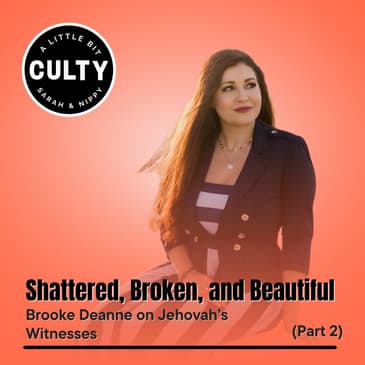
In Part 2 of our conversation with Brooke Deanne, we get into the moment the whole thing finally cracked wide open: the knife incident that became her final straw, the divorce that followed, and the painfully familiar push-pull of leaving a trauma-bonded relationship. Brooke also shared how the Jehovah’s Witness elders protected the wrong person, why the system kept men in power, and how shunning can make you feel like you’ve been erased by your own people.
We follow Brooke through the aftermath: PTSD, panic attacks, therapy that didn’t have the right language for religious trauma, and the very relatable “oops, I traded one cult for another” detour into New Age spirituality. Along the way, she talks about rebuilding trust in her body, learning to spot red flags, exploring somatic work and psychedelics, and finding safer, saner ways to heal—because apparently the nervous system did not sign up for any of this nonsense.
Be sure to pick up Brooke’s book, Shattered, Broken, and Beautiful: Losing My Religion and Finding Faith, or follow her on her website, brookedeanne.com, or social media.
Trigger warning: This episode contains frank discussion of cults, coercive control, emotional, physical, and sexual abuse, shunning, trauma bonding, religious trauma, PTSD, panic attacks, and discussion of psychedelics.
Also…let it be known that:
The views and opinions expressed on A Little Bit Culty do not necessarily reflect the official policy or position of the podcast. Any content provided by our guests, bloggers, sponsors or authors are of their opinion and are not intended to malign any religion, group, club, organization, business, individual, anyone or anything. Nobody’s mad at you, just don’t be a culty fuckwad.
Buy the A Little Bit Culty book on Amazon or order a signed copy.
Check out our amazing sponsors
Join A Little Bit Culty on Patreon
Get poppin’ fresh ALBC Swag
Support the pod and smash this link
Check out our cult awareness and recovery resources
Watch Sarah's TED Talk and buy her memoir, Scarred
CREDITS:
Executive Producers: Sarah Edmondson & Anthony Ames
Production Partner: Citizens of Sound
Co-Creator: Jess Tardy
Audio production: Will Retherford
Production Coordinator: Lesli Dinsmore
Writer: Sandra Nomoto
Social media team: Eric Skwarzynski and Brooke Keane
Theme Song: “Cultivated” by Jon Bryant co-written with Nygel Asselin
See Privacy Policy at https://art19.com/privacy and California Privacy Notice at https://art19.com/privacy#do-not-sell-my-info.
[00:00:00] We always recommend Shopify. It took us from an idea to a real business. We got set up, I think, in less than a day with very little effort. We could just focus on the supply chains and the product development. Shopify gives us the ability to customize without the complexity. We can change something without introducing fragility or having to pay a developer. We're Thirsty Turtle and we leveled up our business with Shopify. Start your free trial at shopify.com.au
[00:00:30] This podcast is for informational purposes only and should not be considered legal, medical, or mental health advice. The views and opinions expressed do not necessarily reflect the official policy or position of the podcast and are not intended to malign any religion, group, club, organization, business, individual, anyone, or anything. I'm Sarah Edmondson.
[00:00:58] And I'm Anthony Nippy Ames. And this is A Little Bit Culty. We woke up from a cult. And that journey was captured in The Vow on HBO and in my memoir, Scarred. Now, in this podcast, we break down the shame and secrets that make these experiences so destructive with honest conversations on how seemingly benign groups can cross into the cultiverse and how to spot and recover from trouble if it happens to you. Each week, we bring in experts, survivors, and whistleblowers to explore red flags, resilience, and even share a few laughs because sometimes you gotta laugh.
[00:01:26] Subscribe to our Patreon for early and ad-free listening, some live Q&A, and exclusive content at patreon.com slash a little bit culty. Welcome to Season 8 of A Little Bit Culty.
[00:01:49] Welcome back to Part 2 with Brooke Deanne. If you haven't listened to the first episode, I think it's self-evident what your next step is. Brooke, okay, so you have a long journey with your push and pull with both Ryan and the show of his witnesses. What's your final straw and what do you need to see to finally leave? I know there's lots of things that happen up to that point. Whatever you feel like is important for people to know. I have a couple follow-ups there. Yeah.
[00:02:18] Yeah. I think the final straw for the relationship was when he pulled a knife. That'll do it. And put it up in the throat. Yeah, that'll do it. Yeah, that was my final straw. That was really what I call one of my first awakenings to be like, what am I doing here? Why am I continuing to play this out? About seven, eight months before that event, I had figured out that I was even in a narcissistic friendship.
[00:02:46] And I started to research narcissism. Now, that's the crazy thing about being inside of a cult. You are not taught to research outside of the cult. And so that even shows up when there's things like this, right? I really had never even explored the term. And when I saw that was happening inside of a friendship inside of the cult, it really awakened me to be like, oh my gosh, I think I'm in a narcissistic abusive relationship.
[00:03:14] And so I was already kind of like pulling back the layers of what had happened to me in the relationship. And when he did that day, I just said, there's no more of this. You can't do this anymore. And so that was the pivotal moment of us starting that divorce process. And in that process, he, of course, any trauma-bonded relationship, I was feeling the push and pull back to go back,
[00:03:39] to want to go back, feeling so addicted to that relationship in what I thought it gave me, a sense of safety, you know, quote unquote, not real safety, what my system thought was safety, because it was what was familiar. And at the same time, knowing that I also did not resonate with the cult anymore. I was still trying to pretend for my family. I was so afraid to lose that support system, to lose my friends.
[00:04:10] And so there was a part of me that said, you know what, maybe I'll just fake this. As I was getting divorced, I even had an elder approach me and let me know that he was so interested in marrying me. Like I had opportunities to get remarried very quickly. Like I was not even divorced yet. There goes the scarlet letter. And I was already having... Exactly, right? Like I was literally having men like line up to be like, oh, pick me, like I'll marry you. And it was pretty interesting like how that happens.
[00:04:38] And I was like, okay, I could pretend. Oh, I'd have the perfect family. My dad always wanted me to marry an elder. I could have it all here. And yet there was a part of me that said this, I don't resonate. I don't really know why, but I just can't do it anymore. There's something that I don't feel called to anymore. And so I just quit one day. I didn't go back. I was in front of the Kingdom Hall one day and I was going to take my boys inside and I couldn't even get out of the car.
[00:05:07] So my body was even trying to say, what are you doing? Like, don't do this. And I just told the boys, we're leaving. We're not going here. And that was... I never looked back after that. Even though there was, again, that push and pull dynamic of wanting to go back because it was like, oh, well, I'm losing my community. My family's looking at me like I have a virus. Like I'm sick. Like they can't touch me or talk to me. But yet also knowing that I just didn't want to pretend anymore.
[00:05:36] I felt like I had been performing my whole entire life. I had performed in my marriage. I had performed outside of my marriage. I had pretended like everything was okay when I was not okay. And so I just let the walls start to crumble down. One of the things we noticed, I noticed in a lot of our cult talk is there's often a governing
[00:06:01] apparatus that is supposed to protect you but ends up protecting the perpetrator. What did you notice inside and outside when you started to air your grievances that didn't uphold you and upheld the perpetrator? So I'll tell you the first time that I noticed it. The first time was when Ryan did commit adultery and he confessed to me. He had to go to the elders. At that time, he was a ministerial servant.
[00:06:29] So he was already, you know, he was somebody in the religion at that point. Well, he went and confessed and it was multiple times. This was not just one person. And so, of course, my rage was like, I hope you get disfellowshipped. I hope you get punished for this. Because, of course, I was suffering. I was in pain. And he came back.
[00:06:53] He sat on the couch and with a smirk on his face looked at me and said, they just tapped me on the hand. Nothing. I'm not getting disfellowshipped. I'm not even getting announced that I've done anything wrong. And that was the first time that I was like, if it would have been roles reversed, I would have been disfellowshipped. Hands down. I know it in my bones. There is no way.
[00:07:22] He got away with it because he had hierarchy. They didn't want the upheaval of him being announced that he had done something wrong and being looked at differently because that makes the whole system look bad. So, of course, they're going to protect the perpetrator. Of course, they're going to protect their own. And this is what this is constantly happening inside of the system with these men. That's why they hide the child sex abuse cases.
[00:07:50] It's why they're like there is all of this happening. The harm that's going on in the system is like we haven't even unraveled most of it. Why does a man's transgressions being exposed make it look worse than a woman's? Like why are they hiding the man's, are you asking? Yeah. Like why wouldn't they hide yours thinking, oh my God, we're, you know, our organization doesn't function the way that it does. I think it's suppression for the women. We control you, right? It's that message.
[00:08:19] We control you. You don't control anything outside of this. And it's more of like the men have control over everything. So, why wouldn't they protect their own? Of course, they're going to protect their own. And I think that's, you know, that's my answer to the question. Do I really know? But they don't see the women as their own? I mean, no, I think they see women as a commodity. Yeah. Women are, they're the weaker vessel, right? We're told that how many times from the scriptures. We're the weaker vessel.
[00:08:48] Well, women are just the women that, you know, make sure everything's okay for the man. They're there to build the man up. That's the messaging we get, right? Take care of the home. Take care of the children. Do your duty as a Christian woman. Do what you're supposed to do. Like you don't really have a role other than that in this religion. You are not looked at someone with any authority or you're not allowed to have autonomy. You are connected to the man.
[00:09:18] They constantly speak about that scripture when Adam, like God created Adam and then he took Adam's rib. And, you know, that's the only reason basically why a woman is around because of Adam's rib. So, you know, like, so it's just showing like how they view women just by the messaging. Have you watched Bad Mormon? I mean, read Bad Mormon by Heather Gay? No, but I'm going to have to take a look. Yeah, there's a lot of parallels. Yeah, we didn't mention it in our book because we read it afterwards, but I highly recommend it.
[00:09:44] And also she is a series out right now about sort of the truth behind the Mormon church. That's fucked up. It's so fucked up. But like both Jehovah's Witness and Mormons, when something like this happens or like sex before marriage or whatever, they get grilled by the men in these private rooms and the men want all the details and it's disgusting. And they get off on it. That's a parallel. And you just reminded me of something also, one of the first interviews I ever did, but this is before the vow.
[00:10:10] And I got flown to New York and I met a bunch of survivors and one of them was a survivor, Jehovah's Witnesses. And she told her story of basically that she was going to butcher this, but she was basically molested by like a much like a grandfather figure. And she started developing all these as a little girl, like as a seven year old and developing all these STDs and like horrible. Like, I don't even know what.
[00:10:35] But nobody did anything about it because when she tried to get help because there was no witness, ironically, you have to have a witness for it. Nothing happened. And I was so horrified. And I didn't know much about who I was a witness at the time other than like no birthday parties, no blood transfusions. That's sort of like the only thing I knew of growing up. And then the camera guy who had been filming us and learning about NXIVM, I said, what's the most shocking thing you've learned about this before we even had a podcast?
[00:11:05] I was like, what's what like what have you found? He's like that the he said to me, the Jehovah's Witnesses are a safe haven for pedophiles. That's what he told me. Before we hear from our sponsors, just a quick reminder. Our book, A Little Bit Culty, Navigating Cults, Control and Coercion is officially out and available on Amazon. Signed pre-orders have closed, but you can still get your copy today. This book is the culmination of five years of conversations, interviews and research.
[00:11:36] Everything we've learned about how people get pulled into high control groups and how to avoid escape or heal from them. If you've been listening to the podcast and want a deeper go to resource, this is it. Available now on Amazon in print and as an ebook for Kindle. And yes, the audio book is coming soon, narrated by us. Just search A Little Bit Culty and grab your copy. Do it. Thanks, everybody.
[00:12:06] I don't know about you guys, but I like keeping my money where I can actually see it. Unfortunately, big wireless seems to like keeping it as well. After years of overpaying for phone bills, mystery fees and those free perks that somehow cost extra, I finally want to tap out and switch to Mint Mobile. Mint exists to fix exactly that. Premium Wires plans start at just 15 bucks a month. You still get high speed data and unlimited talk and text on the nation's largest 5G network without the financial side eye.
[00:12:35] And switching is super easy. Bring your own phone, keep your number, activate with eSIM in minutes, and you're good to go. No contracts, no hassle. So yeah, maybe it's time to stop doing wireless the hard way. Get three months of premium service for 15 bucks a month with Mint Mobile and keep more of your money where it belongs. Next time I switch my mobile plan, that's what I'm using. If you like your money, Mint Mobile is for you. Shop plans at mintmobile.com slash culty. That's mintmobile.com slash culty.
[00:13:03] Upfront payments of $45 for three months, 5GB plan required, equivalent to $15 per month. New customer offer for three months only, then full price plan options available. Tax and fees extra. See Mint Mobile for details. So when we first moved to Atlanta, our outdoor space was, let's call it aspirational. There was some plastic chairs we inherited. There were some things we got from a garage sale. I mean, it was generally an eyesore, and we just didn't use it.
[00:13:30] And that's why we were so grateful for Wayfair. Wayfair made it so easy to fix that and give us the vibe that we were going for. The delivery was easy. The assembly was easy. We have these beautiful Adirondack chairs around a fire pit that, let's just say, the neighbors covet. I think they covet it. You can shop by style, modern, coastal, farmhouse, whatever your vibe is, and actually find pieces that work together without spending hours spiraling and scrolling and looking at reviews. Their filters, reviews, and photos from real people are clutch.
[00:14:00] It's like having millions of second opinions before you commit. And for somebody like me who has trouble making decisions, this is a game changer. And everything's in one place. Seating, rugs, lighting, storage, even grills. So you're not piecing it together from five different sites like a part-time job. Plus, with Wayfair verified, their team vets products with a full quality checklist. So you know you're getting something solid. And if you're not exactly handy, like Nippy and I, they've got assembly options too, which saved us from at least one patio meltdown. And we're grateful for that.
[00:14:29] Basically, less guesswork and more actually using the space now. Come on over. We're having a party. Get prepped for patio season for way less. Head to Wayfair.com right now to shop all things home. That's W-A-Y-F-A-I-R dot com. Wayfair. Every style. Every home. Lately, I've tried to be more intentional with what I wear. Because as a parent, I have approximately 90 seconds to get dressed before someone needs a snack or a ride or emotional support over something.
[00:14:58] So I just need clothes that work. No fuss. No outfit spirals. No, does this go with this and whatnot. That's why I keep going back to Quintz. I'm so excited that they are still our sponsor. Everything is effortless, comfortable, and makes it look like I tried. They've got some incredible spring pieces made from 100% European linen, organic cotton, and super soft denim. Think lightweight linen pants, easy dresses, and tops starting around $30. Breathable, wearable, and on repeat. Here's the best part.
[00:15:27] It all looks way more expensive than it is. Quintz cuts out the middleman and works directly with ethical factories. So you're getting high quality pieces for 50 to 80% less. I am lucky enough to go away on a little Mother's Day trip, and I needed to upgrade a few things. And I'm so excited to say that I got some incredible bathing suits. I also got a bunch of basics like an organic cotton micro rib scoop neck tank in Heather Oatmeal.
[00:15:52] But my biggest obsession is 100% organic cotton gauze smocked sleeveless maxi dress in ocean breeze. So that's like a light blue. So thanks to Quintz, I can look like a semi-functioning adult, even if my morning has already been chaos. Yes. Refresh your everyday with luxury you'll actually use. Head over to Quintz.com slash culty for free shipping on your order and 365-day returns. Now available in Canada, too. That's Q-U-I-N-C-E dot com slash culty for free shipping and 365-day returns. Quintz.com slash culty.
[00:16:25] Thank you for listening. Now, let's dive back into the cultiverse. Yeah. You're spot on. I mean, you just gave me chills when you said that. That is exactly what it is because it doesn't matter if you speak up. You know, I don't talk about this a lot, but I was sexually abused as a child as well. And I think that is entirely, you know, we don't know how to voice those things. And especially when it happens to you at a younger age, you don't really know how to.
[00:16:55] You don't even know it's abuse yet, right? But even if you did. Yeah. Yes. But even if you did, they don't believe you because they didn't witness it. Because that's what you're taught. You're taught the two witness rule. So, if there's not been two people to see when it happened, well, then, well, we can kind of just throw it out, basically. Because we don't know. We can't take your word for it. And so, wait a second. You can't believe me? And that was my experience.
[00:17:25] You know, it was not believed. And I think that's a lot of women's experience. We're seeing that right now happen in the political scene. It's a time bomb. Feels like Jehovah's Witness is a time bomb. Because I just don't know how long you can keep that kind of. Well, it's already exploded. But you said it's falling apart. I think so. You know, a lot of people assume that, like, leaving a cult or high-control religion, you just have instant relief. But there's this invisible aftermath in the body and the nervous system.
[00:17:54] Tell us a little bit about how you went from waking up to, you know, where you are now in your therapy and in your journey of reclaiming your sovereignty. What's been the most helpful and how have you gotten to where you are now? Yeah. You're right. There is a lot of aftermath. You don't realize it. When I left, I was quickly diagnosed with PTSD. Just so many years of abuse. But that I couldn't even focus on the religious trauma. So I kind of want to speak to that, too, for a lot of women.
[00:18:23] Sometimes it's like you almost, like, can't even deal with what happened to you inside of the religion. I kind of had to throw that away for a little while and throw that to the side as I was just trying to cope with what was going on inside of my body. Panic attacks, fear anxiety. Like, a lot of not being able to just really find safety within myself and in my experience because I had just lost everything in one fell swoop. So, and including my whole identity and my whole belief system and relationship. Like, it was just, it was a lot.
[00:18:52] So it was an overload. So I began therapy very quickly. Like, I knew. It was like, I need support. I need help. But what I found is that I was finding therapists that had no idea or language to speak to my religious trauma. They had never lived it. And so they're, like, trying to support me and help me through it. But one, I think they had textbook understanding of narcissistic abuse. They didn't have any frame of reference for religious trauma.
[00:19:20] And so I was really struggling in not being able to find the right support. I didn't find that support until probably about five years later when I found a woman that had left Mormonism. So she was an ex-Mormon. So she really understood what was going on for me and was able to finally give me a little bit of relief to start to kind of sort through the religious trauma that really had happened. And then I started to, like, make the connections and see how the patterns had happened. And I'm like, well, no wonder.
[00:19:50] Like, I had been set up and conditioned from birth by there was just no chance. Like, no wonder I kept getting into abusive relationships and why I stayed in an abusive relationship. It literally conditioned and trained me to be set up for that exact experience. And so it just started to kind of unravel, like, the similarities between narcissistic abuse and being in a cult-like system.
[00:20:17] Like, how it is all, like, very intertwined in the same tactics, same manipulation, same gaslighting, same control that was happening in relationship. It was also happening within the religion. And so as I started to see that and kind of piece those things together, I finally started to really come to understanding of what had happened to me so I could grieve. Right. Like, I didn't even have space to grieve. That's a good point. I was just surviving. I was just surviving being a single mom.
[00:20:46] So what are the biggest, like, when I got out of my situation, I became super sensitive to a handful of things. You know, use of language, can't question. We list them in our book, but there's a handful that became kind of my talking points of, like, what I feel like I didn't do, like, question more, that sort of thing. What are your biggest takeaways from your situation? And when you go out into the world, you catch them right away, right? Your personal red flags.
[00:21:15] I mean, I know all of them, but there's a couple that I'm like, ah, gotcha, right away. Like, they don't, does that make sense? Yeah, completely. Like, so I think that what was really for me, it was I started to be able to decipher, like, who was someone that was really not a safe person? So what you guys don't know about my story that's not in my book is that when I left the religion, I also, like, I basically traded one cult for the next. And I got, I dived deep into New Age spirituality. I was going to ask you about that, actually.
[00:21:45] There you go. Yeah. Because. Cult hopper. It's almost the opposite, too. Yes, exactly. Exactly. I went to the other extreme. And that's why I want to speak to that, because I think that's a lot of people's experience. You have no idea. Because it's very, well, you do, obviously. Yeah. I'm sure. Yeah. I'm sure you guys understand. I'm sure you see it. I'm sure you've talked to so many people that do this. And I think it's just important to understand it's because of your programming. It's entirely because of your programming.
[00:22:13] Your system is created to seek and detect what is familiar. So we leave one system, but our programming, it's still running the same. Our brain is still operating the same programs. It's now just like, well, wait a second. We don't believe in Jehovah anymore, but now we need to go and find what is something that we believe in. And so that's how the brain operates. And so it's why I've dived into neuroscience.
[00:22:41] It's why I've done the work I've done to understand how we operate and how that brain seeks what it needs to feel familiar and safety. And you probably are giving me a book. I think you're giving me a book. I want to show you. Can you see it? Oh, I love it. A cult-shaped hole in your heart. Yes. Is that what it said? This is the chapter about cult hopping. What shape is that? Well, it's just the cult shape. It's like this hole. And like you leave it. So when you left Jehovah's Witnesses, what were you going for in the spiritual community? Was it more community?
[00:23:10] Was it just answers? What was your hook there? I became a deep seeker of answers. Yeah. So what I realized is I lost my sense of certainty, which we do when we leave a cult, right? We lose all certainty. We're like, oh, my God. And so your system, like your brain and your body are like, where's my certainty? It needs to land somewhere. Yeah. Yeah. It has to figure it out. And so where did my body land? Well, my body landed in new age spirituality.
[00:23:36] And it was like, but it was the same toxic spirituality that I had left. It was just different language. Yeah. I traded one thing for the other. And so when you say like, what was the red flags? Well, that wasn't a red flag yet because I was like, oh, okay, well now I'm getting these psychic mediums and they're telling me that this is what's supposed to be happening. And they're telling me like all of these things. And then I was finding people in new age spirituality that are like, you know, toxic positivity, completely spiritual bypassing.
[00:24:05] But seeing it as you're not allowed to have negative thoughts. And so I would have, you know, I'd have teachers and mentors that would tell me you're not allowed to have these negative thoughts because if you do, guess what? Bad things are going to happen to you and you're going to create bad things in your reality. And I was like, what happened to me now was like, now I became obsessed with not creating more negative thoughts because I was like, oh my gosh, now I became OCD about figuring out what am I supposed to be thinking? Oh, I'm thinking a bad thought. Oh my gosh.
[00:24:33] It's just another thing of like, it's just different language. It's completely opposite, but the same thing. But what it did, it ran on my, the base level of where my nervous system was is fear. So I recently wrote an article called fear consciousness because that is what the model was that was set up for us in cults, fear. What did our body learn? Fear.
[00:25:00] So we were constantly repeating that cycle within our nervous system. It was our emotional imprint and fear and more fear was all we knew. And that was what was happening to me in this community as well. And so I had to then deconstruct again and I stripped everything down. I went to bare bones. I was like, I am stripping and deconstructing Christianity. I am stripping and deconstructing new age spirituality.
[00:25:28] All the delusion that is happening in spiritual spaces, that's where I went to. Like, and I didn't stop. Like, I'm still continuing to see things as I work with my clients. You know, I do hypnotherapies. So I see in real time when people come out of religious trauma, the programming that is happening in the background that's still running there and operating their life that they're just not consciously aware of.
[00:25:57] And that's helped me to see the themes and the patterns in cult survivors. And it's been, it's fascinating work. And I feel like at some point I'm going to really be able to put it into, you know, so people can actually see this and how that's working out for them after they leave these systems. Full disclosure, I have 20 pages left in your book, so I don't know how it ends. You have to tell us. It's a problem with full disclosure, Sarah. Yes, but I will say you just got to the point where you were sharing how you found a mantra
[00:26:27] in TM and you were discovering your Kundalini. And listen, I'm a proponent of spiritual dabbling. I take a little bit here. I take a little bit there. I'm not, I will never follow one person or group or doctrine thinking ever again. So I'm not. You do have scented candles though. I do have some candles. I have some, I have lots, I do, I do non-culti yoga. Like there's lots of things I do. So I'm not poo-pooing on any particular thing. However, I just want to make sure that you're aware of some of the, you know, history of
[00:26:55] the inner circles of TM and the inner circles of Kundalini. You are. Okay, good. Mind if I chime in with my soundbite? My soundbite as late is every group has an extreme version of itself. That is actually mic drop. That is perfection, to be honest, because it is true. I think that every group there is some maybe truth sweaved into it. But then there's also the extreme parts of it. That is, I mean, that's classic. I'm going to have to write that one down. Because that's a good one.
[00:27:25] Look, I have a, I write them down. I have a slew of them. They're all on my phone. I can, yeah. Because sometimes we're on these shows and we got to go, I'm like, it's time for this one. It's time for this one. I kind of have them in my head. Because I can't even tell you, Brooke, how many people have been like, oh my goodness, I'm so sorry that happened to you. And it sounds terrible. I would never fall for it. We've done an episode on it. But I know that they're just doing their mantra and they're fine, right?
[00:27:52] They're not going to headquarters and learning how to levitate and giving the organization thousands of dollars. They are fine. But so then I have to tell them, you are fine now. You know what I mean? But these are the red flags. But read my book. But read my book. Let me know what you think. But also, we end with what are the green flags, which I think you're going to really like. How do you navigate these spaces and what to look for? What is there that's positive? But you were going to say something. So where are you at now?
[00:28:21] And how do you stay safe knowing all of this? Yeah. Well, I mean, I think I needed to do, it sounds like when you say that about TM, right? I think I needed to try all the cult-like spaces. I think I needed to test them out. And I think what that helped me to do is to really learn what to pay attention to, right? What is safe? What is not safe? And seeing that, like, and also being very trauma-informed and doing so much learning about trauma and the nervous system and all these things.
[00:28:50] And now it's like, I can sense when something's not safe. So I think that's the most important piece when you leave these places is find someone that can support you to learn how to come back into your body. Because your body's wisdom and its intelligence, like, it already knows when you're not in a safe environment. Like, it's already screaming at you. I recognize that now looking back, like, the messaging that my body was already giving me.
[00:29:19] But I was completely ignoring it because I was told not to trust my heart, not to trust myself, right? That was repeatedly drilled into me and programmed into me not to trust myself. My desires are not right. The things that I think are not right. And so, of course, I would not listen to my body. I'd only learn how to dissociate from my body. So that's what I say for anyone listening. First, learn how to connect back to yourself.
[00:29:49] How can you start to, like, create that beautiful relationship back to your body? Because it knows. Like, your intuitive hits and the things that you already feel inside, it's there. It's there for you. You just got to learn how to pay attention again. So that was the one thing that actually I did not get wrapped up in TM, just so you guys all know. That was not a thing for me. Seriously, we don't want to have to have you come on and do another episode about... No, I did not. No.
[00:30:14] But TM did give me the ability to sit still with myself. Great. To actually feel... Yeah. Yeah, to access knowledge, to feel emotions that I had been suppressing for years because I just now didn't... Because my system was running on fight or flight. So that's a trauma response that is really based in fear. So I was constantly busy. I couldn't be still.
[00:30:42] Constantly feeling an underlying anxiety. I just... My nervous system was so hijacked. I feel like she's going around about something. I'm that way. Yeah. I'm very busy. Oh, okay. I stay busy to not feel stuff, 100%. Yeah. My system was just so hijacked. It was the only way that I could... You know, now, like, it was almost like this was a... I felt like it was a gift for me to finally be able to sit still. And so that was the first part of my healing, right?
[00:31:11] Then going back to school, learning about the mind, going back to be a clinical hypnotherapist, you know, doing all of the trauma work and understanding of how my trauma existed in my life helped me also now help others. But the next piece of my true, I'd say, awakening is when my ex passed. And that really, like, just created that chain of events because now I had to find, like, a frame of reference of, like, what do I believe when people die?
[00:31:39] Because I was told with certainty what happened when people died. And now I had, like, nothing. I was like, well, I don't know what to believe. And that brought up a lot of more fear again. And so that's when I, again, I went back on another quest to really find what was true to me. Like, it didn't matter what anybody else told me. It didn't matter what I could read. It was like, what feels true to me and what feels like I can be at peace with this? And that's kind of where I went.
[00:32:08] But my next part of that piece is finding psychedelics. I started psychedelic-assisted therapy. And that really opened up my mind and opened up my world to a completely different understanding about myself. Twins, by the way. And helped me heal. Ketamine or mushrooms. Which ones did you try? So I did ketamine. I did psilocybin. And I did ayahuasca.
[00:32:38] Let's take a little break from the cultiverse. Here's a word from our sponsors. Thank you for listening. Now let's dive back into the cultiverse. I'm scared of those. I've done mushrooms. A lot of people are afraid. I still like barfing. So I'll probably never do ayahuasca.
[00:33:07] But I'd like to try ketamine. Did you? I didn't barf. You didn't? Just so you know. Not everybody barfs. Everybody barfs. I did a... We did the mushroom ones like five years ago. Yeah. And this guy after was kind of laughing because when I did it, all I wanted to do was hang out with him. He was kind of guiding me through it. And all I wanted to do was talk to him and hang out with him. He's like, I've never seen that. Most people like... Go internal. Go internal.
[00:33:37] And I was like, all I want to do is talk and chatty. And I felt nauseous and like the clammy hands and all that. And I just didn't... It's not my thing. I want... Yeah. I still microdose like almost every day or every other day. But yeah. Where am I when this is... You didn't like it. So I don't give it to you anymore. Okay. But ketamine, I'm really curious to try. I just had to find the right practitioner. Because surprise, surprise, like Nippy said, even in this space, there's culty. Yeah. There's cults. There's cults in this space. Yes. And so that's another big warning, everybody. This is a red flag.
[00:34:06] There is also a lot of cult-like systems running the psychedelic space. I saw it. I witnessed it. I observed it. I saw... Like I told you, I have literally tried on everything so that I could see where is delusion still happening? Where is distortion still happening to really be able to see? Because I wanted to be kind of a clear channel for my work. I don't want to bring in my baggage. Right?
[00:34:34] I don't want to bring in distorted viewpoints. Or, you know, I want to bring in to people like, listen, this is your experience. And no one gets to tell you what your experience is. Because that's a lot of what's happening in these spaces. A lot of these healers, right? These coaches, these people that are like saying they are the way or the only... They have the thing, right? Everybody needs.
[00:35:00] And I'm like, no, like your thing may be different than my thing. And that's okay. And I can observe you in that. And I can say that's okay. There's like a quarter of our book is about the healing section. And we start it with saying this is what helped us. We're going to share some of the things that have helped our guests. But you're on your own journey. And, you know, one of my very first interviews with somebody who's kind of prominent in the cult space, I said something about my PTSD. And he said, you should be over that by now.
[00:35:28] And I was like, I still was a people pleaser. I mean, it's still fun. You know, I'm like, oh, yeah, totally. I should be. And then later, somebody pointed that out. And I was like, you're right. Like, that's my own journey. Who are you to tell me what my timeline is? You know? Exactly. And that's a lot of messaging that's happening right now. Oh, you can just stop healing. You don't need to be healing anymore. Like, you should be already over it. Like, no. Like, why are you telling people this?
[00:35:54] Like, people are allowed to make their own informed decisions. It's another way of like controlling people and the way they should be operating. No, this is your journey. You know what book? A book that I think you'd also really love if you haven't read it already is I Belong to Me by Tia Lovings, A Survivor's Guide to Recovery and Hope After Religious Trauma. I need to read that. Yeah, she's great. I didn't even have even heard it. Oh, God. I Belonged. Have you not read Tia's books? Tia Lovings? Oh, okay. No. Hold on. Do it.
[00:36:22] First, start with A Well-Trained Wife, which is her memoir. Start there. And then, yeah, she just wrote I Belong to Me. I'm assuming. I think it's out already. If it's not out already, it's out any minute. Survivor's Guide to Recovery and Hope After Religious Trauma. It's a little bit of overlap with our healing section. But it's specifically about religious trauma. Where ours is like cults, all types of cults. Yeah, I just feel like you should connect. But I have to also say, because I saw that you, because, I mean, listen, hypnosis. We did hypnobirthing for our kids. Big fan.
[00:36:54] And, again, truth. And also, oh, we just listened, did a podcast with Alice Hines, who did this. Did you read this? Listen to this about mind. It's called Mind Games. It's on iHeart. So I did listen to her, because I was interested of, obviously, understanding NLP, because I did do NLP. And then I understand how much spiritual bypassing that goes on in NLP, because you're like, oh, well, go into the scene and then just basically forget all about what happened to you. And I was like, that doesn't sound right. Like, I can't. You can't do that. That's not processing. That's not what this is about.
[00:37:24] The whole series is much more in-depth than her being on our podcast. But I was shocked to hear about some of the, you know, the founders of these things that, like, you know, NXIVM was largely based on NLP. And we taught it. And, you know, there's aspects of it that I still use and really appreciate. But just to know, like, again, it's like cherry picking. Like, okay, I'm going to do this part of it. And I'm going to put that in my tool belt.
[00:37:48] And I'm not going to do that part, because that's, like you said, spiritual bypassing or toxic, you know, and understanding who created it and what works and what doesn't. It's just like it's a lot of work. Isn't it? Yeah. It is a lot of work. I mean, it's exactly what you said earlier, right? It's like seeing the NLP and seeing the extreme part of it, too, right? And, like, what it's actually toxic about it. But at the same time, NLP also gives you a frame of reference to understand how your brain operates. Yes, which is hugely useful. Which is interesting, yeah.
[00:38:17] But there's always some sort of malevolent mind that's going to take it to its extrapolation and go, oh, this is how it serves me. Yes. I think the precursor to extreme beliefs is someone comes along and says, this is how it's going to serve me rather than it's serving other people. Which reminds me, when that episode came out, my mom listened to it, and she either studied with or people who trained under Virginia Satir. So I don't know if you know, like, she's one of the, like, the grandmothers of therapy and gestalt work and stuff like that.
[00:38:47] And she trained, I believe, don't quote me on this, but Bandler and Grindler, you know, who started NLP. And apparently, my mom just told me this, which is like, really just echoes what you both just said, is that Satir said, they took the heart out of my work. And so you have heart, you have experience that's very depthy and, you know, you're an empath. So I think that with your heart and that work, it's a different cocktail.
[00:39:17] Do you know what I mean? Yes. Yeah. I think what I added to understanding is somatic work. And maybe you've done some of that yourself. Because you can't just work with the mind, you've got to work with the body too. And I think in doing everything somatically, it's like being able to help people process what they couldn't process in real time.
[00:39:37] So I actually work with a lot of sexual trauma survivors and being able to actually process what happened to keep their body kind of stuck in that freeze. When that experience happened, it helps them like melt that process and kind of feel what their body needed to feel in those experiences and really help them to now not feel as guarded. Or as like, because, you know, the body guards when we've had those experiences.
[00:40:06] And so, but working with the body somatically helps let that kind of soften. And like now you start to be like, oh, okay, now it's like so healing because now you're like, okay, now I don't have to flinch when I'm touched or when something happens. Like now it's just the body is not having to guard as much. And it's powerful work. And so it's why I always tell everybody, everything's like, you've got to work mind and body. You can't just work with one or the other. But I can see why some people are afraid of hypnotherapy, right?
[00:40:33] Because we were all programmed and used in kind of that setting. And I've kind of realized how Jehovah's Witnesses use that by repetitive meetings, learning the same repetitive stuff, making sure that you were studying the same material over and over and over again. That's all a form of, you know, mind training, like using the mind against you. That repetitive information now becomes your identity and becomes your truth. And so that can be a little bit scary.
[00:41:02] But knowing that's, you know, how media works and all of these avenues are using to kind of throw propaganda at you to make you believe in these things. Or flat out lie. Like it's not even. Yeah, exactly. How are your kids now? My kids are 20 and 13 now. And they're both doing, they're honestly, they're doing very well and thriving despite everything they've been through. The loss of their father, the abandonment of, you know, the community, friendships, my family.
[00:41:32] I mean, my family abandoned not only me, but they also abandoned them because of the shutting policy, obviously. Still, there's still no reconciliation there. No, I have not had contact with my parents in over five years now. Yeah, your last interactions with them that you described in your book, I can understand why you wouldn't. And that must be really hard. Sorry. Yeah. It is hard.
[00:41:58] I mean, I think that's probably one of the most insidious forms of abuse. I mean, it is to throw people out of the system and completely abandon them. It's like, wow. I mean, I lost a community, friendships I'd known since I was a young girl overnight. Just, I was no longer. Like they completely erased me. They erased me. I have been erased by that community.
[00:42:27] My family that is still inside, I do not hear from them. I mean, someone could die tomorrow. No one would call me. I mean, I don't even know what's going on. It's a glaring hypocrisy of those groups that theoretically a religion is supposed to be something that's just unite you with your humanity. But the moment they behave like that, they, to me, reveal themselves as antithetical to the things that they say they are. It's so hypocritical. Like glaring. And they can't see it.
[00:42:55] It's an advertisement of their indoctrination, I think. Is there anything that they could do that would cause you to let them back into your life? Or is it done for you? You know, I look at this very differently. I think when I first was shunned, I was extremely angry, which is normal, right? You're protecting yourself. You can't believe this is happening to you. I look at it as our relationship has forever been changed regardless. Even if they came back and said, you know, we're so sorry. We realized we were wrong. That's not okay. That's not love. That's conditional.
[00:43:23] I don't know if I would feel safety with them or even the ability to really truly let them back in. But I also know that, you know, people can make mistakes. And, you know, I also too was one of those people that shunned people, right? I was also the one that thought like I was superior inside of that system and looked down on everybody else. And now I'm seeing, you know, it was just, I was programmed.
[00:43:52] And time does its thing a lot of times. You know, you can't. For sure. How I felt two years ago, five years ago. So I anticipate in two to five years, I'll feel differently because you grow and evolve and you have gaps filled in. They do as well. I find vulnerability and extreme honesty and taking responsibility are the antidote to a lot of those things. And until you experience it, I don't think you're really going to know. I say not you.
[00:44:22] One. I say just one. Yeah. Because, you know, I've had situations and then I've had someone, you know, apologize and go, oh, shit. Like that's, now my humanity's on check because they're doing something very difficult and transcending their own whatever for me. And that has an effect on me. And now it's in my court, so to speak. You know? So I don't know. I find that. Yeah. You can't really know. No, you can't. Until then I got some pretty firm beliefs about it. Do you know what I mean? So.
[00:44:51] Is there anything that you wanted to talk about that we didn't ask you or any last messages we can leave our audience with? I think the biggest message is that one, you know, know you're not alone. Like this journey is really difficult moving outside of the system that you thought was true and you thought that was your certainty. But most of all, I think is just get the support you need. When we don't get support or we don't find safe support and safe community, like it's so isolating.
[00:45:19] And I find that such a big story for a lot of people where they kind of just stay stuck in like the fear of like the world is a horrible place. And that can be, I mean, that's terrifying to live like that. So I think just say, you know, find the right support, find the right community and know that like you do have the ability to thrive outside of these systems. Like and you can find safe community. It is out there.
[00:45:47] So even though we're talking about all these horrible cult-like systems and how you can call hop and all of these things, you will learn from your experiences and find that safe community that works for you and makes you feel alive. That's great advice. I think you're going to love our new book. There's we echo some similar sentiments. So you have to let me know. Let us know when you've read it. I will. Definitely. Yes, I will. Definitely take that. I mean, I'm so excited that you guys wrote that. That's something that's very neat. And there's lots of references to other books, even as you were talking.
[00:46:17] I was like, oh, have you read Fawning by Dr. Ingrid Clayton? Yeah. Yes. Yeah. She's amazing. Yeah. Ideally, we want our book to be the kind of the crossroads where people go, oh, and sends them to other places and kind of becomes grand central for cult talk. Yeah. And also, like you, I also had PTSD. I couldn't read a lot of the heavier, headier kind of academic books about cults.
[00:46:41] We chunked this into very small sections with like checklists so that somebody with PTSD could read this and not be overwhelmed. And high school and college kids. Yeah. Very, very smart. Yeah, because that's exactly what PTSD survivors need. We need something that's simple and to the point. We don't want a lot of language. No fun notes necessary. Brooke, it's such a pleasure to meet you. I think your book's fantastic. Your work's so important.
[00:47:04] And we really hope that we can support each other and that your healing trajectory is smooth and graceful, however long it takes. Or forever. Right. Exactly. Thank you guys for having me on the show. That was a great conversation. Thank you so much. Thank you.
[00:47:40] All right, everybody. That was our second part with Brooke. And we really appreciated her time and her thoughtfulness and her book. Check it out if you haven't already. And do it. Ours too. Obvs. Can't wait to hear what you think. A lot of book sales. Yeah, a lot of book plugs here. Build your library and a little bit culty. Hope this finds you all doing just great in this May-cember, as we call this month. It's so crazy. So much going on. End of school. Well, at least here in the south, it's end of school.
[00:48:09] Maybe not in the rest of the world. And then the oven turns up to 11. If you're listening to this in Vancouver, we are coming to Vancouver. We will be doing a book launch there somewhere. Stay tuned for that information. If you're not signed up to our newsletter, that's a great place to find out. Any other housekeeping, babe? Bruh. Bruh. Take care. Bye.
[00:48:48] We hope you're enjoying A Little Bit Culty. If so, please do show us some love. Drop a rating or leave a review. Hit subscribe on Apple, Spotify, or wherever you listen. And subscribe to our Patreon at patreon.com slash a little bit culty. Even better, send this episode to someone who needs it. Maybe they're in a cult. Maybe they're just a little bit susceptible. Or maybe they just love a good story. Spread the word. Spread the love. Thanks for listening. And see you next time. A Little Bit Culty is a Trace 120 production.
[00:49:15] Executive produced by Sarah Edmondson and Anthony Nippy Ames in collaboration with producer Will Rutherford at Citizens of Sound. Our co-creator is Jess Temple-Tardy. Our production coordinator is Leslie Dinsenbor. Writing by Sandra Nomoto and social media marketing by Eric Swarczynski and Brooke Keene. Our theme song Cultivated is by the artists John Bryant and Nigel Aslan. Thank you.