
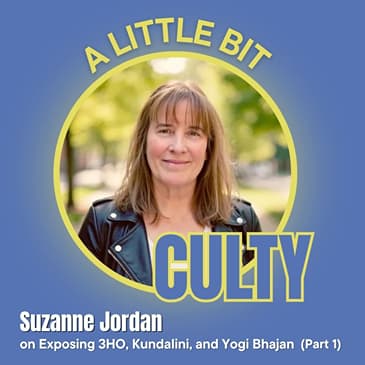
Suzanne Jordan joins us for a deep dive into her time in the early days of 3HO, Kundalini, and the world built around Yogi Bhajan. She shares how childhood trauma, family rupture, Omega House, and a desperate search for safety and belonging created the perfect runway into an ashram that initially looked like a wholesome new family, with yoga, vegetarian food, chanting, and a suspiciously effective café.
Suzanne takes us from her first exposure to 3HO through marriage, spiritual bypassing, tough love, and the increasingly impossible gymnastics required to reconcile Yogi Bhajan’s public teachings with his abuse of power. We also discuss Omega House, Yogi Bhajan, 3HO, Kundalini, Pamela Dyson and her book Premka, which helped crack open the truth for longtime devotees, along with Suzanne’s own memoir, The Deviant Daughter. Stay tuned for Part 2 on Thursday.
Follow Suzanne at SuzanneJordan.com and check out the Yogi Bhajan Kundalini abuse Facebook page and Beyond the Cage, a private Facebook group.
Also look out for the documentary, Long Time Sun, by Fifth Season in the US, and check out Suzanne’s Yogi Bhajan Smack Down: https://youtu.be/1qKVh7RHUG4?si=alqvTl-CDyMBhW7t
Trigger warning: This episode contains frank discussion of childhood trauma, troubled-teen programs, emotional, physical, religious, spiritual, and child abuse, sexual grooming, assault, and violence, coercive control, and suicide.
Also…let it be known that:
The views and opinions expressed on A Little Bit Culty do not necessarily reflect the official policy or position of the podcast. Any content provided by our guests, bloggers, sponsors or authors are of their opinion and are not intended to malign any religion, group, club, organization, business, individual, anyone or anything. Nobody’s mad at you, just don’t be a culty fuckwad.
Buy the A Little Bit Culty paperback, ebook, or audiobook on Amazon or order a signed copy.
Check out our amazing sponsors
Join A Little Bit Culty on Patreon
Get poppin’ fresh ALBC Swag
Support the pod and smash this link
Check out our cult awareness and recovery resources
Watch Sarah's TED Talk and buy her memoir, Scarred
CREDITS:
Executive Producers: Sarah Edmondson & Anthony Ames
Production Partner: Citizens of Sound
Co-Creator: Jess Tardy
Audio production: Will Retherford
Production Coordinator: Lesli Dinsmore
Writer and administrator: Sandra Nomoto
Social media team: Eric Skwarzynski and Brooke Keane
Theme Song: “Cultivated” by Jon Bryant co-written with Nygel Asselin
SUPPORT OUR SPONSORS:
Find the fall pieces you’ll reach for most at Quince. Download the Quince app for app-exclusive offers, or go to Quince.com. Get free shipping on your order and 365-day returns. Now available in Canada and the UK, too.
Find pieces made for real life, and get even more value with Wayfair Rewards. Join Wayfair Rewards today to get five percent back on every purchase. Head to Wayfair.com to shop all things home.
You’re going to love Hungryroot as much as we do. For a limited time get 40% off your first order PLUS get a free item in every box for life. Go to Hungryroot.com/culty and use code culty.
To get your new wireless plan for just $15 a month, go to MintMobile.com/culty.
That scratched up pair has done its job. Upgrade today with Zenni! Go to Zenni.com/PODCAST and use code PODCAST15 for 15% off your first order, plus free shipping on all US orders over sixty five dollars.
Celebrate Raycon Month with the Everyday Earbuds. Go to BuyRaycon.com/CULTY to get 20% off.
See Privacy Policy at https://art19.com/privacy and California Privacy Notice at https://art19.com/privacy#do-not-sell-my-info.
[00:00:00] You'd think as podcast hosts we'd have our act together by dinner time. Nope. Meal prepping is not our strength. We're much better at talking than at chopping vegetables in advance like responsible adults. That's exactly why Omaha Steaks has been a godsend. Dinner is handled in minutes with my freezer stocked with restaurant quality protein, tender steaks, flavorful burgers, seafood, chicken, sides, all delivered right to our door.
[00:00:36] Rushed weeknight or Saturday cookout. Quality protein's already there, no scrambling required. I stick to the fillets because of my lean physique. Every now and then I'll indulge in some ribeyes and some strip loin. Throw it on the grill, three, four minutes each side, boom. Family's fed. It's basically like having a trusted butcher and gourmet food shop living in your freezer.
[00:00:57] No more gambling on some mystery brand hoping for the best. Omaha Steaks earned this reputation for over 100 years. The same beef trusted in kitchens across the country, shipped straight to yours. It's steakhouse quality without the steakhouse bill. Frozen delivery is actually this good. Meticulously aged, vacuum sealed, individually packaged, ready for grilling, searing, or roasting with minimal effort. No last minute store runs. Nothing else matches quality this dialed in.
[00:01:24] Try the burger perfection flight at OmahaSteaks.com today. That's 20 premium steak burgers for just $79.99. Plus, get $35 off with promo code CULTI. That's OmahaSteaks.com promo code CULTI for $35 off at checkout. Terms apply. See site for details. This podcast is for informational purposes only and should not be considered legal, medical, or mental health advice.
[00:01:47] The views and opinions expressed do not necessarily reflect the official policy or position of the podcast and are not intended to malign any religion, group, club, organization, business, individual, anyone, or anything. I'm Sarah Edmondson. And I'm Nippy Ames. And this is A Little Bit Culty, the podcast where we unpack cults, control, and coercion.
[00:02:16] We woke up from a cult. The whole wild ride ended up in The Vow on HBO and in my memoir, Scarred. Now, after eight seasons of hearing every kind of culty story imaginable, we've bottled up everything we've learned into a book, also called A Little Bit Culty. It's available now in all formats on Amazon, Audible, and where fine books are sold. Or get a signed, personalized copy on our website. Better yet, ask your local bookstore or library to order it and encourage them to get on that cult awareness bandwagon.
[00:02:43] On the show, we break down the shame and secrets that make these experiences so destructive with honest conversations about how everyday groups can slide into the cultiverse. Each week, we bring in experts, survivors, and whistleblowers to talk red flags, resilience, and recovery. And yes, we still make time to laugh. Sometimes you have to, or you'll cry. Want early ad-free episodes, live Q&As, and exclusive extras? Join us on Patreon at patreon.com slash a littlebitculti. Welcome to Season 9 of A Little Bit Culti.
[00:03:24] Welcome back to A Little Bit Culti, everybody. Today's guest is Suzanne Jordan, activist, survivor advocate, and consulting producer on the fifth season docuseries, Longtime Son, which exposes Yogi Bajan and the 3HO movement he built around Kundalini Yoga. You might remember us talking with Jules Hartley about 3HO, the healthy, happy, and holy organization back in Season 7. Bajan arrived in the West in 1969. This guy won't leave us alone, will he, Sarah?
[00:03:54] Founded 3HO and grew a multi-million dollar empire of ashrams, businesses, and Sikh dharma institutions while presenting himself as a celibate saint and master of white tantric yoga. Wait. This sounds... Celibate saint? Jeez, wow. Guys, get a new playbook. Seriously. In recent years, survivor accounts, lawsuits, and an independent investigation have revealed a very different reality.
[00:04:17] A pattern of sexual abuse, rape, grooming, and coercive control against female followers, often facilitated by his inner circle and buried under spiritual authority. Suzanne knows firsthand. After surviving the troubled teen industry as a teenager, she entered 3HO, which we were calling 3HO at one point. That's how we roll. Yeah. At 19, where she says, guess what? What did Bajan try to do?
[00:04:41] Tried to rape her, beat her, and confine her before she escaped in 1984 and spent years trying to expose him against fierce legal and spiritual intimidation. Just to be clear, he attempted those things with her and she managed to get away. She's one of the few. And I think that's why she was able to write such a fascinating book. And her YouTube video where she holds an account of which we'll post is dope. That'll be in our show notes.
[00:05:02] In this conversation, we dig into how abusive systems like 3HO break down autonomy and make young people uniquely vulnerable to charismatic predators. Why it's taken decades for these stories to reach mainstream culture. And how Bajan used secretaries and early female followers to normalize chronic sexual violence under the guise of enlightenment. Again, a familiar pattern.
[00:05:25] We also talk about Suzanne's new memoir, The Deviant Daughter, which chronicles her journey through institutional abuse, spiritual betrayal, and her fight to reclaim her voice and help other survivors do the same. Without further ado, here's part one with Suzanne Jordan.
[00:05:57] Suzanne, welcome to Little Bit Culty. Thank you. Thank you for having me. We are so excited. I don't know if you know this even, Nippy, that Little Bit Culty today is popping your podcast cherry. It's true. It's true. Let's keep it social. It's going to be so great. It's going to be so fun. How are you feeling today? I'm feeling excited and good.
[00:06:23] Anything public I can do to bring awareness to the 3HO cult makes me happy. Should we tell her what Audible calls her 3HO cult? Oh, yeah. So I know your book is not on Audible yet, correct? It should be, yeah. Oh, wait. Audible? No. I think I'm on Kindle. Okay. We couldn't find it on Audible and we have an app that we use called Speechify, which basically, because I don't always have time to read a whole book, so I have it read to me.
[00:06:52] And it's like an AI voice and it's Gwyneth Paltrow is the voice that I use, ironically. And sometimes it gets words wrong. Like it won't say 3HO, but it calls it 3HO. So throughout the book, it was like, well, and I left 3HO. That's funny. We had a chuckle, didn't we, Sarah? Yes, we had a chuckle. It was a really great book. I really enjoyed it. Normally people write these cult memoirs. They kind of skim over there. At least for me, I did as well.
[00:07:21] I kind of skimmed over my childhood, but you got into some real nitty gritty before you joined 3HO. And we're going to talk about that. Just to remind our audience, we have covered Yogi Bhajan Kundalini 3HO, but not with somebody who was there in this era. We covered it with people who came later. In the early days. Yeah, in the early days and actually interacted. Actually, she left before most people. She left in 85 or 84?
[00:07:51] 84. November 84? November 84. So you left November 84 before most of our stories even started, remember? Yeah. So this is going to be, even though somebody might think, oh, I've heard about Kundalini before. You were in the OG group and have lots of personal interactions with Yogi Bhajan, which we'll get to. Just going to dangle that so people will make sure to get to the end. The ho, ho, ho. That's it. That's it there. Three hoes. So, let's see.
[00:08:19] You had quite the childhood, and we're not going to get into all the details, but what do you think is important for people to know about your upbringing that set you up for either success or failure? However you want to look with it. But that really put you in a spot to join later.
[00:08:39] Well, one of my motivations for writing my memoir, The Deviant Daughter, is that after I left 3HO, if I ever decided to divulge that experience to people, what I often heard was, oh, you must be stupid or you must be weak. And it was so frustrating to me because I don't feel I'm either. I'm sure you guys don't feel you're either. And I started to think about how my childhood was kind of a blueprint for cult preparation. And it has to do with trauma.
[00:09:08] Basically, it comes down to trauma. And it comes down to feeling a disconnect from family where you want to belong somewhere. And so, those were really the primary drivers that I wanted to, I guess, elucidate. Like, people that join cults aren't stupid. They're not weak. They're hurt. They're wounded. They're looking for wholeness. And albeit looking for wholeness outside of ourselves. But those were the things that really, I think, shaped me perfectly.
[00:09:36] And my entry into the cult was very different. I wasn't a kundalini yoga student. I was working at a Golden Temple restaurant that some 3HO people were running in Reno. And so, it was almost a more insidious way to get indoctrinated because I was just working my job. But the music was playing. The chanting was playing. Suggestions were made about how to live your life. I was 16 when I started working with them. So, I was really young and impressionable.
[00:10:06] I had started exploring Eastern philosophy. I defected from the Catholic faith. I wanted something that spoke more to me. And Eastern thought just immediately felt very comfortable and believable. So, that's in a nutshell. It was just searching for some kind of belonging and trying to find a way to feel whole. I think that's kind of a common theme. Absolutely.
[00:10:33] And I think it's important to note that you were already not feeling belonging. On top of, like, in many, you know, I think it's sort of teenage strife that a lot of kids go through. You already were ousted from the house when your dad sent you to the Omega house, which is a Synanon offshoot. Or was it actually using Synanon? They emulated the game from Synanon, which I love seeing that in your book.
[00:10:59] Because the whole troubled teen industry, and that was the 70s, tough love. So, tough love was the name of the game. It was like, just be brutal, be confrontational, deconstruct these kids, break them down, and then try to rebuild them. So, yeah. Omega House was in an abandoned whorehouse outside of Reno. And it was run by counselors who were not professional counselors.
[00:11:23] They were kids that were either in school to do that kind of work, or they were people like my main counselor would brag that he survived dropping acid 300 times. So, that was his qualification. And so, they didn't have good boundaries. They didn't have education on how to be with teens. And we're such a vulnerable bunch. And we all bonded together very strongly. But the game was brutal. I don't know if you want me to go into the game at all, but it was brutal.
[00:11:53] We've covered it on a couple other podcasts or versions of it. But if no one's ever heard it before, how would you describe it? It's a pile-on session. Yeah. There were only two rules to the game, as I mentioned in my book. No physical violence and you can't leave. That's it. So, anything else goes. And they had a hot seat that you would sit in the middle of the room with 40 kids. Most of them smoking cigarettes. And then they would scan the room to find who was vulnerable looking or suspicious looking.
[00:12:21] And they'd open up with some horrible line like, hey, Darren, what's up your ass today? Or, you know, you look like you're high. And then the attack would begin. They could get inches from your face, cussing at you, calling you a loser and an idiot. And it was to break you down. It was to make you just into a puddle of tears. And then once they broke you down, they'd make you make commitments about what you were going to do going forward. But we played it every night. I was in high school.
[00:12:49] We played it from after dinner till midnight or 1 a.m. So, we were all sleep deprived. We got up at 6 a.m. to dig post holes out in the yard. There were locks on the phones. We were isolated. And it was just, it was horrendously scary. My first night there, someone tried to commit suicide. And I just thought, I got caught kissing a girl. I didn't do drugs. And I'm in this place going, what have my parents done? Like, why am I here?
[00:13:19] So, that certainly was an amputation from family. It was a shunning. And what's wrong with me? Why, I believed in God. Why would God let this happen to me? I'm not a bad person. And so, it was a really troubled time for me. Really scary. Very isolating. Well, it seems like, and you said, like you said earlier, being the template for later. Or the blueprint, you know, if you look at the family cult.
[00:13:45] Like, you didn't confine to the rules of your family by experimenting with another, you know, with another girl. Which, of course, now I feel like would be a completely different thing. But this is the 70s. And it was wrong and deviant. And, you know, you get kicked out. And going into this program, which I thought was so crazy, is that, like, you were otherwise a good girl. You hadn't done any drugs. You didn't smoke. You didn't drink. You didn't drink.
[00:14:11] And now you're in a place where you're being, you know, you're around so much worse influence. Well, it's almost perpetuating the behavior that they're condemning you for. Yeah. And I got into more trouble being there. I was with kids that had gotten into a lot of trouble. And it was just, my dad called me a deviant. I mean, that was just brutal, you know, just the feeling that, and I'm very close to my five siblings and being told, I don't, you're a bad influence. I don't want you affecting them.
[00:14:40] So, you know, those things were just very hard to take. But you're right. I was in with kids that had gotten into a lot of trouble, had been violent, had done a lot of drugs. The counselors had done a lot of drugs. So, I was put into a whole situation that I think exacerbated acting out, you know, and I got into more trouble. Yeah. In order to have some autonomy, any active autonomy is going to be perceived as acting out, I would imagine, in that environment.
[00:15:09] Yeah, it's true. Not wanting to be abused. Yeah. Not wanting to be abused. And, I mean, I acted out at school. I started stealing, really mouthing off to my teachers, cutting classes. Cutting class was just a way to have some space to myself. I was never alone. So, yeah. And Catholic school was brutal. And the kids there were brutal. I'm using that word a lot, but it really felt that way. It really felt like kind of constantly being pummeled.
[00:15:37] I also felt like from the moment your dad ousted you, that really put you in a situational vulnerability for the rest of, well, I don't know now, but like at least until 3HO that you were homeless. Like your decision later, it seemed to commit to 3HO is partly like you didn't have anywhere else to go. Yeah. Yeah. I mean, I've really been thinking about that, the themes of my life and not feeling resource is a big one.
[00:16:06] Not feeling resource, not feeling that there were options. I mean, the ashram ended up feeling like of lesser evils. At least I'll learn to do yoga and meditate. That's wholesome, right? I'll eat a vegetarian diet. That's wholesome. So, I thought I was trying to provide for myself in the best way to feel safe. Safety was huge. That seems to be the theme. There's never a safe structure for you to rely on. Yeah, it's true.
[00:16:36] And I didn't pick good partners. I mean, my boyfriend that I moved out to the beefalo cattle ranch with, you know, that was a terrible choice. And he was explosive and an addict. And so, all of those things get compromised in trauma. Your decision making, not feeling worthy, not feeling like you deserve better. So, it kind of was a sort of a cascade of events, as you know.
[00:17:01] I mean, just one thing after the other from, you know, 15 until 19 when I moved in the ashram was it felt relentless. And I was very weary at the ripe old age of 19 and just wanted something that would provide some peace and harmony, I thought.
[00:17:48] Loving the podcast? And I was very proud. that the book has been endorsed by powerhouses like Leah Remini, Bethany Joy Lenz, Dr. Romany Dervasala, Tia Lovings, Evan Rachel Wood, Jessica Willis Fisher, and so many more. So whether you've
[00:18:14] been meaning to read the book or you just want to hear us tell it to you ourselves, grab the audiobook on Audible and hit play. And if you love it, leave us a review. It helps more people find the book
[00:18:24] and maybe recognize the red flags before they're in too deep. Enjoy. Break time's over. Let's get
[00:19:01] back to the show. I really got that sense from your book and, you know, choosing bad partners, you can say that now with your wisdom, but at the time, like when you're a teenager, you don't, look, you don't know how to make those decisions. And normally it would be perhaps a mother or father giving you advice, but your parents really seemed were dealing with their own demons and, you know, their own struggles. Was it fair to say you didn't use the word, but fair to say that they were at
[00:19:30] some point before they separated that they were swingers? Were they swinging or are they just partying? I couldn't quite figure that out. I mean, I don't have proof, but there were a lot of, there were weekend parties in the neighborhood. I know that one couple in the neighborhood were swingers and I believe my parents were approached. That was going on. I know my father was unfaithful to my mother their entire marriage. So she lived with that. And, you know, that was really painful for
[00:19:56] her, but you know, they were the cocktail generation. They were, I would say they were a weird age. They were already over 30, which don't trust anybody over 30. So when all this great stuff was going on in the sixties with the cultural revolution, my parents had five, six kids and they were working and they were exhausted and they were too old to be a part of the hippies and all of that. And
[00:20:22] I don't know, they were, their generation was a weird placement where, you know, they watched Star Trek and laugh in at night and drink beer, you know, it was just, they weren't really participating at all in all the cultural changes that were going on. They were trying to manage having six kids with no help. So yeah, it was a really unstable environment. Chaos, just chaos. Okay. So he kicks you out for kissing a girl. You go to a mega house. That's really hard. You
[00:20:51] eventually break out and escape. So that's your first escape. Yeah. Then you end up dating Bill, the count, your counselor from. Let's break down Bill for a second. Let's talk about Bill. Bill was very odd. He had a weird way of looking at the world, maybe from dropping acid 300 times. I might do it. He started grooming me while I was there at a mega house. He started inviting me
[00:21:16] into his room at night and would teach me about Carlos Castaneda and his books and reached inside my blouse one time to kind of caress my breast. He only did that once. And then about nine months after I got out, I got a phone call from him to go to the movies. I didn't know he was taking me to a porn movie, but luckily the theater was closed. It's like, let's go see this movie. The story of,
[00:21:41] Oh, I'm like, Oh, I haven't heard of that. I didn't know it was a porn movie. Anyway, it was not, it was too late to go to that. And he ended up driving me up to the top of a mountain to have sex with me. So yeah, no boundaries. He was 10 years older than I am. Fair to say he's a predator from what I, yeah. In fact, after me, he was with a 14 year old girl. So he was definitely a
[00:22:05] sexual predator. I never saw him again after I saw him that one time after I left Omega house. And then I never saw him again. And he has since passed away, but no protection, even at Omega house, the director of Omega house, the other counselors, nobody did anything to, you know, act on my behalf. My father threatened to sue him, but it would have taken more time or energy than he wanted to put in
[00:22:31] my direction. So that was another feeling of like, at first I was like, wow, nobody's even having a response. And then I just got really defiant about it. You know, I mean, he didn't physically harm me or anything, but it was a coerced relationship for sure. For sure. For sure. Yeah. So, you know, just again, that whole teen industry was just so unregulated and nobody was
[00:22:56] looking out for the kids. If there was toxicity within one of these drug treatment programs, there was nobody to really witness it or report on it. Well, industry being the operative word there. Yeah. A lot of money to be made, grants to be gotten. Yeah. Yep. Did you, are you familiar with Corey Gentry? Is that his name? Hold on. That's it. Corey Gentry. He's one of our guests.
[00:23:22] Yeah. He worked in the industry and now is really big on exposing it and is quite an advocate in the space. I should all connect you if you're interested. I would love to. Yeah, definitely. Because it's such a vulnerable time and how you get shaped while you're in those places, at least for me, of course, set me up perfectly for heading right for our cult. Yes. A hundred percent. Yeah. Okay. So you were working in a waitressing job, if my memory is correct, when you,
[00:23:50] the first time you saw a turban clad Yogi Bhajan devotee, what was your first take? Well, I say in the book, he was a walking advertisement for the comforts of cotton. It was all white. He had on the pants, which are called shuridas and he looked unusual. He was handsome. He was really friendly. And I was intrigued because I had been reading about Eastern thought. So the fact that he was wearing a turban, I thought he must be religious. And
[00:24:18] he was very friendly, invited me to come to their little cafe to try their food. And that was the beginning. That was the invitation. It turns out the most successful cults have really good cafes. It might be true. I didn't. Oh yeah. That's why it wasn't successful. Yeah. Well, it was successful for a while. No. I mean, I'm talking about the really successful ones, like, you know, in terms of having a robust community, our community was fledgling compared to, I mean, Yogi Bhajan had- Because we didn't have a good cafe.
[00:24:47] Yeah. I think that was the, that was the failing point. Start with the cafe. I'll put that in our next book. Red flag. Good cafe. Yeah. So like, tell us about your journey from just eating there to deciding to join. I mean, I went there to have a meal and they invited me to work part-time and I said, yes. And so that began. So I'm 16 years old and I'm now spending time with them. They told me about
[00:25:14] their lifestyle. Sorry to interrupt. Do you feel like you were targeted then? Do you think that was an accident or do you think it was just- No, he sent people out. Reno would have been called an outpost ashram. So he sent followers to outpost ashrams all over the country to create centers and find students. So I don't think they would have ever thought they were grooming me. I don't, I think they would have thought they were sincerely sharing a lifestyle that they thought was
[00:25:41] wonderful. But during the time at the restaurant, I worked there for a little bit on and off from the time that I was 16 to 18 on and off. And during that time, you're listening to the chanting music constantly. They're talking about their lifestyle. Most sentences begin with Yogi Bhajan says, Yogi Bhajan says, you should get up at four in the morning and chant to God before the sun rises. And if you give 10% of your day to God, he'll give the rest of the day to you. You know, things like that. All the different little cliches they use.
[00:26:11] The tropes. Yeah. The tropes. And so they were getting into my system, but I was still a teenager. And toward the latter time that I was working there, I was going to disco. Saturday Night Fever had come out. I would get disapproving looks from the ashram head's wife that I'd been at the disco. So I was kind of straddling these two worlds of having fun. And I mean, I had a fake idea. I wasn't 21,
[00:26:36] but I was going to the clubs and I didn't drink. I just wanted to dance. So that was when it was starting to come in. And then after my Beefalo Ranch experience with my boyfriend beating the crap out of me, I came back and felt so shell-shocked. That was when I thought, and I couldn't go home because my father had taken over our family home and moved my mom out. And I thought- With his new wife.
[00:27:04] With his new wife, my mom's former best friend. And so I just felt like I've got nowhere to go. I need somewhere to land. I was really aware that I was 18 and I didn't feel 18, that adulthood was looming and I didn't feel ready to be out in the world at all. I'd been really traumatized for now four years. And I thought, do this. It should be peaceful. It should be supportive. It'll be a new
[00:27:31] family. Want in on the good stuff? Subscribe to our Patreon at patreon.com slash a little bit culty for bonus episodes, early access, ad-free listening, and the warm feeling of knowing you're supporting independent podcasting. Truly could not do this without the patrons. No robes required.
[00:28:23] All right, everybody. That little break is over. Let's get back to our story. Right. And let's just bridge the gap. It feels really obvious in hindsight, but like, how do you think that psychological warfare of Omega House, like an institutional youth program, left you uniquely vulnerable to, well, we'll find out later what is going to be a spiritual predator? Well, as we know from your former podcast with Jules Hartley, they used that term,
[00:28:50] the Saturn teacher. It was explained differently to me than what she had said. I was told Saturn is a sign of the father. And so it's a tough love father energy, tough love Omega House. So right there. Oh, I'm familiar with this. And so it's interesting that I had such a wound with my dad and I ended up
[00:29:11] in places where men were just, you know, treating me with savage cruelty, you know? And so I think that Omega House made Yogi Bhajan's style familiar. Yeah. It made it, oh, I know this. I've done this before. Yeah. And it wasn't like overtly abusive right away. It was good at first, correct?
[00:29:36] This is what's unique. My first time meeting him, Sarah, I didn't like him. I saw this bombastic, kind of surly getting in people's faces. I mean, he was so loud. And then we were doing the white tantric yoga, which I'd love to do a whole podcast on the fallacy of that. And, you know, we're doing all these prescribed things so that our energy can run down our spines and down our lines and up to
[00:30:04] Yogi Bhajan and he's clearing our karma. And I look over at him, which you're not supposed to look when you're doing the tantric and he was eating Doritos. And I was like, what? So I'm really lucky because right from the get go, there was something off about Yogi Bhajan to me. But what was a stronger motivator was security and community. Yes. So I knew that I needed to be in the, and I got engaged at that first meeting, seeing him. And I
[00:30:32] was like, yes, I have a husband. I'm going to be landed. So all of that took precedence over the fact that I was picturing Don Juan Matas from Carlos Castaneda's book, some little wizened, thin wise man. And I'd had that premonition dream that I was going to be meeting my benefactor very soon. And in the dream, it was a man in white and long robes, but he was thin with a beard,
[00:30:59] like down to his waist. And then Yogi Bhajan was chunky and surly and bombastic. And I'm like, that's not the guy in my dream, but he is wearing all white, you know? And so even my teenager brain was making these leaps. I wanted to connect the dots between my dream and meeting this spiritual teacher so that I could, I guess, feel confidence in it. So what do you think he did well to set
[00:31:24] himself up to abuse power in the way that he did? What was his skillset? His skillset. One of the first things he said, I'm not here for students. I'm here to create teachers. So right away, he's saying, I'm all about your autonomy. Then the other brilliant thing he did is he wedded his
[00:31:46] conflation of Hinduism and his made up yoga with a legitimate faith, Sikhism. And so he set himself up as a nonprofit religious organization very quickly. And so if you were thinking he wasn't legitimate, they would point to the Sikh faith, which has been around for 500 years. And you're like, oh yeah, that is legitimate. So, and we couldn't internet check all of his ridiculous claims,
[00:32:13] right? He made so many fantastical claims about Sikh powers and I mean, ludicrous, but he told us he was there to create teachers and a new kind of world. You know, isn't that perfect for teenagers? A utopian ideal. I'm going to do life differently than mom and dad. I'm in the middle of my time in 3HO going, wait, I'm in a heteronormative religion that has a patriarchal base.
[00:32:41] And I'm acting like a 50s housewife, but my clothing is different. And my name is Kirtan Carr and I can read Gurmukhi. So I did it differently. Right. And it was hilarious. I was literally emulating my mother and father all the way through, but the accoutrements were so different that I felt I had really diverted. I was my own person. I was finding my way to, and I will say
[00:33:08] those early days at like a summer solstice celebration when you're chanting with a thousand people on a mountainside. And on Sunday, everybody washes their hair and their hair is down past their waist. I was like, this is my Woodstock. This is utopia. We're doing, we are God-centered people that want to live good lives. We have a clean living. Oh my God. I mean, I have goosebumps saying
[00:33:34] that feeling, but I could cry. Yeah. I totally get it. It has to be good. Otherwise, why do you stay? It was, yeah. And it's okay to miss those things. It makes the shock and the disappointment of it so much harder to bear. Because it wasn't that at all. No. Yeah. There's,
[00:34:01] I still feel grief about that. Yeah. It's a hard thing to wrap your head around that. Well, that's the abuse too, right? The abuse is a good idea. Yeah. Yeah. And I mean, imagine in 2020, people that have spent 50 years, 50 years of their life following him. I was on the private phone calls with people that were suicidal, that were like, my God, my entire life was a lie. My entire life,
[00:34:28] I was duped by this guy. The harm he did was immeasurable. Why 2020? Was that when the documentary came out? That's when Pamela Dyson's book came out. Oh, right, her book. There were two big events. Pamela's book came out. She was the secretary general to Yogi Bhajan, his right-hand man. So she was very respected and revered. He built her up like she was superhuman.
[00:34:53] And for her to finally admit, right, none of the secretaries still will go on record to say that they have sexual relationships partially because they're getting money from his will. And if they speak, they'll lose that. But this was the first person willing to say, and she said it wasn't, a love affair, basically. But it was the first time anybody ever admitted that. And so lots of
[00:35:18] people started to read the book. The second thing that happened was there was a community Zoom call that got bombed by the second generation. Like, I think there were three or 400 people ended up on that call. And it went for eight hours. And the second generation who, God bless them, they deserve a documentary of their own, were relaying the horrifying ways that they were treated. I mean, absolutely horrifying that he was grooming his beloved students' children for sex,
[00:35:47] that he was telling gay kids to kill themselves, that he was physically abusing them, that the school in India had multiple deaths from neglect. A little baby was electrocuted in water with electrical wires. I mean, just, we had no idea. That really blew the lid off when we realized it's not just the secretaries and the women that he was raping. And trust me, he raped hundreds of women during the course of his life.
[00:36:14] But the second generation who had no choice in the matter, that were just brought into this indoctrination, so many of them struggle. There's a thing called, I think it's called the third culture where you're not American and you're not from the country that you were raised in and you don't really belong anywhere. These children have struggled so much emotionally, physically. It's devastating. And they grew up in it.
[00:36:41] They were, many of them, born into it or got into it when they were young. Yeah. I mean, imagine being his devoted student. Imagine Keith Raniere going after your daughter and feeling her up when she's 16 and saying, you're coming along nicely. And then he would normalize the sex with the young girls by having sex in the bed with one of the secretaries with the young girl laying in the bed next to him so that it would normalize that this is what we do with Yogi Bajan.
[00:37:11] Just, he's a despicable, despicable human being. And it's still not widely known. It's so frustrating. Well, that's diabolical. I mean, that's... Yeah. He's in a league of his own. I mean, he was a criminal. He was a physical abuser. He was mentally ill. He had no impulse control. I mean, you read in the book how he physically tried to take my head off, swinging at me.
[00:37:36] Tell us a little bit about your husband and how that marriage, it seemed like that kind of cemented your... I don't know. It seems like there was many times when you were ready to run, but you didn't because you'd made a vow to this guy. Yeah. Who seemed like a real stick in the mud, but kind of nice at first. He was lovely when I first met him. He was a music major at UNR. He did Tai Chi. He was funny. He was theatrical. I'd say in the book, he looked like Cat Stevens.
[00:38:06] So I grew up in a hick town with a lot of cowboy energy. So he was unlike anyone I'd ever seen. And you loved Cat Stevens. I loved Cat Stevens. He was like a spiritual teacher. And so he was really attractive and appealing in the beginning. And it really changed once the marriage happened, the expectation level of what I needed to do went up
[00:38:29] really high. And then when we moved to Los Angeles, I would say he wanted to be a big fish in that pond. And so he became more dedicated to how perfectly can I live the teaching? And so he became very severe, perfectionistic, very demanding of me. And our biggest red flag was when he told me he wished I could just be saintly enough to immaculately conceive
[00:38:57] so that we could tell Yogi Bhajan we'd given birth to a saint, which, right? All ego driven. I want to break. And that was that blew the lid off it. I was like, wow. Wow. Tell us what I love the line, what his mother said to him when he decided to become. She said, you finally made a decision where you'll never have to make another decision again. And right. Amazing.
[00:39:24] Giving away ultimate power. Ultimate devotion is giving away all your power. And she perceived that in him. You'll never have to think. Basically, you'll never have to think again. And my father, conversely, for all his faults on my wedding day said, don't lose your discernment. And I thought about that my entire time in 3HO. What's my discernment? What am I? Let me critically think.
[00:39:49] So that was a huge gift I got from my dad. But my ex-husband, he just became he literally disappeared. His personality that I had been so attracted to disappeared. And he just became literally like a machine of the teaching. That's all. What do you think his incentives were? Enlightenment. What was motivating him? Enlightenment. He wanted to achieve God consciousness.
[00:40:18] He wanted to be the, he said, I want to be a living example of the teachings of Yogi Bhajan. And he did more meditation and more prayer. He circumvented his emotions by doing hours of Kundalini yoga. Because Yogi Bhajan said, emotional is commotional. Be devotional. So, and I'm a super feeling person, as you've already seen. My emotions come up and they're out.
[00:40:44] And so I was branded the whole time I was in 3HO as an, a commotional woman. Because I had big feelings. And he would just waylay any emotion by doing intense yoga. It's lots of spiritual bypassing. Well, and then I tell him Yogi Bhajan tried to have sex with me. And he says, he's your spiritual teacher. If he wants to have sex with you, he can. And I'm like, he's not who you, he's not who you think he is.
[00:41:12] And he literally plugged his ears and said, you're slandering a saint. I won't listen. Over and over he said that. So. Wow. Can't reach that. I had very obvious markers. There was nothing subtle for me. It was very obvious. But I was always in the grappling of, but this is my community. But I love my community. I didn't know they would betray me in a heartbeat. This is where I belong. And I said I was going to do this forever.
[00:41:40] You know, if I don't, then how can I ever trust any commitment I'll ever make? I believe this is it. So it really shakes you to your core in your confidence in yourself. Can I rely on myself? Can I make good choices? So those were things, yeah, I really struggled with. Because my first ladies camp to backtrack, 1979, I go to New Mexico for the two-month ladies program.
[00:42:08] And I just get there. They have a huge circus tent where he lectures. And the lecture is over. And I see him walking toward a five-foot-tall, 100-pound wet woman. And he's cursing her. You effing this. And your husband is telling me you're not being a good wife. And why do I have to keep hearing this stuff about you? And I watch him right cross her in the jaw and knock her to the ground. Wow.
[00:42:35] First time ever seeing him in New Mexico. And I'm like, I was just stunned. And I'm looking around. There's security guards. There's some peripheral women. Nobody's responding. Nobody. And I rush up to her after he's done lambasting her. And I say, oh my God, are you okay? And she goes, oh, something in my aura must have needed adjusting. That was in my notes too. Oh my God.
[00:43:04] Because that's, you know, yeah, that's so indicative of the kind of mental gymnastics a devotee has to do. You know, ours would have been slightly different wording. But like, oh, you know, I deserve that is basically it. You know, like I needed that. Yeah, there were two premises. So the Saturn teacher was one because it allowed for tough love. It basically excused his lack of impulse control. It excused his rage. It excused his temper. But the other one was what I heard all the time.
[00:43:34] Your spiritual teacher knows more about you than you know yourself. Ultimate authority. Well, it feels like he's just passing legislation to justify his abuse. Yes. And if he did something like punch you or harm you, I must have needed that. My aura must have needed adjusting. He just clobbered you in the face. I mean, she was already bruising. I was so stunned.
[00:44:01] I helped her up and just stood there as she walked away. And I say in the book, I spent that whole night going, how can I stay? I mean, how can I stay now that I've witnessed this? And I was literally trying to make a construct. Well, I won't see him if I don't want to. He won't really be in my life. I do like the Sikh faith. I'll focus on that in my marriage and then I can stay. So it's unique. I wasn't a blind devotee ever.
[00:44:30] I was an aware devotee who had bigger reasons to stay. Then the fact that I didn't really like Yogi Bajan. Yes. Thank goodness. Thank goodness that you went in with open eyes. And I love that you even asked your friends to keep an eye out for you and to come and pull you out if you seemed glassy eyed. Well, yeah. Yeah. And, you know, my friend Peter, who was in the organization, you know, we talk about
[00:44:56] he was born in the 40s and they joined in 69. I joined in 79. But my that decade difference for me, I'd heard of Moonies. I'd heard of Hare Krishnas. I'd seen them at the airport. My parents had warned me about cults. I moved into the Asham six months after the mass suicide murder in Guyana with Jim Jones.
[00:45:21] So all of those things were informing my sensibility that the people that joined in 69 didn't have that. Yeah. They had the Beatles going to India and it looked so romantic. Yeah. It looked cool. Yeah. Maharishi. Yeah. Everyone needs a guru. Yeah. And even he was hitting on Mia Farrow's sister. So he was already up to the shenanigans.
[00:45:45] I mean, we know so much about Yogi Bhajan's motivations and that he was kicked out of Canada after he impregnated a woman. We know so much about his trajectory that his trajectory from the beginning was to sell the spirituality to Westerners and then have carte blanche to do whatever he wanted. I mean, he was a masterful con man. He wasn't masterful at anything else. Yeah. Highly manipulative. Highly manipulative.
[00:46:15] Well, I loved that you stood up to him, but why don't we take a little break there and we'll come back for part two and hear how you confronted him and you were strong in the face of that manipulation. And I'll have you paint some of those scenes. I think that out. Those were really powerful. And I think any cult survivor wishes that they could have had that kind of face-to-face confrontation like you did.
[00:46:41] So we'll come back for part two and hear all those details and how you got out and how you escaped and got your life back. So stay tuned for The Deviant Daughter, Suzanne Jordan.
[00:46:57] If you're finding this podcast helpful, please do us a solid. Drop a rating, leave a review, and hit subscribe on Apple, Spotify, or wherever you get your podcasts.
[00:47:23] And if you're feeling extra culty, join our Patreon at patreon.com slash a little bit culty for early ad-free episodes and all the bonus content. Even better, pass this episode along to someone who might need it. Maybe they're in a cult. Maybe they're just a little bit suggestible. Or maybe they just can't resist a good cult story. Oh, if you want the full download of everything we've learned over eight seasons, grab our new book, A Little Bit Culty. It's out now on Amazon, Audible, and anywhere you can get books. By the way, we narrated the Audible. It's super fun.
[00:47:53] Your local bookstore or library can order it too. Share the love and spread the culty wisdom. Thanks for listening and catch you next time on Season 9. A Little Bit Culty is a Trace 120 production. Executive produced by Sarah Edmondson and Nippy Ames in collaboration with producer Will Rutherford at Citizens of Sound. Our co-creator is Jess Temple-Tardy, and our production coordinator is Leslie Dinsmore. Writing and admin by Sandra Namoto and social media marketing by Eric Skrasinski and Brooke Keane. Our theme song Cultivated is by the artists John Bryant and Nigel Aslan.
[00:48:30] Kia ora. I'm Anke Richter, the founder of D-Cult, a groundbreaking cult awareness conference happening again this October in Aotearoa, New Zealand. We're going to have two days of powerful conversations about healing and justice with survivors, experts, lawyers, therapists, and authors, and we're live streaming them around the world. D-Cult will make a huge difference for people who've come out of cults.
[00:48:56] Join us from 24th to 25th of October in Christchurch or online for D-Cult 2026 Voices of Courage. Go to d-cult.net to register now.