
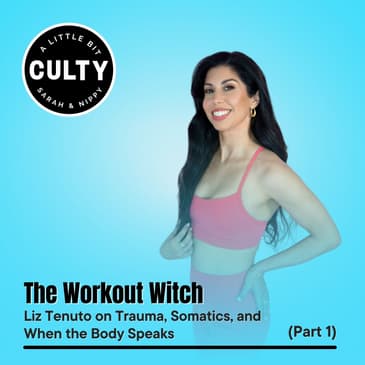
Liz Tenuto, aka The Workout Witch, joins A Little Bit Culty for a seriously useful, beautifully weird conversation about healing after abuse, trauma, and all the body-based chaos that can follow. She shares how TikTok accidentally became her platform, how somatics helped her reclaim her body after an abusive marriage, and why movement ended up being the thing that finally made a dent in her insomnia and dissociation.
Liz also talks about the early warning signs she missed, including love bombing, financial abuse and tech abuse, and the slow, mean little erosion of identity that kept her doubting herself for way too long. Her story is further shaped by childhood sexual abuse, a later assault at 14, and the way trauma can sit in the body until the right kind of healing starts opening the trapdoor.
This episode is equal parts candid, smart, and deeply validating for anyone who has ever felt like their nervous system was running a little hot and a lot haunted. Stay tuned for Part 2 of our convo on Thursday.
Pick up a copy of Liz’s book, When the Body Speaks and follow her at theworkoutwitch.com or on Instagram, Facebook, TikTok, Threads or YouTube.
Trigger warning: This episode contains frank discussion of childhood sexual abuse, sexual assault, domestic and financial abuse, coercive control, dissociation, and trauma recovery.
Also…let it be known that:
The views and opinions expressed on A Little Bit Culty do not necessarily reflect the official policy or position of the podcast. Any content provided by our guests, bloggers, sponsors or authors are of their opinion and are not intended to malign any religion, group, club, organization, business, individual, anyone or anything. Nobody’s mad at you, just don’t be a culty fuckwad.
Buy the A Little Bit Culty book on Amazon or order a signed copy.
Check out our amazing sponsors
Join A Little Bit Culty on Patreon
Get poppin’ fresh ALBC Swag
Support the pod and smash this link
Check out our cult awareness and recovery resources
Watch Sarah's TED Talk and buy her memoir, Scarred
CREDITS:
Executive Producers: Sarah Edmondson & Anthony Ames
Production Partner: Citizens of Sound
Co-Creator: Jess Tardy
Audio production: Will Retherford
Production Coordinator: Lesli Dinsmore
Writer: Sandra Nomoto
Social media team: Eric Skwarzynski and Brooke Keane
Theme Song: “Cultivated” by Jon Bryant co-written with Nygel Asselin
SUPPORT OUR SPONSORS:
Don’t let stigma stand in the way of support. Start therapy with BetterHelp. Sign up and get 10 percent off at BetterHelp.com/culty.
If your glasses are overdue for a refresh, now is the time. Go to ZENNI.COM/PODCAST and use code PODCAST15 for 15% off your first order. The styles sell out, so don't sit on it.
See Privacy Policy at https://art19.com/privacy and California Privacy Notice at https://art19.com/privacy#do-not-sell-my-info.
[00:00:00] AllNote gibt es seit 2013. Wir stellen Fahrradbekleidung her. Der größte Vorteil von Shopify für mich ist, dass wir für die Unternehmensverwaltung keine technischen Vorkenntnisse brauchen. Wir können alles über das Backend und das Frontend steuern und so quasi im Vorbeigehen den Onlineshop betreiben. Wäre Shopify Fahrradzubehör, dann wäre die Plattform das eigentliche Fahrrad. Sie ist einfach die Grundlage. Unser ganzes Geschäft läuft über Shopify. Starte jetzt deinen kostenlosen Test auf shopify.com.
[00:00:27] This podcast is for informational purposes only and should not be considered legal, medical, or mental health advice. The views and opinions expressed do not necessarily reflect the official policy or position of the podcast and are not intended to malign any religion, group, club, organization, business, individual, anyone, or anything. I'm Sarah Edmondson.
[00:00:56] And I'm Anthony Nippy Ames. And this is A Little Bit Culty. We woke up from a cult. And that journey was captured in The Vow on HBO and in my memoir, Scarred. Now in this podcast, we break down the shame and secrets that make these experiences so destructive with honest conversations on how seemingly benign groups can cross into the cultiverse and how to spot and recover from trouble if it happens to you. Each week, we bring in experts, survivors, and whistleblowers to explore red flags, resilience, and even share a few laughs because sometimes you gotta laugh.
[00:01:24] Subscribe to our Patreon for early and ad-free listening, some live Q&A and exclusive content at patreon.com slash a little bit culty. Welcome to season eight of A Little Bit Culty. Seeking down, taking down to the ocean. Hey everyone, welcome back to A Little Bit Culty.
[00:01:49] Today's guest is here to challenge a belief that so many of us carry, that if we're struggling, something must be wrong with us. Liz Tenuto, also known as The Workout Witch on social media, is a leading expert in somatic healing, helping hundreds of thousands of people understand what their bodies have been trying to say all along. With over 230,000 students and millions following her work online, Liz is changing how we think about stress, trauma, and healing, shifting the conversation from fixing ourselves to actually listening to our nervous systems.
[00:02:18] Her new book, When the Body Speaks, is a guide for anyone who's ever felt stuck in patterns they can't think their way out of. Drawing from her own experience with trauma, Liz is a survivor of a cult of one and will share her story with us. Liz brings both depth and clarity to this conversation as we explore why trauma isn't just something we remember. It's something the body carries. I personally found this episode unbelievably helpful, and I can't wait to share this episode with you.
[00:02:45] From panic and shutdown to chronic tension and burnout, we're unpacking what's really happening beneath the surface and how to begin working with your body instead of against it. Not only did we love the book, we loved this chat so much, but trigger alert, we do talk about some upsetting issues and we ask you to listen with care. Here is part one with Liz Tenuto. The Workout Witch.
[00:03:22] Liz, welcome to A Little Bit Culty. Thank you so much for having me. We are so excited. This is like, I know we've never met before, but this is one of the bonuses about our podcast is we get to have like one-on-one chats with people that we really can learn so much from. And it feels like, wow, we have like a bonus coaching therapy session with an expert. Yeah. Yes. Yes. I'm excited. We are too. And this is like, you know, you've got a huge following.
[00:03:51] You've really like tapped to obviously a much needed market. TikTok. TikTok has, you know, catapulted you. Is this accurate? TikTok and Instagram or mostly TikTok? TikTok is my foundation. It's where I built my business. And then I started cross-posting to Instagram. Oh my goodness. We're the opposite. In fact, TikTok, when it came out, I was like, I'm never going to learn that. It's way too complicated. And looking at your success, I'm like, I guess maybe I should. Did you learn TikTok or did you have someone come on in?
[00:04:20] I actually taught myself TikTok when I was like deeply depressed and I couldn't get out of bed after leaving my abusive marriage. I was like, let me just download this fun app and watch people dance. And that's what I thought I was doing. And then I was like, so sad. And I was like, maybe I should try to post one of my exercises per day on this platform. I have zero followers. No one can see what I'm doing.
[00:04:47] And I was too embarrassed to post on Instagram to like my 1700, you know, past colleagues and friends and stuff. So I was really sad. Yeah, I was like, I like was really sad. I was like emaciated, you know, just so sad. And I was like, let me just see if I can create this visual journal for myself. And this is a way to hold myself accountable to doing my own exercises.
[00:05:13] And then I gained like 10,000 followers in three weeks, which was shocking for me. I thought it would be super niche. And I was just documenting my own journey and it blew up. Amazing. So that's sort of how social media can be so incredibly useful and reach people that, you know, you didn't even know needed to be reached. Let's give our listeners a little context as to why you're an expert and why you're on this podcast.
[00:05:42] And just so you know, you know, we get solicited by publishers and PR people all the time. And often I'm like, that sounds really interesting, but I don't really see the cult angle. And that was my first thought too. And then when I looked into a little bit of your story, I was like, oh no, this is perfect for our podcast. Because A, you have the lived experience and B, you found a route out. And our emphasis is so much on healing. And we're always looking for different tools to give our audience.
[00:06:08] So I'm so excited that you're here because I feel like this is an area that we haven't explored yet fully. I mean, we've talked about trauma and we've talked about PTSD and see PTSD, but we haven't really talked about somatics specifically. I'm so excited to give you a platform on our platform and to introduce our audience to what you do. So tell us about how you got here. I was in a abusive marriage. I believe that my ex-husband was a narcissist.
[00:06:36] And I think a lot of cult leaders are narcissists. I'm not diagnosing them. It's just kind of a pattern of behavior. Yeah, it's a feature. It's kind of a pattern of behavior that when I watch cult documentaries or I hear stories about cult survivors, I'm like, wow, they experienced coercive control and like incremental insidious escalating abuse, similar to how I experienced in my marriage. So I got married.
[00:07:06] I got like love bombed, which is where, you know, at the beginning of the relationship, they treat you super well. They seem like your dream partner. And we moved to marriage really quickly. We were only dating for like a little over a year before we got married. But I was so excited. I was like, this is my dream person. Everything was great. And then right after we got married, like a switch changed. It was like a Jekyll and Hyde situation.
[00:07:35] And financial abuse started, emotional abuse started. And then it just like slowly escalated and got worse. There was isolation, you know, stripping you down in terms of like your identity, like losing your identity. And those things I think are really similar to what I've heard cult survivors experience as well. Do you feel like you were targeted? I feel slightly like I was targeted.
[00:08:03] I was like really open and empathetic and generous and kind, but also in a way kind of naive. Like I didn't realize that people could be that abusive, you know, like I didn't understand that. And it was something that like I couldn't make sense of. And even it took me a long time, even after getting out of the marriage to be like,
[00:08:31] how could someone like pretend to love you and abuse you at the same time? And like live with you and like be doing this as like their full-time job. Well, the precursor to their abuse is usually the love bombing. So that's when the abuse starts. And the reason I ask that is, you know, we do a lot of interviews for our book. And one of the things that I really try to emphasize is these people are strategic and know exactly what they're doing.
[00:09:00] And that is the hardest thing for people to get their heads around when it's over. It's like, oh my God, this person did this from the beginning. It was strategic. And it's a very hard thing for, as you say, someone like you who's empathetic to project that kind of malevolence into someone who's behaving in a very exemplary fashion to set it up. That is the hardest reconciliation I find for most people. Just the fact that they do it and the fact that those people exist and they're strategic in how they target you and all those things is a very hard thing to get.
[00:09:30] It's a hard pill to swallow. That's a dark, dark side of humanity that these people are out there and oftentimes thriving. Yeah. And it's really scary. What does the love bombing look like in a cult situation? Well, it's similar in that when you meet somebody who's trying to recruit you or bring you in, you feel connected. You feel like you've, I mean, you feel good. You feel warm and fuzzy. I mean, for me, and by the way, I'm going to send you a copy of our next book,
[00:09:56] which has a whole chapter on love bombing and how I got love bombed and how Nippy got love bombed was different for me. I didn't really, well, go ahead. Yeah. But we, the book is broken down to here's the pattern. Here's how it happened to me. Here's how it happened to Nippy and here's what happened to a couple of guests. So our readers get a really clear sort of template of how different it all looks, but it's also the same. But usually it's just like a lot of affection. You know, we, I felt like I found my tribe.
[00:10:23] I felt really excited and it was very fast, very quick. Like this is my new life purpose. I would also add like with the body of work that we have and not to paint too broad a strokes and get it gender specific, but it's normally men who target the empathy of women. Right. And so like most women that at least that I've come across don't have this dark triad that
[00:10:52] you hear about right now. It's mostly a male feature and I'm not picking on men per se. I just think that's, there's more, or maybe more men are successful at it and more women are susceptible because they have more empathy and they target the empathy of women. And if you're empathetic, you don't really have that dark side. So the elements of surprise is always going to be there. And they know that they know that they could even do a bad behavior and you would never project bad intent into them.
[00:11:21] So they can actually make a lot of mistakes until you catch on to like, wait a minute, this guy's a dick. Like, this is what he does. This is what he does. And like, you know, there's a body of work that to suggest that, hey, maybe this guy, but he has a lot of leeway with empathetic women. I think that's kind of my theory and what I put together over. And we, as women go, oh, we had a bad childhood. Yeah, totally. You justify it because you have to also have to justify your decision. Exactly. And they know that, right? They go, what are you going to do?
[00:11:50] Leave now? Like, it's kind of like that whole, like, they've got you trapped and dependent. So it's like, that's the first setup of abuse because now you're in and you have to do a lot of things to inconvenience your lifestyle to get out of it. Yeah. And you talked about that in your book, how you were trapped, specifically in COVID, which made it very difficult to leave. Yeah. Physically trapped. Yeah. Like, where are you going to go? You can't even go to the grocery store. Yeah.
[00:12:18] So during that time, and now that you know what you know, and I think you'll maybe get some even more nuggets if you have the time to read our book. But looking back, like, what were some of the initial red flags that maybe you missed because you didn't have the knowledge you have now? Before we hear from our sponsors, just a quick reminder. Our book, A Little Bit Culty, Navigating Cults, Control and Coercion is officially out and available on Amazon. Signed pre-orders have closed, but you can still get your copy today.
[00:12:46] This book is the culmination of five years of conversations, interviews, and research. Everything we've learned about how people get pulled into high control groups and how to avoid, escape, or heal from them. If you've been listening to the podcast and want a deeper go-to resource, this is it. Available now on Amazon in print and as an e-book for Kindle. And yes, the audiobook is coming soon, narrated by us. Just search A Little Bit Culty and grab your copy. Do it. Thanks, everybody.
[00:13:24] Your space should feel like you. And if it currently looks like a college dorm room mixed with stuff I inherited from people I don't even know and maybe Facebook Marketplace, well, that's a budget problem, not a taste problem. Enter Wayfair, which understands that good design doesn't require selling a kidney. We've used Wayfair every time we need a refresh. I'm always amazed how easy it is to order and the deliveries are fast and seamless and the quality is superb. Friends, if you're wanting to replace an item in your home, Wayfair should be your first stop.
[00:13:51] Yes, we order from Wayfair all the time and honestly, you should too. Wayfair Verified is basically their team of product nerds hand-testing everything with a 10-point inspection. So you're not buying some chair that looks great in photos but feels like sitting on a bag of regrets. Everything's in one place. Seating, grills, lighting, storage, rugs. No more bouncing between 17 stores trying to find pieces that actually vibe together instead of looking like a ransom note. And assembly? They handle delivery, installation, putting it all together. You just pick stuff and they deal with the soul-crushing instruction manuals written by people
[00:14:21] who hate joy. Plus, 20 million five-star reviews means you're seeing real people in real homes, not some magazine fantasy. Real feedback from real humans who aren't professional stylists. Ready to upgrade your home for way less? Head to Wayfair.com right now to shop all things home and get your space ready for less. That's W-A-Y-F-A-I-R dot com. Happy shopping! Wayfair, every style, every home. We protect literally everything. Our health, our cars, our phones.
[00:14:49] We've got plans and insurance and warranties for days. But your home? Your biggest investment? We just hope nothing breaks. Which is hilarious because things absolutely break. Your plumbing gives up. Your HVAC decides 2 a.m. is the perfect time to quit. Your electrical system has a moment. And your regular homeowner's insurance? Yeah, that doesn't cover any of that stuff. Suddenly, you're panicking. Googling contractors at midnight, hoping you don't get completely fleeced. As homeowners, there's non-stop challenges. Faucets breaking.
[00:15:18] Ice machines breaking right before your son's baseball tournament. It's a non-stop challenge. Enter HomeServe. It's basically a subscription for your home. For as little as $4.99 a month, they've got your back when things go wrong. No more panicking and searching. You call their 24-7 hotline, they connect you with a local contractor from their network of 2,600 and the repair gets handled. Just pick up the plan that fits your needs and budget and you're covered.
[00:15:43] They've been doing this for over 20 years with nearly 4.5 million customers who rate them 4.8 out of 5. A plus BBB rating. They're the real deal. So you can actually start protecting your biggest investment. Join the millions of customers who trust HomeServe. For 50% less your first year, go to homeserve.com slash culty. That's homeserve.com slash culty for 50% less. Savings compared to renewal price. Void in Florida.
[00:16:12] Summer wardrobes are so weird because you end up wearing like five pieces on repeat while everything else just sits there quietly judging you. So why not make those five pieces actually great? That's the whole thing about quints. They nail elevated essentials, the kind of stuff that feels intentional without requiring a PhD in styling or a second mortgage. Their linen pants, for example, start at 32 bucks and become your summer uniform. Soft denim. Organic cotton sweaters for layering when evenings cool down.
[00:16:40] Simple pieces that work together because they were designed that way. Not because you got lucky. And I love their 14 karat gold jewelry. The kind of thing that makes even the most effortless outfit feel like you actually tried. Which you didn't, but nobody needs to know that. But everything's 50 to 80% less than other brands because they skip the middleman and work directly with ethical factories. So you're paying for quality, not some brand's fancy marketing budget. I've been loving all of their basics for my summer travel. I have this cute crossbody black leather purse that matches my little black backpack,
[00:17:09] which sometimes my kids wear and then I wear and we all look cute in it. I also have an awesome super soft matching sweatshirt and joggers that I've worn for every single leg of my flight, including the six hours from Halifax to Vancouver because they're kind of like pajamas, but they're also elevated. So I still look like I'm not traveling in my PJs. And they've also got incredible home stuff, bedding, kitchen essentials, furniture. Basically, Quince gets that you want your whole life to feel intentional without actually having to work that hard at it. Make your summer wardrobe feel easier.
[00:17:38] Go to quince.com slash culty for free shipping on your order and 365 day returns. Now available in Canada too. That's Q-U-I-N-C-E dot com slash culty for free shipping and 365 day returns. Quince dot com slash culty. Did you skip over all the ads? We hope you didn't.
[00:18:08] Thank you to our sponsors and thank you for listening. Now let's resume our culty combo. There were random charges on my credit card sometimes when we were dating that I was just like, and I had never had financial issues before dating him. I didn't make a ton of money before dating him, but I had always, you know, been able to pay my bills and I wasn't in a lot of debt or anything like that. But I was like, what is this thousand dollar charge? You know, like, did I do this?
[00:18:38] And I was like, maybe I did do this and I don't remember. I think I was kind of trying to be like, it must be my memory because I'm also a trauma survivor from childhood and have CPTSD and knew that at the time. So I was like doubting myself instead of doubting him because he would have had to like go into my drawer and like open this little cubby where I kept my credit card when I wasn't home and then, you know, make the charge.
[00:19:06] So there was also another thing that is hard for me to share. But right when he moved in, all of the data got deleted from my computer and from my external hard drive and I went to the Mac store and they were like, there's nothing that we can do. And that was awful because I lost all of my files from like age 18 to 30. So it's like my life got like completely erased. And I thought it was me.
[00:19:36] And I thought like, oh, I must be bad at tech, even though I'm not bad at tech. And then when we got divorced, like right when I left, the same thing happened and all of my files got deleted and my external hard drive got deleted, like right after the separation happened. And it was in the exact same way. Like the computer looked the exact same. And I was like, oh my God, I think that my ex-husband is doing this.
[00:20:04] And so I went to a like tech security specialist and he had installed a remote access device in my computer. So he had all of my passwords. He had like, yeah, like everything. And those were two early red flags that I just blamed myself for instead of ever thinking that this could be. But why would you think that's the whole thing? It's such a malevolent like thing to do.
[00:20:33] Why would you think that he's incapable of that? Yeah. And I noticed. Crazy. It's crazy. And I noticed that like erasing people's identity and like is actually something that happens in like extreme religious situations. I used to be obsessed with watching escaping polygamy when I was getting out of my abusive marriage. It was very soothing for me to watch these other women leaving abusive marriages as well.
[00:20:59] A common feature was that like after they would leave, the family would burn all of their belongings and they would cut them out of photos and just kind of like completely delete them from their lives. I'm going to send you an episode we did with Amanda Rae Grant, who helped with escaping polygamy and also was in a like a very abusive polygamous sect called The Order. And if it, I mean, if it brings you, if it brings you peace. It brings me peace.
[00:21:29] Yeah. It brings me peace. Be careful, Sarah. Yes. I'm like, I think The Order is Warren Jeffs, right? The setting is shining. Wait, Warren Jeffs is FLDS. The Order is somebody else whose name I'm forgetting right now. Did you watch Trust Me about Sam Bateman on Netflix right now? I did. I watch all of them, Mormon. You watch all of them. Yeah. It's like my soothing shows. Yes, I feel you.
[00:21:55] So that episode just dropped this week with Christine Marie, the incredibly brave woman who went in to help those women. And crazy cross story is that she knew and briefly dated our cult leader. Oh, wow. Like 20, 20 something, 25 years ago or so. Anyway, it's a small little polygamist culty world. The cult world we run in. And is your cult leader still like active? No, he's in jail. Okay.
[00:22:23] If you love cult documentaries, we have some homework for you. I know. I'm really excited. I was like, this is going to expand my awareness of cult. I believe you're... Well, you'll see the pattern. You'll see how he targets. And when you see some of the women, it'll put language hopefully to your situation. I mean, we could do a whole other side episode with you after you've watched The Vow on HBO and you could analyze like... I mean, there's a whole... Like the women were sleep deprived.
[00:22:53] They were thin as fuck. They were not eating properly. They were on like 300 calorie diets. They were all like... Like they just... There's a whole somatics thing we could do analyzing that. He sucked their life force. He really did. Yeah. Yeah. But we're going to focus on your book and interweave some stories as we go. Okay. So I just realized that, you know, obviously like we personally have to laugh because that's where, you know, we're at in our journey. But like what happened to you is very serious.
[00:23:24] And also we did... We, you know, didn't really... We sort of touched on it to say that you... I want you to expand however you want or just to say that you did undergo sexual childhood abuse and also was assaulted when you were 14 and roofied, which I think... Well, to what extent do you feel like that's important for people to understand your journey? Letter here. Yeah. I think it's a foundational part of my journey.
[00:23:50] Like my baseline was completely disrupted at such a young age. My baseline for safety like was never there, especially within relationship with like the people that you're closest to. So the childhood sexual abuse occurred with someone in my extended family. So my parents would fly my brother and I out to Chicago every summer by ourselves without them so that they could like take a little break.
[00:24:20] And we stayed at my grandma and grandpa's house, but I have like a really big extended family on that side. And I slept out in the living room. And I don't have the best memories because I was only seven or eight when it started. But I do remember... I have some dissociative amnesia from that whole phase of my life because neurologically, that's something that can happen when you experience trauma like that.
[00:24:50] Like your brain can't process it. And then you kind of like can't remember it for a certain part of your life. Once I started feeling safer and started healing, I did get a lot of flashbacks and a lot of memories came back. But I do remember that... You know, I remember a lot of the sensations that I had while sleeping there. And I remember calling my mom the next day and like begging to come home and telling her
[00:25:15] that there were monsters in my bed and just crying and begging and telling her I didn't feel safe. Please let me come home. Please fly me home. And she was like, you're fine. You're fine. You know, because she thought... Like I didn't have the language for what was going on. And that continued every year that we went back until I was about like 12 or 13.
[00:25:39] And then I was on a family vacation in Mexico and I was only 14 years old at the time and I got left alone at the pool. And the lifeguard came up to me and was like, do you want a margarita? And I was like 14. I was like, yes. And, you know, he had roofied the margarita. And then I got sexually assaulted then. And that like while that sexual assault was happening, I remember having this thought,
[00:26:07] not this again. And so that was when a lot of my childhood stuff started resurfacing for me. And then as I did somatic healing, it like resurfaced even more. Well, first of all, I'm so sorry that you went through all that. And yeah, I think that say like how people suppress it and then it comes out later. So it's such an important thing to understand because I think that people don't like they
[00:26:34] don't have a concept of even how that happens, like why you wouldn't remember it or or maybe they start a healing journey and things start to pop up and then they maybe doubt that it happened or, you know, like there's so it's such a complex. It's also vague too, because you're dealing with memories. So it's a hard, it's a hard, like, did you go through, do you trust your memories? Like, did you ensure there was a whole, yeah, it's, it's a hard one. Yes. Well, also having the CPTSD diagnosis, I was like, am I just having like a trauma spiral right now?
[00:27:04] Am I, you know, like, is this real? And my therapist was like, you literally can't make up flashbacks. Like they're real. You can't like, they're real. They're real. They're real. So, yeah. Well, thank you for walking us through that. I know that's sort of like the template to, you know, maybe missing some of the red flags with your husband. Let's skip to how did you finally leave? Like what was the final straw and how did you get out?
[00:27:37] This episode would not be possible without the support of our sponsors. Let's hear what they have to offer. There are things in life you absolutely do not want to be transparent about. Your swimsuit, your search history, that time you cried watching a commercial, but your wireless bill? Transparency is everything. Which is why Mint Mobile is basically a breath of fresh air in an industry built on confusion
[00:28:06] and gotchas. No hidden fees. No introductory rates that explode after three minutes. No mysterious charges that make you question your life choices. Just straightforward, 15 bucks a month, all plans, even unlimited, high-speed data, unlimited talk and text on T-Mobile's 5G network. That's it. That's the whole thing. You bring your current phone, keep your number, pick a three, six, or 12-month plan, and suddenly you're not hemorrhaging money on wireless anymore.
[00:28:34] Sign up online and boom, you're done. I know it sounds too good to be true because we've all been trained by carriers to expect the rug pull, but nope, just actually $15. Honestly, my only regret is spending years overpaying when this existed the whole time. To get your new wireless plan for just 15 bucks a month, go to mintmobile.com slash culty. That's mintmobile.com slash culty. Cut your wireless bill to 15 bucks a month at mintmobile.com slash culty. That's it. There's no catch.
[00:29:00] Upfront payment of $45 for three months, $90 for six months, or $180 for three months, 12 months. Plan required, $15 per month equivalent. Taxes and fees extra. Initial plan term only, greater than 50 gigabytes, may slow when network is busy, includes up to 20 gigabytes hotspot. Capable devices required. Availability, speed, and coverage varies. Cementmobile.com. Sponsor breaks down. Back for more culty stories.
[00:29:31] So it was COVID. So I didn't really, like, as I was starting to realize that I was being abused, it was early COVID. And it was the time, and at least in California, you couldn't, like, go even to your, like, closest relative's house. It was deep lockdown. And so I was just, like, taking baths and trying to make my exit plan in the bath because that was the only time that he wasn't bothering me or, like, heavily monitoring me.
[00:30:01] And so that was, like, my little safe space. And so I was trying, like, you know, anytime I could to, like, set $5 aside, $10 aside. But I was really, like, digging into what had happened. So prior to COVID, I worked, like, six days a week because I was the breadwinner for us and I supported us financially. His full-time job was just, like, abusing me, apparently, even though he said he was, like,
[00:30:30] a quote-unquote musician. He made no money. And there was just a lot of financial abuse. And I kept trying to bring it up and be, like, why is our money gone? Why is our money gone? Like, I'm making so much more. I'm working so much more. Why is it gone all the time? And he would never, like, he got kind of physically aggressive with me when I would bring that up. So I got really scared to bring it up. And he also had done a lot of things, like, because he had access to all of my computer passwords
[00:31:00] and everything, he had, like, locked me out of our joint account sometimes. So he would, like, change the password and then change the two-factor to go to his phone. So when I would try to do, like, a password reset, I wasn't able to get in because I didn't get the two-factor. He was, like, intercepting my mail when I was gone all the time, like, working. He would intercept my mail and then, you know, like, essentially, like, just pay the minimums on my credit cards so that my credit score didn't tank.
[00:31:30] But, like, he was, he charged over $30,000 on my personal credit cards while we were married without my permission or my knowledge. So there was just, like, so much financial abuse going on that I started really digging into that during COVID because I lost, I was a Pilates instructor and I lost my job at the beginning of COVID because the gyms were closed in California and the studio that I worked for couldn't afford to keep us on.
[00:31:56] So I finally had all this time to, like, look into what was going on. And so I was, like, instead of doing a two-factor, I was, like, calling the credit card company or calling the bank to get access in. And then I was spending a lot of time on it. And when I started seeing the financial abuse on paper, I was, like, oh, my God. Like, this, like, he's stealing from me over and over again. And it was just really intense to see it all laid out like that, like, transfers of $5,000,
[00:32:24] $10,000 to these other accounts that were just in his name while he wasn't working. And I was, like, working so hard I had no energy to do anything else. So the financial abuse was, like, the thing that really made me realize I was being abused. And then I also realized, like, wow, I think I've been brainwashed in the course of my marriage. And that was really scary for me as well. How did you figure that out? Like, where did that thought even come from?
[00:32:53] Did you see something or read something? There's gaslighting going on. Yeah, sure. Yeah, I mean, I thought that, like, he made me trust him a lot because he also had a background with sexual assault as well. Like, he was sexually assaulted in his childhood. So we had, like, this common trauma. And we had trauma bonded over that. And he had always presented to me until, like, the end when he got, like, really physically aggressive.
[00:33:20] He had always presented, like, very understanding and very supportive of me. And so, and then, you know, he did things. He said little things, like, when all my tech got deleted and all my data got deleted from my computer. The first time when we were still together, he was like, oh, you mustn't be that good at tech. Like, and I was like, never had anything like this happen before, you know? But that story, like, because I trusted him so much.
[00:33:49] It was like, and he was my husband, you know? It was like, maybe I'm not that good at tech. Like, maybe that is what's going on. Maybe I need to, like, teach myself tech and get more financially savvy. But I just really started to doubt myself a lot. That's gaslighting. Yeah, that's like classic gaslighting to do the thing to you and then make it. Well, and plant it out. And then make you think that was your problem. That's it. Yeah.
[00:34:17] And this guy sounds, he's very good at what he does. Yes. Yes. He was raised Pentecostal, actually. And his dad was a Pentecostal preacher. Another red flag that I ignored was that he told me that his dad was a master manipulator. And I was like, that's terrifying. And he was like, don't worry, I'm not like that. And then, you know, now I know he is exactly the same.
[00:34:46] And have you met his dad? I met his dad. I didn't, I had met. Do you think he's a master manipulator? Absolutely. Yeah, absolutely. I think you have to be if you're a Pentecostal priest. Yeah. Yeah. Sorry. No, I do too. I'll die in that hill. Yeah, I do too. Yeah, I didn't really get to know his dad. We actually lost our apartment during COVID because of the financial abuse and because I wasn't working and continuously bringing in all this money. And so we had to go live with his parents.
[00:35:15] And then that was another thing for me where I was like, whoa, he is exactly like his dad. And I could see how manipulative his dad was really easily because I didn't have that trust with his dad. You said that in your book. Yeah. Yeah. Oh, my goodness. Okay. So much to cover here. Let's try to condense it so we can get into, you know, what you've learned. But I guess, okay. Everyone loves- We didn't say it led you here. It led you here. But everyone loves a good escape story. How did you actually like- Yeah. How'd you get out?
[00:35:46] Here's your guitar solo. Yeah. So there was an incident that happened where like I was cleaning the garbage disposal and he turned the garbage disposal on while I was cleaning it. And I like looked at his face and his eyes were black. And like, like I could, like he had like this little smirk and I was like, and I luckily pulled my hands out really fast. And I just was like, hey, this was like later in COVID and we could go out again.
[00:36:15] I was like, hey, you should go to that music studio that you go to. And I was like really calm about it because I had learned this technique from Dr. Romani called narcissistic fluffing, which helps you when you're about to escape. So you're like, it's like, it's not, obviously I'm not advocating doing this long-term. It's really helpful when you're leaving to like appease the narcissist. And so that they don't think anything's coming. Right. So I was just like really calm.
[00:36:44] I was like, hey, you should go to the music studio. Like have a great day. I'm going to just keep cleaning the apartment. And he left and I just decided like, this is the moment. I don't have as much money as I wanted to have for my escape plan. But like, this is the scariest moment that I've had with him so far. Like I could have destroyed my hand and I got to go.
[00:37:08] So I called him and I was like, hey, you can't come back to the apartment. Like I'm terrified of you. And I know that you've been transferring large sums of money out of our account. And I have it all on paper. And like, you can't come back. And he was like, like, you can't do that to me. We're married. I'm coming back. And I had already filed a police report on him and was in the process of getting a restraining order.
[00:37:38] And so I went to my apartment building and asked them if they would change the locks. And they did. And so he couldn't come back. And I didn't feel safe in the apartment. So I actually slept in my car for a few nights with my dog because I was just really scared. But then essentially, I just like didn't let him come back to the apartment. There was a day that I said, like, you can come get your stuff.
[00:38:02] But I like moved everything out for him and also wasn't at the apartment during that time. And my mom came up and kind of helped me right after that. But I realized I couldn't stay in that apartment long term. I was terrified. I like had like knives out. And I was just like in such a bad state. You were hypervigilance. Yeah. Yeah. I mean, yeah, he just, he like vandalized my car in the apartment garage because he still
[00:38:30] had access to the fob for the building garage. So I'm pretty sure he's the one that vandalized it. I don't know who else would have done it. Probably a very high chance. That was. The pattern would make sense. Yeah. Okay. And that was it. Were you able to like extract yourself pretty clearly? I mean, no. So like, right. So that weekend, that was when the second data, like all my data got deleted from my computer
[00:38:58] that weekend that I kicked him out of the apartment. And, you know, there was just a lot of like, I was trying to get access to some of my own internet. Like I had already started the workout, which.com at that time and stuff. And I was like trying to get my domain back from him and he like wouldn't give it back to me. And there was just any way that he could try to control me. He did.
[00:39:24] But luckily my parents got me like a tech security person to help me look into everything that happened. And I got like all new devices. I was, I did a lot of things to protect myself. I spent like a month kind of like undoing the tech abuse aspect. And it was like a full-time job for me for a month. And I was living in a hotel for a minute. I was living in my car for a minute. Like it wasn't smooth at all.
[00:39:52] And spending time with my parents right after that, I realized like, oh, all of this childhood stuff came back up where I was like, oh, they have a really similar dynamic to what I experienced just like at a much lesser scale. So I had to like call my brother and ask my brother to come down and help me. And I ended up staying with my aunt and my uncle. And it was just like, I was homeless for four months or so. That's so destabilizing. Yeah.
[00:40:21] On top of everything else. And meanwhile, you've established yourself as a workout witch on TikTok and you're doing this. How did you get into somatics? Like where did that? And why workout witch? I lovingly joke that I am a witch, but really I'm just good at healing. Yes. I'm just good at healing people's bodies in a very non-conventional way. And the workout witch is just like such a fun name. It's so much better than Liz Tenuto somatics. But what was the first question that you asked?
[00:40:51] Oh, yeah. How did you get into somatics? Oh, so I was a professional dancer and my ballet teacher noticed how dissociated I was when I was not dancing when I was like 22. And I knew I had PTSD from the sexual assault at the time. And I was like, yeah, I have PTSD. And she was like, you should try my somatics class. And I was really skeptical because I had seen her somatics class before our ballet class. And it was just a bunch of people rolling around on the floor in their pajamas.
[00:41:20] And I was like, I don't know how this is going to help me with dissociation. I also had like really bad sleep issues, you know, which connects to my trauma. Like I didn't sleep after a lot of that happened to me for like 10 years. So I was like, I don't get how this is going to help me with like sleep issues and dissociation. But I cried in the bathroom after my first session because my body felt so, so good.
[00:41:47] And then after four sessions, my insomnia was like almost gone and nothing else had worked for me that well. Like I had tried doctors, specialists, alternative stuff like yoga, meditation, acupuncture. I would try anything in my early 20s. I was like a wellness junkie in my early 20s. And that was the first thing that like really worked for me.
[00:42:12] And then when I started looking into it, I was like, oh, this is like an incredible way for me to blend my background with movement and dance and Pilates and my obsession with that, with my obsession with healing. Okay, perfect. So when we come back for part two on Thursday, we are going to hear all about what Liz, the workout witch, has learned, what the book is about, and what we'll get more into what somatics are, how to put them in your life.
[00:42:39] And if there's time at the end, Liz has also offered to diagnose unofficially Nippy and I and some of our body challenges and maybe give us some exercises specifically for us, which I think would also relate to so many of our listenership who are on a similar journey. So come back next time for part two with the workout witch.
[00:43:42] And see you next time. A Little Bit Culty is a Trace 120 production. Executive produced by Sarah Edmondson and Anthony Nippy Ames in collaboration with producer Will Rutherford at Citizens of Sound. Our co-creator is Jess Temple Tardy. Our production coordinator is Leslie Dinsenbor. Writing by Sandra Nomoto and social media marketing by Eric Swarczynski and Brooke Keane. Our theme song Cultivated is by the artists John Bryant and Nigel Aslan.