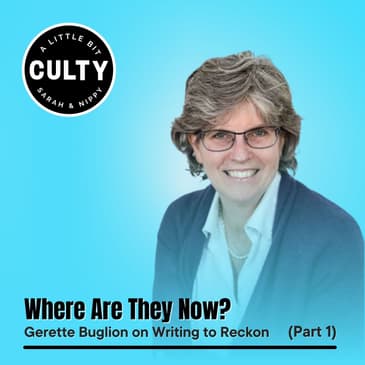
In our next “Where are they now?” catch-up episode, Gerette Buglion is back, and she’s still doing what she does best: helping survivors turn cult experience into something meaningful, grounded, and actually useful. In this conversation with Sarah, she shares how life has evolved since we last spoke, from personal recovery and family life to the gentle, steady growth of Living Cult Free and her writing work with survivors.
A big focus here is Writing to Reckon, her trauma-informed, cult-informed writing program for survivors who want to process coercive control through story. She talks about why writing can be so powerful, how to know when something is ready to share, and why slowing down before publishing can protect people from re-traumatization.
She also offers practical advice for memoir writers and whistleblowers, including keeping old journals and materials which can become a goldmine later, writing privately and imperfectly, and trusting the raw language that comes up. It’s a strong reminder that survivor-led spaces can help rebuild trust, sharpen your bullshit detector, and make meaning out of what happened without flattening it. Stay tuned for Part 2 on Thursday.
Follow Gerette on her website, gerettebuglion.com, or on Facebook or Instagram. Also check out her writing tips at gerettebuglion.com/writingtips and LivingCultFree.com.
Trigger warning: This episode contains frank discussion of cultic abuse, coercive control, trauma recovery, whistleblowing, and re-traumatization.
Also…let it be known that:
The views and opinions expressed on A Little Bit Culty do not necessarily reflect the official policy or position of the podcast. Any content provided by our guests, bloggers, sponsors or authors are of their opinion and are not intended to malign any religion, group, club, organization, business, individual, anyone or anything. Nobody’s mad at you, just don’t be a culty fuckwad.
Buy the A Little Bit Culty book on Amazon or order a signed copy.
Check out our amazing sponsors
Join A Little Bit Culty on Patreon
Get poppin’ fresh ALBC Swag
Support the pod and smash this link
Check out our cult awareness and recovery resources
Watch Sarah's TED Talk and buy her memoir, Scarred
CREDITS:
Executive Producers: Sarah Edmondson & Anthony Ames
Production Partner: Citizens of Sound
Co-Creator: Jess Tardy
Audio production: Will Retherford
Production Coordinator: Lesli Dinsmore
Writer: Sandra Nomoto
Social media team: Eric Skwarzynski and Brooke Keane
Theme Song: “Cultivated” by Jon Bryant co-written with Nygel Asselin
SUPPORT OUR SPONSORS:
You’re going to love Hungryroot as much as we do. For a limited time get 40% off your first order PLUS get a free item in every box for life. Go to Hungryroot.com/culty and use code culty.
Join Wayfair Rewards today to get 5 percent back on every purchase and start saving on your next home upgrade. Head to Wayfair.com to shop all things home.
To get your new wireless plan for just $15 a month, go to MintMobile.com/culty.
Join the millions of customers who trust HomeServe. For 50 percent less your first year, go to HomeServe.com/culty.
That scratched up pair has done its job. Upgrade today with Zenni! Go to Zenni.com/podcast and use code PODCAST15 for 15% off your first order, plus free shipping on all US orders over $65.
Upgrade your everyday. Download the Quince app for app-exclusive offers, or go to Quince.com/culty. Get free shipping on your order and 365-day returns. Now available in Canada and the UK, too.
See Privacy Policy at https://art19.com/privacy and California Privacy Notice at https://art19.com/privacy#do-not-sell-my-info.
[00:00:00] Ich heiße Shannon Maldonado und bin die Gründerin von Yaoi, einem Geschenkeladen, der auf Kunstwerke und handgefertigte Objekte spezialisiert ist. Meine Wahl fiel auf Shopify, weil Shopify im Vergleich zu den anderen Plattformen, die ich getestet habe, mit am benutzerfreundlichsten war. Ich habe vor allem an die Zukunft gedacht. Alle Tools, die für die Auswertung von Verkaufszahlen wichtig sind, zum Beispiel von Lagerbeständen, findet man direkt im Dashboard. Starte jetzt einen kostenlosen Test auf Shopify.com.
[00:00:30] Das sind die Verkaufsungen für die Auswertung von Informational Purposes only und nicht beachtetet legal, medical, oder mental health advice. Die views und opinions expressed nicht unbedingt reflect die official policy or position of the podcast und sind nicht intended to malign any religion, group, club, organization, business, individual, anyone, or anything. Ich bin Sarah Edmondson. Und ich bin Anthony Nippy Ames. Und das ist A Little Bit Culty.
[00:00:59] Wir woken up from a cult, und das journey wurde in The Vow, auf HBO und in mein Memoir, Scarred. Now in this podcast, we break down the shame and secrets that make these experiences so destructive with honest conversations on how seemingly benign groups can cross into the cultiverse, and how to spot and recover from trouble if it happens to you. Each week, we bring in experts, survivors, and whistleblowers to explore red flags, resilience, and even share a few laughs, because sometimes you gotta laugh.
[00:01:24] Subscribe to our Patreon for early and ad-free listening, some live Q&A, and exclusive content at patreon.com slash a littlebitculti. Welcome to Season 8 of A Little Bit Culty. Seeking time to be done to be done to be done to be done to be done to be done. Welcome back to A Little Bit Culty. Happy summer. No doubt. Today's guest is someone who's been helping survivors not just tell their stories, but truly process them.
[00:01:55] Jarette Bouillon is an author, educator, and co-founder of Living Cult Free. And for over a decade, she's been a steady voice in the cult recovery space. Her memoir, An Everyday Cult, and her writing to reckon work have helped survivors move beyond just understanding what happened to actually integrating it. In this Where Are They Now? conversation, we're catching up with Jarette to talk about how her perspective has evolved over the years and why she believes writing might be one of the most powerful, accessible tools for healing from coercive control.
[00:02:25] This is a catch-up, and it is a resource episode for all you writers out there. Speaking of writing... Uh-oh. ...have y'all... Book plug. ...bought our book. Oh, look at that. Just a little segue. Anyway. Uh-oh. And if you didn't, now's a great time. We will be back at the end of the summer if you want a signed copy. Otherwise, it's available on Amazon. And hopefully by the time you listen to this, up on Audible. No doubt. Narrated by... Both of us, Sarah. Nippy has a voice of honey, is what we've been told. It's what I've been hearing.
[00:02:54] And it's quite a spectacular labor of love, and we hope that you're enjoying it. And if you have already bought it and read it, what can they do, people? Are there labors of hate, Sarah? You can write a review. Thanks, Nippy, for contributing to this conversation. The reviews really help. Also, you can send it to somebody who... The audio... I mean, the video reviews are kind of a bonus. Oh, yeah. You can record yourself and leave a review on Amazon. Yeah. So if you hate your voice... But love your face? Love your face. You can do that. What if you hate both?
[00:03:24] No, just write it. Just send us a review. And thank you again for all your support. It's been really wonderful hearing how y'all are loving it and how it's helping you navigate the world, giving it to people who might be involved in something a little bit culty and healing if that's where you are in your cult trajectory. Hmm. Hopefully, the book's going to get to people before they join in the first place. Hopefully, we can start this episode. Here we go. Our catch-up resource episode with Jarette Bouillon.
[00:03:53] Bouillon. Stay tuned for some dream analysis. Oui. Stay tuned. Oui. Well, welcome, Jaret. Welcome back to A Little Bit Culty. Oh, what a delight to be here, Sarah. I'm so excited for our conversation today. Us too.
[00:04:21] So you might not know this, but we've been doing a Where Are They Now? series. Just because some of our audience really loved some of our past guests. And we've been catching up with Mark Vicente, Isabella Constantino from NXIVM. And now we're branching out to the library and seeing what are some of the things that the people are doing out in the world right now. And you've been up to some really cool things. So let's just catch the audience up on what you've been up to since you were last on A Little Bit Culty.
[00:04:50] Oh my gosh, that feels so long ago. Doesn't it? It's like three or four years ago? Yeah, time flies. And yeah, life has been really full. And I've definitely continued in my own personal recovery journey, which I'm deeply grateful for. Having, I'm just so fortunate, Sarah, to have some really good supports and a really good
[00:05:17] husband and an amazing place to live. So I'm really enjoying that, enjoying time with my family. And also really gently working away on the nonprofit that was started a few years ago that you might be familiar with, The Living Cult Free. And plugging away.
[00:05:41] Like, I have a real commitment to myself to be doing things in a way that I can stay regulated and balanced and not hyper-focused like I have been in the past. So bringing just more balance into my life. That's so great. And for those who may not remember, the everyday cult where you were in a dream analysis, psychoanalyst cult. Was that how you describe it? Your everyday cult? It sure was. Are you still analyzing your dreams?
[00:06:11] Oh, what is really wild is that in the last six months, I have had like three like powerhouse dreams. Really? Yeah. Which is totally wild. Like my father coming to me. My father died the year after I left the cult, which was 12 years ago. And so that, and it was not just a fleeting father dream, like it was significant.
[00:06:41] I've had a couple other dreams that were like, you know, like these, like I call them forever dreams, like ones that really are really meaningful that I don't forget. Although of course I forgot one of them right now, but I, there's value to dreams. There's value to working with dreams. And it's a really beautiful thing to kind of recover that just in little ways. Yeah.
[00:07:10] Well, I hope that people will get to the end of the episode because if there's time, I have a dream to share with you that I'd like you to analyze. Oh, we have to. Save time, Sarah. Yes. So we're hoping that this episode can go in the, in a catalog, which we've been planning to organize maybe either on YouTube or somewhere on our website of resource episodes. So we have one with Rachel Bernstein about how to help a family member and we've done others, which I'm blanking on right now, but this one we're hoping to be a resource specifically
[00:07:39] on, you know, how to write either a cult memoir or how to process some of your culty trauma through writing. So you have this workshop that you run every few months or so. Is that right? Writing to Reckon has several different aspects to it. So one is there's a weekly class that's a drop-in class on Friday mornings. And that is like a first come first serve class.
[00:08:06] And it's really, it's for anybody who is just wanting to pick up the pen or put fingers tapping on the keyboard to write about their experience of cultic abuse. So, and like I said, that's a drop-in class. So that's one thing that's ongoing and there's only five spots in it. So it's good to, you know, think at least a few weeks in advance if you're interested in trying it out.
[00:08:33] But then there's another aspect of writing to Reckon is also the connections program, which is where the same group of survivors come together and go through a whole series based on roughly using the Writing to Reckon journal for survivors of cultic abuse to go through that whole journal together in a way that's really supportive and inter, you know, really
[00:09:02] very deeply relational. So that's another option. And that just happens twice a year. That's spring and fall. And then there's the writing symposiums that happen also twice a year. Okay. And that's more bringing in experts who have written. Experts like Sarah Edmondson. Do you happen to know her? That was such a fun symposium to be a part of. I really enjoyed that.
[00:09:27] That was, you were part of the very first symposium and we now, there now have been four heading into our fifth symposium. That's such a good word. Symposium. A writing symposium. Symposium. I like that word. Isn't it great? Yes. There's, yeah, it reminds me a little bit though of disquisition, which was a term brought into NXIVM in the later years. It used to have like a debrief and then they started calling it disquisitions. Why are we changing the names?
[00:09:57] As in inquisition? It was a disquisition, right? I don't know what the difference is. But it has nothing to do with a symposium. No, it just has the same sort of weight. A disposition, a symposium. Anyway, so this is great. So you've talked publicly about how writing could be, you know, one of the most accessible tools for survivors of cultic coercion. What do you think it is about writing that makes it such a powerful way for people to
[00:10:25] reckon with experience, especially with the fragments that are so hard to name? Yeah, that's a great question. I think it's because we are biologically wired as to be storytellers and story listeners. We survive. We relate to each other through story in such an integral way.
[00:10:50] And I don't know if you've ever heard of the work of James Pennebaker, who is a social psychologist who really devoted so much of his, you know, many decades. Long career. To language and how language is so essential to what it is to be human, including our well-being. So he's done lots of research that shows how writing, even just a little bit of writing
[00:11:19] on a regular basis, can have profound support, can give profound support to every aspect of your being. How you feel relationally, but also your physical well-being. Like your blood pressure can go down, even diabetes. I mean, it's wild, the research that they've done.
[00:11:42] So writing, I think, just encourages us to relate in a way that we as human beings naturally and essentially need to relate. Before we hear from our sponsors, just a quick reminder. Our book, A Little Bit Culty, Navigating Cults, Control and Coercion is officially out and available on Amazon. Signed pre-orders have closed, but you can still get your copy today.
[00:12:12] This book is the combination of five years of conversations, interviews and research, everything we've learned about how people get pulled into high control groups and how to avoid, escape or heal from them. If you've been listening to the podcast and want a deeper go-to resource, this is it. Available now on Amazon in print and as an ebook for Kindle. And yes, the audio book is coming soon, narrated by us. Just search A Little Bit Culty and grab your copy. Do it. Thanks, everybody.
[00:12:57] Thank you for listening. Now, let's dive back into the cultiverse. And do you have an assessment or a way of helping people assess when they come take your workshops or symposiums that you are able to help sort of guide them if it's a time to share privately? Obviously, it's a safe space versus, you know, for a wider public audience. And how do you help people figure out if it's the time for them to, you know, just share
[00:13:24] their story or like maybe they're whistleblowing and like sort of a tell all, like how do you help people navigate that decision? Yeah, that's such an important question. And that's one of the things that I really have so much respect for people who have devoted lots of time and energy into writing.
[00:13:45] And I've worked with a few people who after, you know, really looking at their manuscript, looking at what they have, there are key areas that either need to be developed more or need to be taken out. So I think it is really important for people to kind of hit the pause button before going
[00:14:11] public to just really evaluate what works. What is my nervous system saying about, you know, this part of my story? And how about this part? Because very often people can publish things that then are out in the world and there's regret afterwards.
[00:14:34] So by just slowing things down just a little bit to have a review and a check-in, one of the things that I offer that I, and I don't mean this just to sell myself, but, you know, I offer a manuscript review that's trauma-informed and cult-informed. And what that is, is like looking at the entire manuscript and just noticing, I mean,
[00:15:01] you know that I'm kind of a nerdy educator person. So if there's content in there that feels unintegrated, that feels like it's maybe a little bit of a balm that, and it might be even read that way by a reader, that would be a place that could be, you know, just opened up. And either a decision can be made to strike it from the manuscript, or it can be a place
[00:15:29] that actually opens up a whole new world for that author to be able to, you know, to really give the space and time to allow, to, like people really, ideally, they're able to talk and self-reflect about their story before going public.
[00:15:52] And there's so many, so many documentaries out there in which people afterwards, you know, can experience some trauma. And if it's a re-traumatization, instead of, you know, writing being something that can actually be so powerfully integrative, if they can be avoided, great. You know, it's just something that can help with the healing process.
[00:16:18] And for some people, and you might know a thing or two about this, Sarah, you know, some people, you just, you have to go through this, a whistleblower experience. Like, there's a, there can be like, you know, the time is right, and you just have to do it. I'm honestly thinking about the incredibly tragic story of Virginia Giffray, you know,
[00:16:45] who was an Epstein survivor, who in the end, I mean, the fact that she told her story again and again, I think it's a huge help to, you know, this whole process. And yet in the end, this is someone who lost her life. So there's very real, very real consequences.
[00:17:10] You talk a lot about the combination of writing and speaking and therapy, good therapy, as being integrative. How do the pieces work together to repair sort of relational ruptures? Yeah. Relational ruptures, like, you know, cultic indoctrination, cultic experience is ultimately relational trauma.
[00:17:32] So by, you know, the combination of honestly really good discussion groups, that's, you know, it asked early on something that I've been doing in these, you know, last few years, something that has been incredibly helpful for me personally, our discussion groups that are, you know, specifically for survivors. And there's something about being in a wide, a group of people who are all survivors.
[00:18:01] And we're just there to talk. We're just there to, to relate, to hear each other's story. And it's, it's not even, it's not even like cult education related necessarily. It's life related. So by being in an environment that I get to bring all of my survivor self forward, I get to share a really hard situation with some tough stuff going on in my women's group.
[00:18:31] So I can look at it with the lens of being a survivor with other people who know those dynamics. And the kind of feedback and support that I get is gold. It's just so, so helpful. So being in environments where we get to have that kind of reflection, I think is really important.
[00:18:58] And then also speaking first, of course, to people who we know unequivocally we can trust. And I think it's important to, to use care in your writing and speaking process. I've experienced people, you know, be really super excited about a piece that they wrote that was extremely vulnerable.
[00:19:25] And then they share it with someone and it falls flat. They don't get the reception that they wanted. Right. It can be really devastating. It can just be salt in the cult survivor wounds. Instead of it just being like a little thing, it can be a re-traumatization. Yeah.
[00:19:49] So using a lot of discernment, not only about who you're sharing it with, but actually being really specific. Like, I'd like to share this piece with you. I wrote it last week. I feel really vulnerable about it. And there's one thing that I would like to hear from you.
[00:20:13] I don't want to have any advice on the writing itself, but if you could share with me even just one thing that, that you related to the most and one thing that, one phrase, you know, one scene that you thought was moving to you. Just like be really specific. And you can say, I don't want any feedback.
[00:20:44] Let's take a little break from the cultiverse. Here's a word from our sponsors. Thank you, sponsors. We couldn't do it without you.
[00:21:13] Now let's get back to the show. Is this the context of the workshop or the symposium? Or this is just advice that you're giving to people who want to write something and share it? This is advice for people who want to write and share. Okay. Proceed with caution. Proceed with caution. Especially if you're sharing with someone who didn't go through what you went through. Like isn't a fellow survivor, just like a family member or something. Tell us a little bit about the format. Like what could people expect?
[00:21:43] And is this a good time to weave in some of the tips that you have? Or how do you want to share those? Yeah, I would say, so there are two different things. Like the Writing to Reckon class is a space that is really designed for survivors where we create a pretty safe container. And so it has a very specific structure. So the class is that, you know, we come together.
[00:22:12] I offer a writing prompt. And that writing prompt can be something very similar to one of the ones in the Writing to Reckon journal. Or most of the time, it's something that's happening within me that's, you know, live and personal. And I relate it to some aspect of a cult dynamic. So it's always directly cult related.
[00:22:41] And then, so there's just a couple minutes of talking about the prompt. And then we start writing. And we'll write for about 40, 45 minutes. And then we all come back from the writing. And when we come back, you can share. And I should also mention, people can use the writing prompt or they can throw it out the window. So you only use the writing prompt if it resonates, if it fits with where you are right then.
[00:23:10] Can you give us an example? Like what kind of prompt? What kind of prompt? Tell me your favorite three prompts. Oh, gosh. I can't do that because I'm too wordy, Sarah. Yeah. My writing prompts are because I'm a nerdy educator. Yeah. So like what I do is I'll bring in, I'm just going to like super quick. So a prompt could be something.
[00:23:40] Oh, yeah. I just, I was reading a book and the word contingency was used. And I'm like, contingency? I know what contingency is. I'm a, you know, the queen of contingency planning. You know, like I know contingency. But this author was using it in a way that did not make sense to me. It's a completely different experience, use of that word.
[00:24:08] And so I realized that I was experiencing cognitive dissonance. So the prompt is, okay, here we experience cognitive dissonance all the time. And as a cult survivor, I have come to learn that cognitive dissonance is my best friend. So because what it's doing is it's showing that there's a bit of a, you know, like, what the fuck?
[00:24:36] Something is not meeting up. So what I'm talking about here has nothing to do with the word contingency. It's actually just an example of me experiencing cognitive dissonance and then saying to myself, okay, I know this is actually, there's something more for me. What else is there for me? So we use the, you know, the potential prompt. Cognitive dissonance is my friend.
[00:25:05] You know, try writing to that topic. So that's, you know, like that's one possibility. Another, so I'll be maybe learning something from my therapist about memory reconsolidation. So I'll bring in a prompt, I'll bring in my personal experience around memory reconsolidation, which actually was connected to that dream about my father.
[00:25:34] And then memory reconsolidation, you know, becomes something to, becomes a prompt. You know, in that particular dream with my father, he was smiling at me. My father was not a man who smiled. Like I do not have a single photograph of him smiling. But then in my dream, there's this whole thing going on.
[00:26:02] And then he is smiling at me with this love. And I'm like, again, it's a little bit of cognitive dissonance. But the memory reconsolidation experience is one where I get to layer a new memory of my father who has smiled at me in my dream.
[00:26:24] I get to layer that onto all my other memories of my father, which are mostly as a stern, rigid, authoritarian kind of bitter, controlling guy. So it's a new experience. And it's an experience that I get to write about and integrate. And, you know, writers in the Writing to Reckon program, you know, yeah, they get to hear probably a bit too many of my little experiences like that.
[00:26:53] You just heard two such experiences. But it's usually like the first, like, you know, four minutes of the class is hearing the prompt. You know, and then we just go into silent writing together. And then when we come back after we've written, then each person has the opportunity to read their writing.
[00:27:17] And when you're reading something that you just created, it's an exquisite experience, especially when you're able to read it to others who have an understanding of what coercive control is.
[00:27:37] And so when you read, we like, the way that I set it up for people is that it's like, we're taking in that creative process that writer just went through. And we see it as a piece of art. And then as a listener, our task is to notice what resonated, to notice what we loved.
[00:28:04] And then after that writer has finished sharing, we then get to share. Each listener can say, oh, that really resonated with me. I loved that scene where, and oh my gosh, the use of the word blah, blah, blah, in that moment just pierced my heart, you know, whatever it might be.
[00:28:24] And that process is so powerful because not only are you getting affirmation from people who know about cultic involvement and see you, you're also getting direct feedback on your writing. And you naturally become a better writer. Mm-hmm. That's amazing. Is that sort of the arc of a class? Yep, that's exactly the arc of a class. And then we say, bye-bye.
[00:28:54] Like, you know, like that's the end after the last person has read and received feedback. And you mentioned that you have some tips for memoir writing. Would that be a good time to share those? Sure, yeah.
[00:29:09] Gosh, my first thing is there is a really natural tendency for survivors to throw out all your old journals and throw out your old workbooks and notes from the cultic experience. So first tip is suppress that. If you haven't done it already, suppress that urge.
[00:29:35] Because even though that might come from a really healthy part of you, if you have the slightest desire to write or even to be really serious about your own healing, it's way better to take all those documents and pack them up in a box and put them aside. Because they are a writer's goldmine. To see what you wrote when you were under indoctrination.
[00:30:04] To see and to even look at old, you know, pamphlets or flyers or class material or whatever it is or, you know, Bible readings if you're in a Bible one-based group. It's incredibly revealing and helpful to have that. It's a resource. It's gold. It's like gold. So that's one tip is to hold on to that. But also, you know, do take care of yourself to pack it away.
[00:30:34] You don't need to keep it out, you know, and have other people. Look at it. Exactly. You want to keep it away. And that's another tip for sure is that your writing is a private space. Even though what we've talked about, you know, the relational part of writing and sharing your work is very important. But your writing is yours. And you get to do it however the hell you want to, you know.
[00:31:03] And it will come in fits and starts. You might have times where you just, you know, do these downloads and you're like at your computer for hours. Or you're writing, you know, in a journal and your hand starts cramping because you're writing so long. Whatever it is, you don't have to complete sentences. You just write whatever it is that comes.
[00:31:29] And trust the words that you're hearing in your, that come up in your head. Notice the words that come up in your head like when you take a walk or if you're thinking about or talking to somebody else about your experience. Take note of the language and let that language come into your writing. Because we can also have this feeling of like, oh, I've got to be, I've got to be my good self, you know, or my professional self to write.
[00:31:59] And fuck that. It's really important to just, when we are processing coercive control and indoctrination, we need to just let it rip. Yes. That raw material just in whatever language resonates for you. So don't let other ideas or what some writer told you about what you should or shouldn't do. Those rules might apply for some people, but they don't apply to cult survivors. Mm-hmm.
[00:32:29] I was just thinking as you were talking that I'm guessing that depending on how long it's been since somebody got out, that they might even repeat whatever sort of pattern they ran in the cult in your workshop. Like, you know, for me, I might early on, I might be trying to like get it right and do a good job and get the gold star and get approval of the teacher or something like that. Do you see those things happening? You know, I do see them happening. Mm-hmm.
[00:32:55] And there's also, though, a space. There's an interesting way of getting the feedback. It's like the feedback and your words reveal it all. Mm-hmm. So if that's happening, you know, there might be a, like, since the other cult survivors in the room see through shit, they're not going to elevate that in a piece.
[00:33:26] What's going to get elevated is the piece in your writing that just felt the most visceral and the most real or vulnerable. And that's what gets noted. So there's kind of this, I never thought about it this way, Sarah. I love that question.
[00:33:43] But I think that there truly is a kind of self-correcting that takes place because the focus is we're in an environment where we're focusing on increasing our bullshit detector. We get to do that for each other and for ourselves.
[00:34:23] We hope you're enjoying A Little Bit Culty. If so, please do show us some love. Drop a rating or leave a review. Hit subscribe on Apple, Spotify, or wherever you listen. And subscribe to our Patreon at patreon.com slash a little bit culty. Even better, send this episode to someone who needs it. Maybe they're in a cult. Maybe they're just a little bit susceptible. Or maybe they just love a good story. Spread the word. Spread the love. Thanks for listening and see you next time. A Little Bit Culty is a Trace 120 production.
[00:34:49] Executive produced by Sarah Edmondson and Anthony Nippy Ames in collaboration with producer Will Rutherford at Citizens of Sound. Our co-creator is Jess Temple-Tardy. Our production coordinator is Leslie Dinsenbor. Writing by Sandra Nomoto and social media marketing by Eric Swarczynski and Brooke Keene. Our theme song Cultivated is by the artists John Bryant and Nigel Aslan. Our co-creator will see you next time. Her impact is my discussion of foreseeable damage. Everyone is jahon them. Our co-creator will be based on theقة of an industry battlefield where we take into account due to a specific area.