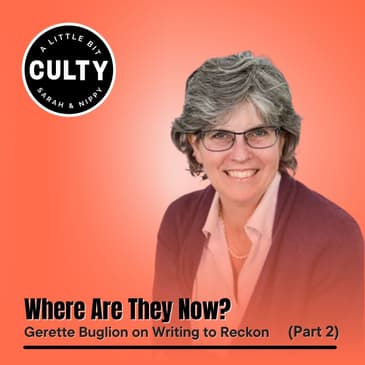
Gerette Buglion’s back for part two of our catch-up. This one dives deeper into the messy, important work of healing through writing, therapy, and self-trust. She talks about internal consent, knowing when to pause, and why it’s so important for survivors to move slowly when a story starts to light up the nervous system.
We also get into the realities of publishing after cultic abuse, including how predatory dynamics in the writing world can hit old wounds hard, and why it’s crucial to know your allies and keep strong boundaries. Gerette shares how survivor experience can help you spot when something is genuinely off versus when an old trigger is getting activated. She reflects on the value of humor, love, and safe enough relationships in real healing.
The episode wraps with more on Living Cult Free, including its discussion groups, symposiums, and survivor-centered podcast, plus a vivid dream exchange that lands on themes of predators, intuition, and self-reliance.
Follow Gerette on her website, gerettebuglion.com, or on Facebook or Instagram. Also check out her writing tips at gerettebuglion.com/writingtips and LivingCultFree.com.
Trigger warning: This episode contains frank discussion of cultic abuse, coercive control, trauma recovery, and re-traumatization.
Also…let it be known that:
The views and opinions expressed on A Little Bit Culty do not necessarily reflect the official policy or position of the podcast. Any content provided by our guests, bloggers, sponsors or authors are of their opinion and are not intended to malign any religion, group, club, organization, business, individual, anyone or anything. Nobody’s mad at you, just don’t be a culty fuckwad.
Buy the A Little Bit Culty book on Amazon or order a signed copy.
Check out our amazing sponsors
Join A Little Bit Culty on Patreon
Get poppin’ fresh ALBC Swag
Support the pod and smash this link
Check out our cult awareness and recovery resources
Watch Sarah's TED Talk and buy her memoir, Scarred
CREDITS:
Executive Producers: Sarah Edmondson & Anthony Ames
Production Partner: Citizens of Sound
Co-Creator: Jess Tardy
Audio production: Will Retherford
Production Coordinator: Lesli Dinsmore
Writer: Sandra Nomoto
Social media team: Eric Skwarzynski and Brooke Keane
Theme Song: “Cultivated” by Jon Bryant co-written with Nygel Asselin
See Privacy Policy at https://art19.com/privacy and California Privacy Notice at https://art19.com/privacy#do-not-sell-my-info.
[00:00:00] Ich heiße Sarah Edmondson und bin die Gründerin von Yaoi, einem Geschenkeladen, der auf Kunstwerke und handgefertigte Objekte spezialisiert ist. Meine Wahl fiel auf Shopify, weil Shopify im Vergleich zu den anderen Plattformen, die ich getestet habe, mit am benutzerfreundlichsten war. Ich habe vor allem an die Zukunft gedacht. Alle Tools, die für die Auswertung von Verkaufszahlen wichtig sind, zum Beispiel von Lagerbeständen, findet man direkt im Dashboard. Starte jetzt einen kostenlosen Test auf shopify.com.
[00:00:30] Das sind die Verkaufsfragen, die wir nicht nur für die Auswertung von Verkaufszahlen verwendet haben. Die views und opinions expressed do nicht necessarily reflect die official policy or position of the podcast und sind nicht intended zu malign any religion, group, club, organization, business, individual, anyone, oder anything. Ich bin Sarah Edmondson. Und ich bin Anthony Nippy Ames. Und das ist A Little Bit Culty.
[00:00:59] Wir woken up from a cult. Und das journey war in The Vow on HBO und in my memoir, Scarred. Now in this podcast, we break down the shame and secrets that make these experiences so destructive with honest conversations on how seemingly benign groups can cross into the cultiverse and how to spot and recover from trouble if it happens to you. Each week, we bring in experts, survivors, and whistleblowers to explore red flags, resilience, and even share a few laughs because sometimes you gotta laugh.
[00:01:24] Subscribe to our Patreon for early and ad-free listening, some live Q&A, and exclusive content at patreon.com slash a little bit culty. Welcome to season eight of A Little Bit Culty. She can tell me, take a touch. Okay, so the tip so far is don't throw away your journals and notebooks and whatnot.
[00:01:51] Don't let anybody else tell you the rules, just let it rip. What else? I think one of the really important things, Sarah, is to be really attuned to your internal consent. And what I mean by that is that only write what you're really ready to explore.
[00:02:14] If you find yourself writing about something that really activates your nervous system and you start getting really agitated, it's really important to give yourself the permission to just hit the pause button. And pivot to something else that feels safer or take a walk, see what it is, you know, give yourself space to integrate. So I think that's important.
[00:02:42] And that, of course, really dovetails with how important it is to, in an ideal scenario, have a good therapist that you're working with. Like therapy is, and I know it can be hard to find good therapy. Ideally, we're working with someone who has lots of experience with coercive control. And there are more and more therapists in that regard.
[00:03:09] But I know there's still, it's still, sometimes it can really be an obstacle. I would never have not having a therapist be a reason to not write though. Mm-hmm. And at the same time, having a therapist and letting your therapist know that you have a desire to write or that you are writing and bringing that into the therapeutic narrative can be just profoundly helpful.
[00:03:40] Yeah. Do you think there's a, like, I don't know if there's an answer to this, but I guess I'm wondering if you have a thought on when having, like, I'm just thinking about times when I was writing Scarred or the new book where it was hard to tell if I was, like, having a reaction, like, being triggered by what I was trying to write.
[00:04:00] Or I guess I just don't know when, like, when do you keep writing to get through it or you put it aside because you need to not be through it? Like, when do you go through it and when do you put it down? I guess is the question. Yeah, that's a good question. And I think that is so individual. I hate to say it.
[00:04:21] But if you know yourself well enough, you know, to kind of know what certain responses in your, like, just to use that kind of therapy language of being activated.
[00:04:34] You know, sometimes being activated is actually a really good place because it can be like a, you know, like an indicator of, oh, I'm getting into some hot territory that I really want to write about and, you know, just keep going.
[00:04:51] And if that's the case, then I would also just really hope that writer knows himself well enough to also practice some really good self-care after. Because if you're in a way pushing yourself to write through some really challenging stuff, then you really need the time afterwards. Right.
[00:05:21] To integrate. Yeah. Just like after a good yoga class, you know, like. Shavasana. Shavasana is so important. Yeah. When I see people leaving early before shavasana, I'm like, what are you doing? I'm here for the shavasana. You're missing the best part. You have to, you definitely have to integrate and let your body just let it all in. Such a good point. Okay. What are your other tips?
[00:05:47] You know, there's lots of tons of writing coaches and writing programs and writing tips and trades and all of that that's out there that it's a huge industry. And a lot of that industry, I have no idea what the percentage is, but there is a very strong predatory dynamic in that industry.
[00:06:14] And that can be profoundly triggering for survivors. So being aware of that, you know, especially if you're pursuing publication. You know, going into that with your eyes open and a, you know, your boundaries clear and a plan A and a plan B and maybe a plan C.
[00:06:38] Because most likely you're going to bump up against stuff that will trigger the cult wound. So, again, you know, creating a space where you get to recognize what's happening and practice self-care. But another thing that is so important is to identify your allies.
[00:07:04] Like, who are the people that really are your allies in this project? And, you know, an example, of course, Sarah, was the way that you were an ally for me when I published An Everyday Cult. You know, that you wrote the foreword for it.
[00:07:23] And that experience of developing, having enough trust with someone who knows and understands what you've experienced is an extraordinary gift. I don't think I'll ever forget when you read the, you were like, oh my gosh, I don't know if it's okay. So I'm just going to, can I just read it to you?
[00:07:50] And I like, was, for whatever reason, I was up in the closet of my bedroom because I couldn't bear, like the kids were, you know, there was noise in the house or something and I wanted to like really hear it. And I just felt so seen.
[00:08:08] So knowing who your allies are and knowing when and how you, how to open to them and when and how to reach out for trust and support. And, you know, of course, you probably have a lot of people that have asked you for support and you're unable to give it because there are too many people that want that of you.
[00:08:35] I can certainly understand that and having the boundaries. Before we hear from our sponsors, just a quick reminder. Our book, A Little Bit Culty, Navigating Cults, Control and Coercion is officially out and available on Amazon. Signed pre-orders have closed, but you can still get your copy today. This book is the culmination of five years of conversations, interviews and research.
[00:09:01] Everything we've learned about how people get pulled into high control groups and how to avoid, escape or heal from them. If you've been listening to the podcast and want a deeper go-to resource, this is it. Available now on Amazon in print and as an e-book for Kindle. And yes, the audio book is coming soon, narrated by us. Just search A Little Bit Culty and grab your copy. Do it. Thanks, everybody.
[00:09:36] August always hits different. It's that weird mental space where you're not quite ready to let go of your beach stuff and summer, but autumn's already knocking. Like, back to school. It's, you know, the universe's way of telling you to hit reset, start fresh. So I try to start with my closet. But here's what Quince taught me. You don't need an overstuffed closet to look put together. Literally, somebody at the Folk Festival here in Vancouver the other day said to me, You seem like the kind of person who's always put together. I like your whole vibe. I like your wardrobe. And I was like, thanks, it's Quince. Here's the thing.
[00:10:03] You just need 10 genuinely great pieces instead of 50 mediocre ones. Their organic cotton and Mongolian cashmere sweaters are the definition of effortless. Tailored well, built to last, and somehow appropriate whether you're in a meeting or grabbing dinner afterwards or everything in between. You don't need to do that whole costume change because it works for everything. The denim, though, is where things get very impressive. Premium stretch starting at $50. With that structured, weighted feel you'd expect from some designer label charging three times as much.
[00:10:32] Yes, they are genuinely as cool, affordable, and well-fitted as you see on the gram. I can attest to it. I have two pairs. Everything's 50 to 80% less than comparable brands. They cut out the middleman entirely, working directly with Ethel Factories. So you're basically funding quality instead of some brand's marketing department. Yes, that's where all the money goes with other brands. I'm super attached to my Quince ribbed tanks and totes adorbs workout gear.
[00:10:55] I have multiple maxi dresses, which I can rock out in that summer to fall era and not feel precious about them while I romp around with my boys because they're so affordable. And it's not just clothes. They bring that same elevated but affordable approach to everything else. Hotel-quality bedding and bath, kitchen staples, thoughtfully designed furniture. So while your closet's getting that reset treatment, your whole house can join in too. Reset season just got a whole lot more affordable. Upgrade your everyday.
[00:11:21] Download the Quince app for app-exclusive offers or go to quince.com slash culty. Get free shipping on your order and 365-day returns. Now available in Canada and the UK too. That's quince.com slash culty. Happy shopping. Anyone else feel like August is the Sunday of summer? That weird limbo where you're bracing for the autumn chaos but also refusing to admit summer's basically over. It's the perfect time to hit reset. And for me, that always starts with my closet.
[00:11:49] Quince proves you don't need a crowded closet full of options you never wear. You just need the right pieces. Their organic cotton and Mongolian cashmere sweaters are beautifully tailored, one of my personal favorite, built to last, and somehow work for morning podcast recordings straight through dinner without you having to overthink it. Boom. Their premium stretch denim starts at $50 with the fit and structure you'd expect from some designer brands charging triple. Everything's 50% to 80% less because they skipped the middleman entirely.
[00:12:17] My personal favorite, other than the sweater, are the slacks. Sarah says my butt looks slammin' in those. No big deal. And it's not just clothes. They've expanded into hotel-quality bedding, kitchen essentials, and furniture elevating your whole life without the luxury price tag attached. Upgrade your everyday. Download the Quince app for app-exclusive offers or go to quince.com slash culty. Get free shipping on your order and the 365-day returns. Now available in Canada and the UK, too.
[00:12:44] That's quince.com slash culty. Remember when summer meant actual freedom? No homework. No teachers. No alarm clocks. Just weeks of glorious nothing stretching ahead of you. As adults, summer freedom looks a little different. But Mint Mobile's summer sale is bringing some of that magic back. Right now, all their plans are $15 a month. Even unlimited. That's not a typo. That's just what happens when a wireless company decides to stop being ridiculous. Free yourself from big wireless and all their gimmicks and gotchas.
[00:13:14] High-speed data and unlimited talk and text on the nation's largest 5G network. T-Mobile's network. Not some knockoff version. Bring your current phone. Keep your number. Pick a 3-, 6-, or 12-month plan. And stop overpaying. That's it. Sign up online. It takes minutes. And you get three months of premium wireless for $15 a month. Turns out freedom in adulthood mostly just means not getting fleeced by your phone company. Close enough to summer vacation, honestly. To get your new wireless plan for just $15 a month, go to mintmobile.com slash culty.
[00:13:44] That's mintmobile.com slash culty. Cut your wireless bill to $15 a month at mintmobile.com slash culty. That's it. There's no catch. Upfront payment of $45 for 3 months, $90 for 6 months, or $180 for 12 months. Plan required. $15 per month equivalent. Taxes and fees extra. Initial plan term only. Greater than 50 gigabytes may slow when network is busy. Includes up to 20 gigabytes hotspot. Capable device required. Availability, speed, and coverage varies.
[00:14:14] See mintmobile.com. Sponsor Breaksden. Back for more culty stories. Yeah, that's a little difficult. I was thinking actually just to go back for a second, you said something about trigger the cult wound.
[00:14:36] I guess I'm wondering like how do you, maybe this is a therapy question, but as you're navigating, like you said, predators and the publishing space and people that maybe no one have your best interest at heart. But how do you know when it's, oh, my old cult wound is being triggered versus, no, that's my guidance saying this isn't good. That's my inner intuition coming back and saying, oh, this is not a good dynamic.
[00:15:05] How do you navigate that? Yeah. What's funny is that I actually see in a certain way it's this, it's the, I mean, it's not the same thing. It's, you know, two very different things to kind of go into the cult wound and versus no, like this feels wrong.
[00:15:33] So that kind of, this feels wrong, I would say they're most likely is a bit of an experience of cognitive dissonance. You know, there's a bit of a like, oh, okay, this person is saying that, but then this is actually what's happening. Let me tread slowly and carefully.
[00:15:51] And sometimes it's just a really, I mean, if it's a clear gaslighting and you know gaslighting in your body, that is like, yeah, get me out of here. You know, I had an interesting experience in my own publication of my book where the, there was some bullying that took place, especially around the cover of my book.
[00:16:23] And I, the, what's his name? What do you call it? The publicist? I guess it was the publicist. No, not the publicist. The editor? Publisher? It was the publisher. Yes. So the publisher had this idea that my book cover was perfect the way that it was at this certain time.
[00:16:48] And the colors were really muddy and muted and it felt really off. And he was really pressuring me. And this is a hybrid publisher, by the way. So, you know, I've got, I, you know, own the rights to my book. It's not that I had sold my book completely to them. And he was being rather aggressive and using ultimatums to kind of move this through.
[00:17:17] And it was profoundly triggering for me. And I had to just like step back and get a little perspective and realized he was just flat out wrong. And we needed new art. We needed to, like, the slides that he had were not the right ones. And I needed to hold my own. And I did.
[00:17:46] And it was delayed by a few days. And it did not, it was fine. You know, so sometimes it's like, you know, that, and my experience as a survivor is what, what helped me to see that. So it's like, yeah, you know, we see what we see now and we're not going to be, you know, pushed around.
[00:18:10] But if we're getting, you know, down into the mire where the wound is open and we really are not making sense, that's when we really need to be with our therapist. That's a very good point. When you were talking, you reminded me of something I said in your symposium about definitely one of the pros. And there's pros and cons with everything, but the pros of self-publishing or hybrid publishing is that you can, ultimately you do have that final say.
[00:18:40] People are guiding you, you know, towards certain things. And that was hard with my, with Scarred where I didn't have a choice on the cover. And as a cult survivor, I think it's always good to have more choice. Absolutely. And of course, a nice advance is great. That's what I tell people now is if the advance is enough for you, knowing that you may never earn it back and that's all you're going to get from the book. Then take it and get the support.
[00:19:07] And know that you just, that you're giving up a lot of control. But also, you know, anyway, that's in the symposium. And that's a really good point that the symposiums and there is just incredible, a whole, you know, width and breadth of support for survivors in the symposium recordings. And they can all be accessed actually through the Living Cult Free website. So great. Yeah.
[00:19:36] So they are, it's a mini fundraiser. But if you can't afford the $7 to rent it, just reach out and we'll send the symposium link. It's the same price as a latte, a fancy latte. That's right. But I hear you. We don't want anyone to not be able to have access. Yeah, exactly. I say the same thing about my book. Yeah. And there's one more tip I would love to share. Yeah, please.
[00:20:01] And that is that there's a tendency to kind of congregate with people who got out of the same cult as you. And some people even create little, you know, writing groups around that particular group. And I have seen a number of times where that has actually backfired. And to me, it makes a lot of sense that it would backfire. And it's because... Why do you think?
[00:20:29] Well, it's the same thing as with a discussion group or a therapy group for the same group of survivors. Right. Is that you're so charged. You're activated by, you know, the same words. And people in that group are going to be using the same language. You have the common experiences.
[00:20:53] And when instead of that environment, you can be in a space where there's a mix of different varieties of coercive control and coercive relationships, we're much less likely to get tripped up on something that is related to what we experienced rather than too closely related. Mm-hmm. So it gives...
[00:21:22] We can see oftentimes survivors, you know, can see more clearly from somebody, from something, you know, a different kind of group, which is why A Little Bit Culti is just an extraordinary resource for survivors. Oh, thank you. That width and breadth of experiences that are represented on the pod is just an incredible asset for survivors. Thank you. Yeah.
[00:21:50] So we get to see that in our writing. I think I would also imagine, and at least this would happen for NXIVM, that if we started a group that was writing all together, there might be some old dynamics come out regarding, like, the ranking system. Like, you know, who was above who and sort of, you know what I mean? I don't want any of that. Like, I know in this book we talk about getting together and, like, having bitch sessions where you just sort of, like, let out all the things you couldn't say. I think that's fine.
[00:22:19] But even in those situations, I remember, like, deciding whether we were going to do something. I forget what. And there was, like, dynamics around, like, somebody saying, like, well, you're not my green sash anymore. Like, I'm not above it. I'm like, I don't want to be your green sash. Like, I don't need to have authority over you. I don't want it. Like, don't think that I, I mean, like, there's all these weird playing out of the old patterns. Yeah.
[00:22:43] But even to say that, like, to hear that phrase, you're not my green sash anymore, that could also be, that's so personal. Like, it's hard to not take that personally. So then you get triggered. So it's just an environment where one is more likely to be triggered. 100%. And we can avoid that. There's so many healthy, amazing, better ways to work. Yeah.
[00:23:11] And to write and to connect and to share. Well, you must have learned so much over the years. Is there anything else, being a survivor, an author, a leader, an educator in the cult recovery space that's changed your view of healing? Or, like, what's, when you look back at your time in this space, any major, like, has your opinion changed? Or do you have any different outlooks? You know, there are two things that come to mind with that question.
[00:23:37] One is, there's the, and I've already said it, but it really is worth saying again, is that the relational trauma that we experienced is such, you know, it's the big wound. And in order to really heal, we actually need to be in environments where we can relate with others in a safe way, in a way, or a safe enough way.
[00:24:05] There's no perfect safety. So, really focusing on the relational aspect of healing, I think that's been a huge part of the last couple of years for me. And it has really changed my broader perspective of what it is to heal as a survivor.
[00:24:28] And then the other thing that comes to mind with that question is also living as we are right now in a time when there's such widespread authoritarianism. And I think there's a way that that really triggers the cult wound, or it can be a way that can trigger the cult wound.
[00:24:55] So, being aware of that and taking care, you know, like not listening to the news, you know, titrating yourself or deciding, you know, reporters or speakers that don't activate your nervous system. You know, that don't get you too riled up. Humor. Oh, I just wanted to tell you, I'm proud to say I have not watched the news.
[00:25:20] Like, I mean, I get the news through other means, but I have not watched a news program since March of 2020. Woo-hoo! Wow! Yeah. That's my self-care. Yeah. My mom lets me know it's important, but I also get, you know, I get emails or not. Yeah, exactly. It's different when you're reading headlines versus ba-ba-ba, you know. Yeah. Yeah. It's really different. It is really different. Mm-hmm. And so how has that, like, say more about that, Sarah, because I think that's important.
[00:25:49] I just feel like it's what I've needed to do to not be constantly anxious, because there's like, I can't control it. I mean, I can participate in certain things, but I can, I just, it just riles me up and triggers me and makes me anxious. And I feel like, especially certain media, it's so, you know, the production values and the spin and the slant and the bias and all the things that is just, it's too much. And then fear-focused, like, you know.
[00:26:16] And also I just, and this, some might say this is my leftover cult stuff, but not trusting the media. And I would say both can be true. I might have leftover cult stuff, and I still am not going to trust the media. Like, when I, when I see the same incident being cut up and shown completely opposite views by the, you know, the two different networks, I'm like, both of you are not to be trusted. So, no. Yeah. Exactly. And.
[00:26:46] I'm just not getting, I'm just not getting my news from there, for my own well-being. For sure. For sure. It is just, and to trust your gut, you know, trust your gut that if this is like, if you have a feeling of, ugh, I don't want to see this, or this is too much for me, you know, trust that. And I think setting healthy boundaries around, yeah, around media.
[00:27:14] And I tell you, we have to laugh, and we also have to be willing to love. Because that's part of what happens, you know, when you have progressed in your healing, when you've integrated enough of this, you know, culty dynamics. Like, if we don't laugh, if we can't, like, let loose, that's not good.
[00:27:39] You know, like, definitely, whatever kind of creative expression floats your boat, you know, if it's listening to whatever favorite comedian is. But also just, you know, relationally, like, I, yeah, laughter and love. It's the spice of life. This episode would not be possible without the support of our sponsors.
[00:28:07] Let's hear what they have to offer. We protect everything. Health insurance, car insurance, phone insurance. We've got a plan for basically every possession we own. But your home? Your actual biggest investment?
[00:28:37] We just cross our fingers and hope nothing breaks. Which is wild, because things definitely break. Especially with two boys and you're going to football practice and one of them pulls the doorknob off. HomeServe definitely could have helped. Your regular homeowner's insurance doesn't cover the day-to-day stuff. Plumbing failures, HVAC breakdowns, electrical issues. You're on your own for those, usually at the worst possible moment. Think of it like a subscription for your home. For as little as $4.99 a month, they've got your back. Here's the difference.
[00:29:03] When something breaks, you're not frantically Googling contractors at 11 p.m. in a panic. You're already on the phone with HomeServe's 24-7 hotline getting a repair schedule. Choose a plan that fits your needs and budget. And when something goes wrong, just call. They've been doing this for over 20 years with a trusted network of 2,600 local contractors. Nearly 4.5 million customers, a 4.8 out of 5 post-repair rating, and an A-plus BBB rating. They're legit.
[00:29:32] Emergency home repairs can get really expensive really fast. So next time we're dealing with the faulty electrical outlets, a broken light switch, a burst water pipe, a furnace that decides to quit, or a water heater on the fritz. HomeServe is who we're calling. It's time to protect the things you're protecting everything else for. Join the millions of customers who trust HomeServe. For 50% less your first year, go to homeserve.com slash culty. That's homeserve.com slash culty for 50% less. Savings compared to renewal price.
[00:30:01] Void in Florida. The kids are heading back to school soon, and along with the school supplies panic comes my annual how am I supposed to feed everyone healthy meals and have time for anything else spiral. It's a lot, especially with sports. This is exactly why we're so thankful Hungry Root sponsors this podcast. Yes. Hungry Root is awesome because we are able to have the best healthy snacks for our kids while we're trying to get them to practices to and fro, and sometimes get back at 930 at night and have to give them a quick dinner before they go to bed and get up at 6am. Here's what's wild.
[00:30:31] Hungry Root gets smarter the more you use it. It learns your taste, your dietary needs, and just keeps refining what shows up in your cart. Like it's slowly becoming psychic about what you and your family actually wants to eat. With over 50,000 chef-crafted recipes and 1,000 grocery items, we never get bored. Most recipes are ready in 15 minutes, which is a miracle during back-to-school chaos when everyone needs to eat immediately and simultaneously. They're serious about quality screening out over 200 sketchy additives.
[00:31:00] No hormones or antibiotics in their meat and seafood. You know exactly what you're going to get. Honestly, the biggest gift is not having to think about food logistics on top of everything else. My brain has exactly zero extra space during back-to-school season and this podcast, and Hungry Root just handles it like a boss. Our family's eating better without me having to become a nutrition expert overnight, which I kind of am. That's a win. And with the time we save from not having to meal plan or grocery shop every day, we can put more into this podcast.
[00:31:29] You're going to love Hungry Root as much as I do. For a limited time, get 40% off your first order, plus get a free item in every box for life. Go to HungryRoot.com slash Kulti and use code Kulti. That's HungryRoot.com slash Kulti. Code Kulti to get 40% off your first box and free item of your choice for life. We had a very specific home challenge this summer. We need to give it a facelift. We need to zhuzh things up a bit. There was a lot of things that were just a little old and ratty.
[00:31:57] Throw cushions on the couch that had straight edges and oven mitts that were probably about 10 years old. Just everything needed a little refresh. Thank goodness for Wayfair. Wayfair completely solved this problem because buying furniture can be a gamble every time, especially online. It looks amazing in photos, but when it arrives, you're wondering if you accidentally ordered a prop from a low-budget movie set. This is why I trust Wayfair Verified.
[00:32:23] Their product specialists actually hand vet everything with a 10-point inspection, quality of materials, how it functions, even how long assembly takes. So you know it's built to survive real life, not just a photo shoot. And the value is real too. Wayfair Rewards members get 5% back every single day. So you're saving as you go. Plus they got options across every price point. So creating a home you love doesn't mean draining your savings account. And here's what really seals it. Over 20 million verified five-star reviews from actual customers.
[00:32:53] Real photos. Real feedback. Real people who bought the thing and are telling you the truth about it. I look at the reviews every time and it's pointed me in the right direction and strayed me away from other things. And I'm so grateful for that. So instead of guessing and hoping, you can shop with confidence. Join Wayfair Rewards today to get 5% back on every purchase and start saving on your next home upgrade. Head to wayfair.com to shop all things home. That's W-A-Y-F-A-I-R.com. Wayfair. Every style. Every home. Wayfair. Every style. Every home.
[00:33:36] Did you skip over all the ads? We hope you didn't. Thank you to our sponsors and thank you for listening. Now, let's resume our culty convo. So, I'm aware of the time and we're at an hour, so I'm going to ask you one more thing. Where is it? Well, first of all, where's the best place for people to find you if they wanted to reach out about any of your workshops or symposiums? Hmm. Those symposiums.
[00:34:01] The best way is to go to my website, my name, jurettebullyan.com, and to subscribe to my newsletter because that's where everything is kind of processed through that, through my newsletter. Okay. I have a writing blog. Like, I write every week. So, it's a blog post that's written for survivors, to survivors, about being a survivor, and that is my...
[00:34:30] I'm on Substack, too. That's, of course, all on Substack. And then the other place is to go to livingcultfree.com. Oh, yeah. Tell us about that. We didn't really get into it too much. What's it do? How have you kept it healthy? Do you know how we kept it healthy, Sarah? Tell us.
[00:34:49] By just having a steadfast commitment to only let it grow naturally in a way that each person who's on the board, each person who's part of it gets to say what they're excited about doing and they get to do that. And if they're not excited about something or if there's something that is starting to feel like too much pressure, you just back off.
[00:35:18] So, there is no pressure. And we have grown very slowly. And it's really, really beautiful. Like, we're now poised at this moment with Hoyt, who is a Hoyt Richards. Yes. Who I know you know and love. Hoyt is just incredible. So, he is a founding board member of Living Cult Free and has been with us from the very beginning.
[00:35:44] And there's a documentary, an HBO documentary coming out about the cult that he was in and his work. So, we're really excited about that. Thanks for reminding me. I have to send him a book. And we've been talking about him coming on the podcast since we started like six years ago. So, thank you for reminding me. Oh, it's time. It's time. It is time. And he's so articulate and so great. And we mentioned him in the book. He's the one who told us, you might want to process your trauma before you process it on film.
[00:36:14] And we were like, too late. Yes. Good advice. Exactly. Yeah. Hoyt is just, he's a gorgeous human being. And yeah, so on the Living Cult Free website, you know, there are three main things that we offer. There's the symposiums that we partner with and there are sponsors so that there's scholarships to attend the symposium.
[00:36:42] We don't want, we have to this day, we have not turned anybody away because of the scholarship fund, which is really exciting. And that happens spring and fall. We also have discussion groups, which I mentioned. And the discussion groups are such a beautiful way of connecting with other survivors. And I talked a little bit about that earlier.
[00:37:07] So I hope that anybody that is just feeling isolated, needing ways to process what's going on in the world today, in your personal life, but also in the bigger world, having the discussion groups are just a really beautiful opportunity for people. And there's a bunch of different discussion groups. And then we also have our podcast, Living Cult Free, the podcast. Oh, great. Amazing. How's that going?
[00:37:36] It's really sweet. Oh, good. In fact, our most recent episode features Hoyt and Hoyt's story. And it also is kind of the first telling of, public telling of his love story, which is just a beautiful story. He's getting married. That's all I know. I have to hear the rest of it. Well, also that she saved him. That's what I know, loosely. That's it? Yeah. Yeah.
[00:38:06] It's beautiful. I'll make sure to ask about that if we have him on, finally. I'll text him after this. Yes, for sure. Amazing. And the podcast is done in a really unique way. It's just the voice of the survivor. So there's no back and forth. Yes. And it has, so it's really kind of an artistic rendering of that individual story that includes some sound effects and some music. It's great.
[00:38:33] And we have this gorgeous editor who just is so passionate. And, you know, we only, we do one a month. Great. So it's, you know, it's very, that's what I mean by we pace ourselves. Smart. Yeah. Yeah. So that's Living Cult Free. And I think, yeah, you can find me through either of those.
[00:38:58] Well, I'm so happy that we were able to catch up and to, you know, platform your important work, your current work, your current projects. And I hope that this episode yields a lot of new writers coming to find you and listen to the podcast and using the resources at Living Cult Free and joining you in your symposiums. Indeed. Let's symposium. Let's do it. Do you have a symposium?
[00:39:27] I don't, I've never symposium. Well, I was on your symposium. I have another call in two minutes, but I'm going to really quickly tell you my dream. Okay. So then I got to jump. Okay. So really quick. This is when I was at Rancho La Puerta two weeks ago and it's by this mountain, which is apparently a very like vortex spiritual, like kind of like Sedona, like it's very, people have big dreams there. And I had this very vivid dream that I was looking at some body of water and there was
[00:39:53] like these big, like predatory fish under the water, like sharks or like something scary. I could see the shadows moving. And I was at the edge. And while I was at the water's edge, a very large fish came up and bit me in the hand that had these two like prongs in me and like was digging into my hand right here and like kind of hooked into my hand and I couldn't get it off. And I was like trying to get it off. And then I was at Target in my dream and I was like trying to get someone to help me.
[00:40:19] And these women that worked at Target could give a shit that I was in pain and had a, you know, a fish hanging off my hand. And I was like swearing at them and like, I kind of like cussed at them and told them to whatever. And I, and then I eventually was able to pull it off myself. And I got, I like slid the teeth out of my hand and pulled it off myself. And I have an assessment, but I'd love to know what your dream assessment is. Isn't that crazy vivid? Wow. Holy shit, Sarah.
[00:40:50] So, oh my gosh. So like, I, you know, what's funny is that I have the narrative that my, what my fuckhead leader would say about it, what Doug would say. But there's something when you described just like, okay, like pulling it out. Like, to me, there's like this feeling of like, I know predators and fuck it.
[00:41:19] I'm done there. So, you know, there is that, that's what gave me like goosebumps. Yeah, me too. Hearing that feel like, I could feel that in my body. So bravo. I say bravo. Thank you so much. What do you say? Yeah. I feel like that's what it was about too. Like I've been in this world, I'm looking at the predators and like, and I'm still getting sort of like, I can get kind of hooked and hurt.
[00:41:46] And I think there was also some residual of like being resentful that I was sort of alone in that in a lot of ways, especially with the women of NXIVM. But then realizing that like, I can handle it myself and reconnecting to my intuition that I do know what to do and I can take care of myself and being self-resilient and also sort of a general feeling of like, I'm done with that. Yeah. Yeah. And being, being strong enough to do it on my own.
[00:42:12] Well, just so is there a connection between that feeling and persevering with our tech stuff just now? Yeah. You did it on your own. Yeah. A little bit. Yeah. A hundred percent. You did it, Sarah. Yeah. Yeah. Self-reliance has been a big part of my, part of my journey. Yeah. That's awesome. I thought you'd appreciate that dream. I've been waiting. I've been saving to tell you it. I don't normally remember. Sometimes I wake up in the middle of the night. I'm like, oh, that's a heavy dream. I'll, I'll write that down tomorrow and then it's gone.
[00:42:42] But that was like, so, so vivid. Whew. Okay, my dear. So good to be with you. So good to be with you. Bye, Jurette. Thank you for your time. You're an incredible person and such an inspiration. And I'm so happy we could reconnect. Oh, I'm so glad. Thank you, Sarah. Delight. Oh, and thank you for being a beta reader on A Little Bit Cult-y. Did I send you a copy? Oh, my gosh. Did I send you? Okay, good. Yeah, yeah. Okay, good. Good. You're all done. You're so self-reliant. You can trust yourself that you did it. I can do it.
[00:43:11] You did it. I did it. Bravo. Bravo. We hope you're enjoying A Little Bit Culty. If so, please do show us some love.
[00:43:41] Drop a rating or leave a review. Hit subscribe on Apple, Spotify, or wherever you listen. And subscribe to our Patreon at patreon.com slash a little bit cult-y. Even better, send this episode to someone who needs it. Maybe they're in a cult. Maybe they're just a little bit susceptible. Or maybe they just love a good story. Spread the word. Spread the love. Thanks for listening. And see you next time. A Little Bit Cult-y is a Trace 120 production. Executive produced by Sarah Edmondson and Anthony Nippy Ames in collaboration with producer Will Rutherford at Citizens of Sound.
[00:44:11] Our co-creator is Jess Temple-Tardy. Our production coordinator is Leslie Dinsenbor. Writing by Sandra Nomoto. And social media marketing by Eric Swarzynski and Brooke Keene. Our theme song Cultivated is by the artists John Bryant and Nigel Aslan.