
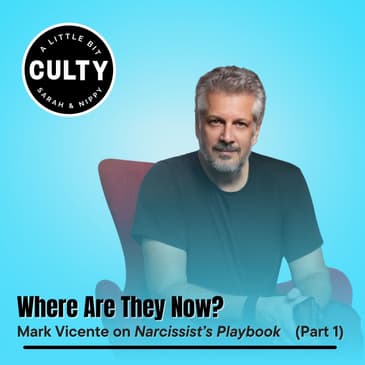
Mark Vicente returns for a new “Where are they now?” conversation and opens up about the five-year journey behind his upcoming film, Narcissist’s Playbook, which he describes as a way to better understand the psychology he once lived inside. We revisit how narcissistic patterns showed up in NXIVM and why they’re so hard to see clearly while you’re in it, and how the film tries to explain the mechanics of manipulation without pretending people can simply “love” abuse away.
Our conversation also digs into the documentary’s most disturbing insights, including the way narcissists can mirror people back to themselves, target vulnerabilities, and create long-game strategies of control that are hard to recognize in real time. Mark talks about what he learned interviewing self-aware narcissists and why the film is meant to be a tool for survivors, clinicians, and students alike.
We also revisit NXIVM’s bizarre intake questionnaires, Nancy Salzman’s role, Keith Raniere’s manipulation tactics, and the relief that comes from speaking openly once you’re out. Stay tuned for Part 2 of our conversation on Thursday.
Watch the trailer for Narcissist’s Playbook and stay tuned for early access links and screenings near you: narcissistsplaybook.com/long-trailer-landing-page
Follow Mark at markvicente.com, on Patreon, YouTube, Instagram, Facebook, X, or TikTok.
Trigger warning: This episode contains frank discussion of narcissistic and sexual abuse, coercion, manipulation, psychological control, and cult dynamics.
Also…let it be known that:
The views and opinions expressed on A Little Bit Culty do not necessarily reflect the official policy or position of the podcast. Any content provided by our guests, bloggers, sponsors or authors are of their opinion and are not intended to malign any religion, group, club, organization, business, individual, anyone or anything. Nobody’s mad at you, just don’t be a culty fuckwad.
Buy the A Little Bit Culty book on Amazon or order a signed copy.
Check out our amazing sponsors
Join A Little Bit Culty on Patreon
Get poppin’ fresh ALBC Swag
Support the pod and smash this link
Check out our cult awareness and recovery resources
Watch Sarah's TED Talk and buy her memoir, Scarred
CREDITS:
Executive Producers: Sarah Edmondson & Anthony Ames
Production Partner: Citizens of Sound
Co-Creator: Jess Tardy
Audio production: Will Retherford
Production Coordinator: Lesli Dinsmore
Writer: Sandra Nomoto
Social media team: Eric Skwarzynski and Brooke Keane
Theme Song: “Cultivated” by Jon Bryant co-written with Nygel Asselin
See Privacy Policy at https://art19.com/privacy and California Privacy Notice at https://art19.com/privacy#do-not-sell-my-info.
[00:00:00] Let me ask you something. When was the last time you actually got excited about opening your underwear drawer? Yeah, me neither. It's usually a depressing game of which pair is the least sad. Then I tried MeUndies and now I'm that person who has opinions about underwear fabric. The second you touch it, you get it. It's buttery soft. It's breathable. It actually stays put. No bunching. No riding up. No readjusting yourself like you're trying to be subtle but absolutely are not. I totally did that in yoga the other day and I'm sure somebody saw me.
[00:00:30] Anyway, here's where it gets fun. The Prince. My drawer went from mystery bag of beige sadness to something I actually look forward to putting on. They've got everything from classic black basics to prints that just kind of make you smile. From extra small to 4XL so everyone gets a flattering fit. Their ultra-modal fabric is so soft and stretchy, perfect for summer when you're wearing as little as possible, and comfort is non-negotiable. Plus if you're not happy with your first pair, it's on them. Zero risk and all comfort.
[00:00:58] I have loved every pair of little undies and bralettes that I've gotten from MeUndies and I've gotten them for a lot of gifts from my friends as well. I have never met a pair of undies from MeUndies that I didn't love. Seriously, 5 stars. Highly recommend. And honestly, I didn't know that underwear could be this much of an upgrade. Now I do and there's no going back.
[00:01:18] So right now, as a listener of our show, you can get up to 50% off your first order plus free shipping at MeUndies.com slash culty. Promo code culty. That's up to 50% off plus free shipping at MeUndies.com slash culty. Promo code culty.
[00:01:32] We always recommend Shopify. It took us from an idea to a real business. We got set up, I think, in less than a day with very little effort. We could just focus on the supply chains and the product development. Shopify gives us the ability to customize without the complexity. We can change something without introducing fragility or having to pay a developer. We're Thirsty Turtle and we leveled up our business with Shopify. Start your free trial at Shopify.com slash AU.
[00:02:03] This podcast is for informational purposes only and should not be considered legal, medical, or mental health advice. The views and opinions expressed do not necessarily reflect the official policy or position of the podcast and are not intended to malign any religion, group, club, organization, business, individual, anyone, or anything. I'm Sarah Edmondson.
[00:02:31] And I'm Anthony Nippy Ames. And this is A Little Bit Culty. We woke up from a cult. And that journey was captured in The Vow on HBO and in my memoir, Scarred. Now, in this podcast, we break down the shame and secrets that make these experiences so destructive with honest conversations on how seemingly benign groups can cross into the cultiverse and how to spot and recover from trouble if it happens to you. Each week, we bring in experts, survivors, and whistleblowers to explore red flags, resilience, and even share a few laughs because sometimes you gotta laugh.
[00:02:59] Subscribe to our Patreon for early and ad-free listening, some live Q&A, and exclusive content at patreon.com slash a littlebitculty. Welcome to Season 8 of A Little Bit Culty. Welcome back to A Little Bit Culty, everybody.
[00:03:25] This is part of our Where Are They Now? series, as promised, with Mark Vicente, author, speaker, filmmaker, and one of the voices who helped turn The Vow into required viewing for anyone who ever said, well, sounds a little bit culty. We first spoke with Mark back in Season 3, and since then he's been doing what he does best, using film to drag manipulation out of the shadows and into the light where it cannot hide behind buzzwords, branding, or fake smile wellness glow.
[00:03:51] And by branding, we mean like marketing branding. To be clear. His latest project, Narcissist Playbook, is a feature-length documentary. You may have noticed, if you listened to our Reload throwback episode last week with Dr. Robini, that he's been working on this for quite some time.
[00:04:10] This documentary pulls back the curtain on the psychological abuse with expert insight, survivor testimony, and some truly jaw-dropping confessions from self-aware narcissists. I didn't even know that was a thing. The film makes the case that the same manipulation tactics show up in intimate relationships, workplaces, dysfunctional families, and even authoritarian systems, just scaled up or down, depending on the venue. What makes it especially remarkable is that it's been entirely funded by survivors.
[00:04:38] Mark and his team are still raising money for marketing, advertising, and outreach, and putting the film in theaters themselves. So head over to www.narcissistplaybook.com to watch the trailer, share it, donate, do whatever you can to support this important mission. You'll remember we interviewed Survivor's Bentino Massaro organization right here on ALBC in 2022. Mark has since gone deep on that story, where he talks to Survivors about experiences inside the organization. It's part of a much larger TV series he's been developing for the past five years.
[00:05:05] That's available on his podcast, WTF is On My Mind. So yes, Mark is doing a lot in this space, and he knows the terrain from the inside. From his years as a filmmaker of What the Blib Do We Know to his role in exposing NXIVM, and now his ongoing work unpacking malignant narcissism, coercion, and the mechanics of abuse.
[00:05:24] So in this conversation, we catch up, because you know we love to do that, on his life, what he's been building, and why he's so fired up about telling these stories, and how he's trying to turn hard-earned lessons into real-world tools for survivors and awareness for the world. Hope you enjoy this two-part catch-up with our friend and colleague, Mark Vicente.
[00:06:01] Mark Vicente of the filming industry. Of the filming industry. It's a wide net. It's a wide net. What kind of filming? You might not know this, because you've been busy with your pod, but we've been doing a series called Where Are They Now? I did see that, actually. I did see it. I saw you did Isabel, I think. We did Isabel. Yeah. Yeah. You're the second. You're the second series. No, you're on me. This is you. We sprung it on you. You sprung it on me. Where are you now?
[00:06:26] Well, you may have sprung it on me, but your producers actually had reached out like months ago, and I forgot. And I was, by the way, intending, shameless plug, shameless plug. Oh, thank you. I was going to read this. Well, I actually skimmed through the entire thing. I read a bunch of sections, but I had to skim through some of it, because some of the stuff I knew, I kept on going through. But let me just give it a shameless plug quickly. I think it's a super important book, like super important.
[00:06:50] And I think that what's amazing about it is you show the pattern, and then you show all the examples of how the pattern plays out, which I think is very important. And also the stuff at the end, you know, about recovery, about advice and stuff like that. I think that's super important, because a lot of people reach out and say, like, what do you think I should do? And I'm like, well, you know, we didn't exactly heal, and we went to war. And I don't know, maybe heal a little bit, you know, before you go to war. And do you want to go to war?
[00:07:17] Because maybe war isn't the best way, you know, but super important book. So well done, guys. Well done. Thank you so much. Yeah, the chapter, Heal Before You Holler, at one point was Heal Before You Squeal. Then we didn't want to be a page. I think holler's better. I think holler's better. Yeah. Yeah. You like the Dylan quote, huh? I love it. I'm going to read it quickly. I'm going to read it again. So it says, could be the Fuhrer, could be the local priest. You know, sometimes Satan comes as a man of peace. Bob Dylan, man of peace.
[00:07:47] I'm like, dude, that's wisdom right there. He was ahead of his time. It's a good song. Listen, people who don't get Dylan, I think they go, oh, he can't sing, he can't whatever. Dylan's, and they think he was prophetic. And one of the things about that movie is like, oh, the left thought he was political. He was apolitical. Yeah, he was. His songs were like, yeah, they're prophetic, but they're also kind of like warnings. There's a great album of his called Infidels. And he made it like in 1980 or something like that. And he has Mark Knopfler from Dire Straits on it.
[00:08:15] And he has Mick Taylor, who's the Rolling Stones guitarist from 68 to 74, in my opinion, when the Stones did their best work. And it's such a good album. It has Joker Man. It has all these, if you look at just the lyrics, let alone the songs themselves, that's what Man of Peace is on that album. And it's just, I think it's one of his best albums. Can I give you some trivia about Dire Straits quickly, since you're on Dire Straits? So I went to school with a guy called Terence Reis. He's a Portuguese dude.
[00:08:43] And in drama school, drama and film school. And Terence was obsessed about playing the guitar, but all he ever played was Dire Straits. That's all he played. Cut to decades later, he became the front man for Dire Straits, the Dire Straits experience, and now travels the world being that dude that plays the guitar. No way. Look, those are some great riffs. That's dreaming. That's a man who knew how to dream. Dare I would say he was persistent and did a Dire State persistency? Mark Duffler.
[00:09:14] Persistency. I mean, he was embodying Mark Duffler. He was embodying him, and now he's a dude. So this is turned from, where are they now, Mark Vicente, to rock and roll trivia. Where were they? Where did they get to rock and roll? This is what Mark and I would do. But we'd go talk about growing the men's group, and then we'd just riff on life shit. Yeah. And then, yes. That's a good old day. All right, call you tomorrow. All right. Gotta go. Next meeting. Gotta go. Gotta go. Gotta call. Okay.
[00:09:43] That was me all the time. All the time. All right, what are we talking about? Probably we'll end this call the same way. Okay, so we're going to talk about, this is your third time on A Little Bit Cult-y, I believe. That's right. That's right. Where are you now? So I think the world knows you've spent, how many years now, making your film? This is five years now. Five years. About as long as we've been doing this podcast. Five years. Yeah. Yeah. I mean, it's interesting. Tell us. The journey. How'd you start?
[00:10:11] Remember when Bonnie was basically giving us all the articles to help us figure out what's going on? And she made that first list. And she was trying to explain to me what narcissism actually was versus what we were all taught by, you know. Right, right. Fuck face. A narcissist. A narcissist. And then I think around 2019, after the trial, she said to me, I think you should make a film about narcissism. And I thought, actually, that's a really good idea because I was so obsessed with trying to understand like how it worked.
[00:10:42] So I think we did our first, you know, reached out to Scott, who you know, did our first shoot in, we began prepping in 2020, did our first shoot in 2021. Which was actually, I think it was with Dr. Romany. And then we went to, I think, Macedonia or Prague or wherever it was. We did a whole bunch of stuff. So basically, we've been going for five years. And it became my obsession. I'm really happy, like, we're finally, like, at the finish line. But here's what's cool.
[00:11:14] In the film, which you guys have seen, I get to sit down and I get to interview these people with these pathologies, right? We never got that opportunity with Rani. Like, he never admitted anything. He never told us who he was. Yes, you know, we saw him in court, the way he behaved. But like, in some ways, it was healing because I got to interview him, the archetype of him through other people. And I got to understand, oh, this is what's going on. Or this is how it works. This is what he would never confess if he even was aware.
[00:11:44] Because talking to self-aware narcissists is really interesting because some of them really have deep insight into their behavior. They say they don't have a choice, which I don't know if that's true. But they have deep insight into their behavior and very deep insight into what they do to other people and why and how much they enjoy it, right? That's an incredible, incredibly valuable asset that you've put forward to people because I don't think anything like it exists. Well, also... Does it? Not that I know of.
[00:12:14] If you remember our Dan Shaw interview, and one of the things we were talking about with these kinds of people is they never put themselves in a position or conversation they can't curate. Which is, you know, I don't know how many others have been done or why these people break that mold.
[00:12:32] Or maybe you just found people that broke that mold and are kind of doing, getting the attention from revealing their psychology, still doing the behavior while explaining the behavior. That's it. That's exactly what it is. I mean, I remember having a conversation with... Because we reached out to HGTutor, right? I had a conversation with him. And I just wanted to be our friend. And I just said, like, why are you doing this? Like, why are you going to do this? And he says, because I'm going to get something out of it. And I said, okay. I said, what exactly?
[00:13:01] He said, well, I'm going to get an audience. I'm going to get fuel. And you're going to get what you want. Very clean discussion. Wow. Transactional. Very transactional. The same with all of them. I mean, I think what happens is the, you know, being on YouTube, whatever, being on the internet is a lot of fuel. Being in a film is like a lot of fuel. You know? So they just spoke. I mean, it was kind of insane. I was like kind of surprised. And by the way, there's some stuff that's not in the film that's way worse.
[00:13:30] Like HGTutor told me stuff that I thought, that's amazing. I put it in the cut. It was so dark that the audience couldn't recover from how dark it was. Like they went down a hole. Can you share it or no? There was one thing he said. There was a few, but there was one thing he said that really struck me. He said that he was, I guess, dating or with some woman who basically left him. And he just waited. I think he waited for like seven years. And then what he did is he basically started to encroach back into her life. At this point, she was married. She had children.
[00:13:59] She had an amazing life. He worked his way back into her life. He seduced her and blew up her entire marriage and destroyed her entire family and everything. And I thought to myself, that level of evil, like where you just play the long game for maybe seven or nine years or whatever it was, to completely destroy somebody who left you less than a decade before. That's a level of like strategy and evil that's profound.
[00:14:26] But the problem is it was so dark the way he said it that I was like, the audience can't come back from that. Because like we do try to give the audience some solutions at the end, as you saw. If it goes too dark, I mean, look, it's already fucking dark. But there were some things like that, that's too much. Too much. Yeah. Did you feel like you gained more insight into what happened with us and with Keith doing the film? I did. There's so many different things.
[00:14:52] I mean, I think one of the things is that, you know, I just saw how we kept on projecting on an empty wall. Like, you know, to different degrees. Like we kept on projecting stuff on him that was based on our own values. And when they talk about themselves as empty, they really are empty. But what they can do is they're good chameleons. In some ways, they're kind of good actors. They basically mirror back to you everything that you want.
[00:15:21] You know, that's why like, you know, let's take Nippy, for instance, like, you know, your love of the ideas of democracy and the founding fathers and all that shit. You know, he would mirror that back to you and it moved you. I mean, it moved Jim as well. You know, rest in peace and all that. Jim would cry about those things, you know, and he believed that Ranieri understood those values better than even he did. So that was one thing. The other thing that I didn't understand, but did later, and I saw this with Ranieri and a new woman that came into the organization.
[00:15:51] I remember once we were in Apropos, and I'm not going to say who it is. It's an actress who you know very well. Starts with the letter R. Blonde. Unicorn. Yeah, exactly. And I remember her walking out the back door, that back door to the parking lot. And he and I were talking, and he pretty much pushed me over, like, pushed me to get to her. And I was like, it was so weird because it was like the act of a desperate boy going after a girl.
[00:16:20] I'd never seen him do that before. But there was something, he was so desperate about it. And I thought to myself, you know, let's say you're a complete psychopath. Like, why would you be desperate? Well, the thing that's interesting, and I don't know what his actual pathology is, but I realized that they actually idolize their targets. Before the target is going to become a target, they idolize them. They actually kind of like fall for them. They become obsessed with their target, which I didn't realize.
[00:16:46] Until the person they're obsessed with doesn't behave the way they think they should behave based on the internal picture of the person. And that's when they start destroying them and devaluing them. Like, they live in a fantasy world. I didn't quite understand the level of fantasy that Raniere must have lived in to do some of the stuff he did. You know, we can say, yes, he's evil and all of that. But there were some very boyish things that he did. That was one example. Like, obsessed like a teenage boy about some girl who was walking out the room that he just had to get to. That impulsiveness.
[00:17:17] Well, that's also consistent. Yeah, sorry. Yeah, impulsive. I was going to say, also consistent with what we know about his reaction with some of the sisters, like kissing Ben or the other, like finding out that they maybe had a crush on somebody else. Like he couldn't handle that. Yeah, like the whole cock measuring fucking text message is bullshit. I mean, my God. Jesus, I forgot about that. My God. Yeah, that's pretty good. When you're 13, maybe, you know, but like, come on. Grow up. I didn't do that at 13.
[00:17:46] You didn't? Did it at 20? Seven? Closer to my 20s, yeah. Yeah, but this dude was like, he was like in late 50s at this point, you know, come on. Before we hear from our sponsors, just a quick reminder. Our book, A Little Bit Culty, Navigating Cults, Control and Coercion, is officially out and available on Amazon. Signed pre-orders have closed, but you can still get your copy today.
[00:18:13] This book is the culmination of five years of conversations, interviews, and research. Everything we've learned about how people get pulled into high control groups and how to avoid, escape, or heal from them. If you've been listening to the podcast and want a deeper go-to resource, this is it. Available now on Amazon in print and as an e-book for Kindle. And yes, the audiobook is coming soon, narrated by us. Just search A Little Bit Culty and grab your copy. Do it. Thanks, everybody.
[00:18:59] Thank you for listening. Now, let's dive back into the cultiverse. I know. I wonder if he's measuring cocks in prison. Oh, I'm sure there's, yes. I'm not, you know, I'm going to keep it clean. There is a kind of measuring going on. And I think he's the recipient of it. Oh. You know, Mark, you mentioned that guy waited seven years ago, ruined his ex's wife. That's why I think, you know, you need to monitor Keith in jail. I agree.
[00:19:28] I don't think he's done. If this guy ever gets out. That's all he has. You're fucked. That's all he has, right? So he's sitting around concocting ways, probably manipulating people. But like people still, they still listen to his phone calls, right? Like those phone calls are monitored, aren't they? They are. The BOP monitors them. But I don't know. Maybe he talks in code or I don't know. But then again, you know, I really have problems with lawyers because like his lawyers can tell him anything from somebody else. You know, client confidentiality and all that.
[00:19:58] So like, I don't know. Did the BOP evaluate those messages? Well, I mean, I would hope they do, but maybe they don't. So I don't know. I don't know. Speaking of the long game, do you remember there was a module that was like about suppressives level two? I think it was like the best game in town or there was a module. I don't remember. I think it was something. Delayed gratification. Yeah.
[00:20:20] It's where we learned that suppressive people, a.k.a. him, instead of like if you were a jealous neighbor, you know, they got the job you wanted or whatever. You wouldn't just scratch the car and as an impulse, you would slowly poison the dog over time. That's right. Remember that? Yes. I forgot. Yeah. So he did tell us that the long game was the best game for a suppressive. Yeah. It's amazing because it was all in there.
[00:20:46] I mean, literally, I would sit there like interviewing some of these people because some of them I spent days with, you know, some of the people in the film I spent days with. And I would sit there sometimes and they would say something and I would suddenly realize, oh, my God, there it is. That's the thing I didn't understand before. You know, and there's a certain charm as well. I'll say one thing like about HG Tudor. He has a kind of confidence that seems impenetrable and unbreakable.
[00:21:15] And I do remember that in the mindset that I was in when I was still in ESP, I found Ranieri's confidence like a good thing. Right. Because I didn't understand what I was looking at. The fact that he never seemed ruffled by anything, which wasn't true because later when I went back and thought about it, I said, he was ruffled about that and he was ruffled about that. But I just believed that he was unruffled. I thought, well, that's a level of certainty. That must mean he's right. You know, that wasn't an intellectual putting together of an idea.
[00:21:44] That was just a gut feeling like this dude fucking knows, you know. So it's to be expected. Like everything he felt like was like, yeah, that's part of it. And this is how you handle that. Yeah. You know, after so many episodes and, you know, being in this world for a while, I thought I kind of like had a pretty good handle on the topic. Yeah.
[00:22:04] You know, but one of the things that I learned from your film, and I wonder how you think this applies to Keith, is one of your narcissists, I won't say who, so it's not a spoiler for the audience, is how he explained that when he's looking for something, you know, when he's scouting, he can tell whether or not the person wants to be healed or whether the person wants to be destroyed. I know. I know. That was new. Was that a surprise for you? That was new. That was a surprise for me too.
[00:22:31] And look, a lot of people have pushed back against that. They don't believe that. But like, we all have at some point self-destructive tendencies. And I've known people that just are on the path towards self-destruction. And depending on your wiring, I think there's some people that keep on going into situations, probably not consciously because they, maybe he's right. Maybe they don't want healing. I think it's a minority. Maybe they want to be hurt. I mean, shit, there's a reason there's S&M exists, right?
[00:22:59] I guess, and all that bonded shit and whatever. But it's a very dark thing. Now, look, I think he was in a very performative mode as well because I don't know if what he's saying is true. Yeah. I was going to say. It may have been a performance. He was enjoying the camera a little bit. Yeah. A lot. A lot. Yeah. But there's something about that, about the way they can scout people. It's just fascinating. And by the way, what was so interesting about that scene you're talking about is there was a woman in the audience that had flown in to see him.
[00:23:29] For a treat kind of thing. And I thought to myself, he's saying this stuff in front of her. And you can see, and I won't try and describe her because, you know, privacy and all that. But like you see her melting down in the audience. Because he's literally talking about what he's going to do to people. And she's sitting there. And I was like, this is the most fucked up thing I've ever seen in my life. And, you know, because you're behind the camera, you're shooting, you're doing all this stuff.
[00:23:57] But at the same time, you're aware of this, you're like, something's not right here. That's just horrible. Anyway, there's a long story. And I was also surprised that he was married. He's married. He's married. That's crazy. But listen. My God. I will say that I think in some ways he's done a service to the field of psychology. Because I think there's a level of insight. Like, I think it's one thing to be a psychologist that studies this shit.
[00:24:26] It's another thing to actually have it. Intellectual versus experience. Yeah. There's something about really having it and understanding what motivates you. Now, that's a topic for a lot of discussion. Because, you know, the question is, does he understand? Does not? Whatever. I'm not sure. But I will tell you, I learned a lot. A lot. Yeah. You have an experience. There's forensics there that anyone watching superficially can get. You know, the parallels that I saw when he was saying, what was it? Some people want to be destroyed or taken care of. What was the line?
[00:24:55] Some people want to be healed and something like some people want to be destroyed. Simply how he was putting diagnostics to everyone. Like, there's not a coincidence of all the parallels between all the DOS women. And we don't have to call them all out. But they all have emotional congruencies that I'm seeing just kind of knowing them. Yeah. I'm sure Keith developed an acumen where he can go, this person's susceptible. This person's susceptible. They're not. They're going to take some work.
[00:25:23] Like, I think his forensics were able to just go, boom. This is what this is going to be. Silo these two. They're loyal. Use them to indoctrinate the others. Normalize. You know, like, I'm sure that's like, because if this is what you have a lifetime of doing, I mean, look, I got good at throwing a football because I did it all the time. Right? This is what he's been doing. We've heard from Barb O'Shea since he's a teenager. Yeah. Probably his persistence is his persistency. I think so. He's mastered recognizing impulse sets.
[00:25:49] And just from, like, you know, I said this in a podcast a little while ago, just from the fact that you and I sat down for 10 years, elicited information with the same questions to thousands of people, we got a sense of, like, oh, this is probably how they're going to answer this question. And I wasn't trying to do it for any sort of manipulative reason. I just started recognizing impulse control. Right? You could almost, they could walk in and we could probably go, this is probably the module they're going to have a problem with. Yeah. Right?
[00:26:15] So Keith, with this pathology from an early age, just can walk into the room and recognize, oh, I'm going to sleep with her in one month, six months. You know what I mean? Like, if that's what he was practicing and honing. He got good at it and then was able to create an architecture around it. It's interesting you say that because I was thinking back to, like, one of the things I learned from Raniere, well, we all did actually, that is actually very valuable, is understanding that whatever person says, they say it's based on believing something.
[00:26:45] Yeah, their base assumption. Base assumption. If you can understand enough about them, spend time with them, you understand the base assumption. The base assumption is what drives everything, you know, which is very NLP and also, you know, what he taught. Which is interesting because it's not like I've been able to shut that off completely. Right. When I interact with people, like I say, I start to not only analyze it, but I also feel a lot more now than I did inside ESP. Like, I feel a lot more. And I feel what's probably going to happen. And you're right.
[00:27:14] Somebody that's trained their whole life to do that, but uses it not to help, but to hurt. Like, of course. And that's what you see in the film. You see people that have trained themselves to do that. And I mean, look, I know it's, I know the film is very shocking in some ways. I think one of the things that I was trying to do so much, remember how when we came out, when we started coming out, people were saying, oh, I can't believe he's evil. I can't believe this. I can't believe about Raniere. And we were trying to explain to them, like, no, this should exist.
[00:27:42] Like these, this is, he really is another species. He said, he said it himself. He described those people as another species. I wanted to make a film that dissuaded people from the idea that these people could just be loved back into wholeness. Like that there really is something wrong, you know? And just because you're a good human being and you love people, that ain't going to do shit, you know? So I think we did do that. I think a lot of people, we did a screening at UCLA a week and a half ago and they were all like clinicians and like the cream of the crop, you know?
[00:28:11] And they were blown away and they were like shocked. And I was like, wow, that's, it felt really good. I was terrified of that screening. Yeah, because I was, I was scared because they were all like, they were experts and they loved it, you know? So I was, I feel like we really succeeded. Were there parallels? Like, did they disagree, agree? No, they pretty much agreed with everything. And they thought it was basically an amazing tool to help explain how it works. A lot of people saw the parallels like with, you know, domestic violence and with, you know, other kinds of sexual abuse.
[00:28:39] And they saw all the parallels because the film really has you see the, all of these things come from a pathology. I mean, I talk about this all the time and I know, I know Ranieri did as well, which is sometimes irritates me. All the bad things in the world are coming from people with this pathology. And that's what we're trying to show in the film. You know, it's true. I totally agree. That is where it comes from. He just talked about it to hide the fact that he was one of those people. Exactly. And when you were talking about the... He described how those people worked inside systems.
[00:29:07] And shift your strategy and all that, which is another conversation. But when you were talking about how he, you know, systematically found those people, I still don't have an answer to this. And maybe Karen Unterreiner or one of the, you know, OG, you know, inner circle members would know. But do we ever know for sure if those intake sheets like those, what are they called? Remember those? Evaluation. They were NPD evaluations. Yeah. So who read them? And did Keith sit with them? Did we know? I can tell you what I know.
[00:29:37] What do you know? I can tell you what I know. What do you know? Are you talking to Mark or me? You. I'm just basing this way. So after a training, because I was staffing it, Karen Unterreiner gave me a box of them and told me to take them over to the shredding after everyone had done it. That's interesting. You're telling me this now for the first time? I mean, okay, well, I will tell you that I know that there were boxes of them in the center that were never looked at.
[00:30:05] And there are being some of them, at least in the early years, they must have. Were being shredded. Maybe. I think it was just to fucking wear us down. I think in the early days, they must have looked at them and said, okay, this person's a narcissist or this person's, you know, grandiose. Or I know that this person has his birthday. Go find his birthday. I want to find out how they answer these questions. Yeah. I just texted Karen. Oh, how he used the intake. The intake. I mean, and for those who don't know what we're talking about, we had to fill out this
[00:30:33] like 25-page questionnaire that was basically different questionnaires from the internet printed out and then photocopied. And we think about it, like the format and the font was different. Some were multiple choice. True or false. Some were true or false. Some were the format changed. The font changed. It was so bullshit. But we were told that they were being shipped off to be analyzed to see how we changed over time. But I think it was a way for him to see who was. Anonymous. 100%. Except for our birth dates. 100%. Yeah.
[00:31:04] Yeah. And then what I found out later is that it was basically a questionnaire to determine whether somebody had narcissistic traits or I don't know if it was NPD or just narcissistic traits. I was like, why would you want to know that? I think we figured it out because if you Google, am I a narcissist or like take home test for narcissism, the questions were not only the same, but they were like, that was where the test was from. Yeah. You just like downloaded it and printed it. And then like, I want to be a leader.
[00:31:33] I think I can run the world. I forget the questions. Here's a question for you, Mark. I don't want to be a leader. It's a good sign that we can't remember because I can't remember either. Nancy's out there yapping her gums a little bit. She's coaching. Yeah. Do you think she's reconciled? That's what she was next to for however many years. And do you think she has an understanding of it? Because I don't, based on what I'm seeing. No, I don't think she has a clue. And how do you think Keith used her? Knowing what you know now about narcissists. Yeah.
[00:32:02] I think what he used was, I think he used her, she was mission oriented. She wanted to be a good girl. She wanted to help people. And she wanted to be special and loved. And smart. And smart. And I think he used all of those things. And had some skill sets. Yeah. All of those things. And gave her that at first.
[00:32:25] But what was interesting later, I was telling somebody the other day in 2015, because I was, you know, all those executive board meetings, some of them, or green meetings, some of them, like, I think before you came in, Sarah, into green. Some of them, she was at the green. Some of them she was at as well. Raniere would treat her like shit. Like he was just mean to her. And I remember at one point in 2015, I was taking a walk with her and saying, like, do you notice how he treats you? And she's like, no. I'm like, treats you really fucking badly. Exactly.
[00:32:55] She just couldn't take it in. You know? But, like, a lot of other people could see it. That was, you know, green meetings and executive board. So I think at first, he did love bomb her. And then he made her believe that she wasn't living up to her potential or what she should live up to. And then she spent the next, like, you know, decade and a half trying to live up to something. Yeah. Live up to something that she couldn't do. And he would punish her all the time, which is exactly kind of what he did to all of us.
[00:33:24] Like, he told us we should have these goals and we should have these whatever. That when we tried to get there, he would punish us back. You guys, I mean, you saw that as well. Constantly. Like, Mark, I remember, I don't know what year he was, but I remember, I always had kind of an arms distance relationship, especially to certain things that Nancy would say. But, you know, a lot of times I'd be in the training and I'd be like, okay. But I was on board with what we were doing or I thought we were doing. Yeah.
[00:33:51] And I remember Nancy comes in one day and she was talking about how Keith was in a meeting, ignored her, turned her back to her, and did not answer her questions directly and reprimand her. And she was gushing about what a great master teacher he was by making her see her attachments. Wow. And I remember thinking, what a fucking dick. Yeah.
[00:34:16] Like, why would you, what's, and she was raving about how like, like he was doing it for this noble reason, treating her like shit. And I remember thinking, what? I never heard that. This is when I was peripheral. This is peripheral. This is like probably when I came back to work on a film and like, not there for the curriculum per se, but like hearing like, what in the fuck is she talking about? I remember her bragging also about how she, he would wait to like the very last minute to give her the curriculum. That's abusive.
[00:34:46] Like for me as a planner, you know, control freak, I was like, that's not okay. That's not okay. It's not. In the name of her growth. In the name of your growth. No, like people are paying lots of money. You got to get torqued. It sets you up for failure. Yeah. And then she would actually talk about it with enjoyment, how she was being tortured. Yeah. It was insane. I don't know the curriculum until I get up at 8 a.m. And I go over to Keith's. He downloads me. And then I have to make him some eggs. But by the way, that's why the first trainings were chaotic. Chaos. They were fucking chaos. Chaos. Oh my God, remember?
[00:35:16] And we'd say things like, it doesn't make sense. And then she'd get upset and we'd say, it still doesn't make sense. You know, you know what I remembered the other day? Sorry. We're going down. We're going down memory lane. We're having a piss now. In just a second. But I remember like Nippy and I just started dating. I'd come to New York to visit him. We were doing, and we decided to go up to Albany for New Year's. And then while we were there, they announced Mobius to start in three days. And I was like, I've got a flight.
[00:35:44] And I remember Nancy pulling me into her office and saying, what does it mean that you are a center owner and you're not taking every piece of new curriculum that Keith Raniere rolls out? Yeah. It's extraordinary. It's extraordinary. It is extraordinary. I had to take it. I got those calls too. I know. We had to take it. Was there ever curriculum that we didn't take that was rolled out? Also, the worst part. We didn't miss a thing. Me, I didn't take Ethicist 2 the first time it came out. And I got so much shit for it.
[00:36:12] Ethicist was such a load of shit. Also, it puts you guys in a situation too. It was a movie watching program. Where you guys had to go, I'll make the same phone calls. You know when that stopped though, Mark? Was with the university program. Yeah. When they rolled out the university program in the last few months. That was my last conversation with Nancy. She called to ask me why I hadn't recruited anyone for the university program. I was like, well, five grand a month for the same curriculum that's Ethos is kind of not really doable for the people in my organization. Fuck you very much.
[00:36:42] Anyway. You know, it feels so good not to be like, not to feel afraid of that shit anymore, you know? Yeah, to talk about it? Yeah. Yeah. And I'll tell you, you know, that people that have been, people that have been, and you guys know this because you talk to these people as well. People that have been abused by these people when they come out and they start comparing notes and they feel the relief, not at first. At first they're terrified, but then they start to feel the relief of being able to say whatever they want about the leadership. It's very freeing. Which is why they start saying horrible things.
[00:37:11] I didn't see that part. Yeah. It's have a free for all. Have a bitch session with former members. I didn't see that. Oh, I like that. I like that. There's going to be a lot of things that you've gone through with us. Trying to put it all in one book so we can, you know, give it to somebody. It is very hard to compile it all, but you'll appreciate it. We're going to make the cheat sheet top 10. That was the other thing. You like the cheat sheets? I told you privately. T-shirts. The cheat sheets are amazing. T-shirts. I love them.
[00:37:41] They can skip to the cheat sheet and still go. Exactly. Exactly. Very smart. I think if you're out in public and someone has cheat sheet for love bombing and they read the back of it and go, Holy shit, that happened to me. What's love bombing? Yeah. Oh, it's in this. Yeah. It's a conversation starter too. Exactly. Back to your, back to the, no, no, not but. And back to the movie. Let's take a little break from the cultiverse. Here's a word from our sponsors.
[00:38:17] Thank you, sponsors. We couldn't do it without you. Now let's get back to the show. Yeah. I mean, so good. So good. And also very uncomfortable. As you know, which I think is important. It was uncomfortable. You told me you stopped at about, I think, 30 minutes and then you continued the next day. 40 minutes. Yeah. We split it up also because just the way our lives are, but I needed to just take a little breather. And yeah, the interviews are great. You know, the twists, which we're not going to get into. It's because we want people to watch it. So where can people watch it, by the way? Let's wait. Let's not wait to the end.
[00:38:47] Like, what's the story? Tell us what's been going on. Yeah. So look, we've been working in this room for a long time. We actually showed a few streamers and studios an earlier cut. It was really interesting. Like, I'm not going to say the name of the studio. It's a big studio. The woman that ran things at the very top loved the film, wanted the film, were like, oh my God, this film's incredible. But their boss, a man, said, there's no audience for this movie.
[00:39:15] And if you'll remember with What the Bleep, it was the same story. So a few streamers and a few studios have said, like, oh, there's no audience. And we're like, you guys are fucking idiots. And then what was interesting is we started submitting it to film festivals. The normal route, you make something, submit it to film festivals, get the buzz going. We got turned down by 26 film festivals. And we were like, everybody was like, what? Everybody. Everybody who's seen the film is like, what?
[00:39:44] And so we were like very puzzled. And then a few of the festivals said, it's too hot to touch. And we're like, what do you mean? It's, oh, it's a legal nightmare. And like, whatever. And I was like, that's interesting. But there's something about this film. And maybe because it goes tangentially after power structures and how the power structures have this narcissism embedded inside of it. That seems to be terrifying people, I think. The Guardians of the Gates. Yeah, exactly.
[00:40:10] And or some of the people that make decisions at the film festivals are like kids who just don't fucking understand what they're looking at. I don't know. But what we decided to do is, okay, we had the same problem with What the Bleep. We turned it into something amazing. We're going to just start putting it out ourselves. So we've been raising money as we go. We've had this amazing donation campaign, which is still going on. The people that have donated, they're going to get to see the film on May 30th. The general release will be in July.
[00:40:39] But what we'll do in between then is probably do like a weekend event where we'll show the movie like on a Friday. And we'll have a bunch of panels and all the experts and people in the film and make an amazing weekend out of it. And what's basically happening, just like What the Bleep, is the audience is coming on board to promote the film, which is what we hoped would happen. Because what the streamers and studios didn't understand was that the audience is there, they're hungry for it. And the minute they know it exists, they're going to want to tell everybody about it.
[00:41:08] Because the thing, I'm going to say it this way because I know we want to be careful. The film takes you through the experience, and you guys will probably nod your head, of what it's like to be fooled and fucked over. And it does so very effectively. And what happens to survivors, and everybody who's ever been in that kind of relationship or a cult, gets asked the question, how did you not see it?
[00:41:28] Well, motherfucker, let me tell you, in an audience of 400 people at UCLA, 399 people didn't see the twist. They did not. It was a fucking surprise. One person said, yeah, I thought so. That's clinicians. That's trained people. That's people who are doctors and professors and fucking masters and everything.
[00:41:54] So I think what happens is when people see it, who have been through it, they're going to tell other people, like, I want you to see this film. This film will explain why I didn't see it. This film will explain, like, why I stayed. Because I can't explain it to you. Because that's the thing people always ask, well, why did you stay 10 years? Why did you stay 7 years? You're on my meme list. We send memes. Oh, yes. My brother sent me a meme. I can't remember the artist, but someone like Prince or someone like that.
[00:42:21] And it was something like, the people at studios don't know what the people want. Tell them what they want. That's true. Tell them what they want, right? Yeah. Also. And I think if you can, I mean, I would love to help you out and get it in schools here. Sarah and I, like, when we talk about our book, like, I'm not good at self-promotion, but I have zero problem saying to high school parents, high school college kids, read this book. If there's anything I feel comfortable saying is, read this book. Your kids need this knowledge. That's true. You can say the same thing about your film.
[00:42:51] That is true. You got to get these kids early because they're in risk of going down the road of narcissism, right? Because this new world is training narcissistic. There's no shortage of narcissistic people. Yeah. Right? And it's being nurtured and it's being rewarded. You need to get the kids going, this is the wrong path. And it's a soulless existence, right? Yes. A hundred percent. The work we're doing, at least I feel like, hopefully, I don't think it's presumptuous, is it's soul saving. I think so.
[00:43:20] Ours got sucked on and now we're giving back. Oh, yeah. You know? Yeah. You just reminded me. Does that make sense? Yeah. I mean, I think I got language for it, but that's the importance of it. And I want to get you in schools. I mean, I want to get into universities, you know? Universities. Yeah. I want to get into universities and I want clinicians to see it because it's one thing to study the shit. It's another thing to have an experience, you know, like in a theater with people. That's the other thing. We really want people to watch it in theaters. Yeah.
[00:43:46] Like we want to do a road show, you know, to go to different cities, to have people together. Because what happens is, remember like with What the Bleep? Sarah, you and I spoke about this years ago. Like people, when they finished watching it, just wanted to talk to each other. They just wanted to connect. Remember on the cruise ship, right? Everyone was talking about it. The same thing happens with this film. What happens when the credits are over is everyone's just in stunned silence at first. And then they start talking to each other. And then they start comparing notes. And then they start sharing about what happened to them.
[00:44:16] It's incredible because there's this really interesting community that builds. And often you have clinicians who, or people at different stages, you know, who are further along, who can talk to the people that have just come out. Or some people realize in the theater, like, oh shit, this is my marriage. That's intense. And one person I want. You need like a support group. Yes. We're going to do that as well. But I will tell you, and I'm not going to name names. One of the experts in the film, who has many degrees, we interviewed her.
[00:44:48] And then she found out that's what her marriage was. No. And she said, how did I sit in that chair and be interviewed by you twice and not know? She was stunned. You can't say who that is. I can't say who it is. But that's the whole thing. You need to tell us when we're not recording. Yes, when you're not recording. Yeah. You can never fall for it. That's why I love what you say in the book, you know.
[00:45:15] Like, when you say, I can't fall for it, you're a sucker. Yeah, you're fortifying your blind spot. Totally. You're the most vulnerable. Yeah. You're a sitting duck for those fuckers. If intelligence agencies know how to build a profile on somebody and get them, then cults do too. You know. Yeah. That's the algorithm. Sarah's mind is spinning. Yeah. Well, think about it. To a lot of these people. I'm picturing scenes from aliens. It has a mathematical feel to it.
[00:45:45] Yeah. The feelings I get around them, like, oh, this person's probably going to do this. That's a math. Yeah. Well, actually, I love the way you said that because that is kind of what I'm hoping people get. It's like either the right glasses to see how the shit works or the math to know how it works. Yeah. You know, to me, it's a bit like, remember seeing chess when I was a kid the first time and made no sense until I understood what everything did. And then I was involved in watching the games. You know, you need to understand how shit works. Right. You know, because then you can be like, oh, that's what's going to happen.
[00:46:14] And then that's what's going to happen. Oh, here comes a devaluation. Oh, there we go. You know. Also, history is really great. History is amazing. Pattern recognition. I don't remember where it was. Someone was saying everything that's going on right now in the world right now has happened before. Yes. Will happen again. Yes. And it has a kind of trajectory to it that could go one of a handful of ways if these things happen and being able to recognize it.
[00:46:43] And Winston Churchill's quote, the further back into my past I looked, the more I learned about my future. Yes. I'm happy you said that because you know what I've been thinking a lot about? I think Nippy, you and I may have discussed this at one point. You know, the whole thing that's been happening in the academic world where people get pulled up in front of boards and they get interrogated and they are told you have to get training to change the way you think. And I'm like, that's the Marxist struggle sessions. That's the struggle sessions from China. It's crazy.
[00:47:11] Like, how do you not see the relationship between those two things, you know? It's crazy. And any criticism is evidence of your perpetrating. Yes. Yeah. It's really, it's nasty some of the shit that's going on. Speaking of patterns, I didn't know that you were into chess. Yes. Did you hear our episode or have you seen anything about Danny Wrench and Dark Squares, his book about chess? No. You should have him on. So let me tell you really quickly, a little tangent. He's great. He's a great interview too. Great interview. And you'd love his book. Are you really into chess? How did I not know this?
[00:47:40] No, I just, no, no. I just, I just thought about like how I knew nothing as a kid, you know? And just then when I learned how it worked, I was like, oh, that's fucking amazing. So just a quick sidebar. He was in a cult called The Collective. He was raised in the 70s and 80s in, I want to say Utah. It doesn't matter. Arizona. Arizona. And there was a medium not dissimilar to Dumpster. Should we call him her Dumpster? You know what I'm talking about? Mm-hmm. Mm-hmm. We're not going to say names. Dumpster. A medium that you may or may not have studied with. A trans person. Yeah.
[00:48:10] Oh, you're calling her Dumpster. That's what Keith called her. Yeah. Keith used to make fun of her name and say, might as well say, what else could you call her? How about Dumpster? Dumpster. That's a little guru envy. Guru envy. Yep. Anyway. That's true. Remember that? That's true. I do. So he grew up with that and the leader of it, Stephen Camp, at a certain point, everyone was watching, searching for Bobby Fischer and they were also kind of on lockdown because the community around was like being aggressive towards them. So they're all kind of staying at home or something like that. So they all got really into chess.
[00:48:40] And Danny got really into chess and he got really good at chess. And so the leader was using him as a pawn to basically prove to the world that the group was good, the collective was good. And he got really good at chess and became like a master at a young age. And anyway, he broke free of that and now is one of the co-founders, this chief CCO, chief chess officer of chess.com, which is like that biggest online platform. So he went from like literally having no shoes to owning this like billion dollar company.
[00:49:10] And he wrote a book about it and it's just fascinating. Well, I think what you'll like about him is this. He started chess.com kind of for the love of the game, you know? And it was like his project and didn't expect it. And then the Queen's Gambit hit. And then COVID. And then COVID hit and everyone got it. And then he has this huge company now. So it's kind of cool the way, like he wasn't this guy, like I got 10 times this, you know, he was doing it, he liked it. And then fortune hit him. It's a great ride. Interesting.
[00:49:39] Universe took care of him in a way. I definitely want to check it out. It's funny, you know, I never does. I never liked playing chess. You know, what am I? I don't either. I told you what am I? One of my hobbies is going to the gun range now. That's amazing. I love, I go once a week to the gun range and I have learned so much. But I've learned so much from the gun range. I will tell you, I've learned so much about breathing, relaxation. That sounds like counterintuitive.
[00:50:07] Relaxation, trust, calm and high stakes. It's been amazing. It's the weirdest hobby that you could ever imagine me doing.
[00:50:37] We hope you're enjoying A Little Bit Culty. If so, please do show us some love. Drop a rating or leave a review. Hit subscribe on Apple, Spotify, or wherever you listen. And subscribe to our Patreon at patreon.com slash a little bit culty. Even better, send this episode to someone who needs it. Maybe they're in a cult. Maybe they're just a little bit susceptible. Or maybe they just love a good story. Spread the word, spread the love. Thanks for listening and see you next time. A Little Bit Culty is a Trace 120 production. Executive produced by Sarah Edmondson and Anthony Nippy Ames
[00:51:07] in collaboration with producer Will Rutherford at Citizens of Sound. Our co-creator is Jess Temple-Tardy. Our production coordinator is Leslie Dinsenbor. Writing by Sandra Namoto and social media marketing by Eric Swarczynski and Brooke Keane. Our theme song Cultivated is by the artists John Bryant and Nigel Aslan.