
This episode is sponsored by Betterhelp.
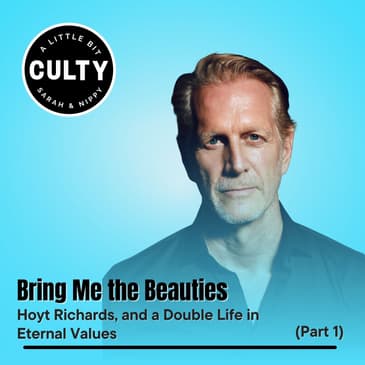
Hoyt Richards joins the pod to talk about the double life behind his modeling fame and his nearly 20 years in Eternal Values, the high-control group also featured in HBO’s Bring Me the Beauties: A Model Cult. He reflects on how a seemingly glamorous world of fashion, access, and status got tangled up with grooming, identity loss, and a spiritual system that kept pulling him deeper in.
Our conversation focuses on how recruitment worked: being flattered, singled out, made to feel special, and gradually separated from family, friends, and any outside perspective. Hoyt explains how Frederick von Mierers (Freddy) used charisma, mystique, and selective “truths” to make himself look enlightened while building a group that demanded loyalty, labor, and secrecy.
We also talk about the psychological cost of staying, the “matrix” framing that made leaving feel spiritually dangerous, and why survivors often need both accountability and self-compassion in recovery. The real story is not just the cult leader, but the ripple effect on everyone dragged into the orbit, and why those warning signs can show up in cults, relationships, and other power dynamics. Stay tuned for Part 2 of our convo on Thursday.
Follow Hoyt Richards at hoytrichards.com and on Instagram @hoytrichardsofficial, and Bring Me the Beauties on Instagram @bringmethebeauties.
Trigger warning: This episode contains frank discussion of cults, coercive control, grooming, manipulation, emotional and spiritual abuse, and family estrangement.
Also…let it be known that:
The views and opinions expressed on A Little Bit Culty do not necessarily reflect the official policy or position of the podcast. Any content provided by our guests, bloggers, sponsors or authors are of their opinion and are not intended to malign any religion, group, club, organization, business, individual, anyone or anything. Nobody’s mad at you, just don’t be a culty fuckwad.
Buy the A Little Bit Culty book on Amazon or order a signed copy.
Check out our amazing sponsors
Join A Little Bit Culty on Patreon
Get poppin’ fresh ALBC Swag
Support the pod and smash this link
Check out our cult awareness and recovery resources
Watch Sarah's TED Talk and buy her memoir, Scarred
CREDITS:
Executive Producers: Sarah Edmondson & Anthony Ames
Production Partner: Citizens of Sound
Co-Creator: Jess Tardy
Audio production: Will Retherford
Production Coordinator: Lesli Dinsmore
Writer: Sandra Nomoto
Social media team: Eric Skwarzynski and Brooke Keane
Theme Song: “Cultivated” by Jon Bryant co-written with Nygel Asselin
SUPPORT OUR SPONSORS:
You don’t have to say yes to everything this summer. Find support in therapy.
Sign up and get 10% off at BetterHelp.com/culty.
Get the right life insurance for YOU, for LESS, and save more than 50% at SelectQuote.com/culty.
Download EarnIn on the App Store or Google Play. Spelled like earnING money without the G. Type in ALittleBitCulty under PODCAST when you sign up. It’ll really help the show. EarnIn is a financial technology company, not a bank. Access limits are based on your earnings and risk factors. Standard Cash Outs take 1-2 business days with no mandatory fees. Expedited transfers available for a fee. Tips are voluntary and don’t affect the service. Available in select states. Terms and restrictions apply. Visit EarnIn.com for full details.
See Privacy Policy at https://art19.com/privacy and California Privacy Notice at https://art19.com/privacy#do-not-sell-my-info.
[00:00:00] We always recommend Shopify. It took us from an idea to a real business. We got set up, I think, in less than a day with very little effort. We could just focus on the supply chains and the product development. Shopify gives us the ability to customize without the complexity. We can change something without introducing fragility or having to pay a developer. We're Thirsty Turtle and we leveled up our business with Shopify. Start your free trial at shopify.com.au
[00:00:30] This podcast is for informational purposes only and should not be considered legal, medical, or mental health advice. The views and opinions expressed do not necessarily reflect the official policy or position of the podcast and are not intended to malign any religion, group, club, organization, business, individual, anyone, or anything. I'm Sarah Edmondson.
[00:00:58] And I'm Anthony Nippy Ames. And this is A Little Bit Culty. We woke up from a cult. And that journey was captured in The Vow on HBO and in my memoir, Scarred. Now, in this podcast, we break down the shame and secrets that make these experiences so destructive with honest conversations on how seemingly benign groups can cross into the cultiverse and how to spot and recover from trouble if it happens to you. Each week, we bring in experts, survivors, and whistleblowers to explore red flags, resilience, and even share a few laughs because sometimes you gotta laugh.
[00:01:26] Subscribe to our Patreon for early and ad-free listening, some live Q&A, and exclusive content at patreon.com slash a little bit culty. Welcome to Season 8 of A Little Bit Culty. Seeking down to the depths of the ocean. Welcome back to ALBC, everybody. This is our second time attempting this because we've recorded it.
[00:01:54] Well, we're new to being a full episode on YouTube, so thanks for your patience for us. Thanks for subscribing. This episode is such a long time coming. Today's guest has lived a double life that sounds almost too surreal to be true. Hoyt Richards was one of the most recognizable faces in fashion, in my world he still is, as the world's first male supermodel. He's worked with icons like Cindy Crawford and was photographed by legends like Richard Avedon and Bruce Weber.
[00:02:20] But behind the cameras and campaigns, there was another story unfolding, one that very few people knew. Legend has it that he invented blue steel. Yes, I think he did. We'll confirm that on this episode. For nearly two decades, Hoyt was deeply embedded in a high-control spiritual group called Eternal Values, surrendering not just his income but his autonomy. His experience is now also featured on the new HBO docuseries, familiar with those. Bring Me the Beauties, A Model Cult, number two as of this morning.
[00:02:50] Amazing. Which pulls back the curtain on the 80s supermodel world and the hidden systems of power, control, and survival behind it. After leaving in 1999, Hoyt began the long process of rebuilding. Over the last 25 years, he's become one of the most thoughtful and articulate voices on cult dynamics, coercive control, and recovery. And we're proud to say that he's a friend. How did we meet Hoyt Richards, do you remember? Stephen Hassan, or Hassan. Stephen Hassan. He texted me and said, hey, you might want to reach out to this guy, Hoyt.
[00:03:20] You had a very similar background. He's your stunt double. Ivy League. He's basically you 10 years older. Ivy League graduate, football playing. And I was like, wait a minute. And then we texted for a while. And then I think after, because I was in the shame process of rebuilding. I didn't really want to talk about it and didn't really. And then I was like, I think eight months later, I finally texted you and we had a conversation. And then we became friends. We met up in New York. That's right. You took none of the advice you gave us.
[00:03:49] You gave us really good advice, Hoyt, which is in our book, right? Do you remember what you said to us? Well, I remember saying that I don't advise processing your trauma on camera if you can't avoid it. Yeah. And then we said, sorry, too late. Yeah. I was like, what? You're like, yeah, okay. But listen, that's how we all learn. It's great to see you guys. And I just thought the second night was even better. Oh, good. Yeah. So it's good. You're getting good at this. Thank you.
[00:04:19] And we've managed to see each other a couple times since at some cult events and the screening of season two of The Vow. And then how full circle that now we get to watch your story. I mean, we've been talking about you coming a little bit culty since we started it. And it was just like never really the right timing. And now it's perfect timing. Well, I think it's meant to happen when it happens because it's now more robust, I think. It is more robust. And I don't know if I told you this, but we're watching the doc, which I think is amazing and everyone should watch it.
[00:04:48] And as Nippy mentioned, Dr. Stephen Hassan said, you know, you guys have a lot in common. You guys are very similar. And then we're watching your modeling career take off. And Nippy looks at me and was like, I never quite hit that level. Never quite that type of model. So. I have two distinctions. There's commercially handsome and then professionally good looking. And I think I fell under the commercially handsome and you're the professionally good looking. And it's a term, you know the world.
[00:05:17] Like I was taking an acting class and this girl comes up to me in my acting class and says, do you do print work? And I'm like, what's that? She said, give me your headshot. She takes it down to an agent of hers. And the guy calls me and then, you know, I started booking like beer commercials or whatever. But then I was trying to get what I think commercial work, like actual on camera stuff. And I take my headshot into this agency. And this guy goes, look, you know, right now I don't think we have room in our roster, but I can put you over to our commercial, our print or department.
[00:05:46] He goes, get literally gets on the phone and goes, listen, I got a guy here, square jaw line looking at me, goes, play quarterback at Brown, commercially handsome. Puts up. He goes, yeah, can you beat him Tuesday? And I was like, it's like, fine. I like called my mom. I'm like, mom, I'm commercially handsome. And then there's professionally good looking. You're professionally good looking. Well, as I always say, my parents did all the work. I just wear the costume. That's true. They should take credit.
[00:06:15] And this is normally a question I'd ask at the end. But since we're talking about it, are you modeling at all anymore? Not really. I mean, once in a while, they might call the old fox, you know, dust them off and send them out to their field. But not usually these days. We'll see. I mean, you know, sometimes I think, well, maybe what's old is new again. So we'll see what happens. If nothing else, it's nostalgic, right? So it's kind of fun in that way. Well, I'll tell you what I saw on the doc. Hold on. I know you have your, like, art that you want to do. Go, go, go.
[00:06:43] There was a scene at the end of the third episode, I think, where you were making out with Cindy Crawford. Did I see that? Yeah. Yep. That was a good job. So I think we should start there and then work backwards. And then how does someone get to work? Well, let me just say one thing. I'll tell you one thing. We know you go. I'll tell you one thing with Cindy. You know, she's a friend of mine. I haven't seen her in a long time, but I know her husband. And he actually modeled at the same time when I was starting. And so I knew Randy as well.
[00:07:12] But there was a time early on in our career when Cindy's was just really starting to take off. And we had been friendly and we had a couple of dinners together. And I'm thinking to myself, you know, I think I'm kind of hiding with this girl and I could maybe ask her out. But then in the back of my mind, I'm like, you can't ask her out. You live on a fucking floor, you know, sleep there with like four to five other people every night. Like, how are you ever going to explain your living situation? So, yeah, all of that, you know, definitely cock blocked any opportunity to really have that. Seriously.
[00:07:42] I was going to say any of the spoils or victory that you would think by being in that business. You know what? I would like to just spend this whole hour or two just talking about the modeling world. Can we do that and not talk about color? Just kidding. We have time. We can weave some stories. I will tell you, Hoyt, that it's kind of cool to know you in this space and, you know, call you a friend and just, you know, feel totally comfortable with you. And then to watch your career, like, you're fucking the first male supermodel. That's really huge. That's huge.
[00:08:11] You know, like, it's a good thing I didn't know that before. I might have been a little, you know, flustered or, you know, fangirly. Oh, it feels like a lifetime ago. It doesn't mean joy. Like, I went through it in a sense because there was so much else going on at that time. So, you know, I had a fantastic experience in the industry. And the people I met, I've developed, you know, long-standing friendships. And I love, you know, a lot of the people I worked with, photographers. The other models, it was like a fraternity, great guys.
[00:08:41] But it's such a strange thing looking back on it because it was so tied to the trauma that was going on. Yeah. There are chunks of it that I just don't recall very well. And I just have this kind of distance to it now because I can't look at those things and not tie what was going on behind the scenes as well. So, it's a strange push-pull with it. And I think even more, it's now I look at it as nostalgic but also some missed opportunities because of the fact that I was involved with Eternal Values.
[00:09:10] I couldn't maybe have as much fun as I could have, which probably saved me getting involved in some bad situations. I mean, I could have gotten into drugs or partying a whole lot more than I would have. So, I guess, you know, there's always silver linings to it. But I do remember, you know, there are events where, you know, it's like, oh, we're all going to this island where Madonna's throwing this big party this weekend. And let's go down there, you know, to the south of Spain. And I'm like, I can't fly that by the group. There's no way they're going to let me do that.
[00:09:35] Because, you know, unless there's some ulterior motive how it's going to somehow generate money for me or for the group. Yeah. And so, everything was being curbed through that lens. So, even though I really look back on my modeling career with fondness because I really did get kind of plucked out of obscurity and thrown into this thing and never really struggled in the way that most people do. You know, trying to enter in. And, you know, Bruce Weber launched me and it was kind of instant credibility. And all of a sudden I started to work. And then, you know, I was still in my senior year of college.
[00:10:05] And I was turning down jobs because, you know, people were calling me from Paris or Milan. And I'm like, I got a test on Tuesday. I can't be in Paris. Like, I don't know what you're talking about. But by the time I graduated, I had just worked lined up. So, I didn't go through that struggle that most people did. That's pretty cool. And I was convinced it was because I was making this commitment to the spiritual life. Now, this is that magical thinking operating, right? We hope that people will watch the documentary because I think there's so much value there.
[00:10:32] But for those who decide they're not going to subscribe to HBO or they haven't seen it yet, let's give a little cursory explanation of your journey. And this is where I'm like, oh, gosh, you just had to explain it so many times. So, you get the bullet points. The bullet points, you know, you're 16, you're on Nantucket, you're on the beach with your friends. I mean, you know, I tried and you guys actually quoted the same words in your book. It's the perfect storm, right?
[00:10:59] Like, you have to be at a point in your life where you're seeking answers on some level, right? And intersect with someone who, from your point of view, is providing some of those answers. Now, that seeker mode is one that I consider a vulnerable place to be. And then if you encounter someone like I did who knows how to exploit that vulnerability, you're kind of screwed. That's kind of the way it works. And, you know, it's one of these things that I look back on.
[00:11:26] And I try to tell anyone who will listen, but mostly kids who are younger, because those are the people I really want to talk more to. Yeah, me too. My public speaking. It's right where I am. You know, because I just wish I had certain perspectives I hold now back then. I think I could have made some different choices. And in that initial conversation with Freddie, he was really engaging me. Like, he was talking at me clearly. And he felt like this is, I thought the way I was interpreting it, he feels this is really important information for me to get.
[00:11:56] And so I'm trying to be receptive. And he would frame it effectively by saying, oh, you're really smart, so you'll understand this. And then he would go into a diatribe. And of course, what do you say at that point? And I'm like, most of it's flying over my head. But I'm like, I can't say, well, actually, I have no clue what you're talking about. So I'm just kind of absorbing it and feeling like he's talking to me like an adult and treating me with respect. But then at one point, he turns and says, looks at my friends because I was there at the beach with my friends when he just kind of put his towel down next to me. He says, you know, you're different than your friends.
[00:12:27] And, you know, and that's an intriguing question and one that, you know, per se is not bad to ask yourself at one point in your life. But it should come from someone who knows you. And the thing that I experienced, because I had not been forewarned about that, was, oh, I went down the rabbit hole like, I'm not different than my friends. What do you mean? Are you saying I'm special?
[00:12:48] And I went down that whole thing thinking about it when really the question I should have been asking is, why is this person who doesn't even know me acting like they do know me and making this statement about me? Because that's the issue. Like, don't deal with the message until you've validated the messenger. And the truth is, the messenger, in this case, should be treated with a lot of skepticism.
[00:13:13] And I was just running with it and thinking like, oh, this person's trying to engage me and seems to somehow care about me. And I think that's the danger is, if you don't know these people are out there, if you don't know that these are potential tactics and techniques, what you're going to experience more likely is kind of what I experienced is, oh, this person gets me. They see me. They understand me. And they're going to maybe be this kind of mentor to me. And you embrace it with all this open arms type of thing.
[00:13:39] And you're off on the ride of being groomed for some form of indoctrination. Before we hear from our sponsors, just a quick reminder. Our book, A Little Bit Culty, Navigating Cults, Control and Coercion is officially out and available on Amazon. Signed pre-orders have closed, but you can still get your copy today. This book is the culmination of five years of conversations, interviews and research.
[00:14:06] Everything we've learned about how people get pulled into high control groups and how to avoid, escape or heal from them. If you've been listening to the podcast and want a deeper go-to resource, this is it. Available now on Amazon in print and as an e-book for Kindle. And yes, the audio book is coming soon, narrated by us. Just search A Little Bit Culty and grab your copy. Do it. Thanks, everybody.
[00:14:38] When I tell people their phone bill could be 15 bucks a month, they look at me like I'm either lying or using two tin cans connected by string. What's the catch, they ask. And I get it. I had the same reaction. Because for years, wireless companies have trained us to expect the rug pull. The hidden fees, the introductory rate that expires after three months, the customer service that makes you want to throw your phone into the ocean. But here's the thing. There is no catch. It's actually 15 bucks. Unlimited talk, text, and data on the nation's largest 5G network.
[00:15:08] An actual award-winning care team that doesn't make you want to scream into the void. You bring your current phone, keep your number, pick a 3-, 6-, or 12-month plan, and just stop hemorrhaging money on wireless. That's it. That's the whole conspiracy. I guess if there's a catch, it's that you'll be mad you didn't do this years ago and calculate how much money you've basically set on fire. But other than justified rage at past you, no catch. Just a phone bill that doesn't make you cry. To get your new wireless plan for just $15 a month, go to mintmobile.com slash culty.
[00:15:37] That's mintmobile.com slash culty. Cut your wireless bill to $15 a month at mintmobile.com slash culty. That's it. There's no catch. $45 upfront payment required, equivalent to $15 per month. New customers on first three months plan only. Speeds slower above 40 gigabytes on unlimited plan. Additional tax fees and restrictions apply. See Mint Mobile for details. Summer always does this thing where it forces me to confront my wardrobe like some kind of annual intervention.
[00:16:06] Suddenly everything's too heavy, too structured, too blah. I just want to feel like a human who has their life together without melting. Especially here in hot Atlanta. Quince has truly nailed that sweet spot of looks expensive but doesn't require a second mortgage. 100% European linen, organic cotton, washable silk. The kind of fabrics that breathe and move and don't make you look like a wrinkled disaster by 10am. Their linen pants start at $32, which honestly makes no sense given how great they are.
[00:16:34] Soft denim for when you need real pants and organic cotton sweaters for those cool summer evenings. Everything's 50 to 80% less than other brands because they skip the metal man and work directly with ethical factories. So you're not funding some brand's fancy ad budget. Just getting quality stuff. I have two personal favorites this summer so far because I've been doing a fair bit of traveling and I'm going to continue to be taking too many planes. But I bought a super soft fleece set.
[00:17:01] One is a full zip hoodie and one is actually got two pants so I can mix and match. The joggers and the wide leg both look great. I also got the Bella Stretch barrel jeans in white and these are my go-to summer jeans. They are high-waisted which is perfect for, you know, the mom-tom. And a plot twist, Quince has also expanded into home goods, bedding, kitchen stuff, all elevated but actually affordable. I've gotten a lot of my birthday gifts from my girlfriends here at Quince. So yeah, join the party. Elevate your summer wardrobe.
[00:17:30] Go to quince.com slash culty for free shipping on your order and 365-day returns. Now available in Canada too. That's Q-U-I-N-C-E dot com slash culty for free shipping and 365-day returns. Quince.com slash culty. Our outdoor space used to be what I called my backyard of doom. A stoop of shame. Like if guests wanted to sit outside, I'd remember that I suddenly have to show them something inside.
[00:17:57] I had anything inside and then we actually used Wayfair and now I don't have to fake emergency indoor tours because I want to host people outside. Right now I am obsessed with the Anderson fully assembled, yes that's right, don't have to do it yourself, 10-person outdoor sectional seating group with cushions. Look it up or come on over. It is a beautiful set and I am so excited about the parties I am going to host while it is warm out here in hot Atlanta.
[00:18:20] Because the thing about outdoor furniture usually is it's heavy, it's complicated and the assembly instructions look like they were written by someone who hates you personally. And Wayfair gets this. They offer installation and assembly services which is code for we'll deal with the soul crushing parts that you don't have to. Thank you. Outdoor seating, grills, lighting, storage, basically everything you need to turn your sad concrete situation into an actual place that humans want to be. And with over 20 million 5-star reviews you can hear from real people who've already survived the process.
[00:18:48] Or process depending on what part of the world you live in. Plus, Wayfair Verified means that their team actually tests everything with a 10-point inspection. Quality, functionality, how long it takes to build. So you're not playing Russian roulette with your backyard. Now when people ask to sit outside I'm like yes please do, it's a whole new world, come on out. People, patio season is here and these amazing deals won't last. Head to Wayfair.com right now to get your outdoor space ready for way less. That's W-A-Y-F-A-I-R dot com. Happy summer. Happy shopping.
[00:19:19] Wayfair, every style, every home. Did you skip over all the ads? We hope you didn't. Thank you to our sponsors and thank you for listening. Now, let's resume our occulti combo. You know, Hoyt, I have a somewhat similar experience.
[00:19:48] I was 17 and I remember I was back on spring break from my boarding school and I was in a bookstore. I would go to a bookstore and just kind of read a book and hang out when I had like a month off. And this guy comes up to me and says he was casting stuff in Atlanta. And he had cast part of Fried Green Tomatoes, which shot here. And he gave me his card and said, you know, you got a good look or whatever. And I told my dad. And my dad goes, stay the fuck away from that guy. Yeah.
[00:20:16] And my dad knew for whatever reason. And like, you know, he's just like, you don't know, like why he, why would he come up? He just gave me some questions to think about because I was like, oh shit, maybe you're going to cast. And like. I would have called him. Yeah. Yeah. Yeah. But it was like, you know, yeah. But that's the whole thing. It's like, you know, I just had a dad who cut it off. And listen, there wasn't going to be, I had natural restrictions on my time and energy at the time. But had my dad not been there and I'm 17 and I'm in school in Atlanta, I don't know any better. Who knows? Who knows what that guy would have done?
[00:20:44] So I got it because I was like, sure, I'm interested in. And that reminds me in the doc, one of the other, what's it called? Not one of the other members of Eternal Values talks about how he was in a bookstore and reading. And Freddie goes in and goes, I've been waiting for you. And I was sort of chuckling to myself because Keith used to say that recruitment's a numbers game. You invite 10 people, like two are going to say no, four are going to think about it. But there's always one part, like one out of 10. It says yes to everything.
[00:21:14] It says yes to everything. So you can just go through. So I'm wondering how many times did Freddie put his towel down at the beach beside a handsome young man or go into a bookstore and say, I've been waiting for you. Makes you wonder. Yeah. Like is it. And that's where the title comes from because, you know, bring me the beauties. He never said that to me, but I heard that from friends of his who were peers who would stay with him up in Nantucket. So that was before I entered the picture.
[00:21:39] And he would rent a house and then he'd invite house guests, have them pay rent so he wouldn't have to actually pay rent. And he would throw a party almost every night. And, but ran the house kind of like a ship in the sense that after the party, they had to get up early. They had to clean the house, restock the bar, you know, go out shop, get the hors d'oeuvres. And when his friends would be going out to the beach or in the town to do whatever activity they had, he would give them a card that had the address of the house and say, bring me the beauties.
[00:22:09] Don't invite their friends. Bring me the beauties and only them. You know, and that was kind of the, you know, the type of crowd that he was trying to pull in. And I think these narcissistic types, sometimes they try to build their self-esteem by who they associate with. And so I think Freddie wanted to be around that type of glamour. He wanted to be around the social scene. You know, I never heard of the social register until I met Freddie. And, you know, I didn't even know that was a thing. And then, you know, he scammed his way into that thing.
[00:22:38] I think, you know, he's kind of like one of those, that woman inventing Anna, you know, where you just kind of fabricate the whole background. And then when that book came out, that's the thing that I watched. It kind of, I tell people, it's like when I got involved with him, he was kind of a narcissist with an entourage. It's like getting in the ground floor of a startup and watching to become a cult, you know, on your own watch.
[00:22:59] And with Freddie, you know, the catalyst to him, it really becoming, you would really kind of qualify and categorize as a cult was that Aliens Among Us book coming out, which basically validated this false biography that he had been selling. And that's when not only did he get street cred, but then we were getting letters from like 45 countries, people wanting to have life readings and wanting to have information. So we had to create an office and a business.
[00:23:27] And that's where the recruitment ramped up. And that's where it really became that kind of entity that you would, you know, properly and accurately label as a cult. Right. He leveraged you guys' credibility too. Yeah, exactly. That's right, Nippy. I mean, that's, you know, when I look back at it in my kind of naivete of like the way he would, he branded us as kind of these beautiful people and that sort of thing. But not everyone in the group is that. Branded us as Ivy League students. Not everyone was like that.
[00:23:56] You know, it was all kind of a brand that he would put out there. And part of that was just this idea that he, you know, was, you know, this educated, you know, highly evolved person. And I never even asked him like, well, did you go to college? Which he didn't. He never went to college. So to have this kind of association with, he was so quick to talk about, oh, my students are, you know, Princeton at Harvard and all this bullshit. But I never stopped and said, you know, well, where did you go to college?
[00:24:25] Where did you grow up? What's your background? He never talked about his background at all. He would talk about his associations with, oh, I met Lord Ben Batten or Mount Ben Batten, some socialite over the prince of something and the duchess of this and the duke of that. And I'm just like, wow, this guy's a traveled man. He knows people in high places. I was enamored by the idea of someone who just had traveled the world. And as he said, I've seen it all and it all means nothing.
[00:24:52] And you should see it all and realize that it's nothing as well. Right. Because he's so evolved and not attached. Exactly. I mean, that's such one of the classic spiritual guru bullshit red flags. It's like, I'm not attached and yet everything in my home must be custom made. Yes, exactly. Exactly. I'll have 10 Mercedes Benz's. It's so on point. Yeah. Yeah. And your spirit, not body, you know.
[00:25:19] Oh, but the way you look is replicated by how you think. It's like, wait, am I spirit or am I body? Like, what am I then? You know, it's like, why are you putting so much emphasis on the body then? Right. Why have you had four facelifts, Frederick? Yeah. Yeah. Right? That's been kind of, I think there might've been more. Yeah. Yeah. He looked like plastic again. He leaned into that stuff. Keith leaned into the schlubby, I'm a hobbit. I don't need these things kind of thing. I'm just drawing the parallels. And one of the parallels. But all the women had to be skinny, right? Like that. Yeah.
[00:25:49] Yeah, yeah, yeah, yeah, yeah, yeah. When Keith, it seemed that the difference is like, one of the things that kind of like, I never saw Keith react in the way that I saw Freddie react. And I'm sure Keith did behind closed doors. I don't know. I mean, I've heard that he has. But when Freddie got challenged openly, he didn't keep his cool in the way that I think. Like on that TV show? Yeah. Yeah. Which I think, you know. The Jerry Springer show. Yeah. If you're a guru, one of the things that you have going for you, I think, is you can always
[00:26:18] accept being challenged. And that's one of the way to win over your doubters is when you're challenged, you accept the challenge. It didn't seem like he accepted questions. He got flustered. He got flustered. Yeah. And that can lose credibility pretty quickly, I think, with people who are scrutinizing. What was your kind of response to that? Had you seen that before that? And what was his life like? You know, it's one of those things that because it's uncomfortable and it goes against the narrative that I'm holding on to, so to speak. Yeah. That, you know, that this is my guru. He's enlightened. I'm on this spiritual path.
[00:26:48] I'm going to become a more, you know, unselfish and enlightened person. I think that's where we all become our own enemies. You know, I certainly, I know I did because I would start to self-censor out the experiences that were coming forward that were contradictory, if not flat out hypocritical to what that narrative was. And so I remember there was a point when he was trying to recruit my younger brother, you know, into the group who was about 16 at the time.
[00:27:15] And I was living in, I was a senior in college. And so at one point I was in New York and I was talking to my brother and he got on the phone and was talking with him. And at this point he was already starting to, you know, put down my parents and how they were holding me back and, you know, and you would never want to become like them and you have to break your patterns and all these sort of things. So he's on the phone giving the spiel to my brother, Christian, and my mother has been eavesdropping and she jumps into really, what are you doing?
[00:27:45] And starts yelling at him. And this is after multiple times of him telling me how I need to confront and tell my mother basically how holy shit she is and all these sort of things. Wow. And he freaks out, hands me the phone and says, your mother's just evil and walks away. And I'm like, what the fuck am I supposed to do now? And I'm just watching him completely cave. And I just suppress that whole thought immediately. Like, oh no, no, no. Oh no, that he must've had a reason for doing that. And this is some kind of test for me.
[00:28:14] Like that's all the bullshit you kind of rationalize away. So yeah, there were indications like that along the way. Those are the things I think are most important about the recovery path is on some level you have to accept a victim of like, okay, I didn't want to do this. I didn't plan this. There wasn't like informed consent getting involved, all that. But then as you go down the recovery path, for me, the most important is the accountability of, okay, I am a victim, but I was also a participant.
[00:28:43] And there were plenty of times when I went along with things and I had enough critical thinking to know this is not adding up. This feels wrong. This feels maybe even abusive. And I would either reflect on just either ignore it or I would, you know, a lot of, I've been convinced that these type of thoughts were the negative dark thoughts that were going to take me off the path and just, you know, say, just don't even listen to that. It's like thought stopping. Like, you know, Steve has, I mean, Robert Lifton talks about.
[00:29:11] And so that is on me, you know, like, and that's the part when I finally had the epiphany and realized I had been in a cult. All those thoughts came flooding back. Dude, you fucking knew. You saw the signs. And that's the place that you have to have the humility to just admit to yourself. Number one, that you got conned. And two, you had all those thoughts along the way. And that is on you. And that is the place that you can say, okay, even though I got in this heavily influenced
[00:29:40] environment, you could stay, I was brainwashed and all that. I'm still responsible and I'm still accountable for all the things I said and did. And that's the part that I can start to rebuild because that was always there. And that part can still operate going forward and make better decisions based on this experience. So that's the part I had to start to rebuild. And that's, I think, where a lot of survivors resist that part. For sure. You have to humble yourself. You have to. Take a bite out of that and lean into it. Yeah. Yeah. And maybe we can get into the recovery more in part two.
[00:30:10] I will say it's important to understand that you can take responsibility, but also understand what's happening to you psychologically that keeps you in. Like watching your story since you left your family at so young, whether consciously or unconsciously made this group your other family, it's harder to leave when you've burnt that bridge. You know what I mean? And you burnt that bridge. Yes, you can take responsibility 100%. But you wouldn't have done that without Frederick encouraging you to. So it's like, it's not like one or the other.
[00:30:40] It's like, yes, and. You know what I mean? Yeah. No, it's both and. I completely encourage. Yeah. Well, yeah. You go from a binary world to a more nuanced world. And that's where I think. Exactly. And I love that term binary because I really think that's more evidence even today than even when I went through this whole time. For sure. 100%. Yeah, yeah. And then you become confidently stupid. The term I like is confidently stupid. Well, I mean, it's all being sold under the guise that it's going to simplify your life, right? Like, oh, yeah. Yes.
[00:31:10] At any moment you make a right or wrong decision. Which sounds like it's going to simplify your life. No, it's very complicated. And your only real asset is having your critical thinking where if I analyze and look at a situation, I mean, again, it's a very subjective process. But I have to use my subjectivity to say, well, what are the pros and cons of the situation? That's my critical thinking operator. And from that point of view, I'm going to make a choice either to act or not to act. And either one of those choices is going to inform me.
[00:31:37] So to start trying to label that as right or wrong, what's the point of that? I mean, I'm just doing the best I can. I'm getting information and I'm learning by whatever choices I make. I'm happily a work in progress. And it's not about trying to get it right or this idea that there's a system that's going to somehow work out with this one size fits all that once you figured it out, you can just go share it with everyone else. That's just not how I see the world anymore. I mean, if you don't live in the shades of gray, you're really doing yourself some self-harm and you're not going to be very authentic to anyone else. Yeah.
[00:32:07] And you're going to get extreme if you keep it binary. Every belief system has an extreme version of itself. And if you don't keep it gray, you risk becoming binary. Yeah. Yeah. It's a good way. And I think you risk being easily controlled. Because it's like, are you with us? Are you against us? It's like, hold on a second. There's more options than that. And we've had presidents say that. Yeah. Well, yeah. Yeah. And we'll continue. I mean, I think anyone who rises that office is probably pretty narcissistic. Yeah. Yeah. 100%. Okay.
[00:32:36] So, Hoyt, we've talked a little bit about your journey into it and how he hooked you through this promise of a spiritual path and community. And you burn the bridges with your family. But also, there's a sort of second commitment to it, I find. Tell me if this is accurate. When your football season ends and then that's another level of really going deeper into the group, right? Yeah. Exactly. That was for me really when I would say the hooks went in.
[00:33:04] Because if you want to call it my grooming process with Freddie was very long-winded. It wasn't a full court press right out of the blocks at all. I would just bump into him during the summer. We were friends when he found out. So, then I went to school in England for a year before I went to college back here in the States. And when he found out I was going to be in New Jersey at Princeton, that's where he's like, oh, you should come into New York. And you should come meet my friends and go to Studio 54.
[00:33:30] Because at that point, I only knew him from bumping into him on the street, going occasionally to his parties. And I didn't get the sense of the entourage. And it wasn't until I went to New York and actually brought a couple of buddies of mine and we went to Studio 54 that I realized he had this kind of posse around him. And so, that was a new dynamic. And again, it wasn't the type of thing of like, oh, you have to come up here all the time. It was just kind of like, when you have time, come up and we'll go to the nightclubs. I'm thinking, I actually thought I was working him at that time. You know, like I'm taking advantage.
[00:33:59] And he never hit on me, but I could tell he liked me. And it wasn't like he liked me in a romantic way. He just, you know, wanted me around. And I think he probably liked the way I looked and he liked some of my, you know, my friends and that sort of thing. So, but when I went through the injury with the football and the trainers basically saying to me, I don't know, buddy, I just think it may be time to hang up your cleats. I was like, I was so, that was such an identity crisis for me because I had been an athlete my whole life. And I know, Nippy, you can identify with this. Like, all my friends were football players.
[00:34:28] My roommates were football players. Like, that was so tied to who I thought I was. Like, if you had asked me at that time, I would have said, oh, I'm a football player in Princeton. Like, that's how I self-identified. So to think, oh, you can't do that. You know, my first reaction was I got to give a second opinion. And that's when I went up to New York and found out that, you know, the guy's like, well, we could operate. This is like my junior, right before my junior year of college. He's like, but I can't guarantee. He says, you can't play this year. In my senior year, you might be able to play, but you won't necessarily have full extension
[00:34:58] of your arms overhead. And I'm like, I'm a defensive back. I got to have full extension. He's like, well, I'm just saying, can't guarantee it. But so that's where I was like, yeah, I didn't have any delusions of going pro or anything. I was hoping that year to maybe fight for the starting position. It wasn't like I was a lodged in starter and I had some great position. I was just hoping to get out there on the field. And I'm like, this looks like I'm going to have to maybe hang up to cleats. And that's when Freddie swooped in and said, hey, have you ever considered acting or modeling?
[00:35:27] That's when he's like, you've got a good look. First time I heard that. And that's where he kind of started the wheels turning. And ultimately, I got in there to the Ford and that's where it all started. So that was the thing that had me started to come to New York a lot. Like trying to pursue that career, going on go-sees and going on commercial edition and all that sort of thing. And that's where I started to interface with this group that was around him. And that's really when the hooks went in.
[00:35:54] So tell us a little bit about like once the hooks came in and you decide to like move in with them. What was, and this is where I'm curious about what the HBO doc got right or what they got, you know, what they missed. Because I feel like it's hard for people to really understand. Like what's the belief system? What's the lifestyle? Like before shit got weird, what was good about it? Well, it's a great question. It's one I think that people leave out a lot when talking to kind of survivors. Like what made you stay, right? I would say it was the camaraderie.
[00:36:23] It was the sense of the like-minded people. Like I found my tribe. And this whole idea that this was your spiritual family. And this was, it's like you can't choose your biological family, but you can choose your friends and spiritual family. So that was really ingrained. And the idea, the way I tried to frame it is when I finally escaped, that was 1999 and the matrix had just come out.
[00:36:49] And that is, I think, the best analogy to describe the indoctrination process I went through. Is at that point, he is more or less telling me that all the brainwashing that happened was before you met me. How you look at the world, what your parents saw you, that's all. That's the matrix. You're stuck in this thing. Most people don't even know that they're in the matrix. And we've pulled you out. This is why you need to avoid going back into that.
[00:37:18] Because those people, although they think they care about you and all, they don't even know there's a matrix. So unconsciously, they're going to try to pull you back into the very thing I'm trying to pull you out of. So you have to show the discipline and diligence, if you're really committed to your spiritual path, to say no to that and walk away.
[00:37:37] And when they cross over to the other side and leave their bodies, they'll be like, oh, my son, my friend, my brother, how powerful and amazing they were that they were able to turn away from the matrix that I didn't even know I was in and live that life they lived. And that's where there will be redemption. But in this lifetime, they're not going to get it. Not going to get it. And that was a really powerful technique to make think, oh, I've been given this special information, this special opportunity.
[00:38:06] And tied to the idea that, you know, the astrology, like, you've gone through lifetimes. And now you've got the opportunity to stop the karmic wheel. Now, if you commit and do what you can do in this lifetime, you'll never have to come back here. Or unless you want to be like me, Freddie, who decided I'm only going to come back here to serve. But I'm no longer beholden to the karmic wheel that's around and going on. And so all of that sounded fantastic. I'm like, how can I turn my back on that opportunity?
[00:38:35] Like, as much as I wasn't sure whether I believed it, I'm thinking, if I just ignore that, I think I'm going to pay some penalty down the road. So I'm like, let me investigate. Let me find out more. And that's really how the indoctrination started. What degree do you think he believed what he was saying? Or do you think, and I guess the question I'm asking is, what degree of malevolence is he operating at?
[00:38:57] Yeah, I mean, I think it's impossible to get inside someone's head, especially someone who I think has crossed into something kind of pathological. I would say my feeling is, having lived with him, I was traveling a lot, but I got to see a lot of him. He never let down his guard. He never broke character, so to speak, right? As far as I could see.
[00:39:16] And from that perspective, he kind of just, I think, because he had been a grifter and kind of a con man, and then when the Ruth Montgomery book came out, he got into this place where, if I say it, it becomes true. And I think he had lost sense of what's truthful, what's false, because he didn't get off the signs of someone who was lying, per se. So I think that's a factor. Another thing that I realized, that he was just very adept at making you feel like he could see you and hear you and connect to you.
[00:39:45] And when he died, and that whole group went through this incredible kind of power struggle and disarray, we would have these kind of group therapy sessions. At that point, there was probably like 30 of us or so, maybe 35. And we would go around the group, and to a person, everyone would say, oh, Frederick made it very clear to me I was his favorite. To a person. And when you hear that, and you see that now at the time, I just thought, oh my God, he's so amazing. But now I can look back and say, well, clearly that's a technique.
[00:40:14] That's not possible to do, you know, unless you're just manipulating. So, you know, it's that authenticity, the authenticity that I thought at times I was feeling, clearly I question all of it at this point. I'll put it that way. This episode would not be possible without the support of our sponsors. Let's hear what they have to offer.
[00:40:48] Do you actually know how much life insurance you have? And more importantly, how much you're paying for it? Yeah, me neither, until I realized I might be overpaying for coverage that probably isn't enough. If your life insurance comes through your job and you get unexpectedly laid off, your coverage disappears just like that. Suddenly, you're unprotected and scrambling to figure out how to fix it. You definitely want to call a select quote because apparently, adulting means having these conversations with yourself at 2 a.m. They've been doing this for over 40 years.
[00:41:16] Helped 2 million people secure over $700 billion in coverage. Their licensed agents actually work for you, not some insurance company trying to maximize their profit. In 15 minutes, they'll compare policies from top carriers to find what fits your health and your budget for free. No medical exam needed for many policies. And they've got options even if you have high blood pressure, diabetes, or heart disease. Same-day coverage up to $2 million without visiting a doctor. Here's the hard truth. Life insurance is never cheaper than it is today.
[00:41:46] So why would you wait? It's time to get this sorted. Get the right life insurance for you, for less, and save more than 50% at selectquote.com slash culty. Save more than 50% on term life insurance at selectquote.com slash culty today to get started. That's selectquote.com slash culty. This message is sponsored by Raycon. Father's Day is coming up and I'm already panicking because what do you get the dad who either has everything or insists he needs nothing? I'm good.
[00:42:16] Don't worry about that. Classic dad move. But I found something that actually works. Raycon's Everyday Earbuds Classic. Boom. I've been using mine pretty much every day. Jim, Aaron's, working from home. They're the ones I actually reach for because the active noise cancellation is legitimately impressive without completely isolating you from the world. You can still hear what's going on around you without sacrificing sound quality, which is perfect for dads who need to stay aware but also want to tune out when necessary. The ergonomic design actually stays put.
[00:42:46] You can pair them with two devices at once. And the new colors are great. I went with cool mint because apparently I make decisions based on vintage appliance aesthetics. Here's the kicker. Same premium motto as the big brands, half the price. Over 3 million happy customers. 30-day guarantee, currently 15% off. So you get them the thoughtful gif and you both avoid the, you really didn't have to dance. Win-win. Upgrade your dad's everyday routine. Go to buyraycon.com slash culty to get 15% off.
[00:43:15] Thanks Raycon for sponsoring. Thank you for listening. Now let's dive back into the cultiverse. Do you think, like I've ascertained in hindsight that I think Keith purposely put people in positions to accelerate their demise and enjoyed them writhing in pain? I believe that.
[00:43:45] I think you can't have, you can't not have a malevolent mind. I don't get that impression from Freddie. Yeah. I mean, I do, I kind of juxtapose Freddie with my mother. And I say that with loving, like towards my mother. But she had narcissistic tendencies and it was a coping mechanism from her issues growing up and having some abandonment issues. You know, her dad having an affair based on the circumstances that, you know, were also kind of relevant to what the choices, you know, my grandmother, her mother had made.
[00:44:15] But she developed all these issues, I think, where because of that, she kind of fostered codependent relationships because she didn't want to be left again. And so I wouldn't say it was conscious and I wouldn't say it was malicious, but she fostered that kind of dependence on her because she didn't. And so that created that controlling aspect. So for me, when I thought I was escaping that exercise in my independence to go join eternal values, I just found a worse version of what I grew up with.
[00:44:42] But I would say the dynamics with Freddie was there was a degree of malevolence and he didn't, like my mother, with all those issues, I really believe and know in my heart of hearts that she loved me and all my siblings. But Freddie, I just don't think he, I think if I psychoanalyze Freddie, he was born to two kids who were 16. He got handed off to his grandparents and he never learned to attach. He never understood intimacy, never said love.
[00:45:08] I think that's why he frowned upon the idea of romantic love because he never had experienced it. So he thought it was all bullshit on some level. And so I think all of that played into this thing of, you know, people wanting to connect to people on that deeper, more personal level. He thought it was all bullshit. He's like, your only real love affair should be with God and everything else is bullshit. And so whether he believed that or not, I can't know, but that's what he sold, you know? It sounds like there's a difference between say like human error, right?
[00:45:38] Versus, you know, with Freddie and your mom versus like someone sees that they're damaged and it's a conscience thing that they're doing. Like a predatory thing. Yeah. I think it falls somewhere in that category. You know, I guess I, you know, more than when I think about it as we're talking, I just have a resistance to giving him too much power. Yeah. Because it's like, you know, it's like, I just think he's a really damaged person with really bad coping mechanisms that only got exacerbated by the attention,
[00:46:06] the book that Ruth Montgomery thing did. And when you're near someone like that, you experience the kindness that person creates. You're in their wake. When you look at, you know, the template that we now know so well on the side of recovery, he does so many of the things that are, that make these cult leaders successful. He got you and so many of the people young, like under 20, you know, 16, 17, whatever. He mixed truth with lies because it is true.
[00:46:33] When you are raised, you have the indoctrination of your parents. Like the whole thing with the matrix, like you said, he's, he told you that you were removing yourself from the brainwashing of whatever your parents taught you. There is truth to that. Your parents indoctrinate you in the way that they want to indoctrinate you or the school teachers or your society or whatever. There is truth to that. You have this path out, which requires full commitment. And if you're not fully committed and doing all the things, then you're not part of the group anymore.
[00:47:04] So there's consequences. Consequences. And you, and then, and you, you burn your bridges with your family. So like that just, you know, pushes you further and further in. And before we take a break, is there anything else that we didn't cover in terms of that wasn't covered in the doc or like any other major red flags that you now, knowing what you know now, like perceive differently or. Well, I think like when I think of the doc, you know, one of the things I had always said I wanted to do was tell the survivor story.
[00:47:33] Cause I feel like that doesn't usually get, that's not the lens that these stories can tell them. They're generally being told as the villain's tale. You know, they focus on the cult leader. They focus on the carnage they create. That's the true crime train wreck entertainment type of thing.
[00:47:50] So, so I feel we ended up somewhere in a hybrid version of that, you know, because I just think the way these things have to get sold, you know, it's too irresistible not to lean into the, you know, as I say, Freddie heavy type parts of the story and all that. But I really do feel like the way these stories would be most effectively told is, but I like to call the ripple effect because you don't go through this experience in a vacuum.
[00:48:16] Everyone who cares about you gets involuntarily dragged on this journey with you. It's like having a drug addict in the family who you're observing, albeit maybe under great influence, whether the drug or in this case, you know, cults. They're making choices that clearly are self-sabotaging and maybe even, you know, self-destructive in some form. And you feel powerless to stop that person and you suffer a really traumatic wound.
[00:48:42] And so I feel like that aspect of the story is a great way to tell the story. Like what's the insider perspective and what's the outsider perspective? Because the audience is going to identify much more with the family and the outer friends. It's like, dude, what the fuck's going on? They're acting so differently. What is happening? And I think it's important to tell that part because those are the red flags that you start to see.
[00:49:07] And just like in the story, you know, my roommate started to say like, he's not the same guy anymore. And meanwhile, the only thing they could point to is like, well, he's eating really healthy. He's not partying as much. Like it doesn't sound so bad. But if it's the personality shift where you feel like that person, it's kind of a very, you know, human inherent nature thing where you're like, yeah, but something's off.
[00:49:31] And that's the type of thing that I wish got addressed more so that whether it's therapists or psychologists, like those are things that are red flags you need to be alarmed about. And it's time to take action and not just pass it off like, oh, he's just on a spiritual path that you don't understand. Let him be. No, those are things to be serious and really think about. Yeah. If you focus on that, the other part isn't so much content specific. It can be anything. It can be a church.
[00:49:59] It can be someone who's attracted to drugs, attracted to a political group too much. It can be the process of how human beings do these things ought to be the spotlight rather than the train wreck. And it's something everyone's experienced most commonly in a friend getting involved in some love relationship. And then they're talking up this person. They're all excited. And then when you meet the person and you see them together, your friend is acting totally different. You're like, dude, what the fuck is going on here? Yeah.
[00:50:29] You know, and that's a cultic relationship where all of a sudden you see this personality shift around this other person that they've been building up saying they're the greatest thing and they're making it better and all that. That is, you know, that dynamic that I like to frame as, you know, the greatest criteria of a cultic relationship is this, you know, clearly the factor that you've given your power away, usually unconsciously to this other person or group.
[00:50:52] And you're now, you know, it's usually happened because they've swept you off your feet maybe in some way of through flat or your intention. And at a certain point you start seeking out that attention. And then at that point, either the person or the group start to withhold some of that and you start to pursue it more. And then, you know, they're exercising potentially some control or even abuse to try to, you know, keep you in line. And all you're experiencing is no matter how hard I try, it never seems to be enough.
[00:51:22] And no matter what I seem to do, I'm always being diminished. And that is part of the human condition. That's why I like to look at this kind of like the cultic relationship spectrum. You know, Steve Hassan talks about a continuum. I really think we have to look at these things like it shades of gray, like every relationship, whether group dynamic or one-on-one are somewhere on that cultic spectrum. You know, once you understand those dynamics and depending on how much of those influences are in place or not, we'll determine how dangerous or not that relationship could be.
[00:51:49] But that just seems to be the way that we interact with other humans. And those factors are present or not present depending on the degree of their relationship. But for us to think that that's why I think that label cult can be so dangerous because the way the media is kind of pop cultures portrayed it. It's such a triggering thing to have to dig out of. When I take ownership and say, oh, well, I was in a cult for 20 years. People are like, what, Jonestown? Like, you know, were you guys going to kill babies?
[00:52:17] Like, you know, were you running naked in some orgies? And it's a lot to kind of dig out of. Yeah, you certainly have to contend with a lot of thought objects of it that aren't. Yeah. So if I say I had a 20-year cultic relationship with a group, now people are like, oh, what does that mean? And then it's a healthier way to start the conversation, I thought. Or saying, I try to share now, like, you know, I worked for the executive coaching program for many years that turned out to be a front for. Of course, a group.
[00:52:45] You know, so that people can understand that I wasn't actively part of a cult. Like, I wasn't consciously part of a cult for 12 years, you know? Right, and I think that's why even that word join that people use, like, you know, did you join the group? It's like joining implies informed consent. Yeah, yeah. You know, and these things are inherent. And you guys write about it in your book, you know, it inherently involves deception. So it's not, you know, like, you know, if there's any joining, it's the pitch.
[00:53:14] You're, you know, like, I joined the idea that this was some movement that was going to be some spiritual guiding principle that was going to help the world and help everyone involved and become elevated and more spiritual and more kind and less selfish and a better version of themselves. Right. So I'll never beat myself up for that idea. And that's that narrative that I bought into. And I think it's something to be proud of to say at that time and place in my life. Yeah, I totally agree. You were disciplined. You know, because people are like, how did you come out of this?
[00:53:44] Do you feel like, you know, you've got commitment issues? I'm like, no, actually, I learned I can totally fucking commit. Like, I can go all in. But if I could do it for something that was healthy for me, I think it might serve me a little better than what I did. So, but I, yeah, you got no problem with commitment. You also, you know, address something, kind of touch on something that I've policed myself to do is like, I don't defend myself anymore.
[00:54:07] Like, I think that comes from a place of like, you know, I'm reluctant you to turn ego or like you're trying to preserve your self-image. Like, you know, I made, like you said, a decision based on a certain amount of assumptions that I don't beat myself up for. And in short, like this is something that took me a while to embrace, but I was a victim of a crime. You were a victim of a crime. And I think that's where the emphasis should be. And then exposing the crime, you know, isn't something I'm ashamed of.
[00:54:37] Yeah. And then reconciling it. So I don't defend myself anymore. Like it's just. Yeah. No, I, and I concur, you know. I think it really is a matter of, again, if you don't know those people exist, if you don't know someone is out there who can, in essence, weaponize your noble inclinations against yourself, you just won't see it coming because you don't, that's not on your way. It's kind of like a thing I noticed, and I'd be curious to hear you guys respect them on this.
[00:55:05] People within the power structure of the cultic system, there's always a hierarchy. And I think I was watching that, a doc about, you know, that was one love or something like that. Love is one. Love is one, right. And there was kind of an expert type witness there talking about it. And he was saying how there is this criminal element to the way the cult leader operates. And for the true devotee seekers, learn how to operate in that way. I was falling into that category, not seeing things in that perspective. You're just devoted, going along, doing the best you can.
[00:55:35] But for the people who are more criminally oriented, they start to recognize what's going on. And they learn that they can mirror that behavior. And those are the people that rise up in the organization. Because they catch on, and they feel comfortable being tyrannical. They feel comfortable screaming at people. And for the worker bees like myself or the true believers, there was either you were doing it,
[00:56:00] which meant you were being abusive to people and tyrannical, or you were a pussy and a follower. And I fell into that category because I wasn't comfortable screaming at people and trying to put them down and all that sort of thing. But I also didn't... That wasn't your jam. Yeah, but I also didn't recognize, you know, thankfully, I don't really have that criminally, you know, tendency to want to do that to people. And those people are the ones that rise up. And that was really helpful for me to go, oh, okay, that makes more sense of this power structure that I was involved with.
[00:56:30] You also had other things going on in your life to get your self-esteem from, too. So it's not like, you know... Yeah, that did keep like one foot in reality that it really did. You know, the fact that I wasn't there all the time and the fact that, you know, I developed friendships and people I cared about outside the circle, which was frowned upon. I had to lie about that, you know. And I think that's why I've been such a blabbermouth about my experience for 20 years because I really realized that being silent was something that didn't sit well with me when I finally awakened to what...
[00:56:58] I spent so much time being deceptive, not only to the people on the outside about what I was involved with eternal values, but even the people in eternal values, I would not admit how much I cared about these people on the outside. They really meant something to me. And I even loved them. So I just felt like I was being deceptive and lying to everyone at all times. And that was like a little Pac-Man that ate at me. So when I finally figured it out, like, I don't know what I'm going to do as far as dealing with this, but I'm not going to shut up. I'm going to talk about it. I'm going to figure it out. And I made a lot of mistakes.
[00:57:28] And, you know, I mean, I went through kind of like that initial period where I just had to tell someone. Like, I was so... I mean, after being in the fashion business and all about putting on a persona and like selling a product, and I was like, that is so not who I am. And I know like when I get in a cab, people are going to think I'm like that guy. And so I'd be in a cab and I'd be going like, oh, yeah, I need to go to 48th and 3rd. Did I tell you this in a cult? Yeah. You know, 20 years. Yeah. Oh, my God. Really? And the guy's like, who is this person?
[00:57:58] I'm like, and it would just come out of my mouth. I'm like, I just want you to see me. You know, I'm so tired of being this deceptive facade. Like, I want you to see me. And then, you know, then I kind of fell into the pattern of like shocking people and kind of getting off on that and realizing that's not healthy. So it's been an evolution. But I was determined, you know, I mean, it's actually in the dark. You know, that moment when I finally went public and said, you know what, I'm going to stop defending this group. And I'm going to tell you that it was not good and it was bad.
[00:58:27] But let's come back on Thursday for part two because what we didn't hear quite is how you escaped, which I think is very harrowing. And I feel like there's some unanswered questions when I watch the doc about that. So we're going to pause here and see you next time for how you got out, how you're healing, what you're doing now. And we have some questions for you as well that we're going to save to the end. So don't miss it, everybody.
[00:59:13] We hope you're enjoying A Little Bit Culti. If so, please do show us some love. Drop a rating or leave a review. Hit subscribe on Apple, Spotify, or wherever you listen. And subscribe to our Patreon at patreon.com slash a little bit culti. Even better, send this episode to someone who needs it. Maybe they're in a cult. Maybe they're just a little bit susceptible. Or maybe they just love a good story. Spread the word. Spread the love. Thanks for listening and see you next time. A Little Bit Culti is a Trace 120 production.
[00:59:40] Executive produced by Sarah Edmondson and Anthony Nippy Ames in collaboration with producer Will Rutherford at Citizens of Sound. Our co-creator is Jess Temple-Tardy. Our production coordinator is Leslie Dinsenbor. Writing by Sandra Nomoto and social media marketing by Eric Swarczynski. And Brooke Keane. Our theme song Cultivated is by the artists John Bryant and Nigel Aslan.