
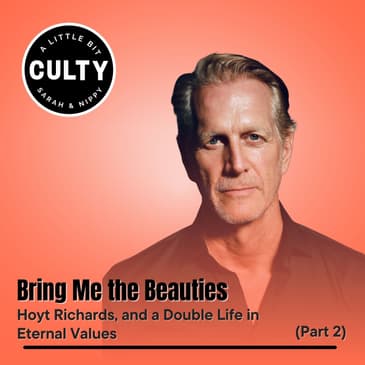
Hoyt Richards is back for Part 2 with the escape story nobody knew they needed: love, coercion, a shaved head, and the unlikely guardian angel who turned out to be Fabio. After Frederick's death, the new cult leader still made Hoyt's life hell. When Hoyt fell secretly in love with Donna over four years and dared to question the apocalypse timeline (spoiler: it didn't happen by 1999), he was forced to break up with her, shave his head to prevent modeling, and do slave labor while facing nightly verbal firing squads. He tried to escape three times before finally succeeding—and that's when he discovered who actually had his back.
We talk about Fabio. Yes, that Fabio. How a Renaissance man electrical engineer in a romance novel cover became Hoyt's sanctuary when he showed up at his door a shadow of himself, giving him safety without questions. We discuss his reunion with his brother Rory (ten years of silence, then grace), reconnecting with Donna, and the painful realization that some people from the group are still devoted to Frederick—framing abuse as training.
Hoyt shares his nuanced take on victim-blaming, using Allison Mack from NXIVM as an example of how we focus on the perpetrator she became rather than understanding how she was seduced and manipulated. He explains why the lens should be on the seductor, not the seduced, and his mission to make cult awareness accessible by framing it on the continuum of everyday power dynamics: coaches, bosses, lovers, and family members who make us give our power away. We wrap with Wellspring, creative arts as healing, and the shaman's wisdom about flipping the tortilla.
Follow Hoyt Richards at hoytrichards.com and on Instagram @hoytrichardsofficial, and Bring Me the Beauties on Instagram @bringmethebeauties.
Trigger warning: This episode contains frank discussion of emotional and psychological abuse, physical violence, coercive control, and cult dynamics.
Also…let it be known that:
The views and opinions expressed on A Little Bit Culty do not necessarily reflect the official policy or position of the podcast. Any content provided by our guests, bloggers, sponsors or authors are of their opinion and are not intended to malign any religion, group, club, organization, business, individual, anyone or anything. Nobody’s mad at you, just don’t be a culty fuckwad.
Buy the A Little Bit Culty book on Amazon or order a signed copy.
Check out our amazing sponsors
Join A Little Bit Culty on Patreon
Get poppin’ fresh ALBC Swag
Support the pod and smash this link
Check out our cult awareness and recovery resources
Watch Sarah's TED Talk and buy her memoir, Scarred
CREDITS:
Executive Producers: Sarah Edmondson & Anthony Ames
Production Partner: Citizens of Sound
Co-Creator: Jess Tardy
Audio production: Will Retherford
Production Coordinator: Lesli Dinsmore
Writer: Sandra Nomoto
Social media team: Eric Skwarzynski and Brooke Keane
Theme Song: “Cultivated” by Jon Bryant co-written with Nygel Asselin
See Privacy Policy at https://art19.com/privacy and California Privacy Notice at https://art19.com/privacy#do-not-sell-my-info.
[00:00:00] Verwandle deine Leidenschaft mit Shopify in ein Business und knack Umsatzrekorde mit dem Checkout mit der weltweit besten Conversion. Du hast richtig gehört! Der Checkout mit der weltweit besten Conversion. Der legendäre Checkout von Shopify vereinfacht das Shoppen auf deiner Website bis hin zu Social Media und überall dazwischen. Na, das ist Musik für deine Ohren. Wie du es auch drehst und wendest, mit Shopify kannst du zu einem echten Hip werden. Starte deinen Test noch heute für nur einen Euro pro Monat auf shopify.de.
[00:00:30] This podcast is for informational purposes only and should not be considered legal, medical, or mental health advice. The views and opinions expressed do not necessarily reflect the official policy or position of the podcast and are not intended to malign any religion, group, club, organization, business, individual, anyone, or anything. I'm Sarah Edmondson.
[00:00:58] And I'm Anthony Nippy Ames. And this is A Little Bit Culty. We woke up from a cult. And that journey was captured in The Vow on HBO and in my memoir, Scarred. Now in this podcast, we break down the shame and secrets that make these experiences so destructive with honest conversations on how seemingly benign groups can cross into the cultiverse and how to spot and recover from trouble if it happens to you. Each week, we bring in experts, survivors, and whistleblowers to explore red flags, resilience, and even share a few laughs because sometimes you gotta laugh.
[00:01:26] Subscribe to our Patreon for early and ad-free listening, some live Q&A, and exclusive content at patreon.com slash a littlebitculty. Welcome to Season 8 of A Little Bit Culty. Seeking time to dance with the ocean. Quite welcome back. Thank you for your time with us.
[00:01:53] I forgot to mention in part one, we were talking about Rick's obsession with royalty. I'm glad I wasn't born a couple decades earlier because my grandparents were lord and lady Sanford. I would have been chasing my dad, although I don't think I'm tall enough to model or have all the other criteria. But, you know. Well, again, that was more the branding. Not everyone was a model, but that was the poster child.
[00:02:19] Well, you were the poster child and you were a very obedient and very, you know, good cult member donating all of your money. We're not going to talk about how much money because it's painful. But you eventually have enough. But it's not that you decide you want to leave. Steve, you don't actually feel that this is accurate in the doc, that you're able to pull your weight or get it right. And this is after Frederick's death. And you decide that you have to go and you make a plan to escape in the night.
[00:02:47] I feel like that part of the story was a little bit glossed over and I wanted to know more. Can you tell us a bit about that escape? Yeah, absolutely. Because I would say after Freddie died, the group went through a power struggle. And the person who ended up emerging as the new cult leader didn't have nearly the savvy or the charisma that Freddie had. So, you know, Freddie could really pile on the affection and make you feel seen and cared for.
[00:03:12] And then he could turn on the dime and just be this, you know, disciplinary that would crush you like you've never been, you know, ripped an asshole before. And this guy was just like the hammer, which is, you know, would just hammer all the time. So it's kind of like I think when you've been indoctrinated and the buttons are in place, if someone can still push the buttons, they can still rule. And that's how it kind of emerged. But it became a very toxic, you know, environment where people would basically peel off like one a year. Someone couldn't take it and they would, you know, run away in the middle of the night type of thing.
[00:03:42] And I was always frowned upon as someone being weak and that sort of thing. And so I had a lot of conflict with that person because there was also a lot of pent up resentment and jealousy of the way I had been given preferential treatment when Freddie was alive. Because I was the golden goose and that bought me privileges. So that was one of the things that was kind of stored up that I felt the brunt of after Frederick died.
[00:04:05] So for the 10 years that the cult went on after Frederick died, for me, were much harsher as far as, you know, what I would now frame as abuse, I thought was all part of my training. But so within that dynamic, the group had moved down to North Carolina. It definitely was now preparing for the apocalypse. We had four years of stored food, gold and guns. And I was not as enthused about that scenario. I had bought into the, you know, the Star Wars version, like, you know, the space people are going to come down. They're going to lift us out.
[00:04:34] We're going to go in the rejuvenation chambers. We're going to get trained and we're going to come repopulate the earth after all the shit hits the man. This idea of fighting for crumbs with the scavengers, you know, was not the scenario I bought into. I was like, so I was always reticent about like, this is what we're preparing for. And one of the things that, you know, that the doc talks about is this frowning on romantic love. And a real factor that led to me getting out was meeting this girl, Donna, who I'm going to marry in September.
[00:05:04] Amazing woman and wonderful love story. And so I had met her and it was a situation where I could see her very infrequently, but I could see her without the group knowing. Because they had all moved to North Carolina. I had met her in L.A., found out she lived in New York. So when I would, I lived in New York at the time. I had passed through New York. I could say, oh, let's have a dinner. And so I could do it in a basis where no one in the group knew about it. And that went off for four years.
[00:05:30] And all of a sudden I developed feelings for her and, you know, things that I was probably not able to say at the time, but they were love, loving feelings. And I kept thinking, this doesn't feel so bad, actually. But I was deeply conflicted because I knew that was against the group's rules. And it was also considered very selfish. Why would you get involved with someone when the apocalypse is coming? You certainly would never want to think about having kids. Like all of that would just be a waste of time. It would be selfish and throw away the opportunity that you have at hand.
[00:05:58] But meanwhile, I feel like I've had this person who's in my corner and looking out for me. And I'm like, so simultaneously, the clock is ticking. Freddie had said it was going to be around the millennium. It's now like the end of 98, beginning of 99. I'm in like Paris, Milan. And I'm thinking he'd always said there were going to be storms and indicators that this is going to, you know, there was going to be a prelude to this cataclysm.
[00:06:23] And there were going to be earthquakes and tidal waves and governments and economies collapsing. So I'm just here in Paris, Milan, just going, nothing's happening. And meanwhile, they're down in North Carolina in this kind of cultic bubble, thinking and preparing for the end. So I started to think, if nothing else, the timeline's off. And I think this is, you know, part of, you know, Donna's involvement that my critical thinking was starting to come back a little bit. And so I got up the courage when I went down the next time in North Carolina and said, listen, this is what I'm thinking.
[00:06:52] I think maybe the timeline's off. And I got attacked like a blasphemer, you know. You know what Frederick said? Oh, you're just a pussy. You can't, you know, face the truth. You're just chicken shit and all this sort of thing. And so as I'm getting screamed at, I'm thinking, well, it can't get any worse. So I might as well just tell them, oh, by the way, I haven't seen someone. What? What do you mean? How long? How long? Four years? What? You know, like just like attacked.
[00:07:20] And then they said, you've got to break up with her. And they demanded to see her. And they treated her so harshly in this meeting that we had with two other members. And basically, I was forced to break up with her and never see her again. And that harsh treatment of someone who was completely innocent, knew nothing about what we were doing, really didn't sit well with me. And I wasn't ready at that point to say, what you're doing is wrong and you're being like bad people.
[00:07:46] And I was like, if this is what I have to emulate to be a spiritual warrior, I don't have it in me. I just, this is just too, she should have never been treated like that. And it really started the wheels turning for me that, you know, I just don't think I measure up. I don't think. And over the next six months, things got worse and worse. And then they actually started to say, you've got to give up your career. And, you know, clearly you're getting lost in the material world. You can't no longer be out there.
[00:08:14] And that's when they forced me to come down to North Carolina. And they started shaving my head so I couldn't remodeled. It would have no temptation. And I had to, you know, be up, first one up, last one to bed, do every type of, you know, slave labor that no one else wanted to do. And then face a verbal firing squad every night because I had been resistant and resentful of my chores that day. Which was accurate because, you know, I'm looking in the mirror.
[00:08:37] I look like a convict and I'm thinking if I had hair, I could be in like Paris right now, like kissing Naomi Campbell and making 25 grand. They're looking at me like they're never going to give up. And I'm broken and unfixable. And the least I could do is remove them and my dead weight from them so they could spend their time doing something more constructive than dealing with a loser like me. And that was my rationale to finally escape. And it took me three times. They caught me twice, but I finally escaped.
[00:09:07] Well, it sounds like organized resentment towards you. Yeah, I think that was part of it. But I think it's also, you know, this guy at the top who, you know, he was leading the charge and he really had it out for me. And, you know, because I was, you know, I was paying off his student loans. I was paying his dental. And he was just resentful of the fact that he had asked me for money and all that sort of stuff. And he couldn't understand because he was the new enlightened one why I was making money. It just showed him how foolish the world was. Like, why is someone like Hoyt the dipshit?
[00:09:37] That was my nickname. Why is the dipshit getting, you know, all these accolades and money and I, the great one, you're getting nothing. This is only demonstrative of how fucked up the world is. And I had to make, I had to punish him. And so, yeah, he's, you know, and it's interesting because I choose at this point not the name names because it's really not, it's about the behavior. It's really not about being vindictive or whatever. It doesn't move the ball forward. Yeah, those people know who they are and they're going to deal with it.
[00:10:04] And, you know, I'll be curious to see how they function after seeing all of this. And I'm hoping, you know, on some level that maybe this will dislodge some of the grip they have on their perspective. That maybe they'll be able to look at some of the abuse and start to acknowledge that everyone got traumatized in this. And there's something worth talking about rather than avoiding. Before we hear from our sponsors, just a quick reminder.
[00:10:29] Our book, A Little Bit Culty, Navigating Cults, Control and Coercion is officially out and available on Amazon. Signed pre-orders have closed, but you can still get your copy today. This book is the culmination of five years of conversations, interviews and research. Everything we've learned about how people get pulled into high control groups and how to avoid, escape or heal from them. If you've been listening to the podcast and want a deeper go-to resource, this is it.
[00:10:55] Available now on Amazon in print and as an e-book for Kindle. And yes, the audiobook is coming soon, narrated by us. Just search A Little Bit Culty and grab your copy. Do it. Thanks, everybody. When I tell people their phone bill could be 15 bucks a month, they look at me like I'm either lying or using two tin cans connected by string. What's the catch, they ask.
[00:11:25] And I get it. I had the same reaction. Because for years, wireless companies have trained us to expect the rug pull. The hidden fees, the introductory rate that expires after three months, the customer service that makes you want to throw your phone into the ocean. But here's the thing. There is no catch. It's actually 15 bucks. Unlimited talk, text, and data on the nation's largest 5G network. An actual award-winning care team that doesn't make you want to scream into the void.
[00:11:51] You bring your current phone, keep your number, pick a 3-, 6-, or 12-month plan, and just stop hemorrhaging money on wireless. That's it. That's the whole conspiracy. I guess if there's a catch, it's that you'll be mad you didn't do this years ago and calculate how much money you've basically set on fire. But other than justified rage at past you, no catch. Just a phone bill that doesn't make you cry. To get your new wireless plan for just $15 a month, go to mintmobile.com slash culty. That's mintmobile.com slash culty.
[00:12:18] Cut your wireless bill to $15 a month at mintmobile.com slash culty. That's it. There's no catch. $45 upfront payment required, equivalent to $15 per month. New customers on first three months plan only. Speeds slower above 40 gigabytes on unlimited plan. Additional tax fees and restrictions apply. See Mint Mobile for details. Think about this. We work, and then we wait. Then we get paid. That's just the deal we've accepted. Meanwhile, everything else shows up instantly.
[00:12:47] Earn-in's been quietly fixing that for over a decade. Get up to $150 a day of what you've already earned, up to $1,000 between paychecks. No mandatory fees. Tips optional. Standard transfers take one to two business days. Instant starts at $399. Five million people have switched. Honestly, waiting is starting to look like the weird choice. I can't even tell you how many times I've had to wait for a paycheck to land to make a big purchase.
[00:13:13] It would just be so great to have access to some of those funds early and feel more in control of what I can purchase, or if I need to pay off a credit card without waiting to get paid. Sounds like a dream come true. Download Earn-in on the App Store or Google Play. Spelled like earning money without the G. Type in a little bit culty under podcast when you sign up, and it will really help the show. Earn-in is a financial technology company, not a bank. Access limits are based on your earnings and risk factors. Standard cash outs take one to two business days with no mandatory fees.
[00:13:42] Expedited transfers available for a fee. Tips are voluntary and don't affect the service. Available in select states. Terms and restrictions apply. Visit earnin.com for full details. Our outdoor space used to be what I called my backyard of doom. A stoop of shame. Like if guests wanted to sit outside, I'd remember that I suddenly have to show them something inside. Anything inside. And then we actually used Wayfair. And now I don't have to fake emergency indoor tours because I want to host people outside.
[00:14:12] Right now I am obsessed with the Anderson fully assembled, yes that's right, you don't have to do it yourself, 10-person outdoor sectional seating group with cushions. Look it up or come on over. It is a beautiful set and I am so excited about the parties I am going to host while it is warm out here in hot Atlanta. Because the thing about outdoor furniture usually is it's heavy, it's complicated, and the assembly instructions look like they were written by someone who hates you personally. And Wayfair gets this. They offer installation and assembly services, which is code for,
[00:14:40] we'll deal with the soul-crushing parts that you don't have to. Thank you. Outdoor seating, grills, lighting, storage, basically everything you need to turn your sad concrete situation into an actual place that humans want to be. And with over 20 million five-star reviews, you can hear from real people who've already survived the process. Or process, depending on what part of the world we live in. Plus, Wayfair verified means that their team actually tests everything with a 10-point inspection. Quality, functionality, how long it takes to build. So you're not playing Russian roulette with your backyard.
[00:15:08] Now, when people ask to sit outside, I'm like, yes, please do. It's a whole new world. Come on out. People, patio season is here. And these amazing deals won't last. Head to Wayfair.com right now to get your outdoor space ready for way less. That's W-A-Y-F-A-I-R dot com. Happy summer. Happy shopping. Wayfair, every style, every home. Thank you for listening. Now, let's dive back into the cultiverse.
[00:15:36] Wait, so are there people that are still followers? Yeah. Oh, yeah. Oh, yeah. Yeah. I didn't realize that. Yeah, I mean, the group doesn't exist. I sued them and took them down. So the group doesn't exist. But as far as belief, yeah. I mean, that guy Russ, he's still a devotee of Freddie. He thinks Frederick was still an incarnation of God. And the guy Paul, who was clearly abused, you know, the one with the long hair, you know, he, you could see, like, he still thinks Frederick was his best friend.
[00:16:06] And that's kind of like Stockholm syndrome type stuff. And so it's, to me, it's a tragedy, the whole thing, that that's how, you know, people have run from some of that trauma. And it's been evidence to me that it's not recommended approach to take. He had a Crispin Glover vibe to him. He had the long hair. Yeah. Yeah, he did. What was it like to see them talking about it in that positive way? Yeah, I've got mixed feelings about it. Because, you know, I feel bad before all of them.
[00:16:36] Because, you know, I mean, we all got exposed to something really dangerous. And I understand, you know, the almost compulsion to protect your ego and to not want to take ownership of, you know, what maybe happened really happened. So I want to be sensitive. And everyone has their own experience. Like, no one has the same experience that you individually have. So I can't answer with them, you know, like, what should they do or could they do? But I do wish that there could be some acknowledgement of just things that are just factual.
[00:17:05] And framing the abuse as training in some way, to me, isn't dealing with reality. You know, so if we could just acknowledge, you know, like that guy Paul, you know, I watched Freddie just, like, beat the shit out of him. I think he said, you know, he had a plate broken over his head at one point. But, I mean, he would slap him and he would be bleeding. And I remember at that time, in my crazy perspective, thinking, oh, thank God I'm not like Paul and don't deserve that kind of treatment.
[00:17:34] Like, never thinking, what the fuck is Frederick doing? This is out of line. It's like, oh, thank goodness I'm not like him. And that's, you know, and I think back on that, like, geez, how out of touch was I with what was going on? So I don't fault anyone in wherever they are in figuring that out. And I just hope they, to, you know, some greater than lesser degree, figure some more out so that they can maybe start to talk about it, take some ownership and start to heal.
[00:18:01] And that's what I'm hoping, you know, as much as I want the doc to maybe just provide information for a larger audience of how and why these things happen. I think the doc does a really good job of telling you what happened, but I think it raises more questions of how and why. And that's more what I like to talk about. But then, you know, that was the, you know, directors, you know, decide, you know, wanting to have a total story. At the end of the day, you can't, you know, it might not have been very interesting the way, you know, I would, you know, I want to teach, you know, I come from that part of you.
[00:18:28] So I understand, like, it's an entity and he did it really well. So at the end of the day, you know, I just hope that maybe even some of the people who are in that category where they've been shameful and afraid to deal with this experience, even talk about it, that maybe when they see it all played out, that they'll realize that maybe this is something better to address than to avoid. We're similar in that way, I think, quite in that, like, all the things that we do and thinking about, like, how is this going to be perceived? Will it help the world?
[00:18:55] But also if the loyalists, because I don't know if you know, there's still many people loyal to Keith. Like, if they're... Yeah, as far as we know. I mean, we don't really know anymore. At least 10, maybe 50. Yeah. I don't know. Somewhere in there. But, like, if they're listening, would this help them? Or if they... Like, maybe if they... Like, they don't trust us. They think we're evil or whatever, but they might watch... But they made us bad people. Yeah, we're bad people. We're suppressive. We're attention-seeking, whatever. Right. Maybe if they watch your doc, they can see it in a different context. Pattern. They can have pattern recognition.
[00:19:26] Pattern recognition. Ideally. Right? Yeah, yeah. Yeah, I mean, that's what we hope for, right? I mean, again, it's like... And that's why I really... Like, you know, I kind of get stuck on the semantics. Like, you know, can I really help someone? I don't think I can. I think people help themselves and save themselves, so to speak. And the way they do that is coming across or seeking out information that they choose to assimilate and then choose to act on. So, I just feel my obligation, if there is one, is to share information in a way that I wish
[00:19:56] I had. Yeah. And maybe... I think, you know, there's a lot of academics in this field that kind of present things in a jargon kind of too complicated way. Totally agree. It's like in Peanuts where the teacher talks like, wah-wah. Yeah, there we go. Right, exactly. That's why I love what you guys did. So, it really needs to be kind of just dumbed down and talked to as people like, hey, listen, this isn't rocket science. You know, let's just... And I feel like that's... Yeah, I really do love what you guys did in the book for that. It really is about that. Totally.
[00:20:25] It doesn't have to be dressed in all these terms and these sort of things. This is, seems to be part of the universal human condition that we give our power away and really suffer from it. And it's a good thing to learn about. And I think it's in some way necessary. That's why it happens in different forms. You know, we went through, you know, you guys and myself, an extreme version of that. But it also, I think, you know, I know personally served me. Like it's, you know, I try to frame it as the...
[00:20:52] I took some very expensive, intense classes at the School of Hard Knocks, but the life lessons were invaluable. And if that's what it took to get me to here, to have the lens I know hold, so be it. Also, we need to talk about how when you got out that Fabio was like your safe haven. Fabio for the fucking win. Who knew? Who knew, man? What a great dude. Yeah. I've known Fabio. He was one of the first models I met, right? He was at Ford.
[00:21:21] And, you know, it's like meeting four, right? You're like, this guy's bigger than life. He's got this chest. But he is the most down to earth, most sweet, kind natured, super polite. Like he's from a really... People don't know. He's from a very well-known and wealthy family in Milan. His dad like invented the main patent for the conveyor belt that was used throughout, you know, 80% of industries, you know? And so he has this kind of inherent elegance and charisma.
[00:21:51] But just the costume was just like, I mean, you know, I'd go to the nightclothes of Fabio and I just might as well have been invisible. Like, you know, it's like you're coming in with Thor. And... But he was just always someone that, you know, I look at Fabio as like, I've never met anyone who's been more comfortable than just being in their own skin. And like, I am enough. And that is an incredibly powerful trait. I certainly know I struggle with that. Like, you know, growing up as a people pleaser and all of that. Like, what do you want me to be?
[00:22:20] I'll try to be that so you like me. And Fabio, it was so okay with just being Fabio. And when I showed up at his door, you know, because he had always said, you know, whenever I passed through LA, he's like, oh, come stay with me. He goes, you should move to LA. You can become a celebrity like me. You know, I'm like, well, yeah, easier said than done, Fabio. But, you know, he was always so giving and generous. And when I had very few places to turn, because, you know, when I escaped, I went to see my parents for the first time.
[00:22:50] I hadn't seen them in 12 years. I show up with a shaved head. But they didn't know what to do, but they were smart enough to not ask what was happening. I made up some, you know, story about some extreme modeling job I had to do. Shaved my head. And they knew, like, don't talk. Don't probe. And so I was there for about 10 days. And then I went to show up at Fabio's. And I showed up at Fabio's.
[00:23:17] And the way he describes it, he says, I knew something terrible would happen. You were a shadow of the guy I had known. And he goes, but I also know in that situation, the last thing you do is probe that person. You know, I wanted to just give you sanctuary and safety, give you a place to put your hat, to lay your head and, you know, remind you that everything's going to be okay. And, you know, you're going to, you know, when you're ready, you come talk to me. And that says a lot about someone.
[00:23:44] You know, I mean, he just knew, like, hey, it's going to be okay. Just, you know, you're safe here. Let's go to the gym. You know, we'll be okay. And so. The Vanity Fair thing came out and he had your back, you know, which I thought was one of the coolest things too. Yeah. Yeah. Yeah. I mean, he's really, he is as loyal as they come. And, you know, it's so funny because people who don't know him and the way he gets portrayed in the media, you know, you would think he's kind of this monosyllabolic kind of thug. And Fabio is like an electrical engineer.
[00:24:14] You know, I mean, dinner with Fabio is minimum four hours, like chatty Cathy, you know, into very, got very strong political stance. He's got, he's into all sorts of, whether it's cars, he's in the motor, he's got 400 motorcycles. He's got probably, I don't know, $30 million worth of expensive cars. He's all into, but he's like, it's all not so much for the show. He likes the technology behind it and what makes them all work and all of that. So it's a, he's just a remarkable guy. And, you know, he's been such a great friend.
[00:24:43] We still see each other all the time. He's just, you know, these situations, you find out who steps up for you. Yes. He stepped up the same way my brother attempted, you know, to get him out with the intervention. When I finally figured out it was a call, I made their two phone calls. First one was my brother, Rory, because, you know, he was the one that attempted to do the intervention, which he knew going in, if failed, would mean I would probably never talk to him again, which I did in Zoom for 10 years. I would not talk to him.
[00:25:10] My younger brothers, like my brother Garth, would say, you know, Rory feels terrible about what happened. You know, he would like to talk. I'm like, fuck Rory. He thinks I'm in a cult. Fuck that guy. Yeah. You know? And so when I had the epiphany, I called Rory and I was like, brother, you know, you were right. Yeah. And, you know, and he was so graceful. I can't even tell you, like, he's like, I can't tell you how happy I am to hear those words. And he goes, and I know how rare it is and what it must have taken to get to there.
[00:25:39] And so he said, what can I do to help? Yeah, man. And, you know, that was really powerful. And then I called Donna and I said, you know how things got weird there at the end? I've been in a cult for 15 years. And she's like, what? And so that was my re-entry point, was starting to make amends and just to say to people that I got this one wrong and I hurt you and I'm sorry, man. You know? So, yeah, it's been a wild ride. It's a wild ride.
[00:26:07] It's a gift in the end, though. That's the... It really is. I mean, I think coming across our own kind of frailty and our vulnerability is important to acknowledge because that's where the foundation for compassion and empathy comes from. It's like you stop thinking, you know, so much of the cult thing. It's, you know, thinking you're just better than people and you're special and you're entitled to some sort of fucking grand existence. And when you realize that's just not what life's about, it's a pretty harsh awakening, but a very important one to have.
[00:26:37] Confidence fueled by ignorance. Yeah. But I'm so glad that you had such a warm reception on the other side. Well, I think that speaks volumes to you as well. Yes. Yeah. Who you are as a person and who people knew your heart and who you were, you know, and welcomed you back without judgment. And that shows too in the doc. It does. I don't know if you know that or not, but it even shows why you're in to a certain extent. Like, you know, so it's, people can't hide who they are, you know, no matter what persona they adopt.
[00:27:07] No, I appreciate that. And I really, I really can't even emphasize how fortunate I am to have, you know, my family has been so great through all this. And even, even coming out with the doc, I was, I tried to be sensitive to them to say, Hey, listen, this is going to unearth a really difficult time in our family again. And, you know, we've lost our parents and that's hard. And, you know, it's like, you know, we're kind of orphans now. And I want, you know, and I've already put the family through so much pain. I want to be sensitive, but they've been really encouraging.
[00:27:34] And I'm hoping, and I'm hoping when they see it, they'll understand things that we couldn't really get into with some of the conversations. Because it's just hard to cover it all. And, you know, I think it's helpful to hear other people's perspectives. And I think the first episode does a good job of at least presenting like what was appealing to it. Like, why would you be intrigued? And because I think that is a big question, the answer, like, what did you see in it? And then I hope you go, okay, I get it. I totally see the appeal. And we didn't really talk about this too much, but I do think it was, you know, especially
[00:28:04] after 300 episodes and covering things like Elizabeth Clare Prophet and some of the other spiritual people that were big at that time, but that were very, you know, they weren't mainstream. So the fact that Freddie took like the attractive, yuppie, you know, blazer, loafer vibe, right? And made it and brought that, brought spirituality to that community. I could so see where that would be needed in that era. Especially with no internet too. Yeah. No background checks. Yeah, exactly.
[00:28:32] But it was like that time in the 80s, people were pushing back on the traditional religions. Like it wasn't satisfying them. So that, after the whole new age thing exploded. And so even in the, in the modeling business, like everyone was into something. So even though I had this group, you know, I mean, like everyone was like checking out some sort of thing, you know, Est was going on and there were all sorts of groups happening in New York. So, so, you know, as models were in this kind of superficial field, everyone was kind of on a spiritual path. So we would have those conversations on set all the time. What are you doing now?
[00:29:02] I wouldn't specify per se, yeah, that, you know, I had this organized group, but I was like, we would have these conversations about spiritual ideas, books we had read, and that was common. So I didn't really feel like I was abnormal in that way. I just felt like I had a special group, you know, that maybe that, but I could see that everyone was kind of in seeker mode. And that's why if someone showed some receptivity, I would consider bringing them in to meet Frederick. And that's where, you know, I'm sure you guys know this.
[00:29:30] Like, those are the things, you know, I was a recruiter and that's one of the things I have to own at the time. I thought I was doing people a solid, but I now don't look at it that way. And that's just something I live with. And it's, you know, it's not something I'm proud of, but it is part of the role I play. Let's take a little break from the cultiverse. Here's a word from our sponsors.
[00:30:03] Do you actually know how much life insurance you have? And more importantly, how much you're paying for it? Yeah, me neither until I realized I might be overpaying for coverage that probably isn't enough. If your life insurance comes to your job and you get unexpectedly laid off, your coverage disappears just like that. Suddenly, you're unprotected and scrambling to figure out how to fix it. You definitely want to call a select quote because apparently, adulting means having these conversations with yourself at 2 a.m. They've been doing this for over 40 years.
[00:30:31] Helped 2 million people secure over $700 billion in coverage. Their licensed agents actually work for you, not some insurance company trying to maximize their profit. In 15 minutes, they'll compare policies from top carriers to find what fits your health and your budget for free. No medical exam needed for many policies, and they've got options even if you have high blood pressure, diabetes, or heart disease. Same day coverage up to $2 million without visiting a doctor. Here's the hard truth. Life insurance is never cheaper than it is today.
[00:31:01] So why would you wait? It's time to get this sorted. Get the right life insurance for you, for less, and save more than 50% at selectquote.com slash culty. Save more than 50% on term life insurance at selectquote.com slash culty today to get started. That's selectquote.com slash culty. Summer always does this thing where it forces me to confront my wardrobe like some kind of annual intervention. Suddenly, everything's too heavy, too structured, too blah.
[00:31:30] I just want to feel like a human who has their life together without melting. Especially here in hot Atlanta. Quince has truly nailed that sweet spot of looks expensive but doesn't require a second mortgage. 100% European linen, organic cotton, washable silk, the kind of fabrics that breathe and move and don't make you look like a wrinkled disaster by 10am. Their linen pants start at $32, which honestly makes no sense given how great they are.
[00:31:55] Soft denim for when you need real pants and organic cotton sweaters for those cool summer evenings. Everything's 50-80% less than other brands because they skip the metal man and work directly with ethical factories so you're not funding some brand's fancy ad budget. Just getting quality stuff. I have two personal favorites this summer so far because I've been doing a fair bit of traveling and I'm going to continue to be taking too many planes. But I bought a super soft fleece set.
[00:32:22] One is a full zip hoodie and one is actually got two pants so I can mix and match the joggers and the wide leg. Both look great. I also got the Bella Stretch barrel jeans in white and these are my go-to summer jeans. They are high-waisted which is perfect for, you know, the mom-tom. And plot twist, Quince has also expanded into home goods, bedding, kitchen stuff, all elevated but actually affordable. I've gotten a lot of my birthday gifts from my girlfriends here at Quince. So yeah, join the party. Elevate your summer wardrobe.
[00:32:51] Go to quince.com slash culty for free shipping on your order and 365 day returns. Now available in Canada too. That's Q-U-I-N-C-E dot com slash culty for free shipping and 365 day returns. Quince.com slash culty.
[00:33:22] Thank you sponsors. We couldn't do it without you. Now let's get back to the show. Yep. We can wait. Yeah, I mean, look, I've always, you know, there's some people, you know, I had a dream about this person recently, actually last night, Allison Mack. I don't know if you're familiar with the Smallville actress. Oh, sure. I know of her. Yeah. She gets really killed disproportionately to, I think, what her infractions are. And I think what's ironic is the people that seem to come down on her extremely hard don't
[00:33:52] realize the story is really in how she got manipulated and how she got conned to be the perpetrator that she ended up being. And while she was being abused, and there's a great opportunity for us to understand deeper how these people work and how you can get under their spell. Instead, she gets killed for, you know, being the perpetrator more so than anything else. And she's not a career criminal. She's someone who's completely normal, likable, presentable, who got conned. And the story, I don't think, gets flushed out enough.
[00:34:22] And she's been shamed to oblivion. And, you know, and I think her story adds more value to the library of evolving this stuff than focusing on what she ended up doing that hurt people. And if we're the country and the culture that we claim to be and the compassion, you know, that, you know, exists in the world or whatever, I don't think she's been treated. Fair is a tough one. I think it goes to the clickbait stuff we talked about earlier.
[00:34:50] Well, it resonates with me, you know, Nippy, is that the, you know, it's like, it is a seduction getting pulled into this thing, right? But even when you use that term, people want to then say, well, the person being seduced was weak in some way. And it's like, no, it's like, we should be looking at the seductor. That's what's going on here. Yeah, there you go. That's where the lens should be. And it's like blaming the rape victim. It's like, hold on a second. You know, so, so, so.
[00:35:20] It's like saying she was wearing a short skirt. Yeah, I think it's like, that's the part I think really needs to be kind of. Yeah, and I think she's. And I agree. So that's what resonates with me. She's also on the other end of a lot of people's resentment because she's successful, you know, commercially handsome, if we use that term again. Do you know what I mean? Right. People, if you tap into people's resentment and they, you know, start coming down on her, you lose sight of, I think, what could be a valuable story to put language to. Yeah.
[00:35:47] And for all those reasons, I hope she finds the courage to come forward and tell that type of story. And she is, and it's not being received. But I think it goes back to what you were talking about earlier, Hoyt, about like the clickbait and, you know, there was so much sensation. What did you say? Trainwreck entertainment? Trainwreck entertainment. Yeah. As we got out and so much of the media was focused on her because she was kind of one of the most famous people and like, you know, Alice and Max, mobile sex cult. Like there's a missed opportunity here.
[00:36:17] So I think overall, when we look at your doc, it is, even though there's no talking heads explaining, well, that was love bombing and that was course of control and blah, blah. But I do feel like people will learn from your documentary. And I'm wondering, is there anything? I hope so. I do hope so. I hope so. And I believe so. Is there anything that you feel like is important to say that you didn't say as we start to, I was looking at the time, like wrapping up about, you know,
[00:36:44] what you want people to know or like anything that's heavy for you? Well, I think the best thing, you know, people can go on my website, hoytrichards.com. I write a bunch of blogs and things about these subjects that I think are, for me, like I said, I'm more interested in the how and why these things happen. And what does it say about our vulnerabilities? What does it say about these people who are out there that can exploit those vulnerabilities? And what are the lessons learned that we all gather from these experiences?
[00:37:10] Because I really do feel that experiences like you and I have gone through because they go towards that more on the extreme side of the occultic relationship continuum. That they're good teaching tools because it's easy to see those dynamics and stories like we went through.
[00:37:29] And then with that perception, you can maybe see the more subtle version that you encountered in your own life and therefore be available to accept that occultic relationship you may have had early on was quite traumatic.
[00:37:42] And the fact that you got out of it wasn't enough potentially that you need to lean into that trauma because what people may have noticed is when you have that type of relationship, even if you're effective at getting away from it, if you don't deal with the trauma, you start a cycle of bringing those relationships back into your life again and not understanding why and not even recognizing there's a pattern. And that's why I think almost people are kind of unconsciously drawn to these cultic stories because there's a lack of understanding.
[00:38:11] There's a connective tissue here that this is part of the human condition that we get in these relationships where we give our power away and really suffer. And we need to understand more, what are those dynamics? How do they play? And how are we vulnerable? So I think that's the area where I feel like the space that we're in as cult survivors gets limited to the cultic cult experience. And I feel like this really is something that's accessible and usable for almost everybody.
[00:38:36] And that's the space I wish we could start to encroach and just make it cool and acceptable. We'll talk about your cultic relationship. You know, it's like, oh, this one, you know, this person I met, you know, it was my coach or my boss or my lover or my parent or my brother. Like, you know, it's like, I remember one of my good friends from high school. He's like, hey, I had an older brother who told me every day, you know, for 15 years growing up that I was a loser. He goes, believe me, I started to believe it. And those are things that I think are important to talk about.
[00:39:04] Like, yeah, what are those influences that we encounter and how do we process them? And how do we make sense of them to a way to learn from them so we don't just get traumatized and run from it? And then it becomes this unhealed trigger that can just emerge in really uncomfortable positions going forward. Like, how do we foster conversations that potentially can not only help us understand but heal? And that's really the area that, you know, I would like to, in any way, just offer information that maybe people could use in some form. That's amazing.
[00:39:34] And are you still speaking, doing speaking events? Like, how can people hear you? Yeah, yeah. I mean, that's kind of what I'm leading. Yeah, that's kind of what I'm leaning into more and more, you know. You know, listen, as much as I love the movie business, it's like tough to rely on. So I would love to do movie stuff as a hobby and be able to do some public speaking and have some stability in my life.
[00:39:54] And then, you know, kind of, you know, ride off into the sunset with some less stress and just travel a bit and kind of spend time with my bride-to-be and friends that I, you know, don't get to see enough and that sort of thing. That sounds great. That's great. We should do something together. Yes. Come up with some sort of curriculum or something. Yeah. I would love that, you guys. Go back to those schools that we went to. And present. Yeah. We'd love to, if there's a panel or something, it'd be fun to meet up and do a speaking event together or, I don't know, something. It's just always so great to spend time with you. Yeah.
[00:40:24] I mean, and that's what's been fun. Like, I'm on the board of, you know, you know, Jaret. Yes, of course. Yes. That's a fun organization that we've, you know, and we're, I mean, we're microscopic, but it's really trying to foster and encourage survivors to find some way to express their story in a creative form. You know, whether it's writing, whether it's a poem, whether it's a piece of art, you know, whether it's a song.
[00:40:48] And I think, you know, when I went, you know, I don't, you guys don't probably know this place, Wellspring used to exist, which was, you know, this, you know, this cult rehab place that was in Ohio. And I went there, you know, like in 2002 or something. And it was, you know, one of the things they really taught is said, listen, the creative arts are so important because that's how you start to rebuild your self-esteem. Because we all have an individual lens through which we see the world.
[00:41:13] And when you express yourself creatively, you start to say, whatever point of view you hold, this experience, which you may hold a lot of shame and hurt around, actually is part of that lens. And my view is a main kind of gasoline that fuels that creative engine to know that you got yourself in a situation you never imagined, but you also found a way out of it. And you developed a certain degree of resiliency that you wouldn't have otherwise.
[00:41:41] And that, if expressed in certain ways, gives you a particular lens to look at the world that others seem to find captivating. And that helps you rebuild your self-esteem, say, okay, I don't want to be defined by this experience, but I am willing to own it and recognize that it actually serves me ultimately. And like I said, I'll recommend people, make sure you have a really intense cultic experience, you know, and get through that. And then you'll see the world instantly.
[00:42:06] Like, I don't want people to have that in the way that I did, but I do see the purpose it served in my life and I'm grateful for it. And so I think those creative arts is a great way to start to take ownership of it and say, yeah, there were some things that were sucky, but there were also some really real great benefits. Silver linings. Yeah, exactly. That is shaman that, you know, when I got out of the cult, I was still a magnet for every crazy person out there. And so I met this guy and he's talking, but he's like, you know, want to know the key to life? I'm like, sure.
[00:42:35] And he goes, you got to learn to flip the tortilla. And I'm like, what does that mean? He's like, here, look at this. And he puts the plate, he puts the plate down on the plate. He goes, look at that. It's bad, right? And I'm like, okay. He flips it over and goes, look, now it's good. See, it's good. But he's like, that's how you get through life. Flip the tortilla. Yeah. So, you know, I think it is. We choose the lens of how we want to look at the world and ourselves. So that's on us.
[00:43:03] Never going to flip a tortilla without thinking about that again from now on. One final question. How do you feel about gemstones? And do you have any remnant of spiritualness in your life? Or are you like, throw the baby out with the bathwater? I, you know, I think the quick answer is no, I don't buy in anymore. Yeah. But I can't deny that there has been a lore and mystery around it for, you know, there have
[00:43:31] been kind of gem breastplates all throughout history that claim they were a part. I don't know. It all falls into that magical thinking type of category. So I can't really, same thing with astrology, you know, maybe there's something to it, but I can't start basing my life choices on those things. So, so I haven't researched it enough to say emphatically no, I just know that my interest in it is weaned to zero. So from that point of view. Very good answer. You know, yeah.
[00:44:00] So it's, everyone's got to choose their own route, but that's not one that I indulge in. Well, Hoyt, this has been a total pleasure after nine years, I think, eight or nine years of knowing you. I think it's been around. Yeah. I'm going to find that email from Steven and see when we were introduced. And yeah. That's amazing. It's just the perfect timing. Well, it's, it's really great to reconnect with you guys. And I can't thank you enough for all the work you've done and the way you've taken this experience you went through and it really turned it into something not only positive for your
[00:44:28] life, but it's a platform to put out information that is incredibly valuable to people and build the following. Yeah. I mean, it's really a testament to you guys. And I really, really, I'm proud to know both of you. And then I really, you know, it's quite an inspirational story that you've done. And I think the book's fantastic. Thank you, Hoyt. I think it really offers a real kind of accessible way to look at these things, you know, and that's so important. I think, like I said earlier, I think it's, we, it's, it's a rocket science. Yeah.
[00:44:56] We just have to get it, get exposed to it and understand the dynamics. And then I think we have some useful kind of tools in our toolbox going forward that can potentially protect us and serve us in a fantastic way. So thank you for doing that. Thank you, Hoyt. Thank you, Hoyt. I so appreciate it. And we'll be in touch. We're going to try to launch this as soon as we can. So it's parallel with the docuseries and we'll post a lot and hopefully we'll see you in person really soon. Yeah. I would love that. I love that. All right.
[00:45:26] Take care of you guys. We hope you're enjoying A Little Bit Culty. If so, please do show us some love, drop a rating or leave a review.
[00:45:55] Hit subscribe on Apple, Spotify, or wherever you listen. And subscribe to our Patreon at patreon.com slash a little bit culty. Even better, send this episode to someone who needs it. Maybe they're in a cult. Maybe they're just a little bit susceptible. Or maybe they just love a good story. Spread the word. Spread the love. Thanks for listening and see you next time. A Little Bit Culty is a Trace 120 production. Executive produced by Sarah Edmondson and Anthony Nippy Ames in collaboration with producer Will Rutherford at Citizens of Sound.
[00:46:22] Our co-creator is Jess Temple Tardy. Our production coordinator is Leslie Dinsenbor. Writing by Sandra Nomoto and social media marketing by Eric Swarzynski and Brooke Keene. Our theme song Cultivated is by the artists John Bryant and Nigel Aslan.