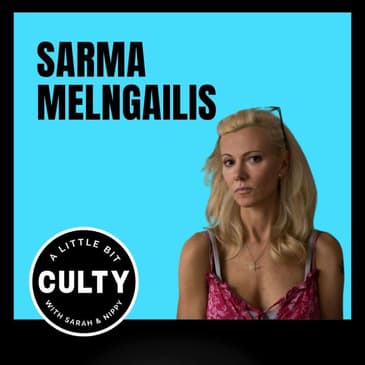
Raw vegan queen turned Netflix “villain”? In this episode, we sit down with Sarma Melngailis – yes, Bad Vegan Sarma – to get the real story behind the headlines. She’s back for her third culty chat, this time with the exclusive on her brand-new memoir The Girl with the Duck Tattoo (don’t worry, we ask her about the title).
Sarma dives into the psychological warfare that turned her life upside down: coercive control, gaslighting, and a manipulative Mr. Fox who left her broke, arrested, and widely misunderstood. She opens up about the pain (and relief) of telling it all, what the Netflix doc twisted, and why she’s reclaiming her narrative – duck tattoo and all.
This one’s raw, redemptive, and a stark reminder: not every headline villain is the real bad guy. For more on Sarma, you can find her on Instagram @sarmamelngailis, on her website sarmaraw.com, or on Patreon at patreon.com/sarmasarma. Also, check out her book The Girl with the Duck Tattoo, available for pre-order now.
Also… let it be known that:
The views and opinions expressed on A Little Bit Culty do not necessarily reflect the official policy or position of the podcast. Any content provided by our guests, bloggers, sponsors or authors are of their opinion and are not intended to malign any religion, group, club, organization, business individual, anyone or anything. Nobody’s mad at you, just don’t be a culty fuckwad.
**PRE-ORDER Sarah and Nippy's newest book here Check out our lovely sponsors
Join ‘A Little Bit Culty’ on Patreon
Get poppin’ fresh ALBC Swag
Support the pod and smash this link
Cult awareness and recovery resources
Watch Sarah’s TEDTalk
CREDITS:
Executive Producers: Sarah Edmondson & Anthony Ames
Production Partner: Amphibian.Media
Co-Creator: Jess Tardy
Associate producers: Amanda Zaremba and Matt Stroud of Amphibian.Media
Audio production: Red Caiman Studios
Theme Song: “Cultivated” by Jon Bryant co-written with Nygel Asselin
See Privacy Policy at https://art19.com/privacy and California Privacy Notice at https://art19.com/privacy#do-not-sell-my-info.
[00:00:00] Ich bin Charissa und meine Empfehlung an alle Entrepreneure startet mit Shopify erfolgreich durch. Ich verwende Shopify schon seit dem ersten Tag und die Plattform macht mir nie Probleme. Ich habe viele Probleme, aber die Plattform ist nie eins davon. Ich habe das Gefühl, dass Shopify ihre Plattform kontinuierlich optimiert. Alles ist super einfach integrier- und verlinkbar. Und die Zeit und das Geld, das ich dadurch spare, kann ich anderweitig investieren. Vor allem in Wachstum. Jetzt kostenlos testen auf shopify.de
[00:00:28] Das Podcast ist für informational purposes only und nicht beachtetet legal, medical, oder mental health advice. Die views und opinions expressed do nicht necessarily reflect die official policy or position of the Podcast und are not intended to malign any religion, group, club, organization, business, individual, anyone, or anything. Ich bin Sarah Edmondson. Und ich bin Anthony Nippy Ames.
[00:00:56] Und das ist A Little Bit Culty. Cults are commonplace now. From fandoms to fads, we're examining them all. We look at what happens when things that seem like a great thing at first go bad. Every week we chat with survivors, experts, and whistleblowers for real culty stories told directly by the people who lived through them. Because we want you to learn a few things that we've had to learn the hard way. For example, if you think you're too smart to get sucked into something culty, you might be prime recruitment material. And who knows? You could already be in a cult.
[00:01:26] If you're not aware of your programming, you're probably being programmed. So keep listening to find out. We'll talk about all sorts of topics on the show, but be aware, this podcast might contain stories that could be alarming to some of our listeners. So please check our show notes for more detailed descriptions and take care of yourself. Subscribe to our Patreon for Thursday bonus episodes, Q&A, and all sorts of exclusive content. That's patreon.com slash a little bit culty. Welcome to season seven of A Little Bit Culty.
[00:02:07] Welcome back to A Little Bit Culty, everyone. Who do we have, Sarah? Well, Nippy and culty family, we have another exclusive. That is right. Sarma Mungalis, our favorite raw vegan New York City trailblazer, joins us for the third time. Thrice, baby. That's right. Thrice, thrice, baby. I would have followed my lead on that. We're such dorks. We are dorks. That was good. That was good. We've had her on twice before, but this is our third time, this being the first podcast
[00:02:36] interview that she is doing for her new book. Very happy to be bragging that we are the exclusive for Girl with a Duck Tattoo, and we're happy to say, this is her words, not mine, that we are her happy place. We posted it on IG yesterday, so. I guess we're bragging. Yeah. All right. In case you don't remember, Sarma's the co-founder of Pure Food and Wine, New York's first upscale raw vegan spot, and one lucky duck.
[00:03:01] After the bad vegan Netflix whirlwind slash debacle, she's spilling the realty in her memoir, The Girl with the Duck Tattoo. I like what she did there. Yes. I like that. She's setting the record straight and also giving people a really clear look at how coercive control works on a deep, visceral, very, very painful level. We're diving into how she's doing post-documentary, why she wrote this book, and some of the coercive
[00:03:27] tricks her abuser used, her healing space, lessons learned, and her new docuseries in the works. This one's raw, real, and dare I say redemptive. We are honored to welcome Sarma back to A Little Bit Culty.
[00:03:58] Welcome back for the third time to A Little Bit Culty. Woo! That's right. This is three. I'm so happy to be here. You guys are always like my first. So you were my first ever podcast, which I recorded before Bad Vegan came out. Yes. And now you're my first podcast since my book. First of all, congratulations. Congratulations. I like that. It's such a huge feat. Like your book is not only like thick and massive, but it is like-
[00:04:27] That's what she said. There we go. There we go. Kicking it off. I like it. This is my kind of- That always comes up whenever I'm like, it's so big. And somebody will be like, that's what she said. My 11-year-old just started to say that. Yeah. Yeah. It's a good one. It's a good one. Indeed. He's nuts. But yeah, it is a very large book. And again, part of the reason I went the whole kind of independent slash self-publishing route is because I knew- I mean, one of the reasons. There are many reasons.
[00:04:56] But, you know, it's like you want to be the one in control of your own story. And it kind of has to be long. You know, I mean, my original draft, the kind of biggest draft I had was 300,000 words. And I've cut it down to 200,000 words. And that 200,000 words is 650 pages. Holy shit. But I'm told it moves quickly. But I think that kind of a big time publisher would have tried to force me to- Yeah, for sure. Make it something short, which just would have been different. It wouldn't have been the same experience.
[00:05:24] It kind of felt like it couldn't get any shorter. And I cut out a lot of stuff I really, really wanted to keep in. But I'm not even joking. I already have like a second follow-up outlined. And so there's things I could put into that. But it just felt like for people to kind of get the experience of what I went through in a way that would resonate, it just sort of needed to be the length that it is. And I'm told it moves fast. So hopefully it's a good read. It's a really good read.
[00:05:51] And it's also like a very painful read. It's a very painful read. I think for people like you, Mark Vicente read it. He just kept saying harrowing. Harrowing. I think for people who've been through this kind of thing, it's, yeah, it's going to be a bit challenging. The same way that, you know, when we watch other documentaries and other stories and it's validating and sort of affirming in terms of making us feel less alone, but also very difficult because it sort of brings a lot of that stuff up.
[00:06:19] But I hope for people who have been through this stuff that it does make them feel less alone and it helps them figure some stuff out maybe. You know, that's what happened with me listening to other people's stories is I would get little tidbits and go, oh, okay. Like that's why he did this or I responded this way. Things that I couldn't understand in the past. Yeah, it's your wisdom. Yeah. Yeah. It was also just painful because I know you now and I knew you then. And for those of you who have not listened to our previous episodes with Summer, which
[00:06:49] we highly recommend, there's a whole section where I'm just like gushing about the restaurant and like I have a very solid memory of like seeing you behind the front desk as we walk in and be like, oh, that's the owner. Like, it's just so weird that our paths had crossed during the height of your golden days. I don't know what else to call it at the restaurant. Should we like say anything so that if somebody listens to this, they have no idea? Let's recap. Let's recap. Let's just say someone doesn't know your story and they've just met you for the first time.
[00:07:18] What's the little like elevator pitch of the last 20 years? Oh, great. I probably should have this down. I mean, sometimes I just say, depending on who it is, you know, that I had a restaurant, I had a brand, One Lucky Duck that was growing. We had products. I had this growing, thriving business and then let the wrong person into my life and everything came crashing down. And I was also blamed for it, landed in jail.
[00:07:43] Other people were hurt financially, wheelbarrows of shame and humiliation and pain and kind of losing everything. And it took years. It wasn't just something that happened really fast. And then I did start to write my story on the other side of it. But some people came and wanted to make a docuseries that turned into Bad Vegan on Netflix, which I thought was going to be a truthful story that would be honest and useful. And it wasn't.
[00:08:11] I mean, I know it does help some people just having it out there. So that's okay. But they really twisted the story and left a lot out and then put this sort of twist ending at the, this sort of twist at the end to make it look like maybe I was in on it all along and they misused. They took a phone call that I'd made before them and put it out of context and then also moved my words around. So like in one section in that, what they aired, my response to him was from a different
[00:08:39] part of the call, like 20 minutes earlier or later. And the way that I really responded to him was kind of the opposite of what they portrayed me as responding. So that allowed all these people to watch it and think that like, I'm actually the criminal and I'm a horrible person. And so that incoming persists still to this day of sort of people yelling at me that I should be ashamed of myself. Does that happen? Like on the street, people? No, no, no, never. I mean, no, it doesn't happen on the street.
[00:09:07] But just again, yesterday, it's like somebody's commenting on a post and saying all the mean tweets, all the mean things. I mean, I'm so used to it now and I've kind of moved past that. But what's painful about that is that I understand why they're saying that based on what they watched, which isn't the truth. So that part is painful. Has there been any resolution with people that misrepresentate you? I mean, what is there to resolve? They did it. They put it out there.
[00:09:33] Maybe at some point I'll tell the story that I was potentially going to do something about it and when was deterred from doing that. And I realize now why? Maybe I'll tell those stories for another time. You can't tell us now? It would take like an hour. We have an hour. We have a podcast. I might have taken some action. And then somebody was like, no, don't do that. And I realize now their motivations were self-serving to my detriment.
[00:09:59] And that's a perfect example of like something that I don't see because I tend to just step into these situations and not see what's really happening. And I think a lot of your listeners and people who've been through, whether it's a cult or whether it's a personal relationship, specifically like an intimate relationship or whatnot, on the other side of it, it's like you can get to the place where you finally realize, okay, this has been a pattern where I've trusted the wrong people and personal relationships
[00:10:26] and eyes wide open and I'm looking for the red flags. But then it'll sort of happen in another way where, you know, in a business context, somebody comes in and tells you what you want to hear and sort of professionally love bombs you. And, you know, like a similar dynamic can happen in business as well. And that's happened to me. And so it's like, I'm still having to kind of go through this stuff and go, oh, okay. I see what's happening now. No judgment.
[00:10:56] No, no. Also, we mentioned this in our book when we talk about even though you have the wisdom of your experience and even though we've done hundreds of interviews on what this looks like, it doesn't mean you're not susceptible. You still have susceptibility in any other areas because human beings are going to keep doing it and they come with different flavors and one of them is going to be yours. Yeah. No, I feel like I have some kind of like an energy or a vibe that's like, hey, I'm going to trust you. I'm going to believe you.
[00:11:25] And people see opportunity in me and they want to use it or control it or make money from it. And yeah, it's been really painful and kind of like on the down low because I haven't really talked about it. So I've had such mixed emotions these days in particular. I mean, I'm so happy. The book is coming out. I'm so, so happy. It's done. I'm so happy. It's, I guess by the time this airs, it'll be available. But at the same time, there's all this other stuff going on in the background that's super
[00:11:54] scary and painful. So it's, I'm not exactly celebrating and popping kombucha or champagne. I mean, I don't know. I don't drink anymore either. That kind of helps. But I'm trying to like separate those things and focus on the book right now. I think it's great, the not drinking thing, because when I was reading your book, I was noticing how alcohol definitely blurred your capacity a couple times to like think more critically, which is obviously what it does for everybody.
[00:12:23] But there were so many moments where I was like, don't drink the champagne. You know what I mean? Like, don't have a beer. Right. Well, there are certain things where like I needed the alcohol to get through it. Of course. I think a lot of people out there where I just drink, it's not that I don't ever drink or ever have like an issue with it. I just want to stay clear. And then there's just the physical aspect of, I don't know if it's an age thing, but I do not feel good the next morning if I even have like one drink. Same.
[00:12:51] And my sleep score suffers, you know, right? I just am so prioritizing sleep and all the things like meditation and journaling and, you know, and alcohol. I mean, I love how it feels having a beer or two. I love that little buzz. But then the next day, it's like, then you're more depressed. 100%. Nippy and I have really, I mean, I can't say don't ever, but it's got to be very particular and if anything, one drink.
[00:13:18] A lot of my friends here are like in their early 40s and they're still drinking in the same way. I just can't. And I'm like, I can't keep up with you. Yeah. Also like we're in the throes of children and them getting up in the morning. 6.30. We only have a handful of those. You only get so many of those and I don't want to be hung over. It's a bad example. It's bad modeling, et cetera. This podcast wouldn't exist without our fantastic, supportive, generous patrons.
[00:13:48] Come find us over on Patreon. We're at patreon.com slash a little bit culty. Go there for bonus episodes, exclusive content, and the occasional Zoom with our fan favorites from our past episodes. Subscribe now and join us. That's patreon.com slash a little bit culty. And now a brief message from our little bit culty sponsors. Remember, when you support our sponsors, you support our podcast. You've heard from our sponsors.
[00:14:17] Now let's get back to a little bit culty, shall we? Summer, there's so many things in what you were just saying that I want to jump in, but I didn't want to interrupt. But like when you said that you hope the book is helpful and that people get things out of it, one of the things that I certainly got is in the way that you kind of walked us through all the decisions to keep giving, what are we calling him now? Fat Fuck? Mr. Fox? What's his name? Meat Puppet?
[00:14:41] I mean, I call him Mr. Fox throughout the book because it just keeps him, first of all, it's consistent. I knew him as one name early on and then another name later on, but just keeping him Mr. Fox kind of keeps him like that character that he was. We both talked about in the past about being people pleasers, but just sort of the element of like, oh, he just went out of his way to give me a ride. I guess it wouldn't matter if he slept on my couch situation. Yeah, those kinds of things.
[00:15:11] I definitely have so much more awareness of that now. I mean, I've done this professionally. It's like somebody seems to have done something kind for me or gone out of their way for me or done something. And so I'll then feel like I owe them or I'll think, well, if they did this, really kind thing for me early on, they must have good intentions. Right. Because it doesn't occur to me that I think a lot of people are super transactional and
[00:15:37] probably even in a way where they think that, well, if I do this thing for her, she'll, it's conscious on their part. You know, if I do this thing for her, she'll owe me. If I do this thing for her, I'm the good guy. She'll, you know, it's conscious on their part. Whereas my brain will just think, oh my God, they did this nice thing for me. They must really care. They must have good intentions. And then they did the good thing. But then later on, turn around and, you know, massive betrayal.
[00:16:04] And then I feel like, oh, I didn't see that coming. So yeah, I think that's one of those things that I'm much more aware of now. Yeah, same. And like just the thought of like, oh, it would be rude to basically for us. This is the awareness I had. And I don't think Nippy has this, but it's like rude to set a boundary is what it feels like. Like, no, you can't sleep over even though you drove all the way from Connecticut. You're going to have to find a hotel. Right.
[00:16:33] That's a boundary. And I think what's really important about your book is the slow erosion of the boundaries. Yeah. Also, it's a manipulation. It's taking his problem and putting it in your part to solve it for him. And you look mean if you keep your own boundaries. Yeah. Yeah. And I mean, and it was like right in front of his dad, who of course was in on the whole thing because his dad was also a bad dude. Oh, really? Oh, yeah. Yeah. I appreciate that.
[00:17:00] And I tried to sort of show a lot of the reason why I kept so much of his communication and his exact words in the book, because I know it gets really heavy with the dialogue in the second half, because there's places where now I see what he's doing, you know, because he says to me like, oh, are you giving up? Are you giving up? And when you're one of those people, and I think you're probably this way too, where if you set out to do something, it's like you're determined, you're persistent, you're not going to give up, you're going to get it done, you're not going to let anyone down.
[00:17:27] So he then would sort of weaponize those things and say to me like, oh, so you're giving up? And we all thought you were the one, but maybe you're not. You know, it's that whole tactic of pretending that you're like the chosen one and then sort of doubting you. And then you're like, no, I am. And then you do what they wanted you to do. That's psychological warfare. Yeah. That and I think at one point I write that I wish I, as much as I am so, so, so grateful
[00:17:56] that I recovered a bunch of our actual written communications. And I have like one audio call. But I remember like him sitting me down for these lectures or according to our written conversation, I'm saying, fuck you, like pushing back on him hard. And then the conversation stops because then he showed up. And so presumably we're with each other in person. And then according to my records, I sent him a wire for $50,000 right after that.
[00:18:25] And so I don't know what he said to me all these times in person. You know, I have some vague memories, but it just makes me think about, you know, Stolen Youth was a story that I really identify with the Sarah Lawrence students and Larry Ray, because I feel like Larry Ray and what he was doing in his psychology, I think is the most similar to Mr. Fox. But I know, you know, I know Keith did that with people too, where he would, oh, I forget her name. I have her book. I think it was one of the first. Tony Natale? Yes. Yeah.
[00:18:53] So, you know, she talks about the first time she met him and going into a room with him and coming out and having no idea that like three hours had passed and having no recollection of what was said. And the boy, Daniel, you know, talks about that time when he gets in the car with Larry Ray and they end up having this like six hour conversation and he comes out and he just doesn't even remember what they talked about. And so I feel like a lot of that was happening with me. And of course, I don't remember, so I can't write about it.
[00:19:21] But whatever was happening there, I think is sort of that missing link of how that would answer the question of why I seem to be pushing back on him so much in writing. And yet then would kind of time and time, like over and over and over again, I'm determined not to send him the wire. And then I end up sending him the wire. What do you think knowing what you know now was happening? Like what techniques do you think he was using on you?
[00:19:47] I've never studied NLP, but I know that he was aware of it because I saw something related to NLP on the evidence that I got back that included the contents of his phone. He did that thing with the sort of very powerful stare. He repeated things a lot. I've really looked a lot into how people can be manipulated and all these sort of tactics, I think, just added up kind of keeping you confused or confusing somebody.
[00:20:13] And then when somebody is in that confused state, it's much easier to sort of implant something. There's all kinds of tactics like that. Yeah. My understanding is create a problem and then the solution, and then you get to feel better about your interaction with them. And the target, as I understand it, is to get you to feel better. And they're the cause of you feeling better. Yeah, exactly. Yeah. And I think that it's sort of like this creation of a situation where there's extreme cognitive dissonance and now you're sort of stressed.
[00:20:42] And the way to get out of that stress is to do the thing, like send the wire. That's the answer. Okay. Now it makes sense because I don't know. I mean, I don't really understand it, but I think a lot of that stuff is not. Yeah, exactly. So he creates the pressure and then gives you the only option to relieve the pressure. Exactly. Because when I'm refusing to send the wire, it's like he's coming down on me hard and it's just this sort of relentless pressure and coercion and kind of coming at me and coming
[00:21:10] at me also with this, you know, those doomsday scenarios, like basically outright telling me bad things are going to happen if I don't. And so, yeah, the only way to kind of relieve that pressure is to then do what he wants. Sounds like our national debt. Yeah. Tell our audience how you got this written dialogue because you have big gaps of memory and he deleted all your emails and took away your phone. But how did you get this dialogue? The bulk of the dialogue I have comes from G-chats.
[00:21:39] So I don't know why it's not a thing anymore, but if you're a Gmail person, years ago, G-chatting was super common. So you're just in your email, but you have like the little chat box open. And when I finally kind of got back into my email address, if you know anything about my story, sort of it kind of in the ending, he took me away for almost a year. And so I was kind of off the grid and disappeared. And during that time, I was out of my email and my phones and he had my email and had control of it.
[00:22:08] So on the other side of it, when I finally got back in, I discovered he deleted all of our email. And then because normally the G-chats would show up in the search. So I thought those were all gone too. But a while later, I just was in the chat box and sort of was scrolling down and I saw his name and I popped it open and there was our chats. And it took hours and hours and hours of time of scrolling back screenshots, scroll back, screenshot, scroll back, screenshot.
[00:22:36] Like I did that for probably two five-hour sessions where like I wasn't eating or doing anything because I was so afraid I was going to lose it. I was so afraid that like I was going to click the wrong button and it was going to be gone. So I have those huge binders. I have a couple of those huge binders full of all this printed out correspondence. And that's what I went through and transcribed a ton of it into the book and then tried to whittle it down and take, I kept whittling it down and taking out as much extra as I could.
[00:23:05] And then there's places where I had taken a screenshot of an email. I got a few emails here and there. I was able to get some texts, but the bulk of it is those G-chat conversations. And then there was one recording that I made of him too while it was all going on that I was able to get back. For more context on what brought us here, check out my memoir. It's called Scarred, The True Story of How I Escaped NXIVM, The Cult That Bound My Life.
[00:23:34] I narrate the audio version and it's also available on Amazon, Audible, and at most bookstores. And now a brief message from our Little Bit Culty sponsors. And remember, when you support our sponsors, you're supporting this podcast. Break time's over, people. Let's get back to this episode of A Little Bit Culty. It's a good one. Yeah, it seemed when reading it that you had these moments of clarity, but you didn't really
[00:24:02] have anybody that you, and he was so good at like isolating you from people. Yeah, once you're siloed, it's tough. You didn't really have anyone to confide in. And I mean, when I say painful, I mean, just because I knew you and I knew the restaurant, I didn't know you. I mean, I knew of you. It's just so many times. I just wanted to like, I say this with so many guests with their memoirs, but I just wanted to time travel and go like, just get away from him. I know.
[00:24:29] I mean, I had that feeling in like this sort of out of body way about myself writing the memoir. I had all those moments too, feeling like, oh, could I just go back to that younger self version of me and pull her out? But here we are. All you can do is write the book and help other people. That's all you can do. You can't help yourself, but you can just provide the template.
[00:24:58] What was it like to go back and do that? I can imagine it was just unbelievably challenging. Yeah, it was definitely brutal and grueling. And I mean, this took me a long time. Not that I spent eight years writing it, but because there would be many months of time where I'm working on something else and I'm not working on the book at all. But I write in the introduction that I feel like writing the story is what will allow me to move on. Because otherwise, I think I would constantly be reminded of things and get these little funny triggers and memories.
[00:25:27] And it wouldn't have been processed. And I feel like the grueling process of writing the book. And I mean, I would encourage people who've been through stuff, write your story, even if you're not going to publish it. Just write it out. Because once you've written it out, it's kind of, it's like it's out of you. It's how it feels, you know? And that's why I think when my book finally, the sample copy first arrived in the mail, I just, I was super emotional because it sort of felt like here it is. It's in this book now. It's out of me and in this book.
[00:25:56] And again, like we keep saying, I hope it will really help a lot of people and help a lot of people who've been through it feel validated in there's people in their family or their loved ones who don't understand what happened to them. You know, if somebody reads my book, they'll go, oh, all right, well, I can see now how that happened to you. Because I think that's among the most painful aspects of going through something like this is that people don't understand. And so you just live in this world where my story was very public, but you live in this
[00:26:26] world where the people around you like don't, they just don't understand what happened to you. And they've got all their own theories that you know are wrong, or there may be questioning your sanity or think you might be sort of mentally compromised. They just don't get it. And so it's just super isolating emotionally, especially when you feel like your family doesn't really understand or even close friends don't understand.
[00:26:51] So I hope that this book might help sort of the people around the people who've been through this to understand and in that way also make them feel less alone. People have been through their own, I don't know, I don't want to say trauma, but like adversity can kind of relate more. Yeah. Or have empathy for it. Yeah, I hope that over time this becomes something that people generally understand. You know, it's sort of like, I mean, I wrote in that thing about P. Diddy that if somebody
[00:27:19] has severe OCD, right, I've never had that experience, but I can read about it. I know it's a thing. So I know that if somebody has a problem and they can't, they just can't use the utensils in a restaurant because they have this OCD. Like I understand that's a thing. And so I understand that it's not that that person could just snap out of it or, you know, severe depression. Like, oh, why don't you just snap out of it? Just do yoga. You'll be fine. Like, no.
[00:27:47] So I hope that over time people having been through this kind of psychological abuse and mind fuckery, as we call it, whether in a cult or a one-on-one situation, I hope it just becomes something that more and more people realize, like, this is a thing. Even if they don't understand it, they can understand, like, oh, that really sucks that happened to you, as opposed to just not understanding it. And we all feel like we're being judged. Yeah. No, I feel like the vow did that for us. Yeah.
[00:28:17] You know, if you don't have an HBO subscription, you're not going to see it. Right. But the people that did watch it had their perspectives shifted around how cults work and how they get you and what's appealing at first. And when you shared your book with family members and people, did you feel like they understood? Like, have you had that result so far? I know you've had beta readers read your book and friends and family take a look at it. Yeah. I mean, one friend of mine comes to mind, Jesse. He's in my upcoming documentary a lot. He's so funny.
[00:28:44] He's so opposite from me in that he's sort of like the ultimate cynical person. He just, every new person he meets, he just assumes they're going to try to fuck me over. You know, it's like the opposite. And so he didn't understand really what happened. But once he read the book, he was like, oh, okay, now I get it. What do you think he saw that he didn't see before? I don't know. It's interesting. I'd have to ask him in more detail. But I just think that what you pointed out, the sort of slow breakdown and kind of, I think,
[00:29:13] through the writing, being able to understand, okay, I guess if I was there, I might have, I can see how this would happen. Yeah. But not all my family has read it. At this point, I think only my stepmother has read it because she's written her own memoir. And I really, I wanted her to read it and sort of give me her perspective on what I wrote about my parents and if there's something in there that I'm missing. Because writing a memoir is, you're writing a lot of really, really personal stuff and
[00:29:39] you try to do the best you can to sort of honor other people and not make anyone else look bad or not say anything that's unfair. And that's a hard part about putting a memoir is that I also write about other people that were in my life and how I was affected by certain things. And so you just want to, it's nerve wracking. It's so nerve wracking. Well, I imagine it's more difficult if you're a people pleaser as well because you want everyone to like it. To be happy. And you're going to have to write a memoir that's true to you and deal with ramifications
[00:30:08] of people who just aren't going to like it because you can't compromise your message. And if they can't develop the requisite empathy to recognize you're coming from a place of vulnerability. And then I have a joke. Nobody really needs vulnerability in the nuts. And if they do, it reveals more about them. Yeah. Than anything. Yeah. And just focus on the people that you are reaching because we have people that come at us less so now, but they came at us and I just, not our audience. Yeah. It's funny as you're saying that I kept thinking in my head, like, just wait for book two.
[00:30:38] Because there's a lot of stuff I couldn't write or that I'd like to write that I think I could do so more openly in a follow-up now that time has passed. So I might call out some more people in a follow-up book. Like some of the other people? You can just call it calling you out. Yeah. Not people pleasing anymore. What about Alec Baldwin? Do you think he's going to read it? Well, I think it's funny because a couple readers told me they loved that chapter about him. I don't know why. I think it was very sweet.
[00:31:06] I don't, I mean, I certainly didn't write anything bad about him at all. So that was my experience with him was he was lovely with me and that was my experience. So I certainly don't have anything bad to say about him. If you liked the show, please consider supporting us by giving us a rating, a review, and subscribe on iTunes. Cults are commonplace now and we're looking at them all and every little bit helps. Hit that subscribe button so you don't miss an episode.
[00:31:39] Okay, everybody. That is the end of part one with Sarma. Please come back this Thursday and hear part two. A Little Bit Culti is a Trace 120 production.
[00:32:08] Executive produced by Sarah Edmondson and Anthony Nippy Ames in collaboration with Amphibian Media. Our co-creator is Jess Temple-Tardy. Audio engineering by Red Cayman Studios and our writing and research is done by Emma Diehl and Kristen Reeder. Our theme song, Cultivated, is by the artists John Bryant and Nigel Aslan. Thank you. Thank you.