
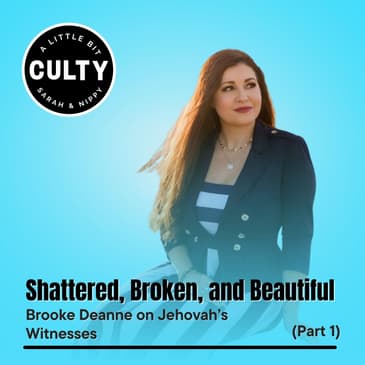
In Part 1 with Brooke Deanne, we chat about her growing up as a third-generation Jehovah’s Witness, the deliciously bad idea of confusing control with “truth,” and what it’s like to be raised in a system where curiosity gets shut down before it can even put on shoes. Brooke walks us through the culty greatest hits: conditional love, shunning, hierarchy, weirdly intense rules about sex and marriage, and the kind of spiritual bookkeeping that makes you feel like you’re always one bad decision away from being sent to the cosmic timeout corner.
We also cover Brooke’s marriage, the abuse she survived, and how religious training, family dynamics, and trauma can all pile on and make it harder to see what’s actually happening in real time. She brings a therapist’s eye to the whole mess, connecting the dots between attachment, gaslighting, trauma bonding, and the very human urge to keep trying to be the “good girl” even when the whole system is rigged. You’ll want to stay tuned for Part 2 of our convo.
Be sure to pick up Brooke’s book, Shattered, Broken, and Beautiful: Losing My Religion and Finding Faith, or follow her on her website, brookedeanne.com, or social media.
Trigger warning: This episode contains frank discussion of cults, coercive control, emotional, physical, and sexual abuse, shunning, trauma bonding, gaslighting, and religious trauma.
Also…let it be known that:
The views and opinions expressed on A Little Bit Culty do not necessarily reflect the official policy or position of the podcast. Any content provided by our guests, bloggers, sponsors or authors are of their opinion and are not intended to malign any religion, group, club, organization, business, individual, anyone or anything. Nobody’s mad at you, just don’t be a culty fuckwad.
Buy the A Little Bit Culty book on Amazon or order a signed copy.
Check out our amazing sponsors
Join A Little Bit Culty on Patreon
Get poppin’ fresh ALBC Swag
Support the pod and smash this link
Check out our cult awareness and recovery resources
Watch Sarah's TED Talk and buy her memoir, Scarred
CREDITS:
Executive Producers: Sarah Edmondson & Anthony Ames
Production Partner: Citizens of Sound
Co-Creator: Jess Tardy
Audio production: Will Retherford
Production Coordinator: Lesli Dinsmore
Writer: Sandra Nomoto
Social media team: Eric Skwarzynski and Brooke Keane
Theme Song: “Cultivated” by Jon Bryant co-written with Nygel Asselin
See Privacy Policy at https://art19.com/privacy and California Privacy Notice at https://art19.com/privacy#do-not-sell-my-info.
[00:00:00] We always recommend Shopify. It took us from an idea to a real business. We got set up, I think, in less than a day with very little effort. We could just focus on the supply chains and the product development. Shopify gives us the ability to customize without the complexity. We can change something without introducing fragility or having to pay a developer. We're Thirsty Turtle and we leveled up our business with Shopify. Start your free trial at shopify.com.au
[00:00:30] This podcast is for informational purposes only and should not be considered legal, medical, or mental health advice. The views and opinions expressed do not necessarily reflect the official policy or position of the podcast and are not intended to malign any religion, group, club, organization, business, individual, anyone, or anything. I'm Sarah Edmondson.
[00:00:58] And I'm Anthony Nippy Ames. And this is A Little Bit Culty. We woke up from a cult. And that journey was captured in The Vow on HBO and in my memoir, Scarred. Now, in this podcast, we break down the shame and secrets that make these experiences so destructive with honest conversations on how seemingly benign groups can cross into the cultiverse and how to spot and recover from trouble if it happens to you. Each week, we bring in experts, survivors, and whistleblowers to explore red flags, resilience, and even share a few laughs because sometimes you gotta laugh.
[00:01:26] Subscribe to our Patreon for early and ad-free listening, some live Q&A, and exclusive content at patreon.com slash alittlebitculty. Welcome to Season 8 of A Little Bit Culty. Seeking down, taking down to the ocean. Welcome back to A Little Bit Culty, everybody. How you doing, babe? We're going to do some humble bragging here. We've hit some benchmarks. Yeah, we have.
[00:01:55] What happened this week? This is not bench press. You can brag about that, too, if you want. I don't do bench press anymore. It hurts my shoulders. But back in the day, I did clear 330. I bet you did. No big deal. What are the benchmarks? 16 million downloads. Yes. 4.9 reviews. 4.9 star. Of our book. Of our book. 4.7 of our reviews. No, no. It's 4.9. No. In our podcast reviews, we're 4.7. Oh, 4.7 in our podcast, 4.9 in our book. Not that that really matters. It matters to me.
[00:02:25] It does. You do get it. You want to hear a positive review? I'm kind of like, I guess. Yeah. We love all the gold stars. Keep them coming. The other benchmark is Troy took a no-hitter into the fourth inning the other night and ended up winning his playoff game 7-2 and he made all-stars. We're very proud. Not that I'm, you know, measuring his performance or anything like that. We do not get our worth off our children's performance. No. That would be crazy. Not at all. No dinner if you don't hit a homer.
[00:02:51] There's definitely an episode in the cult of children's youth sports. If anyone's interested in that, you can listen to a podcast called Pure Athlete. It'll reel you in a little bit. What else? Well, should we talk about today's guest? Oh, right. The reason we're here. We have a great guest. We really enjoyed this conversation. Today's guest doesn't just talk about healing. She embodies it.
[00:03:14] Brooke DeAnne is a former Jehovah's Witness who's turned her own journey of leaving a high-control religion into a roadmap for others reclaiming their lives. After surviving indoctrination, abuse, and toxic relationships, Brooke discovered that leaving wasn't the end. It was the messy, magical beginning of deprogramming, nervous system repair, and building faith from the inside out. She's now a trauma healing mentor and rapid transformational therapist.
[00:03:39] Brooke's best-selling memoir, Shattered, Broken, and Beautiful, Losing My Religion and Finding Faith, unpacks what happens when you walk away from conditional belonging and start rebuilding self-trust, identity, and spirituality on your own terms. Today, we're diving into the invisible aftermath of cult life. The shame, the hypervigilance, the people-pleasing, and how the body remembers control long after the belief unravels. Brooke reminds us that real healing isn't about escaping. It's about coming home to yourself.
[00:04:09] From our lived experience, we learned how to move from survival to sovereignty and reclaim inner authority after years of external control. This is a conversation about how to rebuild identity, spirituality, and self-trust from the inside out. Here's part one with Brooke DeAnne.
[00:04:42] Brooke, welcome to A Little Bit Culty. Thank you for having me here. So excited to be here and have this conversation. So are we. I don't know if you know this, but we have covered... Are you offended by the term JWs? Not at all. Use it all the time. Go J-Dubs. J-Dubs. We have done two episodes, but it's a big organization, so the stories are different. We have a joking relationship near the sports complex our child plays at. There's some J-Dubs that hang out in this little dugout.
[00:05:11] Not a dugout. A press box kind of thing. On the outside. And when we go for our power walks, we see them. We try and win them over. I love that. I used to glare at them and be like, you're in a cold. And now I smile and I say good morning. Bring them cookies. How are you? So that they get counter data about life on the outside. Do they think that's a good plan? I think it's exactly what they need. They need actually the opposite because we are so taught that everyone on the outside
[00:05:40] is evil and something's wrong with them. So you live in a bubble inside of that system. And so people actually really need to see that actually people are actually good human beings on the outside of this religion because I was definitely not taught that. I mean, I left 10 years ago. So I mean, in reality, I'm pretty fresh out. Yeah. Yeah. It's confusing to them. That's the idea. I think I might drop out. I might say, I'll read your pamphlet about the kingdoms.
[00:06:09] What do you call it? The kingdom? The new kingdom. Yeah. Basically the paradise, like the new world that's coming. Yeah. I'll read the pamphlet. If you read my copy of A Little Bit Culty. Let's see what they say. Oh, wow. That's perfect. Do you really do that? That's exactly what they need because they need somebody to just poke them, you know, not scare them, but at the same time, because there's so much fear when you're inside of that system. I mean, when people would actually tell me that I was in a cult, I actually, when I was
[00:06:39] inside the system, I would laugh because I was like, oh, that's crazy. These people think, you know, they just think that we're in a cult. Like, that's so wild because, but here we are, we're going to their door. We're preaching to them, you know, like we're showing up at their front door on a Saturday morning and we're trying to tell them to convert and we're trying to change their belief system. And yet when people would say that to me, I wouldn't be able to receive that message.
[00:07:07] But something in the back of my mind was always like, huh, that's kind of weird. But I never like went into curiosity. I never allowed myself to question because I was taught really young, questioning was not okay. I would be curious. I'd ask questions to my father and my father would become agitated. He would be like, that's just the way it is. You just need to obey. Like, you just need to do it. Like, you just need to obey Jehovah. You need to listen to what we're telling you. And that's it.
[00:07:35] Like, basically don't ask questions. And so I learned very young that was not okay. Yeah, definitely not a group that nurtures curiosity. As I was mentioning earlier, we've done two episodes already, but I was surprised about still how much more I learned about the Jehovah's Witnesses in your book, about a couple of specific things that they do that are horrendous and we'll get into it. But before we cover all that, why don't you give us a little overview, just like we ask
[00:08:03] all our guests who are survivors, you know, how did you get in? In this case, you were born in. So were your parents also born in or did they choose it? Or tell us your family history with this group. For sure. So yeah, we were a third generation. I was third generation. So my parents were born in as well. And that's really all we knew. So, you know, and when your parents come to you and they say, you know, this is the truth. This is the only path. This is the only way to your salvation.
[00:08:31] As a child, you don't question that. You just take that for, okay, this is the truth. My parents believe this and this is the way that we're supposed to live. And even though, you know, you start to see like other things, like that's what I started to see as a child when I was at school. I started to see like different ways people were living. And, you know, I started to be really curious about that and be like, oh, there's just so much freedom here.
[00:08:56] But growing up inside of that, like my parents always told me that, no, this is not okay. Like you're not allowed to be around other children that are not Jehovah's Witnesses. And that's what you're taught inside the system. And so when I would get invited to do things or I would be excited to have these friends outside of the system, that was shut off as well as doing anything extracurricular outside of school. And I just desperately wanted to fit in.
[00:09:25] And I just, I couldn't belong in that. I couldn't belong there in school. And I didn't feel like I belonged in the religion, to be honest. So inside of my own family, my father was really the narcissistic dynamic. He was my first abuser, I like to say, because he wanted control. And I feel like this is a kind of a theme in this religion in particular, where this hierarchy
[00:09:54] of the system inside of it, these men desire this control. And my father really showed me that model inside of the inside of my family. My mother was very suppressed. My father was emotionally abusive. I would often see the dynamic between them play out where he would say things to her to kind of belittle her or demean her in front of me. But she wouldn't say anything.
[00:10:22] She would just quietly cry, you know, washing the dishes over the sink and not really say anything about what had happened to her. But I saw it. I felt it like as a child. And so I just started to notice that and seeing how, okay, it's interesting. I don't have... If I have love for my father, like one moment I was very loving and he was so safe, which is what I thought he was.
[00:10:47] And then the next minute, if you disobeyed or if you didn't stay in alignment with the religious expectations and the expectations of him, that was withdrawn. That love was withdrawn. And so I really saw that inside of that system, if you will, my family system, how love was so conditional. And no wonder it wasn't surprising that I still was okay with love being conditional inside the religious system as well, because it was all I'd ever known.
[00:11:17] Yeah, you talk about it in your book, how what God is to people in Jehovah's Witnesses. Can you explain that a little bit if somebody doesn't know? Like God loves you, but if you don't comply or you don't follow the rules, then what? So I say that that was like I had a trauma bond with God because I was taught that God was loving, right? And we were read those scriptures over and over again.
[00:11:44] But then I was also taught that God was angry and that if you disobeyed him, well, then God took away his love from you. And now you were wicked. And now basically I was set up to be destroyed at Armageddon, which is what the belief system like God's going to come in, destroy all the wicked people. And then there's going to be a paradise eventually that God's going to restore the earth and everybody's going to live this perfect life and be perfect.
[00:12:13] So that was the story that I was told since I was a child. I mean, they have this Bible book of stories, which is for children that all of the parents are meant to read over and over and over to their kids, right? We're learning these stories. And I mean, they're horrific stories. We call it the Bible book of horrors because it is like they're all horrific stories. You know, you see these horrible pictures of Armageddon and God being angry and wrathful and destroying you if you don't obey. And so you're getting that messaging very early.
[00:12:43] And so it's no wonder I was like, oh, well, God loves me, but man, he also can destroy me. And that was the same template for love that I had with my father. It was one minute it was there and then the next minute it was gone. So I have in my notes, I just sort of take random notes when I'm reading a book and I have here grounded by God. Do you remember what that was in your book? I do not remember that.
[00:13:11] Tell me, enlighten me about my book here. I think it was that you, that you were talking about shunning because you did get shunned at one point in your trajectory with J-dubs. And you basically said being shunned is like being grounded by God. I think that's what, I think that was the context. Does that sound right? Yeah, I just thought that was so brilliant. I mean, if anyone is listening who's curious about whether their group is a cult or not, and all you have to really do, I mean, that's like one of the number one checkpoints is like,
[00:13:41] can you leave and be included? You know? When did you start making the parallels between the relationship with God and your dad and then challenging them? That did not happen until really honestly about six years ago. Like after you left. Okay. Yeah. So I think first I, we need to take a little one step back, you know, inside of that. I married like the carbon copy of my father, not knowing, right? Not knowing that I was just repeating a pattern because it was all I knew. I only knew abuse. I only knew, you know,
[00:14:11] Yeah, it was normal. It was normal. Yeah, it was it. And so I married into that. And shortly after that, you know, I realized, well, what, something's not right here. But religion also teaches you that one, God hates a divorcing. And that the only grounds for divorce is infidelity. And so basically they're really teaching women that, you know what?
[00:14:39] Your man can beat you. He can hurt you. He can verbally abuse you, but you need to stay. And that's actually a lot of the story of Jehovah's Witness women that I have found in my journey thus far that have stayed in a very abusive relationships entirely because, well, we're taught to forgive. Jesus forgave. So you forgive, right? And then realizing that, you know, we don't know anything different. We're so suppressed.
[00:15:08] We have no connection to our own voice. We're not allowed to have a voice in our opinion. Only the men do. And only the men have the direct connection to God. We don't. So, you know, there's just so much suppression. So it's no wonder why, you know, I felt like I stayed so trapped and not really understanding what was really happening to me. This episode would not be possible without the support of our sponsors. Let's hear what they have to offer.
[00:15:45] This message is sponsored by Raycon. If you're someone who likes getting outside but still wants moments to really lock in, I've been using Raycon's Everyday Earbuds Classic, and they've been my go-to for daily listening. I finally caved and got new earbuds because my old ones were held together by hope and electrical tape. Very chic. I went with Raycon's Everyday Earbud Classics, and honestly, they're kind of perfect. Active noise cancellation that actually works. They stay put when I'm out for walks, and this is key. They don't fall out after every five seconds like I'm in some sort of earbud trust fall
[00:16:15] exercise. But here's what got me. The colors. I grabbed the blush violet ones because I'm 12 years old at heart, and they actually feel like something I'd choose. Not just here's your standard issue white tech blob. The real plot twist? They sound as good as those brands that cost twice as much. Same premium audio, half the price. Over 3 million people agree with me on this, which is oddly validating. Plus, they've got a 30-day happiness guarantee. So if you hate them, you're not stuck explaining to yourself why you wasted money on fancy ear accessories.
[00:16:44] Honestly, my only regret is not getting them sooner. The Everyday Earbud Classics are the perfect addition to your everyday routine. Go to blu-ray.com slash culty to get 15% off. Thanks, Raycon, for sponsoring. So when we first moved to Atlanta, our outdoor space was, let's call it aspirational. There was some plastic chairs we inherited. There were some things we got from a garage sale. I mean, it was generally an eyesore, and we just didn't use it. And that's why we were so grateful for Wayfair.
[00:17:13] Wayfair made it so easy to fix that and give us the vibe that we were going for. The delivery was easy. The assembly was easy. We have these beautiful Adirondack chairs around a fire pit that, let's just say, the neighbors covet. I think they covet it. You can shop by style. Modern, coastal, farmhouse, whatever your vibe is. And actually find pieces that work together without spending hours spiraling and scrolling and looking at reviews. Their filters, reviews, and photos from real people are clutch. It's like having millions of second opinions before you commit.
[00:17:43] And for somebody like me who has trouble making decisions, this is a game changer. And everything's in one place. Seating, rugs, lighting, storage, even grills. So you're not piecing it together from five different sites like a part-time job. Plus, with Wayfair verified, their team vets products with a full quality checklist. So you know you're getting something solid. And if you're not exactly handy, like Nippy and I, they've got assembly options too, which saved us from at least one patio meltdown. And we're grateful for that.
[00:18:09] Basically, less guesswork and more actually using the space now. Come on over. We're having a party. Get prepped for patio season for way less. Head to Wayfair.com right now to shop all things home. That's W-A-Y-F-A-I-R dot com. Wayfair. Every style. Every home. I don't know about you guys, but I like keeping my money where I can actually see it. Unfortunately, Big Wireless seems to like keeping it as well.
[00:18:34] After years of overpaying for phone bills, mystery fees, and those free perks that somehow cost extra, I finally want to tap out and switch to Mint Mobile. Mint exists to fix exactly that. Premium Wires plans start at just $15 a month. You still get high-speed data and unlimited talk and text on the nation's largest 5G network without the financial side-eye. And switching is super easy. Bring your own phone, keep your number, activate with eSIM in minutes, and you're good to go. No contracts, no hassle.
[00:19:03] So yeah, maybe it's time to stop doing wireless the hard way. Get three months of premium service for $15 a month with Mint Mobile and keep more of your money where it belongs. Next time I switch my mobile plan, that's what I'm using. If you like your money, Mint Mobile is for you. Shop plans at mintmobile.com slash culty. That's mintmobile.com slash culty. Upfront payments of $45 for three months, 5GB plan required, equivalent to $15 per month. New customer offer for three months only, then full price plan options available. Tax and fees extra?
[00:19:34] C-Mint Mobile for details. Thank you for listening. Now, let's dive back into the cultiverse. Yeah. Earlier I mentioned there was a couple new things I didn't know about Jehovah's Witnesses, and one of them which I didn't know, and I know we're skipping ahead in the timeline. I'm going to go back to your childhood in a second.
[00:19:55] But when you were married to Ryan and he did cheat on you, and you tell us the rule about if you can use basically a small window where you can ask for a divorce. But if you sleep with them again, if sex happens, then you can't. I did not know this. Can you explain? Did I cover it? Did I say it? No, you have that spot on. It is. It's a little bit wild. It is. It's wild, right?
[00:20:19] But basically what that says to the elders in the congregation is that you now have forgiven your partner for cheating on you. So that means that Jehovah God. And yeah, Jehovah God now sees that you forgave him, and so now you have taken him back. So I literally, once I knew this, the elders met with me, and they're like, well, did you sleep with him again? And I said, yes.
[00:20:47] And they're like, well, then you're not free to remarry if you divorce him. We just want you to know that. So when you do that, that means that if I divorced him then, I couldn't remarry in the Jehovah's Witness community again. I would forever have to be single. So is this something that's enforced universally? Like is there a Jehovah light where this isn't, like is it consistent in every sort of like chapter of Jehovah?
[00:21:18] So, you know what's funny that you're even asking my question? I don't know if there's any consistencies in that religion. I feel like a lot of it's just falling apart at the seams right now. Playing by ear, yeah. Yeah, it's just a mess. But yes, that is a consistent rule. Yeah, for sure. The other thing that I learned from, knew from your book was the way that you laid out the different roles, which I'm not going to be able to reiterate off the top of my head. But like the, I mean, you maybe do have that, like, is that something you would have in your head by rote?
[00:21:48] Like the different structure in the structure? Sure. Can you, could you mind sharing that with us? Because I think that summary, you said it was like an MLM. And I'd never, like, I'd never seen the MLM component of the Jehovah's Witnesses. Can you break it down for us? It's like a marketing tool. That's a perfect structure for creating a big corporation, right? You have the women that are basically what they call the army of women that go out.
[00:22:14] We're meant to, like, be the main people that go out and preach and try to recruit new members. And so, you know, a lot of these women, like, want to be pioneers and they want to be in service all the time. They're like the homemakers, but also meant to go and preach the word. And then you have the men that are really from a young age.
[00:22:34] They're groomed and conditioned to start to want to go to Bethel, which is, for anybody that doesn't understand what Bethel is, it's like the main headquarters of Jehovah's Witnesses where all the operations are, like, where they create the material, the magazines, all of these things. And so, you want to achieve that. That's, like, big status. Like, if you met someone that's like, oh, yeah, I work at Bethel, you're like, oh, my gosh, you work at Bethel? Like, that's how we would do these people. Where is Bethel?
[00:23:04] So, there used to be a location in New York City. They sold that. I think it's in upstate New York now. Like, I think they call it Warwick. Warwick. So, it's up there. Yeah. Yeah. Pretty interesting name. So, pioneers and then what's the next? So, yeah. So, pioneers and then. So, then the boys try to achieve status as a ministerial servant. So, if they don't go to Bethel, they want to be someone that's used in the congregation.
[00:23:31] So, ministerial servant is like someone that's kind of, it's not quite the tier to elder yet, but you're on your way to becoming an elder of the congregation and being able to make all the big decisions and really, I guess, lead the flock is what they call it. And then above that is circuit overseer. And circuit overseer is someone that travels to congregations to give special talks.
[00:23:58] And people like look at circuit overseers as like celebrities, as a Jehovah's Witness. We look at those people as like, oh my gosh, they've achieved this status and they're the most spiritual people in this religion. And so, everything they say, we take to like heart. Like we are wanting to be like them. We're trying to strive to be more like them. And they're kind of a big deal. And then above the circuit overseer is what they call district overseer.
[00:24:27] I don't really remember exactly what they do. But like I said, there's always a hierarchy of system. And you're basically being pushed and prodded to continue to do more and more. And every kind of, you know, meeting or what we say, like church gathering, some people need to, it's like they're trying to press the same information over and over again. And that is, please be busy in the work of the Lord.
[00:24:57] Please continue to do more. And so, you just really are just like feeling guilty even if you miss a meeting or if you miss going out in service and preaching because there is so much messaging around having to keep busy. That's definitely a through line. And most cults I find is keeping you busy so you don't even have time to think. But meanwhile, and we'll save the juicy details for people to read your book, but you did fall in love, luckily with a witness boy.
[00:25:26] But somebody you didn't, your parents didn't appreciate. Tell us a little bit about your journey with Ryan in terms of like how that affected your connection to the faith and eventually your disillusionment with the faith. Well, I think the most important piece is that when I met him, we quickly, obviously, we were young teenagers, right? And so one thing led to another and we ended up having sex before marriage, which is a huge no-no in the religion, okay? This is one of the biggest sins that you can do.
[00:25:56] And it lands you straight into the back room. One of the most fun, too. Exactly. One of the things you're supposed to be doing at this age, but not as a Jehovah's Witness. And so I landed myself in the back room with three elders, which is basically what they call a committee meeting. And I had to explain in very big detail about what I had done, how many times I had done it, where we had done it, all the assorted details.
[00:26:24] They wanted to know everything. And in that room, obviously, you're looked at shamefully. They read you scriptures from the Bible that are talking about you being a harlot. I was. Basically, in so many words, calling me a prostitute for having sex before marriage without saying the words completely, but that's the messaging I was receiving. and then they decided to pray over me. And then they told me that I was not repentant.
[00:26:54] And so they disfellowshipped me. And disfellowshipping means that you are outcast from the community. You can still come to the community and sit during the spiritual gatherings, but no one will look at you. No one will talk to you. And you can only talk to your family if you live inside of their home. So it's a scarlet letter. Yes, it is a scarlet letter. I spent a whole year being disfellowshipped at 16 years old.
[00:27:23] So I had nobody on the outside of the system and nobody in the inside of the system. I would go and show up to the kingdom hall and people would look at me like I had a plague, like something was wrong with me. And they would like turn their heads. They would look away. Like they wouldn't even look at me in the eyes. And as a young girl, you're just like, I don't understand. I don't, this just, this doesn't make any sense. That's so cruel. Yeah. It was a lot.
[00:27:52] It was a lot to unpack as I, I mean, later on when I finally went to therapy and figured out what the hell happened to me, I was like, oh my gosh, this, how traumatizing was this for me? Like the 16 year old girl, just like being all alone, completely isolated. Yeah. And nowhere to go. I mean, I think that's, this is where, you know, if you're older, you have like a, you know, It was a social circle. Yeah. You have no, you have like no one to run to. So of course you want to get back in the good graces. You want it to be good again. I did. I did.
[00:28:21] I desperately wanted to, because my father told me, you know, you brought shame to the whole family. Right. You now, no one's going to want to marry you because now you're not a virgin. He's like, no ministerial servant or elders going to want you. So I took that to heart. I thought, oh my gosh, I'm not, there's, that means that I'm going to have just a low grade, non-spiritual man. That's going to want to marry me. Like that's what my father was basically telling me that I was not going to be able to find somebody of caliber. Oh, right.
[00:28:51] Everyone outside's inferior. Yeah. Yeah. Okay. I get it. Oh, that was a very difficult thing for me as a young girl. But what that led me to do is it really made me angry, but I also, like you said, I wanted to be the good girl again. I wanted my father's approval again. I wanted to show him that, okay, I can do this. And so for a period of time, I let go of Ryan and we didn't see each other for about two years. But when I turned 18, all bets were off.
[00:29:19] I contacted him again and we ended up eloping. Like that was it. And I just basically said, sorry, parents, not sorry. I'm leaving. I'm going to do my thing. I wanted to get out of their control. Yes, exactly. I wanted to be free. I desperately, like they were just choking me. Like it felt like, because I couldn't do anything I wanted to do. And so of course, you know, a few weeks later, I mean, you read the book.
[00:29:48] I quickly realized that I was not in a safe relationship, but didn't really know or understand that I wasn't in a safe relationship. Because, you know, he suffocated me, threw me up against a pillow and I couldn't breathe. And I didn't know what to do, but I didn't want to go back. Just to be clear, he suffocated with your pillow, threw you up against a wall. Yeah. Well, so he did, but he did. So the pillow, he suffocated me with the pillow. That was my first instance. There was many more abusive instances,
[00:30:16] but that was the first time that I was like, well, wait a second, what's happening here? But it was like such a shock to my system. And then, you know, of course he came back and said, I'm so sorry. I'll never do that again. Like that, you know, I didn't mean to hurt you. And, you know, you just made me so angry. And so that's the first time where I was like, oh, okay, well maybe this is my fault. I did make you angry, right? That's the gaslighting. That's what happens in that experience. And you're just like, okay, well maybe it is my fault.
[00:30:46] There is, you're right. I made you angry. I'm sorry. Let's make up, you know, and then really for 17 years, it was just many more of those instances happening. Not even realizing I was even in a cycle, but also being terrified to leave for multiple reasons because he would threaten me. What he could do to me, you know, he had power over me. He was the one that made the money in the home. I took care, I took care of the children.
[00:31:16] I was trying to be a good Christian woman. I was afraid of what Jehovah would think. My parents, like the community, I'm in the community, like gossiped and talked about people that couldn't figure out their marriages. Like, it is no wonder why I kept everything secret. I wanted no one to know what I was living inside of. So now you're in a cult of one. Yes, exactly. So, question for you. Did he leverage Jehovah over you?
[00:31:45] Was he doing kind of the same thing your dad was doing? Like, using that to keep you under his thumb? Was that? So, no. You know what? He didn't use that always. He used finances. So, there was a lot of financial abuse that went on because he could. He made a lot of money, company. He was very well off. And so, he could use that. He didn't really need to use the religion. For him, everything was about status.
[00:32:15] The religion was about status. Even when he woke up years later, he was like, I'm going to pretend in this religion, and I'm going to show you that I can become a ministerial servant, and that it's not from God. And I was like, okay. I was like, all right, I support that. Like, I want to see what happens. He never got to that point because we ended up, you know, divorcing, and he just decided to leave it all together. And so did I at the same time.
[00:32:44] That was a joint effort. Yes. He woke me up first. I was not complete. I was not ready to be woken up. It was like a jolt to my system. He came to me like a madman, and was like, I need you to look at all these child sex abuse cases, and you need to watch this stuff. I need to show you this stuff. And my training, my conditioning, reacted exactly as it was supposed to. Oh my gosh,
[00:33:13] you've been possessed by Satan. What's going on? You need to stop this. Like, stop looking at other stuff. Stop reading stuff. You know better. Like, Jehovah will take care of it. Like, that was my response. Like, I responded just like the Jehovah's Witnesses had trained me. You were a good girl. Yeah, I was a good girl. I was, I was like, I've got to defend my faith. You're well trained. Yeah. You're well trained. Yeah. When people have clarity, they become a threat. Yes. Right?
[00:33:42] And their clarity becomes evidence for you, rather than more clarity for you. Right? Yeah. And I want to, I want to save your waking up, and what you've done since for part two. So we'll get to that in just one second. But one thing I want to say that I really enjoyed about your book is that you come from it from this therapist perspective. And as you're talking about these horrendous things and your reactions,
[00:34:07] you're also kind of weaving in what you now know about so many things that are very important. Like you already mentioned trauma bonding, gaslighting, narcissism, attachment theory. Can you give us a little bit of the play by play? Like put on your therapist hat for a minute. And I think a lot of people will relate to this part, whether they're Jehovah's Witness or not. But just how, and Nippy and I have even talked about this on the podcast, our attachment styles and how they play out with an incredible person I have to connect you with, Eli Harwood,
[00:34:36] who writes about this. And anyway, I'll do that separately. But give us a little, like put your therapist hat on and tell us like, what was going on for you? What were your wounds? What was his wounds? What was your dad's wounds? How did this all play into the structure of Jehovah's Witnesses? Whatever you want to share with us about that. Yeah. Well, that could be like five more shows. Yeah, seriously. And we'll try to convince that. Yeah. So yes, what you're speaking to is so perfect because I think that it is a really important thing
[00:35:06] that people need to understand in relationship. Like when we're in abusive relationships, it was not entirely just Ryan. Like I also brought wounds into the relationship. Wounds that were created long before I arrived in that marriage. It was from my father. And my father created that, those wounds entirely because he carried his own. He carried his own trauma from his parental upbringing that, you know,
[00:35:36] we just, it's so interesting to see that, how that played out for Ryan and I, Ryan had a mother that was not able to be emotionally there for him. And she used him as her like crutch. He was like the man in the relationship because she didn't have a husband. And so he learned how to kind of resent his mom at a young age because he was like picking up the
[00:36:04] pieces for her and like working at a young age to provide for her. And so he already came in with like resentment and anger towards women, I believe. And so not respect for women. And then I did not have respect. That seems to be a theme of the organization. I mean. Completely. You're so spot on there. I've seen it so much.
[00:36:27] And I didn't have respect for my father because my father used control and manipulation to get me to do what he wanted me to do. And then he also didn't make me feel safe with who I was. I had to be who he wanted me to be. And so I came in with this father wound, really looking at a man is like, don't tell me what to do. If you do one thing, like you're going to, I'm that's it.
[00:36:57] You're going to feel all of my rage. And so I just wanted to be seen, heard and actually loved for who I was. And I couldn't receive that from Ryan because he had his mommy issues and I brought my daddy issues into the play. So we were just like in this cycle, like just playing out these wounds in real time, having no idea that what was happening, that was what was happening underneath the surface because we had no self-awareness.
[00:37:28] Even cult podcasts need sponsors. Check out these must-haves. Lately, I've tried to be more intentional with what I wear because as a parent, I have approximately 90 seconds to get dressed before someone needs a snack or a ride or emotional support over something. So I just need clothes that work. No fuss, no outfit spirals, no does this go with this and whatnot. That's why I keep going back to Quintz.
[00:37:57] I'm so excited that they are still our sponsor. Everything is effortless, comfortable and makes it look like I tried. They've got some incredible spring pieces made from 100% European linen, organic cotton and super soft denim. Think lightweight linen pants, easy dresses and tops starting around 30 bucks, breathable, wearable and on repeat. Here's the best part. It all looks way more expensive than it is. Quintz cuts out the middleman and works directly with ethical factories.
[00:38:24] So you're getting high quality pieces for 50 to 80% less. I am lucky enough to go away on a little Mother's Day trip and I needed to upgrade a few things. And I'm so excited to say that I got some incredible bathing suits. I also got a bunch of basics like an organic cotton micro rib scoop neck tank in Heather oatmeal. But my biggest obsession is 100% organic cotton, gauze smocked sleeveless maxi dress in ocean breeze. So that's like a light blue. So thanks to Quintz,
[00:38:53] I can look like a semi-functioning adult, even if my morning has already been chaos. Refresh your everyday with luxury you'll actually use. Head over to quints.com slash culty for free shipping on your order and 365 day returns. Now available in Canada too. That's quince.com slash culty for free shipping and 365 day returns. Quints.com slash culty. Thank you sponsors. We couldn't do it without you.
[00:39:22] Now let's get back to the show. The problems aren't proprietary, you know, to cults. It's just that your issues are being played out under this ecosystem where that seems to be a little bit more normalized and... It's exacerbated. Exacerbated, yeah. Yes. And there's no way out. There's no lifeline. So you're in a feedback loop where most people can go talk to people and say, compare notes. You're not comparing notes.
[00:39:51] So it makes it even, I would imagine stifling. Yeah. Yeah. Just a little sidebar story on that. At our, we do the summer retreat every year, not V week, in case anyone's wondering, we did that years ago. That's the cult retreat. But now we just go to Hornby Island and we go with a couple of family friends. And there was this one year, do you remember this Nippy? Where it was me and you, Dave and Bonnie are two of our really good friends from Toronto. Oh yeah. And my sister-in-law, my brother, Devin and Steph. And the three of us were kind of comparing notes about our relationship dynamics.
[00:40:20] Like I am anxious attachment. Nippy's avoided. No, no, I came out with was like, I'm doing everything right. stop it. No, it was like in each of the relationship, there was one of us and it wasn't gender specific. Like, I'm always like, pay attention to me. Like, I want to be seen, like hang out with me, which is like you in the relationship, right? Like I want quality time. And the more we want it, the more it pushes the other person away. Right. That's him. He's like, I'm reading. I was reading.
[00:40:50] You know? Yeah. And it is the six of us, the three couples. I was like, me and my brother and my friend, Bonnie's husband, Dave, like we were the one that was always like looking. And the other three were like, give me some fucking space. You know what I mean? And we just thought it was so funny. Like, I'm like who, I'm trying to think of some of the other examples, you know, who's the one who, what was funny. Yeah. It was funny because like. There was always one person. When my friend Bonnie was like, no, I was like, I was like, yeah, I get that.
[00:41:20] The person who wants it can't understand why they're like, no, leave me alone. I'm reading. It's like, it's a very difficult thing and vice versa. I can't imagine being like all the time. Like if he was needy with me, I don't know if I, how I'd be able to handle that. Right. He's so not needy person at all. I'm needy in different ways. Everyone has their needs, right? Like I'm not needy. Like, but it was funny when we were comparing notes and the, for me to be able to tell my friend,
[00:41:48] like for a man to hear it from a woman's perspective was really, I don't know. It was validating. It was validating that we all were like, okay, these are just patterns from our wounds and the way our parents were with us has affected how we are with our partners. And you know, anyway, it was a digression, but I just want to share. It doesn't just happen in high control religion. No, it's totes legit. Yeah. Right. For sure. It's true. And honestly, what that gives you everybody awareness that's listening to this is that when,
[00:42:14] if you can find out what your partner's attachment style is and vice versa, like it opens up a whole new world to have like really deep conversations of like, oh, this is why my partner does this instead of taking it personal. Because that's what I think. That's what a lot of the story is for people that are in these relationships and they're not fulfilled in the relations. They're not happy. It's because they're taking something personal about what they're, why their partner is doing something. And no,
[00:42:42] it's just because this is the way that they operate. It's their pattern. It started in childhood. This is why they're doing the thing that they're doing now. And when you understand this, it's like complete, it's like completely eyeopening. You know, I recently talk about like how everyone has their own love template and it was created, you know, as a child, well, how do, what did we learn or in our childhood that was modeled to us by our parents? One, how we receive love, how we get love, like, well, was it,
[00:43:12] did it have to be earned? Right. Did, what was that? Like, what did love feel like as a child? Because that's your love template. Now, that's how you think that you are getting love or receive love now. And actually how you also give it. So that when you find that out and you figure out. Yeah. Or don't give it. I mean, exactly. Or if you don't give it right. And then it's just, it helps you just see people in your life differently.
[00:43:39] And it helps you actually create huge self-awareness about yourself and how you feel about love. Totally. And not taking it personally is so important. I wish our politicians could look at each other like that. Wouldn't it be a totally different dynamic if like someone got up there and was like, oh, their attachment is, oh, I understand them. And you could speak to that as opposed to, you're awful. Speaking of not taking it personally, I remember learning about. When did you not take it personally?
[00:44:06] About avoidant styles and like Nippy's upbringing and how like he learned to self-suit. And like. I'm one of four boys and a little sister. It was like, you know, I was. And so he, when he goes internal. I'm cleaning. He's like, yeah, he's self clean. He's like, I call it a self-cleaning oven. But I used to take that as rejection. You know? And now I'm like. While I'm cleaning. Well, I'm like, go do your thing. The biggest piece of the healing piece is starting to realize. Oh, wow.
[00:44:34] I've been suppressing what I actually feel in the moment and just been like stuffing it down. And like, that's when like resentment starts to happen in relationships. Right? That's when we start to like project and we start to do things that we don't even realize why we're doing them. It's because we haven't actually expressed how we really felt in all those other moments that are just like stacking up. And so when you talked about the self-cleaning oven, personally, love that analogy. You're actually just kind of sitting with, okay, well, you know, what am I really feeling?
[00:45:03] Like you're like actually kind of clearing out, okay, what's really going on inside of me and being able to sit with what you're really feeling and then being, okay, well, where do I actually need to say something? And where do I need to express myself so that I can feel, you know, fully seen and heard in my relationship or whatever that looks like at your workplace or, you know, however that comes about. And there's a lot of things that fortified me developing that process because I found growing up in my atmosphere,
[00:45:31] an emotional response wasn't respected. And so I was an athlete and then I played quarterback and like, you don't cry in the huddle. You come up with a very rational response. So I had to learn to make those distinctions, come out with what sounded, I don't know, I don't want to say masculine, acceptable in that environment. And so I got good at that process and the process probably had some other muscles that weren't, are underdeveloped.
[00:46:01] Because I leaned so heavily on one process. Yeah. And that's exactly what it is. It's the muscles are underdeveloped, right? and I always tell people, it's like the emotional intelligence. We weren't taught that. I mean, my parents simply had zero emotional intelligence. We didn't talk about emotions. We suppressed emotions. Also the day and age too. It's the day and age. Day and age and the Jehovah's Witnesses. And I do think that like people reading your book don't have to have been raised JW or even in a cult at all.
[00:46:30] Like I think there's so many dynamics between men and women and our upbringings and our wounds. And like you really put a, putting the therapist lens on it throughout. Like I wish I'd known now that I was projecting my own da, da, da onto his blah, blah, blah. Like that's, it's so important for people to understand that's normally what's happening. Like it's, it's, and so you add the cult thing in. Yeah, that has to be humanized. It's humanized. Yeah. You just reminded me about like coming out of cults, not having needs. In NXIVM,
[00:46:59] I just remembered in Nippy of Action, Nippy and I worked through this a lot in therapy is that like, not only it wasn't just women, you couldn't know, you weren't allowed to have needs. It was then your needs were survival based, food, water, you needed was considered a desire, which means a non-integrate. This is NXIVM talk and non-integrated fixation. So if I felt like I needed love, then that was like, what's, well, what's missing in you that you feel like you need that. So like,
[00:47:28] so it was a, just, it was like a distortion of the sort of Buddhist 10. I know you've studied Buddhism since you've left the Buddhist sort of tenant that nothing from the outside fills the hole, which is true, but also it's to thrive. Humans need connection and love and validation to have a thriving full life. Right. So it's like a twist of something really. Then in Keith's case, he needed a harem. Yeah. That's the irony is that he,
[00:47:57] we were taught we didn't need anything and we were told he was a celibate renunciate because he was so evolved. But meanwhile, he has got, you know, women on speed dial available to stop at any moment. So it's crazy. Anyway. Oh my goodness. This is right. Yeah. It's like, you can't even like the, some of the stuff that, you know, your guys' story, like the story of all these people that if you, I mean, yes, I was in a cult, but I'm like, wow, some of this stuff is just like,
[00:48:25] how delusional can we truly become as humans? And you start to see that, like in the fact that these men really particularly men's ego, sorry. But like, it's like looking at, it's like, how can I have control and power over women and make it look like it's exciting? Like make it look like this is what you're meant to do as a woman. I mean, I just, you know, I recently watched the false prophet.
[00:48:55] I don't know if you guys have watched that on Netflix. And I was horrified. Like it was watching these women be like, Oh, you know, like looking at him, like he was some God, you know, that he was their path to heaven. And it's just like, it's hard to stomach these things. It's hard to stomach what, what is happening in these cult like systems. And we, they have no idea. They have no idea. We're hoping to have Christine Marie on, by the way,
[00:49:23] that we've been in touch with her about coming on the podcast. Oh, I can't wait. I can't wait. Listen to that episode. The self harm. They're willing to put themselves through at, for the greater, what they think is the greater good. It's kind of like, Orwell talks about it. It's like, it's the greater good of the party at everything's expense. It's the greater good of the guru at my expense. So they've handed their morality and thought process off to this thing and they'll do anything to fortify it. And then once there's some sort of like evidence to show that they're not
[00:49:52] necessarily the altruistic movement that they are, if they've self-identified with the group, it's extremely hard to divest yourself from what you've doubled down on multiple triple down on. That's the ego part. Yeah. I was fooled. I gave up his time, that sort of thing. All right. So let's take a pause there. When we come back for part two on Thursday, we'll hear about how you woke up, partly thanks to Ryan and how you've unraveled, where your journey of healing has been and make sure we stay to the end
[00:50:22] because I know you have a lot of wisdom about healing and recovery and switching gears, gaining your sovereignty. So see you next time. See you on Thursday with Brooke Deanne for a little bit culty.
[00:50:54] We hope you're enjoying a little bit culty. If so, please do show us some love, drop a rating or leave a review. Hit subscribe on Apple, Spotify, or wherever you listen and subscribe to our Patreon at patreon.com slash a little bit culty. Even better. Send this episode to someone who needs it. Maybe they're in a cult. Maybe they're just a little bit susceptible, or maybe they just love a good story. Spread the word, spread the love. Thanks for listening and see you next time. A little bit culty is a trace one 20 production executive produced by Sarah
[00:51:22] Edmondson and Anthony Nippy aims in collaboration with producer Will Rutherford at citizens of sound. Our co-creator is Jess temple Tardy. Our production coordinator is Leslie Dinsenbor writing by Sandra Nomoto and social media marketing by Eric Swarzynski and Brooke Keen. Our theme song cultivated is by the artists, John Bryant and Nigel Aslan.