This episode is sponsored by BetterHelp.
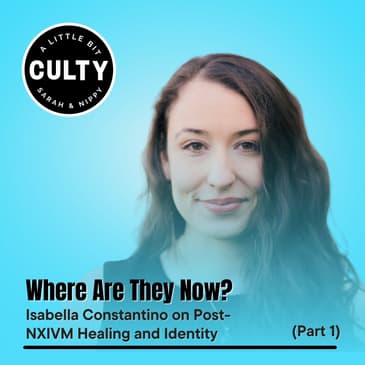
In the first installment of our “Where Are They Now?” series, we catch up with Season 5 guest Isabella Constantino to find out what life looks like after NXIVM when the smoke clears and the cult fog machine finally runs out of juice. Isabella shares what she’s been up to lately, including working at an art museum in Buffalo, and talks honestly about the long, weird, non-linear business of healing—because recovery is not a quick weekend workshop with flip charts and matching outfits.
We also revisited her time in Albany, where the pressure was high, the logic was loopy, and the vibe was of a productivity cult with a side of emotional whiplash. We touch on her working on her Tourette’s with Nancy Salzman and the gaslighty phone calls from Mark Elliott trying to sell the miracle cure. We chat information silos, the body keeping score, and why sometimes the biggest breakthrough is simply realizing, “Oh, right… that was bananas.” Stay tuned for Part 2 on Thursday.
Follow Isabella on her website, isabellaconstantino.com, or on Facebook or Instagram @ic_artconstantly.
Trigger warning: This episode contains frank discussion of cults, coercive control, emotional abuse, gaslighting, eating disorder themes, trauma, compulsive overwork, isolation, and mention of suicidal ideation.
Also…let it be known that:
The views and opinions expressed on A Little Bit Culty do not necessarily reflect the official policy or position of the podcast. Any content provided by our guests, bloggers, sponsors or authors are of their opinion and are not intended to malign any religion, group, club, organization, business, individual, anyone or anything. Nobody’s mad at you, just don’t be a culty fuckwad.
Buy the A Little Bit Culty book on Amazon or order a signed copy.
Check out our amazing sponsors
Join A Little Bit Culty on Patreon
Get poppin’ fresh ALBC Swag
Support the pod and smash this link
Check out our cult awareness and recovery resources
Watch Sarah's TED Talk and buy her memoir, Scarred
CREDITS:
Executive Producers: Sarah Edmondson & Anthony Ames
Production Partner: Citizens of Sound
Co-Creator: Jess Tardy
Audio production: Will Retherford
Production Coordinator: Lesli Dinsmore
Writer: Sandra Nomoto
Social media team: Eric Skwarzynski and Brooke Keane
Theme Song: “Cultivated” by Jon Bryant co-written with Nygel Asselin
SUPPORT OUR SPONSORS:
You don’t have to be on this journey alone. Find support and have someone with you in therapy. Sign up and get 10% off at BetterHelp.com/culty.
See Privacy Policy at https://art19.com/privacy and California Privacy Notice at https://art19.com/privacy#do-not-sell-my-info.
[00:00:00] Verwandle Deine Leidenschaft mit Shopify in ein Business und knack Umsatzrekorde mit dem Checkout mit der weltweit besten Conversion. Du hast richtig gehört! Der Checkout mit der weltweit besten Conversion. Der legendäre Checkout von Shopify vereinfacht das Shoppen auf Deiner Website bis hin zu Social Media und überall dazwischen. Ja, das ist Musik für Deine Ohren. Wie Du es auch drehst und wendest, mit Shopify kannst Du zu einem echten Hip werden. Starte Deinen Test noch heute für nur einen Euro pro Monat auf shopify.de.
[00:00:30] This podcast is for informational purposes only and should not be considered legal, medical, or mental health advice. The views and opinions expressed do not necessarily reflect the official policy or position of the podcast and are not intended to malign any religion, group, club, organization, business, individual, anyone, or anything. I'm Sarah Edmondson.
[00:00:58] And I'm Anthony Nippy Ames, and this is A Little Bit Culty. We woke up from a cult, and that journey was captured in The Vow on HBO and in my memoir, Scarred. Now in this podcast, we break down the shame and secrets that make these experiences so destructive with honest conversations on how seemingly benign groups can cross into the cultiverse, and how to spot and recover from trouble if it happens to you. Each week, we bring in experts, survivors, and whistleblowers to explore red flags, resilience, and even share a few laughs, because sometimes you gotta laugh.
[00:01:26] Subscribe to our Patreon for early and ad-free listening, some live Q&A, and exclusive content at patreon.com slash alittlebitculty. Welcome to Season 8 of A Little Bit Culty. Seeking down to the depths of the ocean. Welcome back to A Little Bit Culty, everyone.
[00:01:53] This is the first of our series of Where Are They Now? This week, we chat with Isabella Constantino, an artist whose NXIVM story first came into view through the organization's so-called Tourette's study and its big promises of relief, growth, and scientific legitimacy. If you caught our first chat with Isabella back in Season 5, you already know how that wild path was.
[00:02:15] She was pulled in hoping for help with Tourette's, postponed her last semester of college, moved to Albany, and spent three years inside NXIVM before finally getting out in late 2017. Today, we're picking up where that story left off and focusing on the aftermath. What it's been like for Isabella to spend even more time rebuilding a sense of self, tending to her mental health, and figuring out what life looks like after a community that asked for so much, gave back so little.
[00:02:40] We'll talk about what she's still struggling with, the hypocritical nature of NXIVM trainings, her relationship with art now. We also share some funny NXIVM stories. Real gems for the NXIVM nerds out there, right, Sarah? Yes, I think so. This is a two-parter. Make sure you stay for both. Here is part one with Isabella Constantino.
[00:03:12] Isabella! Hi! Sarah! What's up, girl? How are you guys? It's been way too long. I know. I was actually just thinking yesterday. I was like, I know the last time I saw Nippy was at the trials, but I was like, when's the last time I actually saw Sarah in person? Because we've definitely talked more post-cult than during it. Probably the mid-teens. Yeah, mid-teens. Mid-teens. Wow. Time goes by so fast. Time goes. Do you know it's been nine years?
[00:03:42] It's been nine years this June. Nine years this June. Yeah. No, that's crazy. It is crazy. We were thinking that this episode with you would start at the beginning of a few that we're going to call, Where Are They Now? Oh, I like that. Yeah, because you're our guest. Kind of like a VH1 behind the scenes kind of thing. Yeah. How is she doing? Because people want to know, especially the NXIVM nerds. We'll come back to your early years, do a little bio. I like that.
[00:04:10] Have some B-roll where you're like making apple pie or something like that. No, she'd be painting in the B-roll. Yeah, painting, for sure. Maybe she'd be painting and doing art. That's right. I'm actually not painting at all. What are you doing? So actually, I'm working at an art museum, which is really cool. Oh, that's amazing. Yeah. Buffalo has like a really incredible modern and contemporary art museum that I actually grew up going to and had a big renovation a few years ago. And it's absolutely gorgeous.
[00:04:40] And I am working there part time and I'm doing tours, essentially, for the kids that come in on field trips. And we take them all around the different exhibits and we talk to them about everything. And it's fun. That's so cool. Yeah. That's great. It's a beautiful place to work and the people are really great. And it's nice to be with people who are like-minded and just kind of have a community in that way. That's so great. That's awesome.
[00:05:08] All the jobs I was doing for a long time were like I was basically by myself or by myself with like 100 people or 1,000 people at a time. And like I didn't really know anyone. So it's nice to like have coworkers and stuff. That's awesome. That must be so good for your mental health post cult, I'm guessing. I think so. Yeah. And I feel like- Also kids. Oh, yeah. Kids are so funny. Kids are great. The things they say. Yeah, you can't write it. When they say from the mouth of babes, they mean it.
[00:05:39] No, but it is nice because I feel like I'm getting like my creative feel from just being around it and like in that environment. But without putting like any obligation on myself to create, which is nice. Awesome. Yeah. But you seem really good. Yeah. I'm definitely doing better than the last time we talked, I would say. Every year I look back and anytime I'm like, okay, I'm very stressed.
[00:06:07] I am like, I mean, it's everything I would say is still hard. Like I'm still dealing with a lot of the effects of being in Albany and just being in the world that we live in and, you know, health and stuff like that. But every year I think like I'm not making progress or anything like that. I like say, well, but I want to be where I am last year or like look at where it was last year or two or three years ago.
[00:06:36] And I'm like, okay, now I'm doing better. So, yeah. Yeah, yeah. That's important. I actually do this with Troy in regards to his sports. Like think of where you were a year ago and you're like, oh my God. Like a lot of people don't do that because for whatever we're conditioned to want our success now or whatever the end game is, you forget to look back and go, it's a journey. Yeah. It's a marathon, not a sprint. So, yeah. Yeah.
[00:07:01] And also when we see like what people we deem successful, like we see it once it's already popped off. We don't see like – Or we don't see the thousands of hours of work behind the scenes or anything. Correct. So it's easy to forget how much work it is to do anything, including heal. Well, that's good timing because healing is important and we are going to pop a book in the mail for you. We always send a present to our guests, but now we get to send you our new book. And the section on healing I'm so excited for you to see because it's really written for survivors.
[00:07:31] And healing has been a big part of your journey and you do a lot and hopefully you'll get some new nuggets from this section. It's also a warning for what to look for. Well, thank you. I love that. I'm so excited. Can you guys sign up for me? Of course. Of course. We just signed, Isabella, like over 250 pre-orders, like people that pre-ordered us. Oh, I love that. Yeah. It took us – I don't even know how many hours. But like a couple weeks of solid chunks of just signing and packaging. Yesterday was my marathon. Yes. We just finished.
[00:08:00] Now we're sending to all of our past guests, future guests, and supporters around. So it's like over 300 copies. Oh, my gosh. It's been very satisfying. We can't wait to share it with you. Oh, my gosh. I'm so excited. I love that. Congratulations. It was a lot of work. It was. It was a lot of work, especially trying to distill like all the things that we've learned into one place because that's what we want to be able to give to someone who gets out and be like, hey, you just got out. Congratulations. Here's your manual. I mean, that's what the boring title would have been. A manual for avoiding healing and surviving cults.
[00:08:31] Yeah. Yeah, that would have been a boring title. Yeah. And we actually considered that. To the point. When I got out, I was thinking because like sometimes there's no how to. I mean, there's lots of books. There's lots of various resources. But it's. I don't know. I'm glad that. I feel like the way my brain just glitched now is indicative of the way your brain is when you get out. There's so many things.
[00:08:58] And I'm glad that you've been able to provide healing for yourselves and for other people and provide resources. I will say one of the things I'm most grateful for when getting out was the amount of people I was able to talk to who had already done some healing, already sorted through things, already like processed and dissected. And were able to point out like, hey, that's not okay.
[00:09:28] Or that's not normal. Or that's gaslighting. And all of that in ways that like I wasn't able to see because I was just a fish in water to it. And I will always be grateful for the first few weeks that I was like in New York and just talking to people and finding all the different perspectives of it. Because obviously, as you know, like with the DOS stuff and with, you know, every part of it, like information was siloed. Like not everyone got the same information. Not everyone was lied to in the same way.
[00:09:57] So what it took to get people out was in a way similar to what it took to get people in. And it was just kind of like you didn't know what it was, though. It's just like all these different pieces of information. And some of them may be helpful. Some of them may not be. You know, I don't know. But like it kind of helped piece the story together with truth rather than with lies. There's no concise language for it. We're kind of putting it together.
[00:10:25] And actually what you just described was one of the struggles in writing the book in terms of all these things happen at the same time. And there's not a real linear format. So I imagine trying to piece it together afterwards has the same kind of process. It's like, oh, that makes sense. That makes sense. Oh, that's love bombing. That's gaslighting. Yeah, all those things happen. But especially like I was just remembering some of the conversations you and I had at the time that you were also still talking to. Are we saying his name? Like do you think he's listening? Should we not say his name?
[00:10:54] At this point, I don't know. It's fine. Okay. Okay. So Mark Elliott, I mean, if people have seen The Vow, he's the one who's an advocate because his Tourette's was cured seemingly. And, you know, those conversations he was having with you, I was just thinking about like how horrendously abusive and gaslighty they are. Maybe I can even find one somewhere and we could play it in this episode. I don't know. But it's next level. But like imagine, Isabella, that you didn't have anyone to talk to on the outside who had already gotten out. Oh, yeah.
[00:11:24] Like you'd probably get sucked right back in. Yeah, yeah, yeah. Oh, well, and I know that's what people were worried about. Like when we went back to get my stuff, like me and the other few people that helped, they were worried about that. Like we planned it so we would avoid people because we didn't know or they were worried about that because I was hearing stories of that happening where people would wake up and have a conversation with the wrong person and get sucked back in.
[00:11:51] And I'd like to say I think that I wasn't quite in that space. Like I think that piece of information for me that made it click made me realize. No, I think I didn't realize. What was it? What was the click for you? Yeah, it's interesting. So this was about, let's see, end of November. I remember specifically it was the 30th of November. It was like six months after you guys left.
[00:12:21] Almost to the day. Almost to the day, yeah. And I met with someone who had left around the same time because of all of that, like mass exodus. Lots of people left with it. And I met with her at a diner. And basically we're just talking for a long time. And the thing that made it click was kind of a, I don't know if it would have made it click had certain things not happened before that.
[00:12:50] Like little things that I felt were off but didn't quite like intellectually place. But basically the piece of information was finding out that a friend had gotten enrolled specifically for DOS and not for the intensives or curriculum versus the other way around. Like my understanding. That's the inconsistency. Yeah.
[00:13:14] Between all the ways that stories were contradicting each other, the information that I was being told, the ways that things are shifting or changing. It's funny. Like it doesn't seem like it would be that crazy of a piece of information to like wake someone up. But that's what did it. It was just an aha moment because I realized the, I don't know, I just, I realized how much I was being lied to.
[00:13:45] Before we hear from our sponsors, just a quick reminder. Our book, A Little Bit Culty, Navigating Cults, Control and Coercion is officially out and available on Amazon. Signed pre-orders have closed but you can still get your copy today. This book is the culmination of five years of conversations, interviews and research. Everything we've learned about how people get pulled into high control groups and how to avoid, escape or heal from them. If you've been listening to the podcast and want a deeper go-to resource, this is it.
[00:14:15] Available now on Amazon in print and as an ebook for Kindle. And yes, the audio book is coming soon, narrated by us. Just search A Little Bit Culty and grab your copy. Do it. Thanks everybody. So when we first moved to Atlanta, our outdoor space was, let's call it aspirational. There was some plastic chairs we inherited. There were some things we got from a garage sale.
[00:14:45] I mean, it was generally an eyesore and we just didn't use it. And that's why we were so grateful for Wayfair. Wayfair made it so easy to fix that and give us the vibe that we were going for. The delivery was easy. The assembly was easy. We have these beautiful Adirondack chairs around a fire pit that, let's just say, the neighbors coven. I think they coven it. You can shop by style, modern, coastal, farmhouse, whatever your vibe is, and actually find pieces that work together without spending hours spiraling and scrolling and looking at reviews.
[00:15:15] Their filters, reviews, and photos from real people are clutch. It's like having millions of second opinions before you commit. And for somebody like me who has trouble making decisions, this is a game changer. And everything's in one place. Seating, rugs, lighting, storage, even grills. So you're not piecing it together from five different sites like a part-time job. Plus, with Wayfair verified, their team vets products with a full quality checklist. So you know you're getting something solid.
[00:15:38] And if you're not exactly handy, like Nippy and I, they've got assembly options too, which saved us from at least one patio meltdown. And we're grateful for that. Basically, less guesswork and more actually using the space now. Come on over. We're having a party. Get prepped for patio season for way less. Head to Wayfair.com right now to shop all things home. That's W-A-Y-F-A-I-R dot com. Wayfair. Every style. Every home. This message is sponsored by Raycon.
[00:16:06] If you're someone who likes getting outside but still wants moments to really lock in, I've been using Raycon's Everyday Earbuds Classic. And they've been my go-to for daily listening. I finally caved and got new earbuds because my old ones were held together by Hope and electrical tape. Very chic. I went with Raycon's Everyday Earbud Classics. And honestly, they're kind of perfect. Active noise cancellation that actually works. They stay put when I'm out for walks. And this is key. They don't fall out after every five seconds like I'm in some sort of earbud truss fall exercise. But here's what got me.
[00:16:36] The colors. I grabbed the blush violet ones because I'm 12 years old at heart. And they actually feel like something I'd choose. Not just here's your standard issue white tech blob. The real plot twist? They sound as good as those brands that cost twice as much. Same premium audio. Half the price. Over 3 million people agree with me on this. Which is oddly validating. Plus, they've got a 30-day happiness guarantee. So if you hate them, you're not stuck explaining to yourself why you wasted money on fancy ear accessories. Honestly, my only regret is not getting them sooner.
[00:17:06] The Everyday Earbud Classics are the perfect addition to your everyday routine. Go to blu-ray.com slash culty to get 15% off. Thanks, Raycon, for sponsoring. I don't know about you guys, but I like keeping my money where I can actually see it. Unfortunately, big wireless seems to like keeping it as well. After years of overpaying for phone bills, mystery fees, and those free perks that somehow cost extra, I finally want to tap out and switch to Mint Mobile. Mint exists to fix exactly that.
[00:17:35] Premium wires plans start at just $15 a month. You still get high-speed data and unlimited talk and text on the nation's largest 5G network without the financial side-eye. And switching is super easy. Bring your own phone, keep your number, activate with eSIM in minutes, and you're good to go. No contracts, no hassle. So yeah, maybe it's time to stop doing wireless the hard way. Get three months of premium service for $15 a month with Mint Mobile and keep more of your money where it belongs. Next time I switch my mobile plan, that's what I'm using.
[00:18:04] If you like your money, Mint Mobile is for you. Shop plans at mintmobile.com slash culty. That's mintmobile.com slash culty. Upfront payments of $45 for three months, 5GB plan required, equivalent to $15 per month. New customer offer for three months only, then full price plan options available. Tax and fees extra? See Mint Mobile for details. Thank you for listening. Now, let's dive back into the cultiverse. Yeah.
[00:18:34] It's funny, the things, like, it's not the branding. It's not the sex with Keith. It's like, wait. No, yeah. That order is all wrong. Like, order is all wrong. And it just is like, oh. My impression is that you're very sensitive and can feel when things are off. And you were in a place where you were done, but you couldn't quite put the language to why you were done. Yeah.
[00:18:56] And needed us to kind of help you see that and validate the fact that what you were feeling has some external forensics to justify the feeling. And this is what they are. And then you got on a specific phone call that I remember was someone was trying to invalidate your feelings and try and use the ideology that he was using to justify any behavior. A number of phone calls like that. They were doing. Is that accurate? Yeah. No, absolutely.
[00:19:24] I was so exhausted. I mean, I'm sure we all were. But there were so many things that just obviously didn't feel right. And they didn't feel right from the beginning, but in ways that weren't as obvious maybe or in ways that obviously were justified. But yeah, I mean, so many things were happening also.
[00:19:50] You know when like the universe gives you signs and you don't listen to them and they get louder a little bit? Yeah. I was having a lot of those. Of course. And I was really confused because, you know, I was using that logic that, you know, the way that they did it, it's like they would fight your feelings. So I was fighting those feelings. Yeah. And. Especially for you. Yeah. Right?
[00:20:18] Because you were being trained to like override anything in your body. No, literally. I mean, I wasn't even. I talked to someone after I was leaving and they were like, I thought you were on a DOS diet. Because I had lost so much weight. And it was like, no, I was just pushing myself so hard. Like you could see all my bones within a year of me being there. That's called a stress diet. It was. It was. But and you know what? Like I'm still struggling with that, to be honest. Like with a lot of the stuff from like that kind of conditioning.
[00:20:46] I feel like it was like being in an, like in the army, but instead of like structured discipline, it was like chaotic. And I still feel like between like the lack of support along the way and like it being a very developmental time, like physically, brain wise, all of that, as well as just coming into adulthood and that kind of chaos. And then I was only out for a year and a half and COVID hit.
[00:21:16] And it's like, I don't know. It just, it's been a very chaotic 10 years almost. And I don't know. There's so many things like that I'm still dealing with. And. Yeah. Tell us. It's interesting. What's residual? I'm sorry. Kind of like tangent and off. No, no, it's okay. That's on brand. Pun it. No pun intended. Yeah. What, what, what's still residual?
[00:21:41] Honestly, I started seeing an eating disorder therapist this past year because with the way that I was pushing myself, I just, when I started, I was pressured to go off of meds. I was immediately isolated. Like I didn't have a job. I didn't have a car. I didn't see many people outside of intensive spaces. Like I was very much in my head a lot.
[00:22:06] And those ideas around like pushing yourself and not giving into your body and all of that, I took very seriously. I took very much to heart and I was very self punishing. And. Remember getting in trouble a little bit for them at different points, like with Nancy, because she was like, where would you get these ideas that like you should be working out this much or not eating? You need food. And I was so confused because I was like, I thought that's what we were all doing.
[00:22:34] But I just like, I, in hindsight, I realized a lot of it was just the OCD mixed with a lot of things that, you know, just the stressors in the environment and the things I was being told. I just really dove headfirst into really bad habits or compulsions, even definitely compulsions, including not eating and not sleeping.
[00:22:57] And I would be running miles and miles a day and working out to the point of failure and thinking I was bad because of it. And, you know, I've read studies around like how people something to do with like a potato. No, that's not it. There was a study in, I believe, the 1940s. No, it was. There's a potato. It was something to do with a potato. No, there was a quote from this from someone who was on this study that had to do with a potato.
[00:23:26] And it was like, I still think about like how good it would have tasted or something along those lines. But there was a study in, I could be wrong, but maybe the 1940s or maybe the 60s. But in, I forget where. Sometime in the past. Sometime in the past. Somewhere there was a potato and a study. Yes. And no one ate the potato. But basically, and it wouldn't pass today, but it was very, it would be very much unethical today.
[00:23:53] But basically, a bunch of people were put in a situation where they were essentially starving. And their bodies and their minds reacted in similar ways, like across the board. And I remember reading about that. I remember thinking, wow, like I felt all of those things when I was there and didn't understand it. Like I was hoarding food. I was thinking about it constantly. I was starving. I stopped menstruating for three years. Like I, you know, our bodies were under so much stress and so much pressure.
[00:24:23] And yeah, I was not doing well. And I am still dealing with some of the effects of that mentally and physically. So recently, I started seeing an eating disorder therapist who has been really helpful. And it never even occurred to me to do that until another therapist recommended it because she didn't even know about that. It didn't even occur to me to mention it. But it's just interesting the things that, you know, we take with us.
[00:24:50] But I actually found out, interestingly enough, that most people with eating disorders have OCD. And so it makes a lot of sense why I was really struggling with that. Makes sense. Especially in that environment. That makes sense. But that's something that I'm struggling with, to be honest. And not anything to do with weight. Just honestly, I feel like I need to be productive. Like I feel like I shouldn't give in to the comfort of food because I need to be doing other things. That's a common one. Yeah. Yeah.
[00:25:20] And. Dude, I totally get that. Yeah. I feel that. The productivity, I feel like, is a, you know, we've got anorexia, bulimia, orthorexia. What's the productivity term like as a problem? You know what I mean? Chill the F. Nippy calls it. Yeah. He's like, Nippy does not have this problem, by the way. I'm very glad. I go 55 to 65. And if I have to go 75 or 85, I will. But I try to keep it in the same thing. It's constant productivity in spurts.
[00:25:47] Well, I remember the last time we talked, you had mentioned that like, because we were maybe in different roles in NXIVM. And I know you said you were frustrated because so many things weren't getting done. So productivity and leaning into that and doing things was helpful or healing for you. Do you feel like you're in a healthy place with that? Well, we're in control of it. So with NXIVM, we were like, it felt like it's a place where a lot of dreams went to
[00:26:16] die and a lot of things were in constant motion of happening, like the Ethical Business Coalition. Yeah, we're working on it. And it was a constant state of we're working on it and things weren't getting done. The whole meeting is minutes. Oh, God. Just think about that for a second. Oh, my God. No, I started to push back on it. Like Sarah was like, we have a proctor meeting. I'm like, have fun. Like, I'm not going to sit there and listen to incompetence. Maybe you just wouldn't show up. I wouldn't show up. People were like incompetent. And it was led by the most incompetent person on the call. And I'm like, that's my time.
[00:26:45] Guys, I just had an integration. Tell us more. Let me just tell you what I realized. Like the whole thing was about being committed to our success, right? And building and growing. And for those of us who have that exia, whatever it is, like the productivity thing, it really like put a fire under our butts and we weren't allowed to vacation because why would you vacate your life, right? So you're go, go, go. I think I was in like productivity or intensity mode or intensity state, right? Which is one of the state modules that they taught. My adrenals were burning out. Didn't know it.
[00:27:13] Meanwhile, these projects like the one you just mentioned, Nippy, do you know about the Ethical Business Coalition? I remember that. Yeah. And you were a part of that. I mean, we were trying to build it since the beginning, but it was a great idea. Since 2003. Since 2003. It never got made. It sounds right. And it was a coalition, right? It was supposed to be like a phone book or a directory for everyone who was involved that would connect people to each other so we could do business with each other. So it would say like, you know, Isabella Constantino, artist. Took an intensive display.
[00:27:42] This is how she would relate. You know, you had a little bio on it. And the idea was that because you had this training that you were an ethical person in which to do business with. And it's a great idea in theory. Oh. That's just one of the- Like a lot of these progressive ideas. They're just kind of like ideas. It's just one of the many projects that never got done. And I guess what I'm saying is, is like, that's such a terrible place to leave people. If you believe that like being productive and successful, like that's our kind of our value.
[00:28:08] And yet I think Keith was like thwarting the success. It's like, you know, he'd say, fill this training. It has to be a hundred people for me to come. Remember this? I don't know if we've ever talked about this in the podcast. We had an SOP training. It had to be a hundred people. Guys flew from all around the world, Mexico, Canada, Europe. And it was like 97 people or something like that. Maybe do you remember? Oh no. It was 98. 98 people showed up. And they even pulled a couple people from a training that Lauren was teaching, I believe, like a level two.
[00:28:39] There's a little caveat. I said to Mark, he's not, Mark said he's not going to do it unless we find two more people. And I say, if he doesn't do it, I'm quitting. I'm out. Mark. Vicente. Okay. I told Mark this. I go, look, if he pulls this, I'm not, I'm stepping down from all this stuff. And I think they pulled- This isn't cool. No. I told people, you know, I told people to fly here. I told people to do this. My name was on the line. And I said, Mark, I won't do it. There was another training going on.
[00:29:05] Two or three of those men had committed to be in this original training and had bailed to go be in Lauren's training, which was going on at the same time. We went and got them and held them to their word of being in the training. And then Lauren said something that we got our final two or three men from her training. At which point Keith said, we need to think about the ethics of that and what it means to, you guys didn't really hit your numbers. You took someone from that training. And I'm over there going, this is bullshit.
[00:29:32] And like Keith, I don't remember what he ended up doing. He canceled the training. But I think he did it because he was lazy and didn't want to do it. He had too many women to fuck back at the Knox Woods Ranch is what he had to do. Yeah. And the gymnastics that went around that and we ended up holding another one and it was just... But without Keith, because he was upholding his word that he would like... But did nothing. But did nothing. He made it work for mental gymnastics. Yeah. No, he made it work, I should say. But yeah.
[00:30:02] That's such a great example, though, of like just the bullshit hypocrisy and crazy making that if you're in and you're committed, like, you know, Nippy was still peripheral enough and also had his foot in reality enough to go, this is bullshit, right? But also committed enough to not say that out loud. You said that in your head. Also, I had to destroy what I was building in order to do it. And I felt like this is something we could work out. Yeah. Not someone who's deliberately sabotaging you and your efforts. Yeah. No, I get that.
[00:30:32] I mean, I feel like the little like Clifton Park community was like its own little bubble anyway. Fuck. And it's like... It was... You were more in that when we were. Oh, yeah. No, I wasn't even planning on moving. Tell us a story. I'll tell you. I literally, I thought I was just going to Albany for a week and then that was it. And... Yeah, that's a common story. No. And we've heard that exact words before. They knew what they were doing. And you know what?
[00:30:59] It's so hard to even say they because I was they to someone else too. Like, I'm sure I've said things that were... Yeah, the point. It's like when you're in a system that is that dysfunctional and self-contradictory, like by nature, it's hard to do anything without like you're participating in it. So you have to either get out of it or actively try to change it, which obviously doesn't work super well.
[00:31:27] But like, it's like there's only like one or two people, probably mostly one person who actually is cognitively like aware of the hypocrisy, you know, and it's weird. But so the bubble, when I say they, I'm also compassionate to obviously everyone for the most part thought they were doing the right thing, which is interesting thing to think about. But I, yeah, I was kind of, I wasn't pressured to go move there at the beginning.
[00:31:56] I was offered it. I worked with Nancy for a day or two. Yes, obviously. Well, yeah, of course, at the beginning. Offered, yeah. It's an opportunity. Yeah, it's an opportunity. Nancy, her day in January, after those like initial seven days that I worked with her when I first started that were like recorded, like, you know, the, in the Tourette's documentary where there's those like seven days of progress sort of thing. And I was like, I don't think I have Tourette's anymore.
[00:32:27] I have Tourette's. I have Tourette's, by the way. Newsflash. But they basically, Nancy was like, I, we think you should move here. You've made progress, but like, you're not where we think you can be. And so I did. And yeah, I was supposed to leave in June. No, yeah, June. And I think I ended up staying longer, like against, like my parents didn't want me to stay longer.
[00:32:55] Like I didn't have much financial support that, like those few months, because I think they were worried. Like they were like, we need to make sure that we're not just like encouraging this. But no, I, gosh, I feel like I'm getting lost in like flashbacks. No, I lost the train of thought too. No, no, no. It was a weird time. It was, the move to Albany was presented as an opportunity to you.
[00:33:28] Let's take a little break from the cultiverse. Here's a word from our sponsors. Lately, I've tried to be more intentional with what I wear, because as a parent, I have approximately 90 seconds to get dressed before someone needs a snack or a ride or emotional support over something. So I just need clothes that work.
[00:33:55] No fuss, no outfit spirals, no does this go with this and whatnot. That's why I keep going back to Quince. I'm so excited that they are still our sponsor. Everything is effortless, comfortable, and makes it look like I tried. They've got some incredible spring pieces made from 100% European linen, organic cotton, and super soft denim. Think lightweight linen pants, easy dresses, and tops starting around $30, breathable, wearable, and on repeat. Here's the best part. It all looks way more expensive than it is.
[00:34:24] Quince cuts out the middleman and works directly with ethical factories. So you're getting high quality pieces for 50 to 80% less. I am lucky enough to go away on a little Mother's Day trip, and I needed to upgrade a few things. And I'm so excited to say that I got some incredible bathing suits. I also got a bunch of basics like an organic cotton micro rib scoop neck tank in Heather Oatmeal. But my biggest obsession is 100% organic cotton gauze smocked sleeveless maxi dress in Ocean Breeze.
[00:34:54] So that's like a light blue. So thanks to Quince, I can look like a semi-functioning adult, even if my morning has already been chaos. Refresh your everyday with luxury you'll actually use. Head over to quince.com slash culty for free shipping on your order and 365 day returns. Now available in Canada too. That's quince.com slash culty for free shipping and 365 day returns. Quince.com slash culty.
[00:35:25] Thank you, sponsors. We couldn't do it without you. Now let's get back to the show. Yes. And I think I recognized the chaos at the beginning. So like I was coming out of functional environments. I moved there Valentine's Day 2015. Took my last semester of college off. I basically had a day to settle and went straight into my first 16 day. Drove like two hours. So intense.
[00:35:55] Drove two hours away. I, someone, Alex from the Tourette study actually picked me up and drove me to a sleep study center like an hour or two away and then drove me back the next day. And then the day after that I started, is it Mobius? Is that the like self-love one? Yeah. Yeah. Were you looking in the mirror and loving yourself? And I, of course, yes. Yeah. In quotations. So I did that. And then like a week or so later I did like two way.
[00:36:24] Like I was just like one after the other and then complete isolation. So I was just doing these and then left alone with my thoughts and then doing another one and then working with Nancy and doing another one and getting scolded by Nancy. And every month I was going home for a sleep study for a day and then coming back and then just, it was just very chaotic. And I. That's great. That's intense. Yeah. And I was going off meds at this point. Like I was not doing well. I don't know if we, I mentioned this last time we talked, but like, you know,
[00:36:53] the environment that we were in definitely severed kind of my trust or relationship with, not even my trust with my doctor, but my ability to recognize what I was dealing with as legitimate medical issues. So when I was dealing with the withdrawal, when I was dealing with any of the things or symptoms I was dealing with, I was thinking I'm attention seeking or what am I doing wrong? That's awful.
[00:37:22] So when I like wasn't ticking, I remember the last appointment I had with my neurologist and I wasn't ticking, but I was so withdrawn and so just, I mean, I was like a shell of the person I was. And this was after just a few months and I didn't tell him what I was going through because it didn't occur to me that it was anything neurological. I felt so cold.
[00:37:51] I felt so like almost not even apathetic. I didn't know how to describe it, but I was, I had been on meds at least two at a time for 10 years. And then basically for all intents and purposes, cold turkey went off of them. I have no words to describe that. And there was no monitoring? They have no monitoring of that by anyone? There was.
[00:38:13] I was checking with Brendan, but it's hard like when everyone's, you're being like encouraged. You're being like, you get in trouble for speaking up, but then you're shamed for not talking. Yeah. So it was hard to know how to voice what I was going through. Another hypocritical. Yeah. Another counter directive. And we're all going through that in our own specific roles.
[00:38:41] You know, Nancy told me, we're like, do we have to send you home? Do we have to like send you back to your parents? Cause you can't like, you're going to continue to act like this or whatever. And I just, you know, I was just breaking down increasingly exponentially every day and just becoming more and more withdrawn. And like, to the point that like, I was in such fight or flight, like such a state of like tenseness and fear.
[00:39:06] And you couldn't hear me when I talked, like, because they were, people were telling me how attention seeking I was, how like impulsive, how whatever. And I was like, also, yeah, I mean, like, I don't know. I was 21. I just turned 21. I had a big personality. I was an artist. I was in college. I was coming into myself and then to be shut down and broken that strategically, that severely.
[00:39:36] And then to get in trouble for not being able to be heard when I was taught, because look how we need to lean into her. You do see how you're being attention seeking. People ask me this all the time and I have my own theory, but, and I can't remember if we talked about this on the first one, but when people say, oh, when they watched The Vow, they got the sense that like, it seemed like some people's Tourette's was being cured or at least marks. What's your take on that? Like, what do you think was actually happening?
[00:40:06] I feel like it's not a loaded question because of the Tourette's. It's a loaded question because of the environment that impacted the Tourette's, I guess. But from the day I met Mark to the last time I saw him, my impression was that he was having tics. I have. So he just sort of sat on them? Like he was just kind of like compressing them? Yeah.
[00:40:30] I, so the thing is like, for me, I was certainly suppressing tics. I will say this. I was very confused for a point because I noticed that before I officially moved there for the study, I noticed that I was doing better, but engaging with the curriculum actually made it worse. Imagine. So when I moved to Albany, my symptoms got significantly worse after the 16 day, significantly worse.
[00:41:00] I was getting in trouble for why are you still choosing to tick? I'm like, I've had Tourette's my entire life. And you think like after a month or so, like, I'm just gonna, it was very unrealistic. You know, fast results, not stable ones. And I think we all had similar experiences with that. I don't know what Mark's experiences were because he wasn't there for a study. He was there for himself. And then a study was created subsequently.
[00:41:27] But I know like the one person who was there after four hours, they said she didn't have Tourette's anymore, but it's like, and then shamed her repeatedly for still ticking. But it's like, you can't say that someone doesn't have Tourette's anymore after four hours. You could notice after four hours, that person doesn't have ticks. And five years from now, after them not ticking for five years, say that person doesn't have Tourette's anymore, but it doesn't work like that.
[00:41:57] You can't in real time say this thing is gone. Like when you don't have the, any kind of. You don't have a body of work. You don't have a body of work. You could say it looks better right now. It looks better right now. Yeah. Logically, that's all you could say. This is a start. Yeah. Well, it seems like it's helping. We'll see. So not only, I feel like we were all held to an unrealistic standard and then being asked to show those results.
[00:42:27] So what other people were going through, I can't fully say, but everyone that I knew was through the study was still ticking. And I want to be mindful of even calling it a study considering it was kind of just like a haphazard kind of experiment. I don't want to legitimize it to anyone in that way. It was not a study. There are things you need to do to make it a study like we talked about. Yeah. There was a film that was made. Whatever happened to that? Is that still out in the world? The My Tourette's film? Yeah. So this is funny.
[00:42:58] So the film is available to watch whether anyone wants to or not. I mean, it looks very nice, but it's not what really happened fully, you know? But I'm like, I want to be mindful of you and like how I say this. So like when it came out, it's funny. It was going to film festivals. Are you trying to speak with honor? I am. Are you trying to speak with honor? Is that what you're trying to say? I still debate with myself a lot.
[00:43:28] And I feel like they're good for you. Let it rip. Okay. Let it rip. Let it rip. Your permission to shit talk. Thank you. Go ahead. I will say I loved the show crew. Like they were great. Like I'm still like, you know, still message them happy birthday or like Alessandro, like, you know, messaged like, you know, for a while she was like, how's your grandma doing? That was good people. Yeah, good people. Good people. Great people. Good people.
[00:43:53] And you know what, I'm assuming being in that role might have been something that, you know, you see a lot when you're seeing it, like from that perspective versus participating in it. And maybe that helped some of them see the fucked upness of it. I don't know. But I digress. The film is available to watch. It's funny how when we lean into our fears, we perpetuate them.
[00:44:21] And this is something like I've noticed, like, you know, I think coming out of NXIVM, a lot of us are very good at pattern recognition in our own process or maybe like certain things. That's at least my interpretation, depending on if we're in denial or not. But I have recognized a lot of times where like, you know, you try to avoid doing something, but you're acting like it's real.
[00:44:49] You're acting, you're making it happen almost, right? I feel like the film is a version of that because in an effort to put it out in the world, it had like hundreds of thousands of views, I'm pretty sure. Maybe less, but a lot of views. And then in an effort to vindicate Keith, the video was taken down and then re-uploaded with
[00:45:14] like a two or three minute, like introduction of Mark essentially wearing the blue coat and red tie because they're leaning into the like, what if not everyone is a victim sort of thing that we see in other parts of the country right now too. And like victim blaming, I should say. But he ended up doing like a two or three minute intro talking about how Keith was like wrongfully accused or convicted and all of that.
[00:45:43] And then asked us as the audience to watch the video. And it's funny how, considering how many views it had before, how much that probably helped in the algorithm or vindicated it or, you know, edified it, so to speak to going to, I don't know, like a thousand views with this weird intro at the beginning and comments underneath from people who had more recently watched it, like Mark. Oh no, what are you doing? And stuff like that. Okay, everybody, we're going to pause there. That's the end of part one.
[00:46:12] Come back Thursday for part two with Isabella Constantino. We hope you're enjoying A Little Bit Culty. If so, please do show us some love, drop a rating or leave a review.
[00:46:41] Hit subscribe on Apple, Spotify or wherever you listen. And subscribe to our Patreon at patreon.com slash a little bit culty. Even better, send this episode to someone who needs it. Maybe they're in a cult. Maybe they're just a little bit susceptible. Or maybe they just love a good story. Spread the word, spread the love. Thanks for listening and see you next time. A Little Bit Culty is a Trace 120 production. Executive produced by Sarah Edmondson and Anthony Nippy Ames in collaboration with producer Will Rutherford at Citizens of Sound.
[00:47:09] Our co-creator is Jess Temple-Tardy. Our production coordinator is Leslie Dinsenbor. Writing by Sandra Nomoto. And social media marketing by Eric Swarczynski and Brooke Keene. Our theme song Cultivated is by the artists John Bryant and Nigel Aslan.