
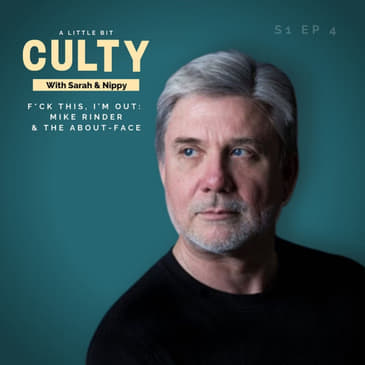
This week, we’re honoring the life and legacy of our dear friend and hero, Mike Rinder. Mike was a pivotal figure in the fight against cultic abuse, and his courage and compassion set the gold standard for turning a difficult past into a powerful force for good. To celebrate his incredible contributions, we’re re-releasing this conversation from March 2021, where Mike shared his remarkable journey out of Scientology, the intricacies of whistleblowing, and the resilience it takes to rebuild after leaving a high-control group.
In Mike’s own words, “If you are in any way fighting to end those abuses, please keep the flag flying. Never give up.” Let’s carry his torch forward.
👉 Support Mike Rinder’s Legacy and Help Send His Son Jack to College here
Thank you, Mike, for being the light we all needed. We’ll miss you, but your legacy shines on. Original episode: F*ck This, I’m Out: Mike Rinder & The About-Face released March 14, 2021 Also… let it be known that:
The views and opinions expressed on A Little Bit Culty do not necessarily reflect the official policy or position of the podcast. Any content provided by our guests, bloggers, sponsors or authors are of their opinion and are not intended to malign any religion, group, club, organization, business individual, anyone or anything. Nobody’s mad at you, just don’t be a culty fuckwad.
ORIGINAL EPISODE CREDITS: Executive Producers: Sarah Edmondson & Anthony Ames
Partner: Citizens of Sound
Producer: Will Retherford
Associate Producer: Jess Tardy
Theme Song: “Cultivated” by Jon Bryant co-written with Nygel Asselin Additional Music Scores by Will Retherford RE-RELEASE CREDITS:
Executive Producers: Sarah Edmondson & Anthony Ames
Production Partner: Amphibian.Media
Writer & Co-Creator: Jess Tardy
Associate producers: Amanda Zaremba and Matt Stroud of Amphibian.Media
Audio production: Red Caiman Studios
Theme Song: “Cultivated” by Jon Bryant co-written with Nygel Asselin
See Privacy Policy at https://art19.com/privacy and California Privacy Notice at https://art19.com/privacy#do-not-sell-my-info.
[00:00:00] Wir sind Teresa und Nemo und deshalb sind wir zu Shopify gewechselt. Die Plattform, die wir vor Shopify verwendet haben, hat regelmäßig Updates gebraucht, die teilweise dazu geführt haben, dass der Shop nicht funktioniert hat. Endlich macht unser Nemo Boards Shop dadurch auch auf den Mobilgeräten eine gute Figur und die Illustrationen auf den Boards kommen jetzt viel, viel klarer rüber, was uns ja auch wichtig ist und was unsere Marke auch ausmacht. Starte Dein Testen heute für 1 Euro pro Monat auf shopify.de slash radio.
[00:00:27] Hallo, everybody. Welcome back to a special bonus drop here on the ALBC feed. If you've been following us on Instagram, you will know that we in the cult survivor space have had some tragic news this week and we wanted to figure out the best way to honor our dear friend and hero Mike Rinder. His book is on our desk and we're staring at a young face of his.
[00:00:54] It's called A Billion Years and we were unsure of the best way to honor him and we thought we would replay some of our episodes with him over the years on the feed this week. Nippy's going to read what we wrote. We wrote a little something for him on Instagram and if you know Mike, hopefully this will resonate with you. We lost a dear friend this week, a hero and a leader in the fight against cultic abuse. We are gutted to say goodbye to Mike Rinder, a friend and constant inspiration.
[00:01:25] Mike was also a pivotal person in our journey. His story is one of the most compelling for not just us, but anyone who has been in any group that has been a little bit culty. His thumbprint on not just our lives, but the ALBC community is indisputable. For us, he is the gold standard of what it means to do an about face on unwitting wrongdoings and making it right. When we needed a light, when we needed an example, and when we needed the balance of strength and compassion to show up, the universe presented us with Mike Rinder.
[00:01:53] His work with Leah Remini and Scientology in the Aftermath is just one example of his strength and tenacity in righting these wrongs. The best way to honor him now is to continue his fight, to pick up that huge torch he lit, throw gas on it and press on. In the words he left us, he wrote, If you are in any way fighting to end those abuses, please keep the flag flying. Never give up. If we know Mike the way we think we do, this is what he would want.
[00:02:20] When we look at his life, we see a love letter to humanity, what resilience looks like, and what doing the right thing requires. Our hearts are with his wife, Christy, his children, and anyone else he held dear. He stays with us in the words of his blog, which will stay up indefinitely. Please consider donating to the GoFundMe created to fulfill Mike's greatest wish, sending his son Jack to college. We love you, Mike. Thanks, Mike.
[00:02:45] Thanks for being a part of season one, and for setting us up on a track to hopefully continue the work that you've done. Everybody, our friend, Mike. Hi everyone, I'm Sarah Edmondson, and I'm here with… Hi, I'm Anthony Ames, Sarah's husband, a.k.a. Nippy.
[00:03:13] And we're here to talk about things that are… A little bit culty. A little bit culty. Speaking of, we were in a cult and we woke up, thank goodness, and we have a lot to say. And a lot to ask. This podcast is going to be a deep dive into everything from the red flags to the narcissism, the manipulation, the resiliency, the recovery process, and everything in between. Also, we want to share some of the good we got out of it so you can get all the nuggets without having to join a cult.
[00:03:40] If you haven't already, because there are a lot of things out there that are just a little bit culty. Welcome to A Little Bit Culty. A podcast about the fads, beliefs, and trends that blur the line between healthy and a little bit culty. Please subscribe so you don't miss an episode. And find us on Instagram if you have any suggestions for things you have found to be a little bit culty.
[00:04:24] Hello, everyone. Welcome to another episode of A Little Bit Culty. This episode, we're going to get into something that's a lot culty. First, as always, I'm going to check in on my wife. How are you doing, sweetheart? Oh, Nippy, that's so kind of you there. I rarely use sweetheart. I'm just buttering her up for this episode. What do you want, Nippy? Yes, right. Good morning. How are you? How are you feeling? We're ready to rumble here. Okay, so we're going to start with questions. Yeah, go ahead. Hit me. Okay, so there was a big announcement a couple of days ago.
[00:04:53] For those of you who are following the story of the vow and NXIVM and all that, and I imagine if you're this deep into it, you have at least a superficial understanding of what was going on. There are something called the Dossier Project, which is the Doss women's group, and they made a statement. And the statement was a lot of word salad. You can look it up, whatever, basically trying to say Keith's misunderstood. And I rarely get involved and I rarely give them a platform or anything like that and don't
[00:05:22] care to because I think that's what they're looking for. But I did make a couple comments on a podcast in the Times Union, particularly because they targeted Sarah. And of course, I defended her. But I wanted to know for you, how does it feel for these people that used to be your friends to be on their end of their psychology that's really out for revenge to destroy you? What's that like? Uh, you know, it's, it's a kind of a, it's a chaps my ass.
[00:05:49] It's, it does chaps my ass, but it's also like devastating to see that we're three years out of this thing, six weeks trial of evidence at their fingertips. And they're still claiming, well, there, there, their words were where that was that I had a false narrative and that because of my false narrative, the FBI made a trial and put an innocent man in jail. And I, and I, you know, I guess the thing that comes up for me, similar to what I said in the Times Union is like, okay, let's just say I had a false narrative.
[00:06:19] Let's say I made it all up. What about all the other women? What about all of the other victims that have been going to the authorities for years, even before NXIVM started? Does it affect your day to day when you get like? No, it doesn't affect my day to day. I don't give them that power. But I mean, as you know, part of why I'm even doing this is to raise awareness and educate people and hope that some of this information will get to them and they will wake up. Well, seed planted. You know, seed planted.
[00:06:47] And I guess what I would say to them is how do you deny all of the other, all the other women's testimony? Well, they're not interested in truth, right? No. They're interested in pushing their narrative. The only time they handle truth is when they're dividing the word of truth. Explain that dividing the word of truth. Well, they'll do it by getting people bogged down in content points and they'll argue language. It's what we talked about in one of our episodes about loaded language. They'll divide. They'll say things. Well, there's a difference between harm and pain.
[00:07:16] Explain to like an average listener why that's gaslighting even. Well, to get into how they divide the word of truth, it's in essence taking whatever content point you have and confusing it. So they lie by omission because they take it out of context. The entire system, the entire process of what Keith was doing is abusive. So they'll just ignore that and they'll go, well, these women wanted it. Well, they wanted it under a false pretense. They're doing the abusing while being abused and pretending that it's noble.
[00:07:45] So a lot of it's pretend. But to say there's a difference between harm and pain, the question would be like, well, can you have harm without pain? Can you have pain without harm? But really the entire process is coupled in abuse. So harm and pain, no matter what context there are in the situation because they're under this process of abuse, are abusive. And lying to someone under a false pretense to be specific with what the abuse is, is the abuse.
[00:08:11] So the horror comes when you find out and the pain and the trauma comes when you find out you've been lied to. And the difficult thing to quantify in any of these things is emotional pain. And you can always deny that. You can just say, well, I'm not an emotional pain. You are. That's yours. And then when you say, well, I'm sorry that they choose to perceive it that way. It's basically saying that the abuse doesn't exist. You're making it abuse based on your meaning that you ascribe to it rather than the fact
[00:08:37] that the entire fucking thing is abusive and you're denying that it's abusive and you're choosing to say that it's not abusive when it is just because you don't recognize it as abuse doesn't mean it's not. When you say you, you mean the doctor? Them. Them. Yes. Okay. So you, not the listener, you, the doctor. You can see it in abusive relationships. You say, well, oh, well he doesn't mean it that way when he's hitting you. He's abusing you and you're saying, you're ascribing a meaning to his hitting you as saying that he loves you or whatever, or he's hurting or something like that to justify his abuse.
[00:09:07] So they've justified the abuse in their own minds and further kick the healing process for themselves down the road. And it's all in this range. Yeah, he has to. Yeah. He has to. Yeah. He's protecting the fact that she's a good doctor, which I do believe she was before Keith got into her head. All she has to do is have a conversation, admit that was going on, and then she'd be in good standing with probably the community. And they'd heal, she'd heal. And then she could probably earn a way back. Instead, she says the women wanted it. And to that I have to respond very clearly. I did not want this. I did not want this. I never would have wanted it.
[00:09:37] Think about it for a second. I had a question for you, but that took a while. So let's move on to introducing our guest who I can't even tell you. I'm so, ah, I mean, honor is not the right word. It's just, it feels similarly to talking with Leah and our, in a previous episode to talk to Mike Rinder. Mike Rinder. Who was born and raised in Scientology. He's just such a, like a figurehead in the cult busting world for us.
[00:10:04] And like I said in his episode and in Leah's, if he hadn't done what he did and been so public about his calling bullshit on his organization, then I don't think that we would have had the same force or power behind us in our journey of being whistleblowers. Well, there's an example of how it's done. Yes, there's an example. He's a trailblazer. So Mike actually rose to the very top of the organization's worldwide hierarchy to become
[00:10:30] one of the international spokespeople and the head of special affairs for over 20 years. Mike worked directly with L. Ron Hubbard, AKA LRH and Hubbard's successor, David Miscavige. And when Mike escaped Scientology in 2007, he left everything he'd ever known behind, including his family. In addition to starting over, he's also become a very well-known whistleblower and just general badass. He's been dedicating his life to exposing the abuses in Scientology, teaming up with Leah Remen
[00:11:00] for the groundbreaking Emmy-winning A&E series, Scientology in the Aftermath, which is actually now on Netflix in the U.S., as well as the podcast, Scientology Fair Game. One of the more compelling things about Mike, in my opinion, is that he's become an advocate for people who've been abused in Scientology and beyond. He's become an ambassador and he's on the board of Child USA, which is a nonprofit working to bring justice for victims of child sexual abuse. He's also a founding board member of the Aftermath Foundation, which is dedicated to helping
[00:11:28] people escape from Scientology. His unique voice and perspective has inspired people around the world. And here's our conversation with him.
[00:11:58] Mike, thank you so much for joining us today. We're so excited. Can I ask a quick question before we start? No, no. I got to talk about the pumping. I mean, well, it's important because it is. But I just wanted him to know that we've already pumped his tires in the intro and not everyone. Yeah, that's I want to know what the hell does that mean? And I am. What pressure am I at? Well, pumping your tires is something like Nippy will say something like you can't pump your own tires because then you're like you're boasting.
[00:12:26] So I like to pump Nippy's tires and be like, Nippy's really good at X, Y and Z. And he'll do the same for me. So we just pumped your tires like hard. All the things that you've been doing and like what an advocate you are. And also, you know, what a what an inspiration you are to us. And I know we've I've said this to you already, but you're our our listenership doesn't know, you know how much you've done to help us get out as a trailblazer in the cult whistleblowing cult busting world. Well, thank you. So yeah, but you had a question.
[00:12:56] Sorry, Nippy. Well, it's not so much a question as an observation. I know it's Mike Rinder, but Leah likes to call you Mike Rinder. That's that's just because she she likes to try to make fun of my Australian mongrel accent and she's not really very good at it. I like it. I want to take that over even in Australia. They don't say Mike Rinder. What do they say Mike Rinder? Okay, because that's my name.
[00:13:22] But that would be how you would think an Australian would say it because all vowels are extended long vowels in in Australia. Nippy, you're perfectly welcome to keep it like like that is the least offensive thing I've ever been called. You've been through the ringer too. So, you know, I think this is this is just pure love in this podcast. This is part of your therapy because I listened to one of your podcasts that you aren't in therapy.
[00:13:51] So we've decided this is actually this is going to be therapy for you. I'm just chilling. Yeah. Well, my therapist is Leah Remini. I get that was one of my questions. That was actually my question. Direct feedback. Yeah. Before we get into that, I just tell you a quick story. So yesterday I was out just in front of our apartment here.
[00:14:11] There's a little like piazza and I was pushing the baby stroller and I had ace in the in the carriage and I was with my dad who is very supportive of what we do, but doesn't really know like what the day to day is. You know, he like I just downloaded the podcast app on his phone so he could subscribe to our podcast. He's like a little behind in the technology times, but he's like he knows what I'm doing. He's he's proud of me and he's they never seen this. And what happened was we're walking across the square and this woman called out to me and she said, are you Sarah?
[00:14:39] I turn around like, yeah. Hi. And she goes and she was like shaking and she's like, I'm an ex Scientologist and I saw the vow and what you're doing is like amazing. And she started to cry and I started to cry and my dad started to cry because he never seen he'd never seen like the effects of this like in the day to day life.
[00:15:02] And she was like, then she told me her whole story, like how her husband was in the military and Scientology made her divorce him. And then she realized she made a mistake and she went back to him and she got cut out by her family and she's being disconnected and how her family still in it. And she's just devastated. And she's like, but the work you're doing is so important and the vow helped me. And I said, it's so crazy. I'm talking to Mike Rinder tomorrow. And he goes, well, he doesn't know me, but I know him and his work is so meaningful to me.
[00:15:31] And then I kept like this all through the tears. You know, I just thought it was so like what a moment that I knew I was going to be talking to you. And then also for my dad to see, you know, the effects of this work on people that we don't even know, you know, that are just right watching this stuff. And then, you know, I would just happen to run into her in front of my apartment. And if you believe in signs from the universe or if you believe in like reinforcement that you're doing the right thing, you know, I just want you to know.
[00:16:00] Yeah, that's terrific. Thank you so much for telling me that those are the stories that make the pain and the heartache worthwhile.
[00:16:11] Like people reach out all the time, even people who haven't been involved in Scientology, but have been involved in other organizations or even abusive relationships or whatever it is and say, you know, I just want to let you know that something that you did or something that you said or something that was on the show impacted my life.
[00:16:36] And that is everything that is more valuable than money. That's more valuable than Emmy Awards. That's more valuable than anything that you can get is the appreciation from people. And then with that appreciation comes the knowledge that somehow something you've done has helped someone just like you and everybody else.
[00:17:05] I have ever met who was involved in a cult of one description or another. Every single person had as a underlying personality characteristic that they wanted to help people, even if it started out as being that they wanted to help themselves.
[00:17:27] They graduate from that almost uniformly into, and I found this thing that helped me. And now I want others to experience it too. And it's not because they are trying to make a million dollars out of it. It's because they really believe that they can help people.
[00:17:50] And I think that we, you know, you guys and me and Leah and everybody else who has spoken out and is trying to put an end to the abuses of, you know, high control groups has that as a common denominator. And it's a pretty good gang of people to be associated with. It just is. I like this gang. I agree.
[00:18:18] I think we need a name for this gang. Like a secret handshake. No, no, just kidding. Too soon. Oh, yeah. Our general format for interviewing guests, just so you know what our plan is for today, is overall, how'd you get in? And I know you were born and raised, and we have questions about that. But like, you know, how did this get started for you? How did you wake up? What were the red flags? And how did you get out? How are you healing?
[00:18:48] And then, you know, we have lots of other general questions. But that's sort of the overall sort of want to cover, just in case there's anyone listening who doesn't know your full story. We don't have to spend a long time here because I know it's out there in the internet universe. So some questions about that. And then we just have like, you know, things we want to know and share with you as well and some similarities between our two groups in general. I told Leah is Scientology light. Yeah.
[00:19:16] Just in terms of the amount of people that were extreme. But in terms of process, the abuses of power to me are always the things that are the most interesting. And I have a bunch of questions about how that happens. I listened to the podcast you did with Ford Green and how the First Amendment has been twisted to protect an abusive entity and all those things. So I'd like to get into that at some point and hear your thoughts on that. Just to hear a little bit about your background. I know you were born and raised into Scientology.
[00:19:45] But when your parents got involved, what did they think they were getting involved in? Like, what was the promise that you, as far as you understand? As far as I understand, they thought that what they were going to get out of Scientology. And I think that this, you know, they both died still absolutely full on, completely dedicated Scientologists.
[00:20:10] That they believed that they were going to get a technology, which is how it's described in Scientology, similar to NXIVM. This is not just a belief system or faith. This is a technology for how to deal with life. This is how to make yourself a better human being, how to make those around you a better human being, how to raise your children properly and effectively, and how to be happier and more capable.
[00:20:39] And that is the promise that Scientology holds out to everybody. These are the sort of catchy kind of things that it offers. And, you know, when you offer that to people and you tell them that you have a technology for accomplishing it, there is a lot of people who will then attest that that is exactly what happened to them.
[00:21:04] And, you know, there are smatterings of valuable, truthful things contained in Scientology, just as there are smatterings of valuable, truthful things contained in NXIVM and anything else that attracts people. You don't attract people by giving them complete bullshit. If you give them complete bullshit, everybody walks away and goes, well, there's nothing to this.
[00:21:31] But if you've got some little bits and kernels and things that, you know, someone once described this as the raisins embedded in the poop. Like if there's some raisins in there that you can pick out, there's some value to it. If it's just a stinky pile of shit, then it has no value.
[00:21:52] And then you start getting the attestations and affirmations from people about what they experience changed their life. And that's very common in Scientology. In fact, it's a requirement when you complete a course of study or a course of auditing, which is Scientology counseling.
[00:22:16] You are required to write what is called a success story, which is used for public consumption. And Scientology uses those things to promote to other people that you can have these benefits too. You know, it's funny, Sarah, when I was reading your book, and I told you this when you were talking to Leo and I on our podcast,
[00:22:39] there are so many similarities between these concepts and even terminology in NXIVM from Scientology that it is absolutely impossible for me to believe that Keith Raniere didn't study Hubbard, not just as a, you know, sort of, oh, here's something I should probably read a bit about this,
[00:23:03] but actually study to figure out how did he go about setting up his deal to duplicate things that he thought was successful, which are successful in Scientology, into NXIVM. So the idea that my parents had, now that they had found the answers to everything, and truthfully, Scientology promises it has the answers to all of life. I mean, Hubbard says that.
[00:23:32] Scientology has the answers to all of life, everything, anything. So they believe that having found those answers for themselves, that they needed to indoctrinate their children into those same concepts. And so there is a sort of a saying in Scientology of, if you don't know what to do, figure out what would Ron do, Ron being L. Ron Hubbard.
[00:23:59] So my childhood, I spent growing up with the idea of solving problems or addressing life through the glasses, I can't say rose-colored glasses, the, you know, distorted glasses, of what would Ron do? What does Ron say? How does Ron tell you to address this problem?
[00:24:25] And by the time I was in high school, it was a foregone conclusion to me that as soon as I graduated high school, I was going to join the sea organization. That I was going to become a part of the inner circle of Scientology that devote their full-time endeavors to achieving the aims of Scientology, and that's the sea organization.
[00:24:55] So it was a point of pride for my parents that I joined the Sea Org. And extra pride for my parents that not only did I join the Sea Org, I went and worked directly with L. Ron Hubbard. Wow. And that was like- What an honor. That's exactly what it was. It was like being a good Catholic and having your son end up at the Vatican, you know,
[00:25:20] within a year of joining the church, you know, or joining the clergy, and suddenly now he's at the Vatican, and pretty soon he becomes an archbishop. And that was, I don't know, to some extent, expected of me. And it's almost what's expected of good Scientologists, that their children are going to become the future of Scientology,
[00:25:45] because they've been raised with the pure thoughts of Scientology from the get-go to now continue the pure thoughts of Scientology for planet Earth. I totally get that. I don't know if this was in the book much at all, but Nippy and I, like, you know, Troy was three when we got out, and for those first three years, we were really excited about the possibility of raising our kid in this community. And I remember in Albany, where it was more insular,
[00:26:12] there was concern about, like, what are our kids going to do in a non-ESP school, where the kids aren't at cause. Like, they're not at cause, you know? And their grandparents who aren't in ESP are going to say things, well, that makes me sad. And you're like, and the little kid would be like, it doesn't make- I don't make you sad, Grandma. You make yourself sad. Like, those are the kind of anecdotes we'd hear. And we're like, well, we needed education, which is where the Rainbow School, I think, which is probably Keith's version of the Sea Org. Anyway, I interrupted.
[00:26:40] So you had this, like, really successful career in Scientology. Was there a particular moment where you woke up? I'm kind of skipping. I'm skipping kind of to the end. One of the things we like to teach here is what are the red flags so people can learn from them in their own life. What were the red flags maybe along the way that you, not ignored, but, like, compartmentalized or couldn't wrap your head around? Or the red flags around if you worked with L. Ron Hubbard. Yeah. Was there anything there?
[00:27:09] Well, there's thousands of them. Right. And this is sort of what's interesting about the experience of immersing yourself into a cult and then ultimately getting out, is you can look back and go, well, I can't believe that I didn't really, you know, that didn't have an impact on me. Or I can't believe that I didn't see that.
[00:27:36] Or I can't believe that I fell for this bullshit. Or et cetera, et cetera. But I think that there is another dynamic that goes on within your head. And that is there are teachings within Scientology that are very, very strongly reinforce this idea, which is the concept, you know, in sort of normal terms is the ends justify the means.
[00:28:04] In Scientology, there is a very specific term for this. It's called the greatest good for the greatest number of dynamics. And I'm not going to go into a long description, but dynamics in Scientology, what Hubbard says are the thrusts towards survival, the eight components of life or compartments of life, which are the thrusts towards your survival. And it starts with yourself.
[00:28:30] And then it goes out in concentric circles to your family, to your groups, to mankind, to living things, to the physical universe, to spiritual universe, and ultimately to God. And the idea is that what is beneficial to the greater number of those dynamics is what is good and survival.
[00:28:55] And what is harmful to the greater number of those dynamics is called contra-survival. Now, one of those dynamics happens to be the third dynamic. And the third dynamic is groups. Now, that means every Scientologist has as his or at least one of the groups that he is a part of is Scientology.
[00:29:22] But when you start breaking down this equation, it's like it all makes terrific sense when you're in there.
[00:29:29] But the truth of the matter is that because Scientologists believe that Scientology is the solution to every problem that every person has, including all the problems of mankind, and not just mankind, but this entire sector of the universe, then what's good for Scientology is good for all the dynamics. Because it's good for every other person. It's good for families.
[00:29:57] It's good for living things. It's good for the planet. It's good for God. I mean, everything. So this equation becomes a completely skewed equation, which is what is survival equals what is survival for Scientology. Right.
[00:30:15] It could be horrendously destructive to you, and you get persuaded that the destruction that you are experiencing is a small speck in the overall picture of the good that is being done for the entirety of every man, woman, and child on Earth. And so all the things that you see that you go, wait a minute, this is some bullshit here.
[00:30:45] Or this is terrible. Or I'm not living in a bunk with stinky blah, blah, blah, blah, blah, blah, or being kept in a room or blah, blah, blah. Everything then gets filtered through two factors.
[00:31:00] That's the first one, which is, look, the pain or suffering that I am experiencing is small potatoes, insignificant, nothing compared to the overall big picture of planet Earth. And secondly, just like in NXIVM, the bad shit that is happening to me is what I caused. Right.
[00:31:25] That this is my creation, and I have to be responsible for it and own it. And if I can't be responsible for it and own it, that just means I'm not yet fully aware and haven't reached the appropriate levels of understanding of how life works and how I work, et cetera, et cetera.
[00:31:49] So I go back and I look and I go, you know, the first day I arrived on the Apollo, which was the ship that L. Ron Hubbard was on at the time, I walked in and I discovered for the first time that my life was no longer my own. I was effectively a prisoner on that ship. And they took my passport. I didn't have any money. We're in Portugal. I didn't speak English. I didn't speak Portuguese.
[00:32:20] I had nowhere to go. I couldn't get off. I hated it when I got there. It was gross. I mean, the place, the ship was gross. But, of course, my first thought is, well, this is the home. This is where L. Ron Hubbard lives. So this has got to be like, and there's all these other big advanced Scientology thetans here, and they know a lot more than I do, and they're putting up with it.
[00:32:48] So it must just be something wrong with my perception or my perspective on this that I am looking at this as, oh, my God, this is terrible. I'm getting out of here. Like, am I rabbiting? Am I running away? Am I coward? What will people think of me? I mean, all these thoughts go through your head. You're gaslighting yourself because you've been trained to. Exactly. Exactly. Totally, 100%.
[00:33:19] And you keep adding these up, and they add up over time. And, you know, I spent, you know, 30 years in the sea organization, and they add up, and they add up, and they add up. For each person, the straw that breaks the camel's back is a different thing. Right. And I don't know that there is a way that you can say it's always going to be X or it's always going to be Y. It's an accumulation.
[00:33:46] Every person I've ever spoken to, it's an accumulation of things that starts building in their mind. And they start, like, adding to this sort of ledger of there's something wrong. There's something that doesn't add up. There's something I disagree with. There's something that's bad going on here. There's something that's bad going on here. There's something that's bad going on here. But as they are accumulating, the weight of them gets bigger and bigger.
[00:34:16] And the benefit side of the equation becomes outweighed eventually by the downside of the equation until the last straw lands on the downside side, and it suddenly tips. And you go, you know what? All this is bigger than all of that.
[00:34:42] All the bad is bigger than whatever all the good is. And ultimately, for me, it got to the point where I'm going to lose my wife. I'm going to lose my children. I'm going to lose every friend that I have ever made in my entire life. I'm going to lose my parents, my brother, my sister. I have no money. I have no job. I have no resume. I'm not even in the United States. I'm in London. And fuck it.
[00:35:12] Anything is better than this. And I walked out the door with nothing, literally, with a briefcase. I walked out the door of the Scientology old L. Ron Hubbard office in Fitzroy Street in London in June of 2007 with nothing, not even clothes, just what I was wearing.
[00:35:33] And it was like a moment of perhaps the greatest feeling of freedom that I have had in my entire life, despite having written thousands of success stories about how wonderfully free I feel in Scientology, which they bring out all the time. Oh, yeah, look at this. He said all these amazing things about us.
[00:36:00] Like, now he's just lying because he's saying it's not true and blah, blah, blah, blah. I was literally sitting on the grass in front of the National Gallery in Trafalgar Square in London in the sun doing absolutely fuck nothing for the first time in I don't know how long, 30 years, and not feeling guilty about not doing anything.
[00:36:27] And sitting there just soaking up some rays and going, okay, now what am I going to do? Oh, nobody here to tell me what to do anymore. Now I have to figure it out for myself. And my God, that's a scary thought. It's also an incredibly liberating feeling.
[00:36:45] We tell our stories.
[00:37:15] We change the world. A Little Bit Culti is proud to support the hashtag I Got Out Project, which empowers survivors of cultic abuse to share their stories online as a catalyst for education, prevention, and healing. Learn more about the hashtag I Got Out movement and find resources at igotout.org. The search for truth never ends. Introducing June's Journey, a hidden object mobile game with a captivating story.
[00:37:41] Connect with friends, explore the roaring 20s, and enjoy thrilling activities and challenges while supporting environmental causes. After seven years, the adventure continues with our immersive travels feature. Explore distant cultures and engage in exciting experiences. There's always something new to discover. Are you ready? Download June's Journey now on Android or iOS. All right, everybody. You know me. I'm always on the hunt for different ways to make healthy eating easier for us.
[00:38:10] Because let's be honest. Between work, kids, life, who's got the time to plan and shop and cook the way that we'd like to? If that sounds familiar, I've got some exciting news. I found a solution that works for me. It's called Hungry Root. Hungry Root has been a total game changer. It's like having your own personal grocery shopper who knows exactly what you need. When I signed up, I shared my goals. Things like eating more veggies. I'm a little bit, you know, keto-ish. Sticking to high-protein meals. Finding quick, healthy snacks for me and the kids.
[00:38:41] And Hungry Root took care of everything. My last box? Total win. It had a veggie stir-fry, steak-caesar salad combo, a chicken fajita thing that the kids devoured, and this dreamy almond chickpea cookie dough I didn't even know I needed so desperately in my life. Didn't have to make cookies. I just had to make the cookies out of the dough that came in a little container. It was brilliant. Everything was so easy to prepare and fit perfectly into our busy schedule. And here's the best part. Hungry Root's groceries don't have any bad, weird stuff. No high-fructose corn syrup. Artificial sweeteners.
[00:39:11] Preservative. Just high-quality ingredients like meats and seafoods that are free of hormones and antibiotics, like I would look for if I was going to the store, except they come to your house in a box. Easy peasy. This has been such a weight off my shoulders. Whether you're looking for smoothie options, salad kits, snacks, supplements, Hungry Root has it covered. It's grocery shopping made simple and guilt-free. You are going to love Hungry Root as much as I do. Take advantage of this exclusive offer. For a limited time, get 40% off your first box, plus a free item in every box for life.
[00:39:41] For the rest of your life. Go to HungryRoot.com slash CULTI and use code CULTI. That's HungryRoot.com slash CULTI, code CULTI to get 40% off your first box and a free item of your choice for life. HungryRoot.com slash CULTI, code CULTI. You got it? Good. The most compelling thing about your story is the about face that you made and then went on the crusade to fix what you had done. And not many people do that.
[00:40:11] Not many people have the character to do that. Well, you guys are. Well, the most compelling story for me when I got out and I saw Going Clear and all that was that's the guy I resonate the most with. Because as guys, we're targeted differently. Very few of us are targeted sexually in the way that the abuses are. So our abuses are different. Right. And a lot of the times morally and in some cases, in your case, you were actually facilitating some of the things.
[00:40:38] And to go back and fix what you had done in the manner. I remember seeing the shot of you. We looked the reporter in the eye. Is that the shot? And you were. And I believe that was the moment where you saw that or something. And you saw yourself. So. Lying. Like saying nothing. Yeah. Saying. That was. That was. Yeah. That was John Sweeney.
[00:41:01] Who was the BBC reporter that I was in London to deal with because he was doing a program which ultimately aired. But one of the focuses of his program was he kept insisting that he had testimony from people that David Miscavige was physically assaulting people. And he said, I've got, you know, I've spoken to five or seven eyewitnesses. I didn't even remember how many who said that David Miscavige has physically assaulted you.
[00:41:30] And I'm standing there looking gaunt and like, you know, I'd just come out of the hole and I weighed about 30 pounds less than I do now with gray bags under my eyes. And saying to him, that's an absolute lie. Why? And I had, as the spokesperson, the international spokesperson for Scientology for many, many years told tons of lies. I mean, it's just a requirement.
[00:41:57] You're not going to go out there and say, oh, yes, we just, you know, that all these people killed Lisa McPherson or, oh, yes, the Z News story is all true. And, yes, we believe in crazy space aliens. You know, I sat on the Today Show with Katie Couric and denied that there was any such thing as Zinu because I believed that that was spiritually harmful. That's what Scientologists are taught. It was called an ethical lie in Nexium and you were doing an ethical lie. Yeah.
[00:42:27] That's exactly right. It was an ethical lie. I couldn't hurt people. I truly believed at that point that I was going to hurt people if I said that. I'm now standing in London and, you know, having been in the hole for a year and, you know, being just the abuse got worse and worse and worse. The physical and mental abuse got worse and worse and worse.
[00:42:54] And the thing that had always prevented me from just up and walking out apart from the physical, you know, challenges of doing so, because, you know, at the Golden Era base in Hammett, California, that's a really hard place to get out of. I mean, it's not just the barbed wire fence.
[00:43:17] It's like in the middle of nowhere and there's security guards and cameras and they track you down and chase you down and people have done it. Mark Headley escaped from there. Ron Miscavige escaped from there. Val Haney escaped from there. A lot of people have done it if you have the determination to do so. But what held me back from doing so primarily was my children and my wife. I couldn't figure out how to get them out with me.
[00:43:45] I couldn't say anything to them because if I said anything, it was very likely that they would report me and then the gig would be up anyway. But what happened sort of as a very short period is I'm standing there with John Sweeney and Sweeney is saying, you know, I've got eyewitness reports that David Miscavige has physically assaulted you. And I knew that was absolutely true.
[00:44:14] And I knew even who he'd talked to. It was Jeff Hawkins. It was Bruce Hines. It was all these other people that I knew John had spoken to who were all there with me, who had watched the same thing happen to me, to them, to all sorts of other people. And I'm thinking, why am I lying about this? Is this really what I came into Scientology for?
[00:44:37] Is protecting David Miscavige because he is physically assaulting and abusing people the right thing to do? And that was like a real moment of, oh my God, where have I descended to? Right. Like, what have I become?
[00:44:59] And then very shortly thereafter, Miscavige sends a thing to someone else with a CC to me saying, he's never coming back to the United States. I'm going to send him to Western Australia and he's going to become like, he's going to have to sell his body on the streets if he wants to make a living. This is what David Miscavige writes. And I looked at that and I went, you know what? There's nothing left.
[00:45:29] There's nothing. It couldn't be worse. Being walking out the door with nothing and no family and nothing couldn't be worse than this because I don't have any of that anyway. It doesn't exist anymore. It's all been taken away from me. So what am I fighting about? Fuck this. I'm out of here. In one of your other podcasts, the extremism, there's no half in the Scientology. And ultimately, that eats itself.
[00:45:57] And one of the distinctions I noticed between what we were up against and what you were up against is we had our lives outside of it. I had my family and we were in and out of it. But the all or nothing aspect to Scientology is like, if you're a Scientologist, you're extreme with your Scientology and your dogma. Whereas you can be a Catholic just going Sunday and you don't have to do all that stuff.
[00:46:20] That to me seems to be a major distinction about the abuses because the indoctrination seems very quick, very extreme. Because one of the other things I read as well, in Australia, you weren't allowed to have the books there. Is that correct? Well, they were hidden. They were hidden. Because in the 60s, Scientology was banned in, well, at least in Victoria. And then they were working on it in other states. So what did they get that the U.S. doesn't? If they see the extreme, the... Well, Nippy, they got it back then.
[00:46:49] But then the Australian High Court, the Supreme Court of Australia, made a ruling subsequently that Scientology is a religion. And it's a seminal case in Australia of how do you define religion? And they went through and said Scientology is that. So it's not all good down there. Steve Canan, who is an Australian journalist, wrote this wonderful book entitled Fair Game.
[00:47:16] And he traces the history of Scientology in Australia and how that all came about. And ridiculous, as this probably sounds, it was a combination of two things. One, Hubbard refusing to return money to a guy. One guy who became a very, very big thorn in Hubbard's side.
[00:47:44] And he happened to be politically connected. And he was... I mean, this story that Steve tells is pretty amazing. But two, there was a particular fellow in Australia by the name of Rupert Murdoch. Yeah. Rupert Murdoch, who, believe it or not, lived one quarter of a mile away from my house. I'd rode past his house on my bicycle every morning to go to school.
[00:48:14] He started at the Adelaide News, the evening news in Adelaide. That's why it's called News Corporation. Because that was his father's newspaper. And he built that into an empire from Adelaide, Australia. The only thing that's ever come out of Adelaide, Australia, I think. And his newspapers in Australia went after Scientology with a vengeance.
[00:48:41] And they were the original tabloid newspapers. There was this newspaper in Australia called Truth, which was far from it. But nevertheless, they went heavily after Scientology and had a great deal of political influence. And so that's why in the 60s, Scientology got in such trouble in Australia.
[00:49:05] It's still like, even though there is a high court decision there now, Scientology doesn't flourish in Australia at all. There's a lot more willingness, I think, in Australian society to be vocally critical of things, even if people tend to... There's too much political correctness here in the U.S.
[00:49:28] You know, obviously, like when I watch Scientology in the Aftermath or listen to Fair Game, the podcast about Scientology, like I can't help but compare. You know, like, oh, yeah, we did that. And always for sure. Keith, I mean, Keith took so much from Scientology. You're absolutely right. Including things like, you know, trying to make a film crew. Like, you guys had a proper film crew. But, you know, like, but what you have to know is that everything that we did was so half-ass in comparison. Like, you guys had a legitimate film crew.
[00:49:58] Valerie was the casting director. I was like, wow, that is amazing. Ours was so haphazard and, like, low budget. Like, Keith wanted it, but Claire wasn't willing to fund it properly. You know what I mean? Like, it was just always never quite fully baked. And so, you know, and I watch it going, wow, like they really had it together. But one thing that I hadn't realized until one of your, one of the episodes I watched was that I didn't realize that people actually could leave Scientology.
[00:50:27] Like, when I read or watched about how Valerie got out of the trunk of the car. But then she went back and left properly routing out. Is that what it's called? Routing out? Yeah. Yeah. Oh, C-org members. Okay. So, I don't think this has been talked about anywhere, but for us, we also had to, and this was like in the later years, people came and left and it wasn't a problem.
[00:50:52] But as there was more adversity against NXIVM, it wouldn't be a problem for people to leave as long as they signed paperwork that was almost identical to what you guys explained. Saying, I'm leaving on good terms. I had a great experience.
[00:51:06] I had a great experience. I, and honestly, and I've told her this and she knows this. I was happy for her when she left.
[00:51:35] You know, I wanted her to go to LA and pursue her acting because inside me, that's why I wanted anyone to do NXIVM or this piece because I wanted them to, to use it in their life and achieve their goals. Right. Inside me also, because I had the, you know, my, my personality. And then also had like Sarah, the proctor personality, the proctor personality was like, how dare she leave with all these responsibilities? Like that I have now got to clean up because she's leaving. So I was like happy for her and pissed that she left so abruptly all at the same time.
[00:52:05] It was a conflict within myself, but then they asked me to get her to sign this paperwork and she wouldn't respond to me, which was one of my red flags is like, if she's leaving on good terms, why wouldn't she just sign the paperwork? But then I don't want to like, I'm not that kind of person to be like, you know, to go after her for it. So I left her a message, which was in the vow saying like, if you could just like, just sign the paperwork, it was becoming a thing. Like, I don't know what's going on with you. But thank God that she didn't because, and I didn't either.
[00:52:33] I didn't sign my paperwork when I left. And that's why Claire withheld all the money that was owed to me. I think it's well documented that I wasn't signing it. So the other thing I wanted to bring up is that I feel like, like it was almost like Keith looked at Scientology and was like, well, that's a bit obvious.
[00:52:51] So I'm going to like dial it back and make it look like everyone's asking for it and make it look more consensual and do the abuse in a, like a tacit kind of, it's just an exercise type of thing. Um, you know, when I saw the episode where they talked about giving you a name tag saying that you were the shit eater, is that right? And I was like, oh God, well, first of all, I'm sorry that that happened to you.
[00:53:16] I know I just like, my heart was like, oh my God, my cruncher's like the opposite of the shit eater, whatever the fuck that means. Um, but I remember like, you know, some SOP trainings and people have looked at it and going like, how could you have endured that latent misogyny and being humiliated? I'm like, but you have to understand this wasn't, I don't think super well explained in any of the documentaries. We entered that thinking we were going through a bootcamp where we're going to be humiliated for the purpose of our growth.
[00:53:46] So that's like the more subtle version of what you were saying. Everything's for the goodness of the good of the dynamics and all that stuff. When I was in there, I'm like, this sucks. And I can't go to the bathroom for three hours. Otherwise I'm going to be, I'm going to get a princess tiara or something, you know, because I have to pee too much. And I'm not going to like in any other training, just so you know, Mike, I would have like a water bottle, a green juice, a coffee, some aromatherapy spray, like whatever I could to like get through. And people made fun of me for it. Right. Like, and fair enough. Right.
[00:54:16] Fair enough. But, but with SOP, I couldn't, I wasn't allowed any of my accoutrements. So I just learned how to be like a good soldier and get through these trainings and like not drink too many liquids. And I couldn't get up, couldn't check my phone, couldn't do all the things. I mean, I could have, but then I would have been called out, but I knew that I was doing that to toughen up, you know, and not be, not be a princess anymore. Right.
[00:54:40] And this is something that, that is promoted heavily in Scientology, most particularly in the sea organization. Within the sea organization. Within the sea organization, there is this idea that being empathetic or being soft is a sign of lack of commitment. And by soft, I mean caring about things.
[00:55:08] Like, it is a, it is a big, big down, uh, negative mark against you as a SEORG member.
[00:55:19] If you are seen to be what's called worker oriented, if you seem to be sympathetic to the people who you are in charge of, if you are seen to be concerned about their wellbeing, rather than concerned about whether they are getting the job done that needs to be done in order to clear the planet.
[00:55:45] And there, you know, like the rehabilitation project force, which is the, the mind, the way that, that SEORG members are supposed to be re indoctrinated is, and it's laid out in these writings. This is going to be terrible. This is going to be terrible. It's going to be nasty, tough. You're going to sleep on the floor. You're going to wear a black boiler suit.
[00:56:10] You're not allowed to talk to anybody outside of the RPF, anybody at all, unless they address you. You have to run everywhere. You get to eat the leftover food from the rest of the SEORG members. Once they're done eating, you are not allowed contact with any member of the organization or your family. You are going to work doing menial labor for 10 hours a day.
[00:56:38] You are like, this is considered to be like, this is how we rehabilitate someone. This is how we make them good again. This is how we get them to be a productive member of the SEORG organization, by abusing them. And it's all like proudly done.
[00:56:58] And Tommy Davis, who was the idiot spokesperson that, that sort of took over from me, made this comment sometime about, yeah, we're tough and we're proud of it. And we're like, like. Like that's a good thing. Whoa. Like that, like you lose perspective on the world outside of that bubble.
[00:57:21] You lose, like you ask a SEORG member and they will tell you, yes, this is exactly what we do. And this is exactly what they think. And they think it's fabulous. It's a good segue to what's happening now. Right. With the dossier. Like Nippy and I were just talking about the dossier project, which we sent you. And the people that remain, it's exactly that. They think it's fabulous. And they're saying, right. Yeah, we knew we were going to do it as a boot camp and we knew we were going to be in pain. And that was what Sarah committed to.
[00:57:50] And the fact that she's leaving and broke her secrecy and has a false narrative just means she still hasn't done the work. She's like breaking her vow, which is what women do. They can't keep a secret. And she's not tough enough or strong enough like us true believers. And that's why he's in jail. Because of me and my false narrative. Right. You know, you were talking, Nippy, about extremists. Real religions have a fundamentalist sort of on the fringes part of their activities.
[00:58:19] Judaism has the real fundamentalist Hasidic, you know, the Mormons have the LDS, like the really fundamentalist, you know, five or six wives and all the daughters. And Muslims have it. And everybody has fundamentalist arms. You know, the Westboro Baptist Church is a fundamentalist arm of the Baptist.
[00:58:46] The mainstream Baptists are just normal, nice people. You know, they're not out there. God hates fags. They're just normal, nice people. But Scientology is 100% fundamentalist.
[00:59:01] The teachings of L. Ron Hubbard include a line in the writing of Hubbard that every person has to read at the beginning of every single course, which says, I'd rather have you dead than incompetent as a Scientologist. Wow. I would rather you be like, you're 100% in Scientology or you are not a Scientologist.
[00:59:27] You are 100% committed or you're a nothing. So that's part of the planted phobia, right? Like if you leave, you believe that you're a nothing. Absolutely. Oh, you're worse than nothing.
[00:59:38] I mean, the stories and what gets told to Sea Org members, when they leave, Sea Org members, people inside the Sea Org today believe that every person who leaves the Sea Org is, to begin with, probably, and this is like repeated a thousand times you can ask any ex-Seorg member. Oh, they're flipping burgers at McDonald's. That's what they do for a living now. Like there's something demeaning about that.
[01:00:05] But secondly, and they all end up dead, dying of cancer, dying of some terrible disease. They get run over by a truck. Like literally, they believe that leaving equates to suddenly their life is going to become a living hell. So how do they justify your success now? Look at you're so happy. You've got a beautiful- They don't. They can't see it. This is the thing, Sarah. They can't.
[01:00:34] What they do is, for their internal public, they put up these smear sites. And those smear sites always have pictures of, you know, Leah, like expanded to look like she weighs 275 pounds. And me to look like I'm a drug addict. And that I'm a wife abuser. And that I'm a children killer. And that this and that that.
[01:00:59] So that they can show to those people who might come along and say, oh my God. I was sitting and I turned on Netflix. And oh my God, the show came on. And I had no idea what it was. And suddenly I'm seeing ex-Scientologists on there. And they're talking about being abused and blah, blah, blah. What am I supposed to do? And Scientologists, oh yeah, that's just those people. They're horrible, failing people. And here's pictures of them.
[01:01:29] Look at them. They look terrible. Because if you look on their smear sites, every picture of us is like, oh my God. They've Photoshopped it. So it's all like, oh look dark. Right. You know, and they capture. They go through videos. And they capture when you're like looking like that. Yeah, yeah. That's freeze-framed. And that's what they do. They're the biggest. And I said this to you, Sarah, about those DOS people.
[01:01:56] The biggest audience for that thing is not outside of NXIVM. It's the people who are still in there that they're desperate to hang on to. That they don't want to lose anymore. They're bleeding badly. They don't want to lose more. So they got to have this stuff that they can show to their people inside to try and hang on to them. And they're way more successful in doing that.
[01:02:24] The worst they can say about us is that Nippy's got an anger issue. And I'm just looking for attention. So, you know. So, okay. So here we are, Mike. 2021. Everything about Scientology is somewhat out there. Most of it's out there. How is Scientology still able to exist? If it's thriving, how is it able to thrive? And how is there a support system that exists for it to thrive? And how does it end? How do you... Where do you punch them?
[01:02:53] How do you punch them? You know, can you punch them in the wallet? Can you punch them? Like, what does it look like when Scientology and this extremism comes to an end? Why hasn't it so far? Okay. That's a great question, Nippy. And it's, you know, a thing that we struggle with and frustrates Leah to no end. I will answer you in the way that I view this. And it's funny.
[01:03:22] I was just talking to someone on a podcast about Mormonism and ex-Mormons, and he asked exactly the same question. He said, you know, it gets so frustrating and blah, blah, blah. I look at things like Scientology and the arc of how society changes and how things change to put an end to abuses.
[01:03:50] And it is a typically a long process. If you look back at the civil rights movement, it took a long time and a lot of blood, sweat and tears and a lot of protests and a lot of activity by a lot of people to first of all, start changing public perception. And then ultimately to get the civil rights act passed into law.
[01:04:16] If you look back at the struggles that the LBGTQ community has had and look back to the 60s, you were an absolute fringe lunatic if you supported gay rights. And even into the 70s, but then it started changing.
[01:04:37] And ultimately it gets to the point where the fringe belief becomes reversed and it's no longer a fringe belief to be for gay rights. Today, it is a fringe belief to be against gay rights. It was a fringe belief to be pro civil rights. It ultimately became a fringe belief.
[01:05:07] You're now literally a Nazi if you're against civil rights. Those things then go to the next step. Once you have changed public perception, that part of that public perception is the perception of elected officials and law enforcement.
[01:05:27] And when you start bringing about that change, ultimately you get to the point where the people who can actually bring about that change, like I, Leah and I can scream from the rooftops. We can have, we can have 24 Emmy winning shows. And that would not result in the loss of tax exempt status for Scientology. We can't do that. The IRS can. We cannot. Members of Congress can put pressure on the IRS.
[01:05:57] We can only raise awareness and generate understanding that something needs to be done. And ultimately that is what will happen. Ultimately, what will happen is that just like, you know, now there is legislation being enacted to prevent discrimination based on gender or sexual orientation.
[01:06:25] And that will ultimately pass. And there's no question that within the next five years, there will be law in the United States that prevents that. Going back to the 1970s, it was you were a fringe hippie nutcase if you came out and spoke pro gay rights.
[01:06:45] Before, and I believe that starting with going clear and Alex Gibney's tremendously impressive film on HBO about Scientology and then carrying on with the aftermath.
[01:07:02] We have systematically been changing the public perception of Scientology from this is a fringe bunch of weirdos in Hollywood that jump on Oprah's couch to this is an organization that systematically abuses people.
[01:07:25] And that people are being hurt and harmed and that that should not be tolerated in society. The next step is to make that intolerance. The next step is to make that intolerance into the law and to translate that outrage and the unwillingness to allow this to go on into enforceable laws. And that is what will ultimately happen.
[01:07:55] The difficulty that exists is because Scientology cleverly, and this was Keith Ranieri's biggest mistake in my view, because Scientology is a religious organization, it has an enormous amount of legal protections afforded it in the United States.
[01:08:19] And because other religions who pretty uniformly seem to be engaged in one sort of abuse or another, whether it's the Catholic Church or the Jehovah's Witnesses or whoever, all across the spectrum, somewhere down the line, they've got some really nasty shit going on.
[01:08:43] Financial, sexual, abusive people, breaking up families, whatever it is. But because they have such a powerful lobby and such powerful and influential people that are elected officials, those churches and religious organizations have seen that the Scientologies of the world are their cannon fodder.
[01:09:11] Scientology is the front line cannon fodder that is the beginning of a slippery slope that all those other religions fear. They fear that if Scientology goes down, they'll be next.
[01:09:26] They fear that if the IRS looks into Scientology's tax-exempt status, that once that happens, there'll be calls for them to look into their tax-exempt status and the private jets that they own and et cetera, et cetera, et cetera. So they fight hard to prevent and support, prevent that incursion and support Scientology in its efforts to prevent those incursions.
[01:09:56] But it will eventually change. And the way that it will eventually change is by continuing to keep getting the message out and making more people aware and raising the awareness of more and more people and never shutting up. Partly, like I'm never shutting up partly because they want me to. So they want me to shut up. So fuck you. I'm never shutting up. In a way, you got dragged into the fight, right?
[01:10:26] Yes, I did. I was not in this fight. I was not. All the steps that we took, we had to take. We were forced to take. It was self-preservation. Well, that was actually one of the questions from our listeners because I'd posted that we're talking to you and they said, how do you find joy when your work in history with Scientology is so sad and dark? Which I feel like you've kind of answered, but like you're happy now. Like you're doing so well. Am I right? Like that's my take on you.
[01:10:53] Oh, I'm incredibly happy. And you know, one thing that I always say to people, Sarah, is look, there are a lot of things in my life that I regret. There are a lot of things that I don't feel good about, but there's nothing I can do about changing the past. All I can do is change the future. I can't alter what happened or what I did.
[01:11:23] I can learn from it. I can look back on it and go, okay, I'm never doing that again. Or, okay, I am doing this again. And I can do something about it into the future because Leah has often said to me, and we sort of joke, like everything that we've done in life has brought us to this point. Yeah. With this exact intention to do what we are doing now, because nobody else could be doing it other than us.
[01:11:52] We feel the same way. It's sort of like, you know, a bit of a, well, I'm going to pat myself on the back and make myself feel better. But there's also some truth to that, that the experiences that we have had make us uniquely qualified to do what we do now. Yeah.
[01:12:11] And what we do now is it's so odd to say this, but what I am doing now is what I thought I was doing in Scientology. You said that. Yeah, absolutely. I thought I was doing something to help people. I honestly and truthfully did. And it was what kept me there for so long was that I believed that. It was total bullshit, but I believed it.
[01:12:36] But that motivation of, I want to do things to help people doesn't go away. And one of the things that shocking or not shocking, one of the things that is upsetting to me is you see a lot of people who leave an organization like NXIVM or Scientology and they find themselves sort of lost.
[01:13:04] And what they lose is that greater purpose for their life. And I've substituted the greater purpose of clearing the planet with Scientology with I'm going to stop the abuses and get my kids back. Yeah. And so that's like the bigger thing that I have in life now. And, you know, I say get my kids back.
[01:13:33] I have now wonderful kids that in no way Scientologists in any way, shape or form and never will be. But I'm talking about my previous children. Yeah. And just to circle back to the beginning of our conversation where we talked about pumping tires, that's what you called patting yourself on the back. And it does feel weird to do for yourself, but we can do it for you. And we do it all the time. That is exactly what you are doing. And it's so inspiring.
[01:14:01] And that's the thing that I, you know, from what I mentioned at the beginning, meeting that woman, you don't even know who you're affecting on that. Right. And that's, you know, and even that woman, what she will do because she's seen your show and because you don't meet her. Right. So that's that must feel so good. And, you know, why I'm so happy to be in this new club with you. And there's a lot of people of influence and power that are aligned with Scientology.
[01:14:28] And there's no way they don't know they're aligned with something that's abusive. How does that end? You mean like the celebrities in Scientology? The Tom Cruise of the world? Well, I think that that ends when there is enough public exposure and pressure that it just, it's no longer tenable to be anti-gay. It's no longer tenable to be pro-Scientology. Like eventually, like I said, the equation flips.
[01:14:56] It's getting tougher and tougher for those guys to be pro-Scientology. I mean, if you notice, they don't go out promoting Scientology anymore. Tom Cruise is not jumping on Oprah's couch talking about how wonderful Scientology is and how it's, you know, solved all his problems or arguing with Matt Lauer on the Today Show about psychiatry. He's out there flipping out about making fucking movies.
[01:15:22] And he has stories planted routinely in the tabloid media saying he's leaving Scientology. They come out every time one of his movies is coming out. There's a new story that appears in, you know, Us Weekly or In Touch or some other, you know, weekly glossy thing on the supermarket shelves that says, Tom Cruise rumored to be leaving Scientology and rejoining Suri.
[01:15:52] And this is because he understands and his PR people understand that his association with Scientology is costing him money now and costing the studios money. And when that happens, oh, sorry, all bets are off. You know, quick Scientology or quick Tom Cruise story. When he jumped on the couch, I was still in NXIVM. Yeah. And Going Clear had just come out, which we hadn't seen. And we were encouraged not to see.
[01:16:20] I remember thinking, okay, I can see how people think he looks crazy. But if he's happy, who am I to judge? Because that's how I felt about people judging me in NXIVM. Right. But that's actually a great segue to our segment that we've now incorporated with our guests, which is called That Chaps My Ass. So this is a segment. Oh, what? We got another four hours? Yes. No, no. Well, here's where it's fun.
[01:16:44] You need to share something that hasn't been shared anywhere else that's super petty and not necessarily petty, but like not such a big deal. But also like I'll give you an example because we share them on every episode. Anytime we're talking about anything, somebody would always say, well, Keith says that you should only have X amount of calories. Or what Keith says, and then people would like refer to him as if he's the expert of anything. And that really fucking chapped my ass. Okay, go. Okay.
[01:17:11] David Miscavige cheated at everything he did. He cheated at card games. He cheated at golf. He cheated at chess. He cheated at everything he ever did. I would, we'd be playing golf with him. He'd cheat like a motherfucker. That would chapped my ass also. That used to chapped my ass. Okay, totally fair. All right. So I'm trying to be quick here.
[01:17:39] So one of the things I did notice is a similarity is that this at cause languaging, the responsible thing. And one of the things that we want to bring to our audience is like, what are the good things that we got out of this whole shit show so that they don't have to join a cult? And I think the concept of personal responsibility as a concept in a certain package is really good. Something happens in your life. If you go like, oh my God, this happened to me versus wow, I made certain decisions and I had certain expectations and it didn't work out.
[01:18:08] And you see your role in something or how you, we used to say how you authored it or how you participated. But there's a limit to that, especially if you've been conned or you're the victim of some sort of abuse or deception. And eventually there comes a point where at cause of this is used against you for your own demise in essence. And it seems like that's the case also with Scientology. Do you ever use that, like any of that going forward in your life?
[01:18:35] Like, is there any anything good that you can glean out of this, your experience that you still use? Or do you have to like start again for yourself? No, I think that there are all sorts of things. I mean, the most difficult thing, honestly, is to sort out what is real and what's bullshit and what's good and what's bad because they're so inextricably intertwined.
[01:19:00] But, you know, like I said before, if everything that was presented in Scientology or in Nexium was just all horse shit, then nobody would be involved. So there are valuable things that are in there, which is what attracts you in the first place. You know, in Scientology, there is a big stress put on communication and the ability to be able to communicate. And that's something that is helpful to everybody.
[01:19:29] Like being able to communicate easily with other people is something that Scientology does a great and spends a great deal of time focused on to teach you. And there are things about it that are terrible. But the fundamental idea of improving your ability to communicate with other people is a great plus. And it sticks with you. And it is a good thing. And it's not harmful.
[01:19:58] But parts of it are. And ultimately, it gets used to control you when you get into doing the training routines and stop being abused. And they're supposed to, like, just like you had to go through. You can't pee. You can't do this. You can't do that. That then becomes abusive. So there's all sorts of things.
[01:20:23] But what I will say is that I believe that there are a lot easier ways to go about finding those things that are valuable in Scientology or in NXIVM or anywhere else. Go buy a book. Listen to an audio book.
[01:20:41] There's tons of people out there who have figured a lot of things out about how to go through life and solve problems and become more self-fulfilled and more competent and et cetera, et cetera. And they don't have an organization that puts their thoughts into play and starts manipulating and controlling you. You get to read it and accept it or reject it and then move on to your next book.
[01:21:10] So that's what I would recommend to people. Go read a book or get an audio book or listen. Don't get involved in organized groups that are promising to provide that to you. Do it yourself. That was one of my last questions. Somebody had asked, like, what's your advice? And I know you've got two minutes and you have to leave. So before you go, I just wanted to say that most people wrote on my statements. No question.
[01:21:39] I absolutely love what he's done as a human to be vulnerable. That's one thing. No questions. Just wanted to share my insane love and respect for this man. And finally, no questions. Just to say he's awesome. So I just wanted you to know. You were my pace car when I saw you. I was like, what's that guy's doing? Thanks so much, guys. Like, it's one of the great pleasures of my life post-Scientology.
[01:22:05] The people whom I have met that had nothing to do with Scientology. Like, you guys and Mark and Bonnie. And, you know, Lloyd Evans, the ex-Jehovah's Witness. Oh, absolutely. Guru who has become a great friend of mine. And, like, all sorts of people. And like you said, Sarah, this is like a group. It's like a gang.
[01:22:31] And it's a lot of great, enjoyable, lovely people who, you know, when you're in Scientology or you're in NXIVM, you get to hang out with people because they're Scientologists. Not necessarily because you like them. And that's a big difference now in the world is I get to hang out with the people that I like, not the ones that I'm supposed to. I love it.
[01:23:01] Mike, thank you so much for spending the time with us. I hope we get to keep talking because it's always so fun and educational. Thank you, Mike. Have a great weekend. And thanks again. And we'll be in touch. Oh, we'll keep talking. You're not getting rid of me that easy. You too, guys. Bye. That was great.
[01:23:30] He even got emotional with you there at the end. I know. It's always great to see that. Mike Reinder, my personal pace car for this entire journey. And it's great to have him on and hear him talk about life. He's in a great place. He really is. And we've read that in a number of the recovery books is that the best revenge is your own personal happiness and success. And he's clearly doing that, which is really heartwarming to see for me. And we'll definitely have him on again as the story is always ongoing with Scientology and these things.
[01:23:58] So thank you to Mike Reinder for coming on. It's an honor to have you. Thanks, everybody, for listening. It's been a great conversation. Looking forward to next time. Bye for now.
[01:24:26] We're going to be back soon with more episodes of A Little Bit Culty with more experts and survivors and sometimes experts who are survivors and some familiar faces from The Vow. If you've got suggestions or questions on upcoming topics, find us on Instagram at A Little Bit Culty. And for more background on what got me to this point, my memoir, Scarred, the true story of how I escaped NXIVM, the cult that bound my life, is available on Amazon, Audible, and wherever books are sold.
[01:24:54] If you'd like to help us spread the word about A Little Bit Culty podcast, please give us a five-star review and tell your friends to subscribe. Like literally take their phone out and press subscribe. Five stars. That's five of them. We're available on Apple Podcasts, Spotify, and every major listening app. A Little Bit Culty is executive produced by me, your co-host, Sarah Edmondson, and Anthony Nippy Eames. Associate producer is Jess Tardy. Produced, edited, mixed, and mastered by Citizens of Sound.
[01:25:21] Our amazing theme song, Cultivated, is by John Bryant and co-written by Nigel Asselin. Additional original music is composed by Will Rutherford. We'll be back with more episodes. Until then, don't jump. Join a cult. I'm Sarah Edmondson, and thanks for listening to A Little Bit Culty.