
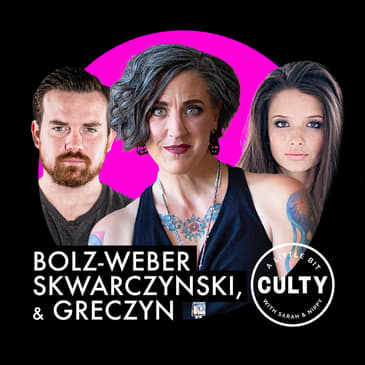
But right now? We’re about to get in the weeds of one of our favorite topics with some of our fan favorites.
On todays episode we are diving head first into the fucked up world of abstinence pledges, purity rings, and knee length skirts.That’s right, we are going deep in the purity culture discussion and we aren’t pulling out.
Joining us are three powerhouse guests.
First is the most rockin’ reverend we’ve ever met.
Nadia Bolz-Weber is an ordained Lutheran Pastor, and founder of House for All Sinners & Saints in Denver: a progressive, queer-inclusive Lutheran congregation. She’s written three New York Times bestselling memoirs, including Shameless: A Sexual Reformation, which takes on what she sees as the harmful ideas about sexuality that Christianity has promoted throughout history. She’s the creator and host of The Confessional podcast, a pop-up prayer network called The Chapel, and a wildly inspirational Substack called The Corners.
Next up is Alice Greczyn - an actress, author, and founder of Dare to Doubt. Her story includes a painful yet rewarding transition from Christianity to atheism, a journey that inspired her to found DaretoDoubt.org, a resource site for people detaching from belief systems they come to fnd harmful.
And last, and probably least, Eric Skwarczynski is the host and creator of the Preacher Boys podcast, which is a platform for survivors’ stories about a deeply disturbing pattern of sexual predation and abuse claims within the Independent Fundamental Baptist movement.
You won’t want to miss a single second of todays show, so let’s get started with our personal Fuck You to Purity Culture, featuring Nadia Bolz Weber, Alice Greczyn, and Eric Skwarczynski. Also…
Let it be known far and wide, loud and clear that…
The views and opinions expressed on A Little Bit Culty do not necessarily reflect the official policy or position of the podcast. Any content provided by our guests, bloggers, sponsors or authors are of their opinion and are not intended to malign any religion, group, club, organization, business individual, anyone or anything. Nobody’s mad at you, just don’t be a culty fuckwad.
Other Links:
Check out our lovely sponsors
Join ‘A Little Bit Culty’ on Patreon
Get poppin’ fresh ALBC Swag
Support the pod and smash this link
Cult awareness and recovery resources
CREDITS:
Executive Producers: Sarah Edmondson & Anthony Ames
Production Partner: Citizens of Sound
Producer: Will Retherford
Senior Producer: Jess Tardy
Writer: Holly Zadra
Theme Song: “Cultivated” by Jon Bryant co-written with Nygel Asselin
See Privacy Policy at https://art19.com/privacy and California Privacy Notice at https://art19.com/privacy#do-not-sell-my-info.
[00:00:00] The views and opinions expressed by a little bit culty are those of the hosts, and do not necessarily reflect the official policy or position of the podcast. No, they don't.
[00:00:09] Any of the ridiculously thought-provoking content provided by our guests, bloggers, sponsors, or authors are of their opinion and are not intended to malign any religion group, club, organization, business individual, anyone or anything. Also, we're not doctors, psychologists, or her supreme holiness, Gwyneth Paltrow. Goop!
[00:00:25] We're just two mortals trying to make a gluten-free, holistically helpful podcast that helps informs and entertains, and maybe moisturizes. Silky silky smooth. Zzzz... Hey everybody, Sarah Edmondson here. And I'm Anthony Ames, AKA Nippy, Sarah's husband, and you're listening to a little bit culty, AKA ALBC.
[00:00:54] A podcast about what happens when devotion goes to the dark side. We've been there, and back again. A little about us. True story, we met and fell in love in a cult. And then we woke up and got the hell out of dodge.
[00:01:06] And the whole thing was captured in HBO docu-series The Vow. Now, in its second season. I also wrote about our experience in my memoir, SCART. The true story of how I escaped Nexium, the cult that bound my life. Look at us.
[00:01:19] A couple of married podcasters who just happened to have a weekly date night. Or we interview experts and advocates in things like cult awareness and mind control. Wait, wait, wait. This does not count toward date night, babe. We gotta schedule that that's separate. So it's two days?
[00:01:32] We gotta hang out? We do this podcast thing because we learned a lot on our exit ramp out of Nexium. Still on that journey. And we want to pay the lessons forward with the help of other cult survivors and whistleblowers.
[00:01:43] We know all too well that culty things happen. It happens to people every day across every walk of life. So join us each week to tackle these culty dynamics everywhere from online dating to mega churches and multi-level market. This stuff really is everywhere.
[00:01:56] The cultiverse just keeps on expanding and so are we. Welcome to season five of A Little Bit Cultie, serving cult content and word salads weekly on your favorite podcast platforms. Learn more at alittlebitculti.com. Hello everyone. How many is everyone? Do you think, sir? It's 125,000 a week apparently.
[00:02:33] At least. We love you all. It's another remix episode of A Little Bit Cultie because... It's always good to take some time to look back and reflect. I personally just listened to our episode one and two. You were blown away about that.
[00:02:46] Honestly, I haven't listened to those episodes since we recorded them, some of them were almost three years ago and I thought, well, we did a good job. It's a retrospective, right? It's like going back and reading your old journals. No, it's definitely not like that.
[00:03:02] Well, it depends if you're a good writer or not. I certainly was. I go back and read my old journals. I throw them away. I keep all my journals. Anyway, we are currently working our tails off on a batch of all new, farm fresh, organic, non-GMO. Pesticide free?
[00:03:15] Fair trade. Gluten free, dairy free, sugar free. Dude, that's culty. Yeah, we're going to do an episode on that. Oh my God. Episodes for a brand new season. Till then, you can always join us over on Patreon as you know.
[00:03:28] That's patreon.com, so I should say a little bit culty for all new weekly episodes, ad free and other treats. Lots of treats over there. So many treats. Yeah, sometimes we mail them to you. Yes. Sometimes we even show up to your doorstep. Right, Ashley? Yep.
[00:03:41] Yes, we do. But right now, we're about to get into the weeds. One of our favorite topics with some of our fan favorites. On today's episode, we are diving headfirst into the fucked up world of abstinence pledges, purity rings, and knee length skirts.
[00:03:53] I like how you do your voiceover work and then you cuss. It's like a great juxtaposition. On today's episode, we're diving headfirst into the fucked up world. Thank you. I like that. Okay. That's right, Sarah. We're going into purity culture discussion and we aren't pulling out.
[00:04:08] You like that? joining us are three powerhouse guests. First is the most rock and reverend we've ever met. This is mine because Nadia the Boltzweber we used to color is an ordained Lutheran pastor, a founder of house for all centers and saints in Denver.
[00:04:26] She's a progressive queer inclusive Lutheran congregation. She's written three New York times bestselling memoirs, including shameless, a sexual reformation, which takes on what she sees as the harmful ideas about sexuality that Christianity has promoted throughout history. No doubt about that.
[00:04:41] She is the creator and host of the confessional podcast, a pop up prayer network called the chapel and a wildly inspirational sub stack called the corners. She's one of my favorite episodes. I loved her. Still do. Agreed. And last and not least is Eric Shorzinski.
[00:05:16] And he's the host and creator of the preacher boys podcast, which is a platform for survivor stories about deeply disturbing pattern of sexual predation and abuse claims within the independent fundamental Baptist movement. I F B you don't want to miss a single second of today's show.
[00:05:31] So let's get started with our personal fuck you to purity culture featuring Nadia Boltzweber, the Boltzweber, Alice Gretchen and Eric Shorzinski. I think when it broke down for me was when whenever there was a difference between
[00:05:58] what I experienced to be true and what I was told was true. Like when these things started to be in conflict, that's when I was kind of like, I'm going to have to go with my experience.
[00:06:11] So I mean, for instance, like the gender thing came down to even we'd have Sunday school teachers who were women up until we were 12 years old. And then all of our Sunday school teachers had to be men because 12 year old
[00:06:24] boys had more like authority in the church than grown women did. And so women were not allowed to teach boys once they were over 12 years old. And when I quickly started asking questions, like if I'm so inferior
[00:06:38] to this man who's my Sunday school teacher, why the fuck am I clearly smarter than him? I mean, I mean, just something basic like that. I knew that my intellect surpassed this man, very sweet man who was teaching Sunday school. And I'm like, that doesn't make sense.
[00:06:55] Or like when I was told like homosexuality is a sin and you can't really you shouldn't associate with people who are gay and gay people are going to hell. And then like I was a kid who experienced a lot of alienation
[00:07:08] because of a disease that I had, which was kind of disfiguring from ages 12 to 16. And it made me kind of edgy and a little snarky. And it made me who I am and I'm grateful for that.
[00:07:19] But once I got to high school, the only people who seemed to like me and think I was funny and fabulous and wanted me around were the gay boys, the gay theater boys in high school. And they loved me and it was kind of a first, honestly.
[00:07:33] It was the first time there was a group of people who felt like they wanted me around. And so basically I'm like, OK, here I have this conflict between what I'm experiencing, which is this love from these gay guys in high school and what I'm told is true.
[00:07:47] And when those things started to be in conflict, I had to default to what I was experiencing as having some kind of authority. So basically in conservative Christianity, there is this incredible authority structure and there's a continual indoctrination,
[00:08:03] especially of the children, children and teenagers, where basically you're told here's what it looks like to be a person who's worthy of God's love. You have to repent of all your sins. You have to only think healthy, you know, clean thoughts.
[00:08:20] You have to only be around other Christians. You have to have your quiet time in the morning with the Lord. You have to, you know, not feel up your girlfriend. And I mean, it's just it's a continual indoctrination of what it looks like
[00:08:34] to be good. And of course, as a kid, you don't know any better. You want to be good. Like you want to you want the adults in your life to be proud of you. The rebellion thing doesn't come till later.
[00:08:46] And so you're forced into this system and we were taught to be very afraid of the world. Like the world is corrupt. You should not be part of the world. But once I got out into the world, I'm like, what the fuck is this people's problem?
[00:09:00] It's great out here, you know? So again, there was that conflict, even with the, you know, my last book was about sex and Christianity. And even when it came to sex, there was so much fear around it.
[00:09:13] If you wear shirts that are too tight, boys will be made to lust and it'll be your fault. And if you allow yourself to go on a date alone, you might be tempted to sin.
[00:09:26] And if you give in to your lustful sexual desires outside of the bond of heterosexual marriage, you will destroy your life. You will become tainted. Nobody will want you. You will have given yourself to somebody and you won't have as much to give your spouse.
[00:09:42] You know, I mean, it's just constant indoctrination around sex. And yet when I had sex for the first time with my boyfriend, I was like, this is awesome. Like I have great sex as a teenager, which I know isn't like super common.
[00:09:56] But I was like, this is definitely for me. And I think these people are insane. So for some reason I was able to go. Yeah, bye. Amazing. I'm so glad that you did. What is it about the Lutheran doctrine or church that's not problematic for you?
[00:10:12] It's just a completely different theological system. The whole point of gravity to Lutheran theology is grace. It's not making yourself good. It's not piety. It's not earning your worthiness or, you know, pretending to have a personality you don't or whatever.
[00:10:29] It's like our origin in God is grace itself. The fact that we're alive is grace. The fact that our worst mistakes never define who we actually are is grace. There's enough mercy and compassion in our divine source for us to draw upon
[00:10:46] and that we shouldn't fall into traps of believing otherwise. And like just the sort of super honest thing of look, we're all simultaneously sinner and saint. We all live in this paradox of being like good and bad.
[00:11:01] And if we think we're all one and not the other, we're telling ourselves a lie, you know? So yeah. And if you don't make allowance for the bad, you can't evolve it to be the quote good that you're aspiring to be.
[00:11:12] It doesn't work where you just ignore it. Do you find the Lutheran part at least makes allowances for that? Oh, totally. I mean, like I'm never. People are like, I can't believe that this person did this horrible thing. I'm always like, oh, dude, I totally can't believe it.
[00:11:27] Humans are horrible. You're kidding? So like I'm never shocked and people who are super optimistic about human beings like who are really idealists. I don't know. I'm like, do you read the paper? Like, right? Look at how terrible we are.
[00:11:43] Also in the face of certain religions, a lot of bad things have been done in the name of religion. So just pick up a history book from probably your own religion. At some point, you guys didn't embody what you profess.
[00:11:55] So just to be fair, Christians aren't the only one pulling this trying to pull this off. Right. There's a lot of new age shit out there that is very similar, you know, in the sense of going like the thing about evangelical Christianity,
[00:12:09] there's this toxic positivity to it, super duper cheerfulness and only positive things and giving glory to the Lord. And I just I just want to praise the Lord. I mean, half the things they say, I'm like, what is it actually even mean?
[00:12:22] But you're supposed to adopt a certain affect if you are to be seen as like holy and righteous. And it's the same in like super new age yoga. I mean, at some point, somebody decided having like super duper,
[00:12:38] like painfully good posture and like speaking with like a passive aggressive half whisper, like you maybe took half a dose of Xanax. Like that's supposed to be like someone. Do you want to chime in on how I'm allergic to all that? Nipi hates that.
[00:12:54] But by the way, toxic positivity has been a theme this season. So you're bringing it back for us really nicely. And Nipi has an impression of that character, that yoga. Oh my God.
[00:13:03] Well, so I have a web series that I wrote an episode for and we shot it. We shot it like a month before our lives blew up and had to put a lot of it on pause and because some of the people were involved,
[00:13:15] we're still involved with the cult and blah, blah, blah. And it's essentially an episode about really what you just did. It's like I started doing yoga consistently when I when I got out here and I don't do it that much anymore because of COVID and all that.
[00:13:26] There's this woman in there and everyone's taking it seriously. And you don't know me well, but I'm kind of like a jock. You know, I mean, I was a jock growing up and they're not kind of a jock, baby. You are the epitome of jock.
[00:13:39] Yoga is stretching for me. OK, let's just call it. And I go in there and all joking aside, you know, I experience, I like it. I have good experience in it. But this woman just goes, now I want you to look in the mirror
[00:13:50] and I want you to take that negative thought right out of your head. And I'm going, I'm not having a fucking negative thought right now. Not till now. Yeah, not until now. But this is this was the joke in my web series.
[00:13:59] I was like, and that thought that you're not good enough. And I was like, listen, sweetheart, my problem is not, I don't think I'm good enough. I'm airing it and have a big ego. What am I doing with that? Like, you know, it's like, this isn't my room.
[00:14:14] Women are often like, how did you find your voice? I'm like knowing when to shut the fuck up has been much more my issue in my life than finding my voice. Yeah. But see, we all have the thing that has,
[00:14:26] you know, that has a bit of a shadow to it or that is a struggle for us or attaches to our ego. Or like we all have that, right? It's just going to look different. Anyway, getting back to the Christian thing and the cult thing both
[00:14:40] is that the thing that feels so that just sort of like hurts me when I think about what happens in these groups is that honestly, it feels like the thing that is exploited in people who become part of these are actually good parts of them. Yeah, for sure.
[00:14:58] It's not their like arrogance that's exploited necessarily or like, you know, that they want to control people or that, you know, they want to manipulate. Usually it's like you want to be part of a community. Yeah. You want a sense of belonging.
[00:15:11] You want to be somebody who strives to improve themselves or to live in a good way or to be somehow counter cultural. I think, you know, maybe if our culture wasn't so fucked up, people wouldn't be so drawn to more extreme like countercultures.
[00:15:30] Do you know what I mean? Like the impulse to like be a part of something that's potentially beautiful is a good impulse and that's what's exploited. We tell our stories. We change the world. A little bit called he is proud to support the hashtag I got out project
[00:16:16] which empowers survivors of cultic abuse to share their stories online as a catalyst for education, prevention and healing. Learn more about the hashtag I got out movement and find resources at I got out.org. This episode is sponsored by Better Help. What are your self care non negotiables?
[00:16:39] Maybe you never skip leg day or never miss yoga. Maybe it's getting eight hours of sleep. I mean, that's my personal and everyone's dream, isn't it? Well, I definitely have some non negotiables like I'm in Vancouver right now and I'm spending literally as much time
[00:16:52] as I can outside of nature, hashtag, cold pools, hashtag, crushing it. Nature is a non negotiable, not enough time in the fresh air and the trees around me. And I start to feel not great, not myself, not grounded. Therapy day is a bit like my nature walks.
[00:17:05] I try to not miss it. And I know I'm just going to feel so much better all around if I make it a priority. I get so much out of it. It helps me put my worries and anxieties in their rightful place
[00:17:14] and helps me clear my mind so I can focus on what I really need. And sometimes what I don't need, like, I don't need to be overbooking myself just because I hate to say no to people. You know what I mean? Thanks, therapy.
[00:17:23] Thanks for helping me see that. And if you're thinking of starting therapy, give better help or try. It's entirely online, designed to be convenient, flexible and suited to your schedule. Just fill out a brief questionnaire and get matched with a licensed therapist
[00:17:35] and switch therapists any time for no additional charge. Look, even when we know what makes us happy, it's hard to make time for it. But when you feel like you have no time for yourself, non negotiables like therapy are more important than ever.
[00:17:47] Never skip therapy day with BetterHelp. Visit betterhelp.com slash culty today to get 10% off your first month. That's better help H-E-L-P dot com slash culty. The Frankies were a picture perfect influencer family, but everything wasn't as it seemed.
[00:18:04] I just had a 12 year old boy still appeared asking for help. He's emaciated. He's got tape around his legs. Ruby Frankie is his mom's name. Infamous is covering Ruby Frankie, the world of Mormonism and a secret therapy group that ruined lives.
[00:18:23] Listen to Infamous wherever you get your podcasts. I was 17 years old, a big part of the type of Christianity that I was brought up in was centered around what's now called purity culture. And for anyone who's not familiar, it's a very overbearing emphasis on sexual purity
[00:18:45] for both boys and girls. But girls have the added burden of being the gatekeepers of boys, not just for their actions, but for even their thoughts. And so girls have to be essentially thought police not only for ourselves and each other, but for the men around us
[00:19:00] to make sure that we're not going to behave or speak or dress or laugh even in a way that might make a male around us stumble into sin by causing him to lust or essentially be attracted to us. So basically, we were told the lip service of men.
[00:19:17] You need to be responsible for your own thoughts and actions. That's between you and God. But girls, you it is your responsibility to help support your brothers in Christ by making sure you are modest at all times with every deed, word and action.
[00:19:32] Another part of this purity culture that I took to probably one of the more dense degrees. They were varying degrees of commitment to purity culture in the youth groups that I found myself like some teenagers would date. You know, I don't think that they would have admitted
[00:19:46] if they were having sex before marriage because I was just a given. You just don't also not being anything other than heterosexual was just a given. So we didn't even talk about non-binaryness or homosexuality in my youth group specifically, not to my recollection.
[00:20:00] For me in my heart, because I always took things very seriously and very literally, I believed that God wanted me to be faithful to my future husband before I even knew him. When this came from a Bible verse in the book of Proverbs
[00:20:14] about how the woman did her husband good and not evil all the days of her life. So to do one's husband good then meant that you are faithful to him in every way before you even know who he is, which meant for me not dating, not flirting,
[00:20:29] not even letting myself have a crush, which I really struggled with that I write about that in my book because I was I was a really boy crazy teen girl. It was like the thorn in my side.
[00:20:40] I thought that, you know, like, like, I guess this is the big sin that because it was not committing other sins came pretty easily to me. I wasn't really tempted to lie or cheat or like do drugs, you know, it was I was tempted to have a crush.
[00:20:52] And so I denied myself all these things fully buying into the promise that if I was faithful to this future spouse, who I would eventually find out because God would confirm it through my spiritual elders and through the man himself.
[00:21:04] Because there's always a question like, well, how are you going to know who your future husband is if you don't date? Well, God's going to tell you God's going to tell the other people in your life
[00:21:12] and and a firm confirm it externally so that you don't have to doubt yourself and doubt if it's your own fleshly desires to marry a certain person. So I thought it was convenient. How convenient. You're suppressing natural instincts
[00:21:26] and those instincts that you follow are the ones where you make mistakes and you grow and you not only just denying yourself things, you're denying yourself the wisdom that comes from dating and figuring out that's not the person, etc.
[00:21:39] Yes. And what your what your needs and wants are and how to learn how to communicate, how to compromise, what turns you on, what turns you off, you know? And like there's yes, absolutely.
[00:21:51] There's a lot of that that gets stunted when you grow up in this sort of sort of thing. And, you know, like I said, I took it really to heart. I really bought into it. And so when I was 17, right before I turned 17,
[00:22:04] I moved to Los Angeles because around that time, you know, God had called me to acting and I moved to Los Angeles and the first couple of months, my mom and my siblings were here with me.
[00:22:13] And then once I got a roommate, they went back home to Colorado. Coincidentally in Christianity, there's no such thing as coincidence. But coincidentally, a boy from my Colorado youth group also moved to LA around the same time. He was three years older than me, so he was 20.
[00:22:26] And I just thought like God had a move there to be a friend, to help me navigate this hedonistic secular world I'd never been a part of because I was homeschooled my entire life until I went to community college briefly.
[00:22:38] So there was that added layer of insulation from the outside world. I very rarely have ever interacted with people who did not share my belief system. So I thought like, oh, God called Luke to move out here the same time as me
[00:22:51] because he knew I'd need a friend to like help me navigate because Luke had gone to public school. So that was my logic at the time. He was just a friend and he knew that I didn't date.
[00:23:00] He'd expressed when we were on a mission trip in India that he'd like to get to know me better. But I had been very upfront with him that, you know, I'm waiting for my future husband
[00:23:10] that I don't think that would honor him and God's called me to this and that. And I don't date and he's like, cool, we could be friends. So we were friends. And when he moved out here, yeah, we just, I again reiterated to him
[00:23:20] like we're just friends or hangouts or not dates could not have been clearer. One day out of the blue, he announced that God had shown him I was his future wife. And it always sounds like crazy to say out loud and and from the place I am now
[00:23:36] because I went along with it instantly, instantly. Like there was never a part of me that was like, come on, dude, like you're just projecting your own motives. Like what you said earlier, Sarah. No, for me, it was like, how could I have not seen this coming?
[00:23:52] Of course it would be him. God had us move out here at the same time. But you know, and that was the biggest red flag because I did not feel anything romantically for him.
[00:24:03] And I've been told that God was going to bless me with this epic love story and reward my faith with this incredible romance. And I was just again, I was a boy crazy romantic teenage girl.
[00:24:15] And I just believed that it was going to be even better than anything I could imagine if I trusted God to let it happen. So that it was revealed to be Luke just broke me. It devastated me.
[00:24:27] And of course I couldn't even process that because I was so scared that if I admitted even to my own self that I was disappointed, it meant I was going against God and therefore allowing Satan a foothold because it wasn't just Luke saying this.
[00:24:39] Long story short, he called my dad to formally ask for my hand in marriage. My dad also expressed that God had shown him that Luke and I were going to get married. Luke's mom, who to my recollection was considered
[00:24:51] something of like a prophet, psychic type in our community, had also heard from God that I was your future daughter-in-law. So there was all this external confirmation that confirmed it was not just Luke's own fleshly desires and because God again, had never talked to me directly.
[00:25:07] I just figured, of course, you know, why would God have told me? And furthermore, it makes sense that God would have told Luke and not me because this is the beginning of me learning how to submit to my husband's leadership, you know, a female submission to the male
[00:25:20] headship in the household is a heavily stressed aspect of this this expression of Christianity. So, you know, we were we were betrothed. That's the word that I came to use because I couldn't say engage because when I thought of people who were engaged, they always seemed so happy.
[00:25:34] And I felt like I was facing an arranged marriage. It wasn't arranged in the sense that, like, you know, our parents got together and decided this was going to happen. And it felt like God arranged this marriage and his divine plan for our lives.
[00:25:47] And I was supposed to either go along with it, but God did give me free will so I could choose not to go along with it. But God also allows consequences to those who disobey his will.
[00:25:56] So it's like, you know, you have free will, but it's your choice to go to hell. You can do that. God loves you enough to give you that choice. That's very confusing. That is so confusing. And also, you know, Alice, when you said this sounds crazy,
[00:26:09] I think if I hadn't gone through my own experience or done all this research or all these different groups, I probably wouldn't get it. But I do get it because your framework, you explained your framework, your beliefs and your assumptions that everything rests on,
[00:26:23] which is that like God exists and he knows best. Right. And then and he decides. So in that framework, what you're saying wasn't crazy and also totally relatable. We didn't have God, but Keith is good and he knows best. So it's the same fucking thing, right?
[00:26:40] It is. I totally, totally get it. I was so happy when your mom stepped in and gave you permission to not marry him. I was like, yay, because up until now I'd been kind of pissed at your parents in the story.
[00:26:55] You know, and I was like, oh, mom. And then I cried because like my mom also like helped me out on my journey as you know, and I had this big like mom cry.
[00:27:04] I'm so happy that she she gave you that out, which was to say like also another interpretation of God is like God wants you to be happy and God is love and not pain actually. Right. Yeah. Yeah, it's interesting because like spoiler alert, like I'm really close
[00:27:21] with my parents. Yeah. I'm so happy to hear that. Yes, I am. And you know, they left that type of Christianity too. They don't even really call themselves Christians anymore, but it took years for them and their own stories is theirs, you know,
[00:27:37] and their timelines a little different than mine and they're and from each other's too. Hey there, listener. Hope you're enjoying this episode and that you're taking deep breaths when we cover the enraging stuff that cult jerks are up to.
[00:27:52] Let it out as in the yoga practice, inhale, positivity, exhale, negativity. That's for you, Sarah. We got this. No hulking it out. All you will hulksters. And if you need some helpful resources on the topic of cult recovery,
[00:28:03] check out our website at a little bit culty dot com. And now here's a brief message from our sponsors. This episode is sponsored by BetterHelp. What are your self care non negotiables? Maybe you never skip leg day or never miss yoga. Maybe it's getting eight hours of sleep.
[00:28:21] I mean, that's my personal and everyone's dream, isn't it? Well, I definitely have some non negotiables like I'm in Vancouver right now and I'm spending literally as much time as I can outside of nature. Hashtag cold pools, hashtag crushing it.
[00:28:34] Nature is a non negotiable, not enough time in the fresh air and the trees around me and I start to feel not great, not myself, not grounded. Therapy Day is a bit like my nature walks.
[00:28:42] I try to not miss it and I know I'm just going to feel so much better all around if I make it a priority. I get so much out of it. It helps me put my worries and anxieties in their rightful place
[00:28:51] and helps me clear my mind so I can focus on what I really need and sometimes what I don't need. Like I don't need to be overbooking myself just because I hate to say no to people. You know what I mean? Thanks, therapy.
[00:29:00] Thanks for helping me see that. And if you're thinking of starting therapy, give BetterHelp a try. It's entirely online, designed to be convenient, flexible and suited to your schedule. Just fill out a brief questionnaire and get matched with a licensed therapist
[00:29:12] and switch therapists any time for no additional charge. Look, even when we know what makes us happy, it's hard to make time for it. But when you feel like you have no time for yourself, non negotiables like therapy are more important than ever.
[00:29:24] Never skip Therapy Day with BetterHelp. Visit betterhelp.com slash culti today to get 10% off your first month. That's BetterHelp H-E-L-P dot com slash culti. Meals bring people together. But for many families, providing their next meal can be a challenge.
[00:29:41] You can help by participating in Macy's annual Feeding the Hungry Food Drive. All proceeds go toward local food banks and families. Now through January 31st, you can purchase an icon in store or online or watch out for the blue Feeding the Hungry shelf tags
[00:29:56] where a portion of your purchase will be donated to local pantries. Together, we can combat hunger in our local communities at Macy's. And the thing I realized is that, and it's one reason I do listen to your show, you know, I really do like the approach to it.
[00:30:13] And one thing that I told Nampi before he had recorded is like, I like that tongue in cheek, you know, I love that you guys are so refrained with what you think about things, you know, like you you share very heavily when you're pissed,
[00:30:23] you can tell. And but the thing is, I've realized in the last two years, like no matter how much you couch what you're saying, no matter how many caveats you add, no matter how much you say not all churches, no matter how much you say probably not you,
[00:30:36] people are going to be pissed if it touches their territory. Totally. And so, you know, if I'm going to call out rape in a church like I'd rather just be blunt about it than saying, now look, before I talk about this,
[00:30:47] I know it's not all churches. I know it's not. If someone's upset, I'm talking about their church. Right. If you're not upset and you agree that rape is bad, I'm not. Right. I'm not. I think you hit the nail. Finally, 45 minutes in, I hit a nail.
[00:31:02] When people like I've aired my support, even just kind of off hand for certain people and every time I put my flag in the ground, it's very small. It's like one or two. Someone's going to send me an email with a link and how my thinking is wrong.
[00:31:16] Listen, I have a different opinion. I have a different stance on things. I'm certainly willing to kick it around. That's what this is about. Right. And yours is extreme. So like I like the fact that like I'm standing against rape
[00:31:27] against this church instead of you lambasting me for it. Right. Get curious. Your curiosity can free you from the thing that I'm talking about. And to your point, I'm probably saying something that conflicts with what your stance is, which is OK. I had a pastor.
[00:31:43] I mean, when I announced that I left the faith entirely, he tweeted and he said it's sad when someone focuses on the bad so much that's all that they can see. And then he said something about like I focused on Jesus.
[00:31:56] So I've seen the good, you know, like I haven't lost sight of the good. And my response to him was like, I've been focused on the bad for the last two years. The bad seemed awfully focused on my denomination for the last 18 and the
[00:32:09] last several decades before that and the last century that it's been around. It seems like without focusing on it, we had a predator shuffle to my church without focusing on it. What the person I worked for in ministry was paying me 11 grand a year
[00:32:22] while paying himself a high six figure salary. It seems like without focusing on it, I got fired from my that same job because I didn't want to pray and lay my hand on a flag and hope that Donald Trump would be president.
[00:32:33] Like it seems to me that the bad was kind of drawn to the denomination. And instead of asking why I'm seeing the bad and focusing on the bad, right? Why is there bad if we're claiming to be this righteous group
[00:32:43] that's set on a hill and supposed to be the example for all mankind? Like why is the bad here? That's such a good message. And I think that's something that all the denominations, all the religions, all the groups have to be able to do.
[00:32:54] If you're if you're saying like the be better, not better and don't focus on the bad or whatever. And next thing we used to call it a shifter strategy. Keith taught us this. It's like, look over here. Like, OK, we're talking about this. Let's focus on this.
[00:33:06] It's important to look at this. We must for the safety of our children. I mean, my goodness, again, it like it just hurts my heart that this is happening. And I guess my question for you now is like, what do you say
[00:33:18] to people who might be listening to this? Because probably people in IFB are not listening to this. But they might and I hope they do. If we use the right hashtags, they're listening to this. What would you say to them to help you change that pattern of avoiding
[00:33:35] this conversation? I mean, it's kind of that thing that was said earlier, like it's be curious about it. What is being said? It's hard wherever this question comes up because I think about like,
[00:33:44] what would I have listened to in it if it was someone else and I would have been like, why would I listen to them? Like they said a bad word on a podcast. Like obviously Christians and they're not, you know, whatever.
[00:33:54] There's yeah, there's a lot of things that are going to be said there. But I would just say like how many people does it have to happen to for it to become an issue and how many times does it have to be
[00:34:03] covered up before it's a systemic issue? I'll say this specifically if you're a pastor listening to this because I know that there's IP pastors that listen to all the stuff that I do because I get tweets about it and sermon
[00:34:12] things about it. My question to them would just be like, when do you address that this is like a really toxic environment that's producing this? I don't judge any pastor when you have a church of 50 people.
[00:34:25] If you're there for a couple of decades or a couple of years, you're going to have something bad happen in your church, in your congregation. The pedophiles are everywhere. You're going to have if you get 100 people in a room, there's someone really shitty there at some point.
[00:34:37] There's someone bad there. I don't judge someone for that. But how do you react when you find out? Is it covered up because we want to protect the church? Is it covered up because we believe that he has more value to us than this girl does?
[00:34:49] That's the thing is like, I'm not going after every church and saying like, oh, if you have anything bad happen ever, you're evil and wicked and you should be destroyed. But when it's happening consistently, when you have churches like Faith Baptist Church in Wildemar
[00:35:00] that has four or five of these cases over a decade with four or five different people, start asking questions. Like why is this happening? Why do we seem to be like a lightning rod for abuse? Again, I'm not asking people to like leave their faith
[00:35:12] or do something like that. Why this? One of the things I saw in one of your other interviews is your new mantra about the microphone. So what needs to happen now to expose this stuff? Yeah, it's conversations like this is something that
[00:35:27] people get wrong is that they look at people like listen to this episode, there's people that go, man, Sarah and Nippy are just great advocates. I'm glad that someone is being an advocate and, you know, because you have a podcast and a platform and they'll
[00:35:41] look at me and go, wow, that's great. I wish I would love to be one. But I don't have a podcast. I don't have a rally that I host or I don't have this or a picket or whatever it is.
[00:35:50] You just need to find a person who has a story. Sarah, you said this in one of the recepts. So it's like cold space for them. There's so many opportunities we have on a small scale, a big scale to advocate for other people.
[00:36:01] And so when you notice something's wrong, the easy option is what I initially did, which is that was awful for me. Totally self-centered approach. That was awful that someone was abused and I had to deal
[00:36:13] with my youth pastor being mean to me because I said something about it. I got the easy version of the story. I left for the rest of those couple years, not thinking about what about all these other people that were hurt?
[00:36:23] What about the people that are still being hurt? What about the people that I left fliers on their door who are now going to the same church as a pedophile that I invite? Like, I have a responsibility to talk about this.
[00:36:33] And and I still like every day I think about if someone gets hurt because he's still at the church, his wife is literally his wife's the principal of the school now that I went to. It's like he has so much access.
[00:36:45] And for me, it's like if something happens and I don't say anything like I'm a part of it, whether I'm a part of the denomination or not, I am. Find a way to help people show their stories. It doesn't have to be a podcast.
[00:36:55] Like it takes a certain type of person that you get in front of a microphone and be willing to do this. You either love it or you absolutely hate it, you know? But it could mean when someone at work tells you
[00:37:05] that someone harassed them, go with them to HR. Find a way for them to tell their story. Repost someone's episode when they share something that's difficult. Text somebody and ask, how can I help you? Like find a way to pass the mic to somebody.
[00:37:18] I mean, I grew up listening to pastors, the whole past the mic thing. I grew up listening to pastors who now I know are connected with abusers who were abusers themselves. And every single Sunday, two times a day, sometimes three if they did Sunday school too.
[00:37:31] And then Wednesday night, they got a microphone, got to conferences, got a microphone, got to share their version of the story, got to share why the church was the way it was and how great things were, what God was doing. But the people that never got the microphone
[00:37:43] were the women and children being abused in the church. So how can we, when we leave an organization like this, take the microphone from those people, take the attention from those people, from the Keith Reneires, from the Jack Hiles,
[00:37:55] from the whoever you want to fill in the blank there, and now give that to people who are harmed by them and let them share their story in the way that they want to share it. That's a powerful thing to be able to do for someone.
[00:38:06] And it's something that, again, people assume because I don't have a million followers, I can't be an advocate. Do it with your family, do it with your friend. Like, do it with your three or four people
[00:38:16] that you can do it with because it can make a big difference. What a great message. Yeah, such a good message. And I saw on your merch store that you have a shirt that says, purity culture is rape.
[00:38:25] Could you just tell us, just give us a little nugget about what you mean by that for those who don't know what purity culture is and how it relates to rape? It proves that I don't like beating around the bush, I guess. Yes, it's very direct.
[00:38:37] No, I mean, this kind of goes back to the culture. I mean, my show Preacher Boys is because they called like young pastors and young kids that were going to college to become pastors, they called them preacher boys. And so I named my show that to...
[00:38:50] It kind of gets the attention of anybody who grew up in it and then everyone else goes like, oh, you're a preacher? You know, like they get confused what the name is. It really is that there's a very much a boys club mentality within the independent Baptist world.
[00:39:01] Purity culture is an issue, I'm sure if you've talked to people in the evangelical world, they brought it up and on some level. But essentially the idea that women are responsible for the actions of men is something that's very deeply entrenched within the IFB movement.
[00:39:16] You know, that's the reason that women wear skirts and not pants because pants outline your leg. Women can't wear shirts that go more than two fingers below their neck because that would show cleavage. You know, they have to close pin this slit
[00:39:28] in the back of a skirt so you can't see the back of their leg. Like there's all these rules and restrictions and regulations on women. And so you've got these two things. You've got the woman who's being taught their whole life,
[00:39:38] like your temptress, you are full of shame, you are responsible for if any guy looks at you and lusts after you and commits adultery in his heart, you caused it. And then you have men who are being taught to act like children their entire lives and saying,
[00:39:54] don't jerk off, don't have sex. But once you get married, anytime you want it, you've got it. And then you've got a spouse who's not allowed to say no. So you've got this very horrible environment in which we're hyper-sexualizing young kids
[00:40:07] and talking about whether or not, you know, little kids can wear sleepers because it shows too much or they can't wear this because it shows too much when they're like six months old. Then they grow up to be 20 years old
[00:40:18] getting married out of high school to some preacher boy and they have a toxic unhealthy relationship where they don't understand consent, they don't understand their own sexuality, they don't understand what a healthy relationship looks like. And so for me, like that's one of the areas I've dipped in
[00:40:33] to addressing like, OK, we're having all of this. We have a rape culture situation within this denomination. What are we teaching from an early age that kind of leads to that? I'm not saying that people are not responsible for their actions because I think some people will say,
[00:40:46] I was raised in it, whatever. We can still look at what some of the causes are without alleviating people of their own responsibility. If you're raping somebody, you're responsible for that. I don't care what you were taught. I was taught all that stuff and I don't rape people.
[00:40:58] So you have a responsibility there, but that's in a nutshell what it is. Thank you. Thank you. Probably could do a whole episode on that. You know, you are part of this team. I think, you know, in terms of shining light on abuses
[00:41:10] and felt that from the moment we spoke on your pod last year. And I just really commend you. I know it's dark work and it's hard. And Nipi and I have certainly been depressed after covering certain content. It's really difficult. The way you go about it's great.
[00:41:25] This podcast is brought to you by Citizens of Sound, a podcast production agency committed to developing and launching shows with gravity and depth. From conception to launch, Citizens will partner with you every step of the way, whether you're an actor, business owner, doctor, fitness coach, hairstylist or influencer.
[00:41:41] Connection is the future of communication. Jump on board with Citizens of Sound today and start your show. Go to CitizensofSound.com and follow them on Instagram. And trust me, it'll be a really good decision for you. How was that for you all?
[00:41:57] Did that fuck you, purity culture episode make you clutch your pearls? I doubt it. Our listeners aren't big pearl clutches. Way too much innuendo in that sense. I'll leave it alone. Hope you liked the episode and it makes you want to go out there
[00:42:09] and do impure things or not. Honestly, we love this journey for you. Life is short. Purity is boring. We'll be back soon with all new episodes. And in the meantime, you can always find us over on Patreon. That's patreon.com slash littlebitculti dropping new episodes every week.
[00:42:22] Also, please go to a littlebitculti.com slash sponsors to see all our fabulous sponsors. Check out the goods we have there as you probably know, we don't get commission but purchasing treats for yourself through our sponsorship links gives you a discount
[00:42:37] and lets our sponsors know that this works for them and they continue to sponsor us and that continues the podcast to keep going. So thank you for doing that. And also on that link is a couple of... It's great housekeeping by the way. Thank you. Great housekeeping.
[00:42:49] Our couple of speaking engagements, one in person here in Atlanta and one which is a free online trauma summit. Both of those links you can find on our sponsorship page. Please do let us know what you think of the episode. Send us a review wherever you listen.
[00:43:03] And until next time, go out and do naughty shit and laugh about it. Just don't join a cult. Capiche? Sinking down to the depths of the ocean I'm hanging on to the wind in my love I find that girl all at all I could leave.
[00:43:29] Hope you liked this episode. Let's keep the conversation going and come hang out with us on Patreon where we keep the tape rolling. Each week, special episodes just for Patreon subscribers and where we get deep into the weeds of unpacking every episode of the vow.
[00:43:41] And if you're looking for our show notes or some sweet, sweet swag or official ALBC podcast merch or a list of our most recommended cult recovery resources visit our website at alittlebitculti.com. And for more background on what brought us here, check out Sarah's page-turning memoir.
[00:43:56] It's called Scarred. The true story of how I escaped Nexium, the cult that bound my life. It's available on Amazon, Audible, narrated by my wife, and at most bookstores. A Little Bit Culty is a talkhouse podcast and a Trace 120 production. We're executive produced by Sarah Edmondson
[00:44:12] and Anthony Nippy Ames with writing, research and additional production support by senior producer Jess Tardy. We're edited, mixed and mastered by our rocking producer Will Rutherford of Citizens of Sound and our amazing theme song, Cultivated, is by John Bryant and co-written by Nigel Asselin. Thank you for listening.