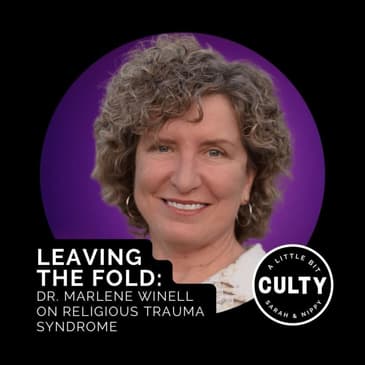
This episode is sponsored by BetterHelp. Dr. Marlene Winell knows all too well that exiting a controlling religion can trigger a devastating life crisis. As a college student, she moved away from the fire and brimstone fundamentalist Christianity she was raised in, and the fallout of her exodus was so dramatically upending that she felt compelled to dedicate her life’s work to studying the very phenomenon that she’d later coin: ‘Religious Trauma Syndrome.’ In this episode of A Little Bit Culty she chats with us about symptoms that arise in response to traumatic or stressful religious experiences, and what can be helpful along the road to recovery after leaving the fold.
More About Our Guest:
Dr. Winell is a psychologist, educator, and writer whose background includes 30 years of experience in human services, in both community and academic settings. She holds a doctorate in Human Development and Family Studies from Pennsylvania State University and is the author of Leaving the Fold: A Guide for Former Fundamentalists and Others Leaving their Religion. Leaving the Fold has become a leading self-help book in the field of religious recovery - and examines the effects of authoritarian religion (namely fundamentalist Christianity) on individuals who leave the faith. She’s also the founder of Journey Free organization, which is dedicated to helping people transition out of harmful religions, recover from trauma, and rebuild their lives. We’ve developed programs for both individuals and groups. If you are recovering from religious harm, we have great respect for your strength and courage. Please know that you are not alone and things can get better.
Hear Ye, Hear Ye:
The views and opinions expressed on A Little Bit Culty do not necessarily reflect the official policy or position of the podcast. Any content provided by our guests, bloggers, sponsors or authors are of their opinion and are not intended to malign any religion, group, club, organization, business individual, anyone or anything. Nobody’s mad at you, just don’t be a culty fuckwad.
Other Links:
Join A Little Bit Culty on Patreon
Get poppin’ fresh ALBC Swag
Support the pod and smash this link
Cult awareness and recovery resources
CREDITS:
Executive Producers: Sarah Edmondson & Anthony Ames
Production Partner: Citizens of Sound
Producer: Will Retherford
Senior Producer: Jess Tardy
Theme Song: “Cultivated” by Jon Bryant co-written with Nygel Asselin
Learn more about your ad choices. Visit megaphone.fm/adchoices
See Privacy Policy at https://art19.com/privacy and California Privacy Notice at https://art19.com/privacy#do-not-sell-my-info.
[00:00:00] I love sports. I love them so much I never want them to stop, but as the playoffs wind down we get fewer games and the sports aren't sportsing like I want them to. But FanDuel lets me keep the sports
[00:00:10] going whenever I want. All I have to do is open the app and dream up bets anytime I'm in the mood. And this summer FanDuel is hooking up all customers with a boost or a bonus daily.
[00:00:20] That's right, there's something for everyone every day all summer long. So head over to fanduel.com slash sportsfan and start making the most out of your summer. FanDuel, official sports betting partner of Major League Baseball. Must be 21 plus in present in Arizona, Colorado, Connecticut, Iowa, Illinois,
[00:00:37] Indiana, Kansas, Kentucky, Louisiana, permitted parishes only, Massachusetts, Maryland, Michigan, New Jersey, New York, Ohio, Pennsylvania, Tennessee, Virginia, West Virginia or Wyoming. FanDuel is offering online sports wagering in Kansas under an agreement with Kansas Star Casino LLC. First online real money wager only, $10 first deposit required,
[00:00:53] bonus issued is now withdrawable bonus bets that expire seven days after receipt. Restrictions apply, see terms at sportsbook.fanDuel.com. Gambling problem call 1-800-Gambler or visit fanDuel.com slash RG in Colorado, Iowa, Michigan, New Jersey, Ohio, Pennsylvania, Illinois,
[00:01:07] Kentucky, Tennessee and Virginia. Call 1-800-NEXT-STEP or text NEXT-STEP to 53342 in Arizona, 1-888-789-7777 or visit ccpg.org slash chat in Connecticut. 1-809 with it in Indiana, 1-800-522-4700 or visit kscamblinghelp.com in Kansas, 1-877-770-STOP in Louisiana,
[00:01:26] visit mdgamblinghelp.org in Maryland, 1-800-gambler.net in West Virginia or call 1-800-522-4700 in Wyoming. Hope is here, visit gamblinghelplinema.org or call 800-327-5050 for 247 support in Massachusetts or call 1-877-8HOPENY or text HOPENY in New York or visit oasas.ny.gov slash
[00:01:47] gambling. Standard text messaging rate supply, sports betting is void in Georgia, Hawaii, Utah and other states where prohibited. The views and opinions expressed by a little bit culty are those of the hosts and do not necessarily reflect the official policy or position of the podcast.
[00:02:01] No they don't. Any of the ridiculously thought-provoking content provided by our guests, bloggers, sponsors or authors are of their opinion and are not intended to malign any religion group, club, organization, business, individual, anyone or anything. Also we're not
[00:02:14] Dr. Psychologists or her supreme holiness, Gwyneth Paltrow. We're just two mortals trying to make a gluten-free, holistically helpful podcast that helps inform and entertains and maybe moisturizes silky silky smooth. Hey everybody, Sarah Edmondson here and I'm Anthony Ames aka Nipi, Sarah's husband
[00:02:43] and you're listening to A Little Bit Culty aka ALBC, a podcast about what happens when devotion goes to the dark side. We've been there and back again. A little about us, true story,
[00:02:55] we met and fell in love in a cult and then we woke up and got the hell out of dodge. And the whole thing was captured in HBO docu-series The Val now in its second season. I also wrote about our experience in my memoir,
[00:03:07] SCART, the true story of how I escaped nexium, the cult that bound my life. Look at us, a couple of married podcasters who just happened to have a weekly date night where we interview experts and advocates and things like cult awareness and mind control.
[00:03:20] Oh wait, wait, this does not count toward date night babe. We got to schedule that that's separate. So it's two days? We gotta hang in? We do this podcast thing because we learned a lot on our exit ramp out of nexium,
[00:03:31] still on that journey and we want to pay the lessons forward with the help of other cult survivors and whistleblowers. We know all too well that culty things happen. It happens to people every day across every walk of life. So join us each week to tackle these
[00:03:43] culty dynamics everywhere from online dating to mega churches and multi-level market. This stuff really is everywhere. The Cultiverse just keeps on expanding and so are we. Welcome to season five of A Little Bit Cultie, serving cult content and word salads weekly
[00:03:58] on your favorite podcast platforms. Learn more at ALittleBitCultie.com. What up girl? How you doing? Hey, so we are, let's see about three episodes deep in the vial currently which we're gonna of course get more into. We're still homeless in Atlanta.
[00:04:31] Homeless in Atlanta. That's a movie. Or a podcast, what's it called? When they, like in a show when they have an offshoot, what's that called? It's called an offshoot. No, there's another name for it. Like when there's a series and then they do like a side thing.
[00:04:43] Spent off. Spent off, yes. Oh my gosh. Really? Is that where we are? This is the effects of being homeless. I am exhausted. Speaking of which, we've made some slight changes to the structure of our podcast and we'll
[00:04:55] tell you about that at the end of the episode. Good changes, good changes. Good changes. You had a dream come true yesterday, am I correct? Can you say that now? Can you drop that? Well, I can't say it yet because they have an offshoot.
[00:05:05] Fine, I'll say it. So, Sarah, nice. No, no, no. All I'll say is that I was interviewed by some of my personal heroes in a podcast that I listened to for my own healing and I cannot
[00:05:19] wait to share it with y'all. Pretty sure that was like one of your manifestation things. Yes, it really was. I've been like visualizing it like one day this will happen which makes me think it's your turn. Well, I manifested Troy's playoff win last night.
[00:05:33] Oh, did you manifest that? Oh, hell yeah, I did. I've been manifesting that in my head for years. I wonder what Amanda Montell would think about this manifesting magical thinking. I don't know. It sounds like we're at cartel right now. You have a segue for us here or
[00:05:46] we should jump right in. I was trying to come up with one. I know. I can see the wheels turning there. I was like magical thinking is a leftover remnant of so many of us recovering from spiritual groups, but so many of us have other things to
[00:06:03] work through. And that's why we are so excited to have our guests this week. Dr. Marlene Winnell, PhD, she knows all too well that exiting a controlling religion can be a devastating life crisis. As a college student, she moved away from the fire and brimstone
[00:06:19] fundamentalist Christianity she was raised in. In the fallout of her exit, it was so dramatically upending that she felt compelled to dedicate her life's work to studying the very phenomena that she would later coin religious trauma syndrome.
[00:06:29] She did this to help encapsulate a group of symptoms that arise in response to traumatic or stressful religious experiences. Today, Dr. Winnell is a psychologist, educator and writer whose background includes 30 years of experience in human services
[00:06:42] in both community and academic settings. She holds a doctorate in human development in family studies from Penn State University and is the author of Leaving the Fold, A Guide for Former Fundamentalists and Others Leaving their Religion.
[00:06:54] Leaving the Fold has become a leading self-help book in the field of religious recovery and examines the effects of authoritarian religions, namely fundamentalist Christianity, on individuals who leave the faith. She joins us today to discuss religious trauma, recovery,
[00:07:07] and recover a few things that will definitely get us uninvited to a few Sunday dinners. And this might get a little triggering for you and may also chap your ass. I'm thinking the latter. Sorry about that. As a side note,
[00:07:20] we aren't interested on punching down on any religion in this podcast. We are interested in helping people recover when their faith tradition harms them. Our intention is not anti-religion, it's pro-recovery. So pro don't be an asshole. Okay. And while it is not an official diagnosis in the DSM-5,
[00:07:37] religious trauma syndrome was a common experience shared among many who've escaped cults, fundamentalist religious groups, abusive religious settings, or other painful experiences with religion. And it is gaining traction as a legitimate diagnosis. But again, we're not doctors or therapists.
[00:07:52] Without further ado, here's our conversation with Dr. Marlene Winnell. So welcome Marlene to a little bit culty. Thank you. Thanks for coming. We heard about you as you know through Alice Gretchen who we interviewed on the podcast and
[00:08:18] she kept talking about religious trauma syndrome, which we hadn't really heard of at that point and then connected us with you. And it seemed like such a natural fit to speak to you as
[00:08:28] an expert but also the person who coined the phrase, which is what a neat thing to have coined a phrase in the field. First question, how does it feel to coin a phrase? That's gotta be pretty cool.
[00:08:38] Well you know I did not realize it was going to spread like it did. You know it really caught on and I did not know that would happen. And obviously it was something that people needed.
[00:08:51] You know we needed a name for it. And so that was really interesting. Yeah I don't think people sit down and go I'm gonna coin a phrase. I think the universe gives it the stamp of approval. So you did something right there.
[00:09:01] For those who don't know, can you define it for our audience? Well let me just give you a tiny bit of history on it. I had written my book Leaving the Fold because I wanted to write something about recovering from religious harm and this was
[00:09:14] back in it was published in 1994 and it was all about what I could see as well the first part of the book is is describing what I think some of the harms are for religion and how you
[00:09:25] can understand what the various issues are because religion gets treated like it's benign if not helpful. Everybody thinks it's a good thing. So I wanted to write about that and then also some steps in recovery. You know what can you do about it if this is your situation?
[00:09:40] And I published with a self-help publisher. So that came out and that was out for quite a few years and then as I was working more and more with people that were referred to me
[00:09:52] for religious trauma. We weren't really calling it religious trauma at the time. It was just recovering from religious harm but as the years went by I realized that it was actually more serious than I thought. You know, I was working with ex evangelicals, ex Jehovah's Witnesses, ex Mormons,
[00:10:09] the occasional ex Muslim and then people from various smaller cults and not only was it more serious than I thought but that I thought it qualified as trauma as we were starting to understand trauma. There was a lot of work going on in the trauma field.
[00:10:25] When you say it was more common than you thought, what specifically are you saying the trauma or the abuses that were going on? Like what's the it? The trauma, the trauma. Yeah and even though in
[00:10:37] my book I wasn't using that word specifically, I was talking about all the various mostly mental and emotional harm that can be done by a fundamentalist kind of religion and I was acknowledging that we've known about physical and sexual abuse in religious contexts, you know,
[00:10:54] the Catholics are famous for that and cults are famous for sexual abuse but I wanted to address mental and emotional because I decided that ideas can be hugely powerful and can be abusive, that ideas can permeate your brain especially things that you teach to a small child like
[00:11:12] being afraid of going to hell or being basically bad as a human being. These are toxic ideas that can get embedded and that can stay with you even when you leave the religion.
[00:11:24] So it deserves to be called abuse and so as this went on and I worked with more and more people, I saw a pattern. The symptoms were quite similar across the population of people recovering from
[00:11:37] religion and that's actually what a syndrome is. A syndrome is when you have a collection of symptoms that are common to a particular population, okay? And I know that people have objected to me calling it a syndrome because they're saying that I'm pathologizing it but
[00:11:56] I'm not. It's like PTSD where the symptoms that you have are a logical consequence of the trauma that you've been through. It doesn't mean you're mentally ill in the traditional kind of sense. It means that you are struggling with certain symptoms because of what you've
[00:12:13] been through. That's what, I mean if you've been through a car crash or you've been in a war, you have PTSD symptoms. Well, I concluded that there were very common symptoms that applied to
[00:12:24] people who had been indoctrinated in a fundamentalist kind of religion and so I actually polled my colleagues to say what should we call this? And I came up with several names and we decided that religious trauma syndrome was the best name for it because it got the
[00:12:41] idea of trauma and it got the idea of syndrome. And what happens when you have a name for something is that people can better understand what's going on, you know? It makes you feel less
[00:12:55] crazy or like you've made it up yourself or that it's all your fault and nobody understands and you're all alone with it. It helps with all of that. It also helps with training and
[00:13:06] research if you have a name for something. So we really wanted to do that and I also concluded that it has two parts. At first, I was just addressing the part of what happens when you
[00:13:19] lose your religion, when your faith fails you and you feel lost and the rug's been ripped out from under you, your whole sense of reality has changed, you lose your social network, all these traumatic things that can be part of an event and that's like traditional PTSD,
[00:13:36] you know? It's part of an event. But then it seemed like some of the trauma actually goes on earlier. It also goes on when you are going through the damage and it's more like CPTSD which is
[00:13:49] complex post-traumatic syndrome where it's like domestic violence or child abuse where it's going on on a daily basis and causing harm to you and you may not even know it. So I basically defined RTS, Religious Trauma Syndrome as being both, both parts, the continuous kind of daily
[00:14:10] harm that certain religious practices and teachings can do to you and the event of leaving the religion, the trauma of losing your whole worldview and basically trying to go from one world to another religious view of the world to a secular one and how much trauma that involves.
[00:14:29] So it's both and people talk about aspects of each when they talk about growth and healing from it. We could go a lot of ways there. One of the things I really like hearing is the distinction
[00:14:43] between a lot of those organizations, when they're held accountable normally it's a physical abuse that everyone can quantify and understand and go, okay yeah that's wrong. And normally the physical
[00:14:54] abuse is a symptom of the earlier abuses which you've quantified in a lot of ways which are harder to quantify and I imagine it's difficult because the emotional abuses are difficult to quantify and
[00:15:07] you get a lot of pushback maybe because people don't want to admit that's what goes on with them and those sorts of things. So putting a name to it I think is very important community for that.
[00:15:15] I would love to dive deeper because as you're talking and as you know with our podcast being a little bit culty and our background being in a cult but not a religion, I couldn't help but
[00:15:27] drop many parallels to everything that you said it's like we could just call it cult trauma syndrome. Like it's religious trauma because to me it's the same in terms of like the
[00:15:38] the CPTSD that I had from the ongoing stress and trauma of being in the cult and then the the trauma of like recognizing I was in a cult getting out recovering and I'd love to dive
[00:15:48] deeper into that but I also want to remain true to the structure of our podcast which is we also love to hear about with experts like yourself what's your backstory if you don't mind sharing
[00:15:59] what was your upbringing and we always ask our guests when they were in a group or a cult or religion whatever how did you get in were you born into were you're born into what your parents had chosen? Yeah yeah my parents were Christian missionaries with an
[00:16:13] evangelical pen and costal denomination called Assemblies of God and so they were in China and then Hong Kong where I was born and then Taiwan where I grew up so I grew up in that and also
[00:16:26] went to a Christian boarding school that was being run by several different Christian denominations in Taiwan and so we had Bible study every day and so I was totally immersed in it and then when
[00:16:37] I became a teenager I started taking it very seriously myself personally and became quite the Jesus freak. We moved to Southern California when I was 16 and I got involved with Calvary Chapel the whole Jesus movement that was going on there with baptisms at the beach and the
[00:16:56] beginning of Christian rock and roll and staying in a commune for a while we were all very zealous Christians on the beach trying to witness to other people to get them into the fold because we
[00:17:08] thought Jesus was coming back any day so it was pretty important to me pretty serious and I had what felt like a personal relationship with Jesus I've called him my first lover because it was
[00:17:19] pretty intense and that went on for a while and it took me a number of years to pull away from that as I went through college years. When you were in it and things were good what were the
[00:17:30] things that you now know as problematic or red flags or things that you couldn't reconcile at the time? Well there's an isolation involved with most of these organizations and this would be true for the non-religious ones too there's a lack of information about alternatives
[00:17:47] you don't really get exposed to multiple worldviews and multiple social and cultural experiences or even literature you are isolated and given a select set of information basically and told that that's what's true and everything else is wrong and bad so you're kind of stunted you
[00:18:07] have delayed development in a number of ways and you're also told to seek your validation in an external way from the authoritarian approval of God, of the pastor, of the church, of the organization you're not really allowed to look within for your value and qualities like wisdom
[00:18:28] and love and strength and all these things supposedly come from outside of you you know you allow God to work through you and that kind of thing. You don't develop a very strong sense
[00:18:39] of self or sense of identity and you certainly don't develop very much in the way of critical thinking because your own thoughts can't be trusted not only can't you trust your own intelligence but
[00:18:50] you can't trust that your ideas are even going to be good or valid or ethical because you're basically evil from birth. I've decided that these fundamentalist religions basically teach two huge assumptions that can affect you for a lifetime one is you're not okay right and
[00:19:06] the other is you're not safe. That's awful. It's awful. You doubt yourself and you don't value yourself and so you become undeveloped that way and you also learn to be afraid. You're afraid of
[00:19:18] other people, you're afraid of other philosophies, other kinds of information so you kind of self-sensor a lot too. You don't expose yourself to very much else. You said something there and Sarah you can attest to this. We had a process within our organization called exploration of meaning
[00:19:33] it's proven to be kind of a faux process. Hodgepodge of therapy. I work with enough people and I'm sure Sarah did too where a lot of those explorations would come down to feeling safe so
[00:19:45] we're not feeling safe. Regardless of what Sarah and I did while we were in there the concept of safety I learned just through working through a volume of people is a very foundational tenet or
[00:19:57] fear a lot of people have. So to hear you say that I don't think it's an accident I guess is what I'm driving at and I think you know depending on how clandestine you think these
[00:20:06] organizations are that's done with extreme precision in a lot of ways because I know they can always they can always get people to not feel safe and you still see it in culture today so
[00:20:15] and to have that go on at such an early age I can imagine is quite a process of unraveling what's safe what's not and having that with your own thoughts can lead to a lot of what
[00:20:27] you experience with the trauma. Yeah it can be terrifying what you get taught and as a young child it is pretty abusive I mean you get taught that there is this supernatural reality that's going on
[00:20:39] concurrently with what we can see and that it's filled with these supernatural entities angels and demons and forces and demons can do all kinds of things and if you're not careful they can
[00:20:49] affect you so it's really pretty terrifying and then you get told that if you engage in thinking or just learning about other ways of being other worldviews that you are endangering yourself and some groups are so militant about this like what you get told if you're a Jehovah's
[00:21:08] Witness that if you wander outside the fold it's extremely dangerous that that Satan is just out to get you it's behind every bush and so people that leave the fold are called apostate
[00:21:21] and it's the worst kind of condemnation and you are in grave danger at all times but even your average evangelical Christian who leaves the fold is also very afraid because you get told that all
[00:21:34] the things that happen to you have this spiritual meaning and God is constantly trying to get you back so if you can't find a job or you have trouble finding an apartment you're having trouble
[00:21:45] with some of the independent living that you're trying to establish then you immediately think that these are spiritual messages and that you can't make it on your own so it's one terrifying thing
[00:21:55] after another for some time that's why it's got this acute stage when you firstly where it's really quite frightening I was just thinking about what I say to my kids when I talk them into bed and
[00:22:09] often it's something you know it's not a by a rote thing but it's often about how much I love them and I say you are safe and you are loved and you are special and all these things that
[00:22:18] just could have come from my heart I can't imagine telling my kids that they're not safe if they don't do x y and z and that just seems so horrendous I mean I wasn't raised in any strong religious
[00:22:30] context and you know my parents were ex hippies and they were you know had a very loving supportive you know unconditional love stance with me and I just like my heart breaks thinking
[00:22:43] about a little kid being told the opposite like for to create this dependency on a system or a doctor of belief or community it just seems so cruel to hear it laid out like that it definitely is
[00:22:56] Sarah and I were commenting how it's the basis of marketing as well now to a lesser degree just in terms of like the the wound that people have whether they're religious or not they feel like
[00:23:06] they're just not enough right like that's just a commonality and anyone these days it's like you need more you need this you need implants you need extensions you need all these things well they need you to feel inadequate to make you act right and act accordingly what they
[00:23:23] deem acceptable in different levels yeah and religious leaders usurp the role of parenting and telling parents how how to be with their children and they quote you know these ancient biblical texts that say things like like spare the rods boil the child they promote
[00:23:39] corporal punishment they promote telling children that they're going to be in danger if they don't give their lives to Jesus that they might go to hell they promote a lot of things that are really toxic
[00:23:48] and parents the adults also victimized yeah we were part of the self what we thought was a personal development program that turned out to be the leader was using the personal development program
[00:23:59] which is very similar to like landmark and astin life spring and those types of groups but it was a front for basically for him to have a harem of women and then the final straw was
[00:24:09] that he was you may have seen this image he was branding women with his initials oh you didn't see that on the news at all sometimes i'm not very up on the news yeah that's okay and this was
[00:24:19] also five years ago just tell you really quickly so he had us it was supposed to be a woman's sorority and we're getting a supposed to be a tattoo in the night of i got this which they
[00:24:30] told me was the symbol for the four elements and then later i found out it was a monogram for the leader's initials and this was supposed to be a woman's secret women's group and he's
[00:24:38] basically using it to it's very comp i'll send you a copy of my book if you're interested i'm sure you'll you'll see lots of parallels google search yeah but that we when we realized what was going
[00:24:50] on that image was on the front page of the new york times that article ended up being the reason there was an investigation and then the leader ended up getting 120 years in prison and that case used it was precedent setting because it used trafficking as the backdrop for
[00:25:06] his charges and now that case is the precedent for like r kelly and eppstein and all these other things that are happening in these dynamics that are cultic it put a language to the abuses
[00:25:19] in a lot of ways that your quantification of the trauma does too so you know one of the things that allows these abuses to go on is that i was saying earlier it's just hard to quantify
[00:25:29] we like to think that our case had a lot to do with the quantifying of those terms and getting people aware aware of it well congratulations for getting out yeah thank you thank you just to
[00:25:40] finish that story and then want to go back to your story when we got out a lot of it was documented because one of that there was a filmmaker in our organization and that footage ended up
[00:25:48] becoming a series on hbo called the vow and the vow brought a lot of exposure to this case and then when it was done it was co vid when it was airing and then people wanted to know more
[00:25:57] so which is why we decided to do a podcast and we call it a little bit culty because we're not you know just pointing fingers like that's a cult or whatever it's called we want to look at the
[00:26:06] parallels in religions we've had alice as an x evangelical we've talked to x jahovah's witness x mormons x orthodox jews and so that obviously like speaking to you we like to vary it between survivors and experts and whistleblowers and there's just so many through lines always our
[00:26:23] format has been with somebody who's gone through it is you know how did you get in and then how did you get out this is the golden age of cult recovery the more we speak up and share our stories
[00:26:34] the more we realize we are not alone your voice and your story can empower others this is sarah and i'm proud to be a founding collaborator of the hashtag i got out movement learn more
[00:26:47] at i got out dot org the frankies were a picture perfect influencer family but everything wasn't as it seemed i just had a 12 year old boy still appeared asking for help he's emaciated
[00:27:07] he's got tape around his legs ruby frankie is his mom's name infamous is covering ruby frankie the world of Mormonism and a secret therapy group that ruined lives listen to infamous wherever you get your podcasts this episode is sponsored by better help what are your self-care
[00:27:29] non-negotiables maybe you never skip leg day or never miss yoga maybe it's getting eight hours of sleep i mean that's my personal and everyone's dream isn't it well i definitely have some non-negotiables like i'm in Vancouver right now and i'm spending literally as much time as i can
[00:27:44] outside in nature hashtag cold pools hashtag crushing it nature is a non-negotiable not enough time the fresh air and the trees around me and i start to feel not great not myself not
[00:27:54] grounded therapy day is a bit like my nature walks i try to not miss it and i know i'm just going to feel so much better all around if i make it a priority i get so much out of it
[00:28:03] it helps me put my worries and anxieties in their rightful place and helps me clear my mind so i can focus on what i really need and sometimes what i don't need like i don't need to be
[00:28:10] overbooking myself just because i hate to say no to people you know what i mean thanks therapy thanks for helping me see that and if you're thinking of starting therapy give better help it's entirely online designed to be convenient flexible and suited to your schedule just fill
[00:28:24] out a brief questionnaire and get matched with a licensed therapist and switch therapist anytime for no additional charge look even when we know what makes us happy it's hard to make time for it but when you feel like you have no time for yourself non-negotiables like therapy
[00:28:36] are more important than ever never skip therapy day with better help visit better help com slash culty today to get 10 off your first month that's better help h e l p dot com slash culty
[00:28:50] so i'm going to circle back to your story if you don't mind okay what was the final thing or how did you end up we call it waking up i don't know if you have another term for it that's a good one
[00:28:59] for me it was a process that took several years my parents made the mistake of valuing education and wanting me to get good grades in school and things like that so i read a lot and i even
[00:29:10] wrote papers even in high school i was investigating all these religious questions more so than my peers i think some people thought i was a little off for caring so much about it instead of being more of a
[00:29:22] teenager but anyway i went to college and it was funny because i was deciding between oral robert's university and a secular university of california and decided on university of california because
[00:29:35] i wanted to be a witness at my friends and i you know thought that we should be there because we needed to spread the word about jesus in an environment of heathens so there i was and my
[00:29:47] witnessing went on for a while but mostly i was taking courses in lots of different subjects lots of different areas of knowledge anthropology history literature psychology and psychology was a big thing because i'm learning i learned about various frameworks for thinking about human behavior
[00:30:06] and especially learning theory that that a lot of what we do is learned from our parents in our environment and there's a completely different explanation the way i've described the process it was a combination of pushes and poles and the pushes were things about the religion that
[00:30:22] was starting to bother me one of which was learning about the bible i was finding out i took a class in bible as literature and learned more about where the bible actually comes from how
[00:30:32] it was put together and became convinced that it really wasn't the word of god there was certainly the hand of of humans all along the way and i was kind of shocked at that
[00:30:42] bible is literature they just heard you say that must be like sacrilege to say for some people bible is literature yeah and history that i took a class in jewish history and that was
[00:30:53] really revealing so i became disillusioned with the bible and that's a very very big deal we haven't got the bible then you're in big trouble with the whole religion the other thing was i
[00:31:03] became pretty disenchanted with the church in the patriarchal ways that they operated and i was becoming more my consciousness was getting more raised in in terms of feminism as part of my education and at the same time i was trying to fulfill some leadership roles at church and
[00:31:22] not being allowed to because i was female and that you know bothered me a lot and then another thing was the way that our pastor was so excited about what he considered to be signs of the end
[00:31:34] and when there was the six day war in the middle east he was getting all excited about that and showing the newspaper from the pulpit more war was going to bring about the end times and jesus
[00:31:45] was going to come back and so this joy about war was really kind of the last straw i felt like just getting up and walking out so those things were were pushing me away and then at the same time
[00:31:55] i was having this experience of learning about alternatives from my world opening up mostly through my education but also just meeting more and more people and meeting people from other religions i remember especially this one couple that were devotees of maharishi and they talked
[00:32:13] about how much joy and fulfillment they got from that and how their marriage had improved all the things that we used to claim were consequences of being christian and so realizing you know that the christians have no monopoly on any of these aspects of human development
[00:32:29] and qualities like love and joy and peace and things that we thought we had a handle on and we're trying to share with others so this whole combination was of pushes and pulls was going
[00:32:40] on oh i also had a boyfriend and was much more interested in human relationships my dependency on god sort of got broken as i became more close to a human being more in touch with my
[00:32:53] body and sexuality and so everything that was good about this world was much more appealing so you see how these things all just kind of came together and after a while i just didn't
[00:33:05] want to have anything to do with the religion anymore when you were kind of i guess making that transition into the real world you had been taught that the real world was satan's
[00:33:13] world correct yeah yeah it's following was it hard for you to not gaslight yourself and saying oh here's a boyfriend this is satan this is what they're talking about oh sure and some of you know i have
[00:33:24] funny stories about making out and feeling just terrible and at the same time finding out what how great it was and then every step in the way of becoming more sexual was extremely problematic you know because oh fraught with these teachings oh my goodness
[00:33:46] sidebar have you been watching or have you heard of righteous gemstones no oh i think you'd love it or i don't know what your what your sense of humor is but it's a very dark comedy about
[00:33:56] a pentacostal family in the south and it's a show on tv right now we just started watching it and i think you'd like it i don't know we love it you're getting a lot of tv assignments out
[00:34:08] of this yeah and i brought it up because there's a daughter of a very wealthy church family who's like experimenting with sexuality and has a boyfriend who's like into like devil worshiping and it's tongue-in-cheek but it's also very relevant i'm sure for a lot of people
[00:34:28] i digress i'm gonna go back to my questions well thank you for sharing your your story that's that's generally like our framework for our podcast with people who've been through something is
[00:34:37] how did you get in and how did you get out the final part is how are you healing and i can only imagine that the work that you do with clients and with retreats and everything is it must be
[00:34:47] i can only project incredibly cathartic and healing for you where are you at in that journey with the work that you do and can you tell your audience about your day-to-day life in this space well it's an ongoing process i think it takes a lifetime it's like other
[00:35:00] kinds of recovery you know you keep on discovering new areas that you need to to grow in early on writing my book it took me four years there were stops and starts i moved to australia i had a baby
[00:35:12] during that time but i also spent all that time sorting through all the questions and issues that i had personally you know and tried to delve into all the different issues and questions
[00:35:26] that people might have that i was clarifying for myself and at at one point too i remember becoming discouraged with writing the book i mean writing a book like that is really hard
[00:35:37] and it was also different for me because i had been a therapist where it's all interactive with people do a lot of listening and you're helping them to power them to think for themselves
[00:35:47] and so forth and here i am writing a self-help book which is kind of an audacious thing to do you know to to act like you've got something to say and that you can tell other people what to do
[00:35:58] you know that was just too weird for me so at one point i had to talk to the publisher and they were gave me an editor and helped me out with it but i finally i finally got through the process
[00:36:08] and but one of my realizations was that i needed to write this book for myself it was my own spiritual journey and if nobody read the book if nobody was helped by it that was okay
[00:36:18] because it was something that i needed to do for myself and that actually freed me up that freed me up to finish it and so it's been interesting that it really did help other people and really has
[00:36:29] so that was almost like a bonus because it helped me so much to do that so i have realized that there are all these different aspects of healing and growth that are important in the process
[00:36:42] and applying those to myself and then working with clients in these different areas i mean there's an intellectual area for example knowing something about the bible some of those things that were intellectual for me can be hugely helpful and to ask the questions that you've been wanting
[00:36:59] to ask the things that you've been told are are anathema to ask that doubt is a good thing and to to go ahead and find out for your own thinking process and then also the emotional
[00:37:10] growth and development the recognition that you have an inner child a very precious inner being that needs love and care and that you can develop the adult part of yourself the wise woman the wise man that's going to do that self-care that self-nurturing and that you don't
[00:37:25] need to be outsourcing it you don't need to be outsourcing your self-care to some imaginary being in the sky this adult imaginary friend that when you thought you were praying who were
[00:37:37] you talking to you know weren't you talking to the the wise part of yourself and can you cherish and develop that so that's like this whole emotional component and then we learn we've
[00:37:48] learned so much in the area of trauma research to find out that trauma actually gets embedded in your body so there's this whole physiological aspect of it that needs to be taken into account so somebody that's getting triggered and having emotional flashbacks needs to learn something
[00:38:04] about that and how to do what i call your trigger management system develop your own personal trigger management system so that you know how to help yourself how to intervene and help yourself when you are having those experiences so it's this whole combination it's a holistic
[00:38:22] kind of thing where you're touching on all these different aspects your emotion and and socially too you've lost your social social support network so you have to make new friends find new community there's that whole social and cultural part that you have to deal with so
[00:38:39] what's happened and even since i wrote the book i realized that there are multiple dimensions to the healing and growth process hey there hope you're enjoying this a little bit culty episode if you're interested in more long-form culty content check out my memoir
[00:38:55] it's called scarred the true story of how i escaped nexium the cult that bound my life you can get it on amazon or listen to it unaudible or find it in most bookstores in the quote total
[00:39:05] badass woman in nonfiction section which is new thanks babe i appreciate you and now here's a message from our sponsors this episode is sponsored by better help what are your self-care non-negotiables maybe you never skip leg day or never miss yoga maybe it's getting eight hours of sleep
[00:39:24] maybe that's my personal and everyone's dream isn't it well i definitely have some non-negotiables like i'm in vancouver right now and i'm spending literally as much time as i can outside of nature hashtag cold pools hashtag crushing it nature is a non-negotiable not enough time the fresh
[00:39:40] air and the trees around me and i start to feel not great not myself not grounded therapy day is a bit like my nature walks i try to not miss it and i know i'm just gonna feel so much better
[00:39:49] all around if i make it a priority i get so much out of it it helps me put my worries and anxieties in their rightful place and helps me clear my mind so i can focus on what i really need
[00:39:58] and sometimes what i don't need like i don't need to be overbooking myself just because i hate to say no to people you know what i mean thanks therapy thanks for helping me see that and if
[00:40:06] you're thinking of starting therapy give better help or try it's entirely online designed to be convenient flexible and suited to your schedule just fill out a brief questionnaire and get matched with a licensed therapist and switch therapists anytime for no additional
[00:40:18] charge look even when we know what makes us happy it's hard to make time for it but when you feel like you have no time for yourself non-negotiables like therapy are more important
[00:40:27] than ever never skip therapy day with better help visit better help com slash culty today to get 10 percent off your first month that's better help h e l p dot com slash culty meals bring people
[00:40:40] together but for many families providing their next meal can be a challenge you can help by participating in macy's annual feeding the hungry food drive all proceeds go toward local food banks and families now through january 31st you can purchase an icon in store or online
[00:40:57] or watch out for the blue feeding the hungry shelf tags where a portion of your purchase will be donated to local pantries together we can combat hunger in our local communities at macy's sarah and i were noticing one of those processes that sarah and i had a little
[00:41:13] conversation about this morning was the amygdala hijack yeah that he spoke about do you mind expanding on that because i think it's very relevant i just feel like it's so relevant
[00:41:24] in so many ways probably for all our listeners who are yeah most a lot of our listeners are recovering i'll give you the lay version okay instead of the highly medical technical version the lay version first of all human beings are still very ancient in some of their
[00:41:41] physiological processes you know you have to look at some of our behavior from an evolutionary point of view and one of them is that safety like you said physical safety and security is like our
[00:41:53] bottom line right and in ancient times when we were cave people you couldn't just go walking out on the plains of africa and feel safe and secure and go off and do your thing by yourself it was tribal
[00:42:06] i know we're still community oriented but it was tribal and it was also geared toward safety as being the primary thing and people's bodies are geared for self-defense okay so when you perceive
[00:42:19] a danger you can perceive it as a life and death question a life and death issue even though it's not and so we have a very natural fear response and the fear response engages your sympathetic
[00:42:30] nervous system and it goes straight to your amygdala and bypasses the prefrontal cortex where you do your rational thinking and it goes to your emotions and it goes to action from those emotions
[00:42:43] so that for example it's a good thing when there's a real danger if you're out in the middle of traffic and there's a bus coming all of a sudden you will react and run move get out of the way
[00:42:54] you don't stand there thinking about it and processing it your body reacts your nervous system reacts with alerting you to the danger and the message goes straight to your amygdala where you have your emotional and your physiological reaction to that so your sympathetic nervous
[00:43:10] system which is the part of your nervous system that goes into gear to do action will activate and then you'll you'll run instead of standing there thinking about it right so we have this
[00:43:21] reaction to things that we perceive as danger and we often can perceive them as a life and death kind of danger because that's how we're wired so the important thing to realize is that it's
[00:43:34] perceived danger and what happens is that you will remember those occasions when you have a very traumatic kind of experience a very dangerous kind of experience your body registers it and remembers it because obviously for survival purposes you would want to avoid that in the
[00:43:51] future right so you store this information and then in the future what can happen is that something will simply remind you right nothing is actually happening but let's say you know you were in a car crash and you had a traumatic experience of that you might respond
[00:44:08] in the future to the sound of metal clashing right and you might your body might just go into full alert because your brain is actually confused about what's present and what's past and this
[00:44:19] is really important to remember that you know you're getting these signals like you you know you're you're supposed to engage in your self-defense because this is happening again you think it's happening again so your your sympathetic nervous system is alert again you've got your
[00:44:34] your muscles tensing your adrenaline and cortisol are flowing and you actually don't really know what's happening except that you feel it in your body and you feel it in your emotions and it feels
[00:44:46] scary and you don't know what to do so that's why I'm saying that what you can learn is to intervene and work with yourself on this physical level to deal with the fact that your
[00:44:58] body is your nervous system is reacting to perceived danger that's what we call the amygdala hijack because the information is going straight from your senses to your amygdala to alert you to react and is bypassing the prefrontal cortex where you do your rational thinking but what you can
[00:45:15] learn is to realize what's happening when it happens and to slow down the first thing you need to do is slow down stop I have a thing in my book I call freeze frame where the first
[00:45:27] thing you just stop and what we've learned from the trauma research is that what you can do at that point is simply relax your body and you can do that with a grounding exercise you can do that
[00:45:38] with progressive muscle relaxation but what you need to do first of all is relax because that engages the parasympathetic nervous system which is the relaxation response and that is antithetical to the sympathetic nervous system you can't really be doing both at the same time you can't make
[00:45:54] a fist and also relax your arm at the very same time so what happens when you become fully relaxed and breathe you actually are able to get the blood flowing back to your prefrontal cortex and you're
[00:46:07] able to actually think about it you're actually able to think at all so it's really a powerful thing to learn how to do so you've put a pause on your sympathetic nervous system reacting
[00:46:19] and giving yourself a chance to think about what's going on for me I really struggled with so like even one of my kids jumped on me and startled me I mean I really felt like I was being attacked
[00:46:29] you know turn into like ah I'm a bear like even though it was my kid and that really scared me that I was so my my you know I was ready to fight so I understand is it so just knowing that this
[00:46:39] is happening is the thing does the knowledge grant you the ability to stop I know that I've had complex PTSD but I still have the startle response so how like is it just a matter of
[00:46:49] time and training or is there other things they need to do to learn to like that thing you just said sounds really good but how am I going to breathe if I'm already reacting you know what I mean like
[00:46:58] how do you interrupt if you there's no time to slow it down yeah but I like I guess is it is knowing just knowing this is that enough to cause you to be able to slow it down or is it
[00:47:08] just I think we can get much better at it I don't think we can get 100% as far as a subtle response because like I said this is a primitive reaction and your body is geared for
[00:47:17] it so you are going to have reactions but what you can get better at is noticing when it's happening sooner so that you can relax and this is so important this part about relaxing your body is
[00:47:29] so important and it's actually missing from my book because all this trauma research has gone on mainly in the last 20 years my book is 27 years old so I was talking about the freeze frame
[00:47:40] to stop and think about what's going on but what I've learned since then and I've taken trauma training since then what I've learned more since then is this physiological part
[00:47:49] and if you can learn to do that then what you're doing is you're giving your brain a chance to come into the present moment and realize that you're okay to realize that you're safe and then you
[00:48:01] can do something I call labeling it correctly which is to say like let's say I had a client who was so indoctrinated to be afraid of hell it was just a constant fear that whenever
[00:48:12] something was extremely hot he would go into a reaction because he would think it was hellfire like taking the pizza out of an oven he'd burn his finger and then just go into a reaction because
[00:48:23] that's what he was trained to think that was about but what you can do once you've relaxed is to label it correctly and tell yourself that's mind octrination again instead of that's the truth to distinguish between truth and indoctrination and label it correctly so any number of
[00:48:40] things can happen like you're driving past a church I mean this happens to people and you get all tense and then you slow down breathe relax and realize that's mind octrination it's not because God is
[00:48:52] calling me to go to that church you know what I mean there's a lot of interpretation it reminded me of the time when the doctor was explaining to us which parts of the brain get developed
[00:49:03] based on what stimulus are coming into the womb so if it happens to be a tumultuous climate outside the womb the lower brain functions get blood sent to them to develop them and if it's a
[00:49:12] calm peaceful environment the frontal cortex gets more blood to develop because it's coming into a peaceful world and then the brain is being prepared versus a violent versus peaceful world and I wonder
[00:49:22] how that relates to who's susceptible to these things once they're out in the world and whatever but I imagine indoctrination and other things play a different role as well but it just reminded you know yeah but you're right I mean we are also physiologically different and we
[00:49:36] and there's such a thing as temperament from birth to where some people are more keyed up than others and react differently to stimulus so we do have differences I have found that the people that struggle the most with religious trauma syndrome are people who are sensitive personalities who
[00:49:54] were basically really serious about their religion and really passionate passionate people that really invested in their belief system that really got involved with their organizations where it was like the meaning of their life where they identified entirely with it to have all of that fall apart
[00:50:13] is pretty traumatic for that kind of person right for people who are less invested it's yeah I can imagine that wouldn't be as traumatic do you see a difference in people's recovery depending on if they were born into the various church or religion or if they were
[00:50:26] if they chose it later in life is it less I'm imagining or is it not a factor oh it is a factor I think it's it's more difficult for people that were born into it because you were fed these
[00:50:37] these ideas and and went through these kinds of religious practices at such a young age I mean our brains are not really completely formed until our early 20s but the early years and people talk about being told about these doctrines and these beliefs and being forced to accept
[00:50:53] age five when your brain really has no self-defense so that's more encoked into the brain the other thing is that if you joined as an adult you joined probably at a time when you were
[00:51:05] pretty vulnerable and you had some really strong needs like you needed family or you needed community or you needed meaning in life and you joined for those needs at the time and then
[00:51:16] when you left you basically got disillusioned and you left for a variety of reasons but you also have a former self right to go back to that you can return to you're not without that identity
[00:51:28] and those aspects of who you once were that you can return to you have you have some personal strengths some inner strengths that the other kind of believer doesn't have you just described
[00:51:39] us yeah we went back to ourselves and maybe and I both woke up pretty quickly when we saw the truth back to what you were just speaking about in terms of that really helpful technique
[00:51:49] to ground are there other things that you recommend to your clients to access the parasympathetic nervous system as a daily practice like outside of being triggered yeah I think that it is
[00:52:01] a good practice to know how to relax to learn to meditate and know how to be in the moment I mean it's interesting that meditation has been a practice in lots of traditions
[00:52:12] and it's largely the practice of being able to be present to the extent that you're good at being present being in and that also speaks to the ability to enjoy pleasure to be in the moment
[00:52:25] and not be constantly somewhere else these are like skill sets that can be developed the other thing that as far as the emotional part that I emphasize is that your basic primary
[00:52:35] relationship is with yourself and so how do you do that I mean how do you hug yourself how do yourself nurture one way that I think works really well and that I've used a lot with clients
[00:52:46] is this idea of having an inner child and having an inner adult having the wise adult self taking care of the child who I think represents your basic needs and your basic feelings and is this
[00:53:00] innocent precious self that needs caring for and so a lot of what you can do relates to developing this relationship so that you know how to talk to yourself we have a lot of voices in
[00:53:12] our heads going on all the time but how about learning to use those voices in a productive way instead of just randomly or the negative self-talk the negative self-talk can be pretty strong and
[00:53:24] pretty vicious yeah it's harsh it can be harsh yeah and I've called it the idea monster because it's more than just an inner critic you know it's more than just a negative self-talk
[00:53:34] or cognitive behavioral systems it can be dangerous it can kill you if you don't master it I just got through doing a talk called taming your monster for the conference on religious trauma the other day
[00:53:48] because this voice that you can have in your head that tells you you're going to hell or you're a bad person or you can't do this and can't do that is a really serious haunting
[00:53:59] kind of voice that needs to be dealt with and there are strategies for doing that it has a toxic energy to it for sure yeah and then you know clearing the space for you to then talk to your child and
[00:54:11] comfort your child and learn self soothing and self comfort because that's what's required sometimes that's definitely something that we could both work on I know that you've written about Christianity is being rife with crazy making which probably doesn't make you super popular
[00:54:25] in certain circles and but it also seems like you've been clear to say not all Christianity is fundamentalism and not all religion is either what do you want people to know who might be quick
[00:54:34] to label you as anti-Christian or anti-religion in terms of the goal of your work I don't have a problem with spirituality which I think can be understood very very differently and I don't have a problem with communities churches that provide community and support and respect
[00:54:49] individuals as having differences and respect people to think for themselves and feel for themselves and that do not dwell on the supernatural but are humanistic and naturalistic I think that there
[00:55:02] are communities like that and there are churches like that and that if you do want a church community that there are some important questions to ask when you're visiting a place or a group of people
[00:55:16] to see whether they they measure up to some of those criteria okay sometimes a church will claim you know to have that kind of respect and they really don't they're really still into conformity
[00:55:26] and authoritarianism and that's what you have to watch for so there are toxic beliefs and toxic practices that need to be understood and so those need to be avoided but plenty of people benefit from from groups that are much more supportive than that and anyone's listening who's just
[00:55:44] getting out of fundamentalist anything what's your number one piece of advice for them or what would you want them to know other than read your book of course which we'll put in the show notes
[00:55:52] I think my bottom line message to people that are coming out is to have hope there is hope there is healing there is growth people that are I call instead of survivors I call them reclaimers
[00:56:03] that was my last question love that yeah we're talking about people that joined later and can reclaim their earlier identities no everybody can reclaim yes reclaimers we just explain to us
[00:56:16] how you came up with that and what that means to you well I have this ongoing support group that is international you can go find out about it at journeyfree.org but people that are in it
[00:56:26] are people that are recovering from all sorts of different religious and other backgrounds and we call them reclaimers because you're reclaiming your life you're reclaiming yourself your identity you're reclaiming everything about you and it's still there there's hope you know you
[00:56:40] can grow and heal and you're not it's not your fault and it's not a hopeless situation that's such good advice I really always try to remember that in dark moments and a friend said that to me right
[00:56:52] at the beginning that there's you'll you'll in six months you look back and see how far you've come that there's light at the end of the tunnel and I think offering people that hope is such a
[00:56:59] service and the work you do is such a service and I know we come from different backgrounds but there's so many parallels that it's such a treat to talk to you and to learn from you and
[00:57:08] you know that's the joy of this podcast for us is that we get to have these conversations and like you said with your book I selfishly get to grow so much and have these moments these
[00:57:17] cathartic moments but then also share it with our audience so on behalf of them and everyone recovering and all the reclaimers out there thank you for your time it means a lot to us
[00:57:27] you're welcome and keep up the good work you guys are doing a great thing absolutely thank you I appreciate that Marlene and appreciate your time thanks Marlene until next time Marlene Marlene Marlene Marlene Marlene you really dropped some wisdom on us yeah is that bad
[00:57:57] please don't leave us just because you can you should see the look that nippy's giving me right now I'm just I'm just witnessing it all taking it all in Marlene Marlene you really dropped some
[00:58:07] wisdom on us leaving a controlling religion can really be so wounding so if you're listening and this has happened to you and anything she talked about or we talked about with her stirred
[00:58:16] things up for you just take a sec take a deep breath healing shit is hard it really is you're doing great see our show notes for links to Marlene's site and we've also got some recovery
[00:58:26] resources on a little bit culti.com and do tell us if you feel inclined what you think about that episode culti listeners let her rip over on instagram or leave us a voicemail over on
[00:58:36] a little bit culti.com and who knows maybe you'll hear your own voice coming back through whatever speakers or headphones you're listening to on this podcast very soon. We will be diving deeper over on patreon unpacking and playing some more of those voice
[00:58:49] emails answering more questions also a reminder that we have a bunch of new sponsors this year supporting our sponsors by using culti discount codes which are posted on our website helps keep this podcast going so if you're interested in any of the things we've mentioned organifi
[00:59:05] better help veori splendid spoon all those things check out our website and you'll see our special links press them get a discount support the pod again thank you everyone who's joined us over on patreon we are having a lot of fun over there posting behind the scene
[00:59:20] contents. Sarah lets her hair down doesn't she on patreon she really does she really kicks back just unwinds glass of wine she's so so great everyone loves nippy's impression and i hope someone is listening to this episode of the boombox hoisted high over their heads
[00:59:36] john kusack style and you guys really do rock see you next time thanks everyone hope you liked this episode let's keep the conversation going and come hang out with us on patreon where we keep the tape rolling each week with special episodes just for patreon
[01:00:10] subscribers and where we get deep into the weeds of unpacking every episode of the val and if you're looking for our show notes or some sweet sweet swag or official albc podcast march or a list of our
[01:00:20] most recommended cult recovery resources visit our website at a little bit culti.com and for more background on what brought us here check out sarah's page turning memoir it's called scar true story of how i escaped nexium the cult that found my life it's available on amazon
[01:00:34] audible narrated by my wife and at most bookstores a little bit culty is a talkhouse podcast and a trace 120 production we're executive produced by sarah edmondson and anthony nippy aims with writing research and additional production support by senior producer jess tardy we're edited mixed
[01:00:52] and mastered by our rocking producer will rutherford of citizens of sound and our amazing theme song cultivated is by john bryant and co-written by nigel assilin thank you for listening