This episode is sponsored by BetterHelp.
NXIVM’s timeline unfolds like a (horror) film with its own subplots. One of the cult’s best known smaller mythologies was its ability to cure Tourette's Syndrome, which is a condition in the nervous system that causes tics like sudden and uncontrollable movements or vocal outbursts. It should be noted that while there are certainly various treatments for managing TS, there is still no known cure.
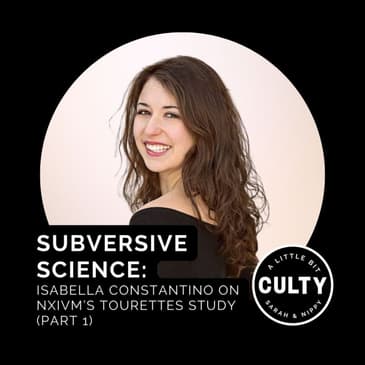
This explains why today’s guest, Isabella Constantino, was attracted to NXIVM and the extraordinary results they were boasting about with their TS study. Ultimately, Constantino wound up postponing her last semester of college and moving to Albany in order to engrain herself in the study and to pursue personal growth, both of which she did for a total of three years before finally escaping. Now, she’s spent half a decade recovering her “sense of self” and navigating life post-NXIVM.
But how did NXIVM actually approach this “scientific” study, and what abusive methods did they apply from their typical conditioning in order to combat Tourette’s? Lastly, did any of their techniques actually help with TS, and if so, at what cost?
For more about Isabella Constanto, check out her site, Instagram, and Facebook:
Please note, this series includes details of sexual abuse. Listener discretion is strongly advised. If you, or someone who know, is a survivor of sexual assault, abuse, grooming, child abuse, or human trafficking, RAINN’s National Sexual Assault Hotline offers support at 800.656.HOPE (4673).
Also…
Hear Ye, Hear Ye:
The views and opinions expressed on A Little Bit Culty do not necessarily reflect the official policy or position of the podcast. Any content provided by our guests, bloggers, sponsors or authors are of their opinion and are not intended to malign any religion, group, club, organization, business individual, anyone or anything. Nobody’s mad at you, just don’t be a culty fuckwad.
Other Links:
Check out our lovely sponsors
Join ‘A Little Bit Culty’ on Patreon
Get poppin’ fresh ALBC Swag
Support the pod and smash this link
Cult awareness and recovery resources
CREDITS:
Executive Producers: Sarah Edmondson & Anthony Ames
Production Partner: Citizens of Sound
Producer: Will Retherford
Senior Producer: Jess Tardy
Writer: Mathias Rosenzweig
Theme Song: “Cultivated” by Jon Bryant co-written with Nygel Asselin
See Privacy Policy at https://art19.com/privacy and California Privacy Notice at https://art19.com/privacy#do-not-sell-my-info.
[00:00:00] The views and opinions expressed by a little bit cultier, those are the hosts. And don't reflect the official policy or position of the podcast, right Sarah? Correct. Any of the quote, fire content, I prefer lava content provided by our guest bloggers, sponsors
[00:00:14] or authors of the opinion and are not intended to malign a religion, a group, a club, an organization, business individual, anyone or anything unless Sarah? You're a douchebag. Yeah, I mean pretty much. Also, we're not doctors, psychologists or wizards.
[00:00:29] We're just two non-experts trying to make you a friendly and formative podcast based on our experience that we've turned into wisdom. Okay? Good talk. Okay. Hey everybody, Sarah Edmondson here. And I'm Anthony Ames, aka Nippy, Sarah's husband, and you're listening to A Little Bit Culty,
[00:00:55] aka ALBC, a podcast about what happens when devotion goes to the dark side. We've been there and back again. A little about us, true story, we met and fell in love in a cult. And then we woke up and got the hell out of dodge.
[00:01:09] And the whole thing was captured in HBO docu-series The Vow, now in its second season. I also wrote about our experience in my memoir, Scarred, the true story of how I escaped next to him, the cult that bound my life.
[00:01:21] Look at us, a couple of married podcasters who just happened to have a weekly date night where we interview experts and advocates and things like cult awareness and mind control. Oh wait, wait, this does not count toward date night, babe. We got to schedule that, that's separate.
[00:01:34] So it's two days we gotta hang out? We do this podcast thing because we learned a lot on our exit ramp out of Nexium, still on that journey. And we want to pay the lessons forward with the help of other cult survivors and whistleblowers.
[00:01:46] We know all too well that culty things happen. It happens to people every day across every walk of life. So join us each week to tackle these culty dynamics everywhere from online dating to mega churches and multi-level market. This stuff really is everywhere.
[00:01:59] The Cultiverse just keeps on expanding and so are we. Welcome to season five of A Little Bit Cultie, serving cult content and word salads weekly on your favorite podcast platforms. Learn more at alittlebitculti.com. All right, we're back with a long-awaited episode.
[00:02:33] One of my personal heroes, Isabella Constantino. So excited to finally be able to share our conversation with all of you. For those of you who don't know, Isabella was in season two of The Vow and she's one
[00:02:50] of the subjects that was followed in regards to the Tourette study. Which a documentary was made about called My Tourette's. So obviously if you guys have followed Keith, Keith claimed a lot of stuff. One of those claims was that through unlicensed human subject research, i.e., not legitimate,
[00:03:07] they're able to successfully treat Tourette syndrome. According to the CDC, Tourette syndrome, which you might know as TS, is a condition of the nervous system. TS causes people to have ticks and ticks are sudden twitches, movements or sounds that people do repeatedly.
[00:03:20] People who have ticks cannot stop their body from doing these things. One patient of the doctor of these studies claimed that Nexium had taught him to overcome Tourette's. So whether or not he actually cured Tourette's, well you're smart enough to figure that out on your own.
[00:03:33] Today's guest, Isabella, was drawn to Nexium thanks to this study and the Vow guest claims. And just for the record, so many people have reached out to us since season two and just like people who are in this field,
[00:03:45] not only explaining how these studies weren't legit but like all the steps people have to go through to do a study. Even just being peer reviewed as one. There's all these hoops you have to jump through to make it legitimate and they did none of it.
[00:03:59] This was Keith's number one strategy, avoid anything that has legitimate standards and practices, which is why anytime I got close and this happened a lot, Tuck Business School, which is Dartmouth's business school, Harvard Business School, a lot of people that were alumni of these things were like,
[00:04:16] we should get some of these things into the school. And anytime somebody came down to do it, to have an interview or something, Keith always changed the parameters and under which it would be required for it to be appropriate
[00:04:27] for them. Well they should do a five day, they should do all these things. And obviously he was making demands that none of these schools would yield to. So Isabella Constantino is an artist with Tourette's syndrome.
[00:04:36] She got in touch with ESP to be a part of the research they were doing, hoping to find some relief. This led to Isabella postponing her last semester of college, moving to Albany and immersing herself in nexium for the next three years.
[00:04:48] Now having left in 2017, Isabella is continuing to renew her sense of self and navigate a healing mental health journey post-life and occult. I'm personally thrilled to be connecting with Isabella after all this time and hopefully help her on her journey, which in turn would help us on ours.
[00:05:03] We connected at the trial. That was the last time I saw her physically. So without further ado, Isabella Constantino, enjoy. Hello my dear Isabella. Hi Sarah, how are you? I'm good, how are you? I'm good. Yeah, how are you doing? How is your life? How is your heart?
[00:05:36] I'm okay. I feel like it's been a very long five or so years. Yes. Yeah, I feel like it's been like very chaotic at times and very, it feels almost sometimes equally stagnant as it is like chaotic and I don't always know how to go about the day.
[00:05:55] I can totally relate to that. Yeah. I want to get so much into like what you're doing and your healing and catch up and everything on the last almost six years now. End of May we knew, but we didn't like make a stink till the beginning of June.
[00:06:12] No, I remember. Yeah, you were there. It's a full document. I was there. Yeah, actually I was well, I was at the intensive that Nipi came in and yelled at Lauren at and
[00:06:25] I had no idea that you did that until I left and other people told me about it because they covered it up so quickly. I don't know if I was working it. I don't know.
[00:06:34] Yeah, I don't know if I was in the basement or like prepping food or what I was doing. But I just remember coming out and everyone was like, we have to move half of these chairs because everyone like half the people left.
[00:06:45] I had no idea what was going on. I remember someone whispered to me, yeah, like half the board just like left. Apparently, you know, Mark's going to make movies and we don't know who's going to fill them in.
[00:06:56] And I was like, okay, that's weird, but like good for them. I don't know what's going on. And then it just like just got increasingly like dark and controlling from there on out just with everyone leaving. It was very chaotic.
[00:07:09] Well, I'll let you know, I'll let you know a little secret because I was debating what I was going to do. And one of the things I was going to do was kind of make a stink in the room where the egg trays
[00:07:20] are, where they line up all those eggs every morning and those things. And I was going to flip them and be and just be, you know, obnoxious. And really, there's just sound in the alarm.
[00:07:30] But all I kept thinking about was the people that had nothing to do with this that we're going to have to clean up my mess. You would have had to clean up the eggs that I flipped. Then I would have heard about it.
[00:07:43] I'm especially glad I didn't do that because that would have been on you and a couple of other people I didn't want to put through unpaid labor. More unpaid labor too. Lot of eggs and a lot of unpaid labor. Right.
[00:07:58] Now, I know that most of our listeners will have watched the vow and they will have seen you and know who you are. And if there's in the off chance, some new person has just come to our podcast and we're interviewing Isabella Constantino.
[00:08:12] Do you want to give us a little mini cliff notes on your brief foray index? Yeah, I got my own big image. Let me ask you this actually. How did Mark Elliott find you? How did you hear about it? So Mark didn't find me.
[00:08:26] I got enrolled because so my senior year of college, I had been doing pretty well mostly before that. But then I think with the stress of not knowing what the future was, change coming, anything else that was going on, my tics had gotten pretty bad.
[00:08:46] We had always tried everything we could to help alternative medicines, everything. And I was pretty involved with the Tourette's Syndrome Association in Western New York. And so I actually, I was volunteering at a conference that is every two years in New York
[00:09:03] State and that year is in Buffalo. And the first day is for teachers and there's a panel and teachers learn about that. And the second day is for the families. So I volunteered to watch all the kids so that families could, their parents could watch
[00:09:18] the doctors and learn about different types of treatments and stuff like that. So I was at that conference, which the director of the Tourette's film ended up, you know, driving to.
[00:09:31] And my mom was there and one of the doctors who we'd known for a long time during his presentation, I'd known him for 10 years. I was actually connected through the ABC documentary I did when I was like 13. And we stayed in touch.
[00:09:45] And he said during his speech that he was really just impressed and, you know, thought it was great that me and my mom never stopped looking for treatment and that we were trying so many things and just kind of commended our resilience in that way.
[00:10:04] And Alessandro heard that and, you know, I think, well, and basically he approached my mom and he had meant to, I think, approach one other person. But they asked him to leave because they didn't really know what it was or maybe they did and thought it was sketchy.
[00:10:20] Oh, they asked him to leave. Yeah, they asked him. And I think one other person went with him. It wasn't Mark. But basically that weekend, my mom said to me, hey, do you remember actually, I'd seen Mark speak at a previous conference when I was in high school.
[00:10:34] And she goes, do you remember that guy we saw speak in Syracuse? And he had the tics and spoke about compassion. I was like, yeah, I remember him. She was like, well, he got involved with this company and he was able to have success in treating his threats.
[00:10:50] Would you be interested? And I said, absolutely. And so basically that weekend, I ended up talking with Mark on a Zoom call with my parents and he kind of told us a little bit about Nexium or ESP. And he told us there's articles out there. Don't believe them.
[00:11:10] It's fine. And I didn't believe them because I trusted it. I was naive. I was 20 and pretty sheltered. And basically just throughout the next few weeks, I got connected with him and then did another interview with Brandon.
[00:11:27] And then basically a few weeks later, I was on a Zoom call in my dorm room with Mark, Brandon, and Nancy. And taking pretty badly, basically saying yes, I would do anything to get rid of this. I'm desperate.
[00:11:41] And I think that and the fact that my tics were so noticeable and I had already had previous documentary footage about my experience and my symptoms and all that made me a good candidate. And basically everyone hopped off the Zoom call and Mark said, I can't guarantee anything,
[00:12:01] but I think you got it. And I just remember hopping off and just being so happy and honestly just breaking down because I had been the first time in my life, I'd given up hope on getting better. And I was ecstatic.
[00:12:17] And then a few weeks later, I worked with Nancy and that's how I got connected. Wow. So you were really wanting it? Yeah. And it all happened very fast within the matter of like a month and a half.
[00:12:29] So yeah, the film crew came the day after I turned 21 and they were supposed to come the day of, which I'm glad they didn't because they wanted to film at the bar and just like, oh, experience. That was best that they did not do that.
[00:12:43] But they came the next day. And that's when we filmed the initial footage for the My Trats movie. And then I did a sleep study that weekend. And a couple of weeks later, I drove basically with my mom, like straight after my last exam to Albany.
[00:13:00] And I worked with Nancy for a week or so and came back. What was it? What was that like? Were your first impressions? Well, I had met Mark and I had met the film crew and they were all great. Like I really loved them.
[00:13:14] And up until that point, it had been a really good experience. You know, it was a little stressful doing like preliminary like questions with Brandon, who was the doctor in the study just because you know, he was asking like the severity of ticks and different symptoms.
[00:13:30] And that was stressful because that was a normal type of stressful. So nothing had stood out as a red flag because talking about that can be difficult. It wasn't out of the ordinary. But once I got there, actually the center had flooded that week or two before that
[00:13:48] or like maybe that week. So instead of driving to the center, we kind of rerouted halfway through and went to Nancy's house instead. And they didn't want to introduce me to Nancy. Initially, they wanted to get kind of the pretesting data and then I would meet her
[00:14:02] the next day on camera and everything. So I spent like two, three hours in Nancy's basement with Brandon all hooked up and everything. And that was for quite a while. That was the hardest part until like kind of the abusive aspects got really bad.
[00:14:22] That was the thing I looked back on because it just, they basically asked you, they're trying to get data on where your, where my ticks and where my body and where my brain was at pre-nexium, pre-curriculum.
[00:14:37] And asking me to do different, think about different things, ask certain questions. Maybe like, I don't remember, like hold my breath for five seconds, breathe for five seconds, try not to tick for two minutes.
[00:14:50] And just things that were just, is already stressful, is already like an unknown environment to me. There's a lot going on. So it was pretty hard. So kind of went in a little difficult. I was a little unedged, but I was very excited.
[00:15:04] So the next day when I met Nancy, I was very optimistic. And you can see on, they had it on film, on camera. When I was talking with Mark and my mom and Nancy, my mom asked me, do I have any fears?
[00:15:17] And I said, you don't know because this is, you know, I've had Tourette since I was like six or seven. This has been the thing that we've been looking for, you know, since then.
[00:15:28] And then I felt pretty stupid the next few years because I was like, you're scared of everything. And I was like, wow, I was so naive then when I said I wasn't scared. But realistically, God, it just got shittier from there.
[00:15:40] Yeah, I was going to ask, like, was it hope that they sold you on? Like, did you think that you were going to get through this? Like, was that, you said Mark said he couldn't guarantee anything.
[00:15:50] But what was like, you must have gone in thinking I'm at this level. Ideally, I want to get what? Like what was the kind of dream or the hope that you were hoping to come out of it with? And how much was that sold to you?
[00:16:05] So there had been four or five people on the study before me, including Mark. So they already had results. So it wasn't like completely this unknown hypothetical thing. There's already people who were doing significantly better.
[00:16:19] And at that point, I was doing worse than I had been in years. In years. So any form of relief from that would have been just welcomed and ideal. But I was always very hopeful and optimistic.
[00:16:35] And never did I think in my life, like, I will have this my whole life. That is just, I just have it. That's the only thing. That's the only option.
[00:16:46] It was always there will be something that I can do or someday I will wake up and I will not have this. And I didn't think that I would really be the one to do that myself.
[00:16:58] So when this was put in front of me, I, you know, this was the only thing that we'd ever seen like this. And the only people I'd seen after being involved with the trust community for so long, who'd had results like this.
[00:17:14] So I just, you know, it's the unknown, but it was a better unknown than, you know, what I knew I couldn't access before. This is the golden age of cult recovery. The more we speak up and share our stories, the more we realize we are not alone.
[00:17:34] Your voice and your story can empower others. This is Sarah and I'm proud to be a founding collaborator of the hashtag I got out movement. Learn more at I got out.org. So from that point, when did it start to just fade?
[00:17:57] Well, like I said, I was very young. And because of the threats, I was sheltered in a lot of ways. Like I didn't start driving till a couple years after that. You know, I just, I there's a lot that because I was so focused on all the neurological
[00:18:11] stuff, the threats, the OCD, the ADHD, it was very debilitating. I think I was ahead in certain ways from having to deal with that and behind in other ways from not, you know, just having to focus on that instead of other things.
[00:18:23] So I did not have maybe a good sense of what was not okay in a workplace or in a, you know, corporate environment or just because I was young, you know,
[00:18:37] I was used to adults treating me like I was young and that's, they treated me like I was young. They treated me like I was very out of touch and very naive. And when I voiced from the very beginning what I was uncomfortable with or my own thoughts,
[00:18:54] like it was, I mean, I think it was probably similar to a lot of people's experiences in Nexium with the curriculum and that if you didn't go along with the curriculum, you know, there's something wrong with that or you're, you know, you're being defiant.
[00:19:05] You're being attention seeking, you're being whatever. Your issues were always leveraged. Your issues came up. Yeah, all that. Your issues were leveraged to make you obedient. Yeah, exactly. I said this in my victim statement, which I sent Sarah last night actually. I read it. Yeah.
[00:19:22] Very well written by the way. Thank you. I wasn't going to write one actually and then like two days before I was like, gosh, I should write one. You have a lot to say.
[00:19:29] Exactly. I don't want to say. Well, I mentioned in that that just working with Nancy broke me in it, broke me very fast. She was very good at being very hot and very cold and you think it's
[00:19:42] you and not just her being inappropriate in a professional environment because I'd never really been in a professional environment. So I assumed it was normal on some level or I was doing something wrong and they address the ticks and any symptoms I had.
[00:20:00] Like it was, the way that they explained it to me was so like ESP is a personal growth company, but it's also like a human ethics company. It's a, you know, all of these things where you
[00:20:12] have this thing that you want to meet and then you have to look at where you're holding yourself back and you have, you know, they said your body values and you have your ideology. So if you're upholding body, you're not holding up your ideology and vice versa.
[00:20:29] So because all of this was so intertwined, the curriculum was, you know, so much a part of the study outside of the EM's. They were using a lot of, well, all the concepts in the curriculum
[00:20:43] to address my ticks and my symptoms. Yeah, I know. I can see where that can get abusive really quickly and it kind of take a moment to flush out what you just said so our audience
[00:20:53] understands. I'll give a kind of layman's example and then I can see how that layman's example can be leveraged to abuse you as I'm hearing it. The example they gave is like, if you're sitting on your couch and you have the ideal self as being in shape
[00:21:10] and you want to go to the gym and you think of going to the gym, but the bag of Doritos feels better. When you indulge in the bag of Doritos, you're indulging your body and your ideology, which is
[00:21:19] this person to eat well and stay in shape is being quote breached against. And the same time, if you go to the gym and uphold your ideology, you're breaching what your body wants, which
[00:21:30] feels good. Eating the Doritos in the moment feels good. So basically what I'm talking about is short-term thinking versus long-term thinking. So if I have a tick, I can... This is what I think
[00:21:41] happened is if I have a tick or I'm doing something that's of my body and I indulge it and I have this ideology of a person without Tourette's, you're ripe for abuse based on accepting the premise of the curriculum. And I think that's what's been leveraged
[00:21:59] and you got shamed and all that stuff. Oh, it's terrible. Does that help? Yeah, perfectly accurate. I assumed I was the worst person in the world because I was just giving into this all the time.
[00:22:12] It was so bad. And the thing was I was going off meds at the same time at their request and there's so many unhealthy things that were normalized in the community that I just fell into that are terrible things for anyone, but let alone especially if you have
[00:22:32] neurological issues. Neurological issues. So the lack of sleep, the lack of food, all of these things are things that I'm still struggling with, but make my ticks, make my OCD so terrible. Just between... Sleep is one of the things that is just so important for keeping
[00:22:52] your neurological system regulated and everything, absolutely everything about nexium is just one thing after another that just dysregulates you and just compounds on each other. And then you're just like, what the fuck is going on? I literally don't even know
[00:23:09] what's up and what's down and what my body's saying. And because of just all of the self-doubt they instilled in everyone, it was very hard to tell both in
[00:23:22] nexium and coming out of it. Like as you're trying to heal, as you're trying to just get through the day, what is your intuition and what's them? So it's just all of these... It was very difficult. So you have unqualified people without standards and practices and degrees,
[00:23:42] constantly throwing shrapnel into your central nervous system. And people that are supposed to be helping you attain this hope that you came in under the guise of and maybe a couple of examples
[00:23:53] of people who have done it, but really what they've been able to endorse the shrapnel in their central nervous system and put on a good face of obedience and control their own ticks. It's essentially the gist of it. Yeah. And I think Marc Vicente actually... So I didn't...
[00:24:10] I haven't listened to a lot of nexium related material or podcasts and stuff. I've been... I've been... I've limited what I've exposed myself to just for my own mental health. Smart. Yeah, thank you. But I listened to Marc Vicente's summary of episode three of season two,
[00:24:29] the one that focused on the Tourette study in the Vow. And there's a point in his podcast that where he makes a metaphor with the Tourette study, it's like if someone sneezing or coughing
[00:24:45] for a very long time and they can't stop and they just keep coughing and no matter what they do, they can't stop. Someone holds a gun to their head, they might be able to stop. But that's not
[00:24:54] really a sustainable long-term. And I think that's what a lot of us were dealing with. And no one to my knowledge actually did stop ticking. Even Marc, when I left, I don't know if anyone else would know it if they didn't know Tourette's very well. But
[00:25:10] you could still see he was having symptoms. I was having symptoms. We're all still dealing with it on some level. Do you have a theory on that for Marc? Do you think... Because he was the first, right?
[00:25:21] Do you have a theory on what his success came from? Do you think it was the same as yours? Because in the documentary, whatever methods they used, good or bad, it did seem like you had some big shifts.
[00:25:34] I did. Yeah. So I think my experience in Marc's were very different in a lot of ways. I went to Albany for a week thinking that would be it. And I start working with Nancy,
[00:25:46] the EM's, and the curriculum and everything. And I think, okay, I'm going to leave and that's going to be it. I'm going to do better. But on the last day, I remember feeling very emotional
[00:25:58] and feeling very confused by the nature of the curriculum and the fact that now I just had all these concepts and ideas about myself and about my tics and trying to figure out and film very
[00:26:09] angry and defensive. And I just remember in that last day working with Nancy, her and Marc sat down with me and we're going to keep in touch. Don't worry. We're not going to leave
[00:26:18] you. And I was surprised by that because I thought that was it. But a month later, so this is kind of introducing or explaining how my experience was different than Marc's. A month later, I went there
[00:26:30] for a couple of days to do an EM with Nancy and they asked me to move there. So I ended up deciding, you know, this has been the only thing that works. I don't want to leave school,
[00:26:41] but I think this is worth it. So basically Valentine's Day 2015, I drive up with my parents and my sister, they moved me in and I'm there for six months. And my experience of being in Albany
[00:26:56] was very quick, very unexpected and very kind of extreme in the way that all of my experiences in those first six months and on the study were either very difficult, kind of abusive or toxic
[00:27:12] in nature being around a lot of people in curriculum based situations or very isolated. And I kind of had a very strange and very fast introduction to all the next in curriculum, to the Tourette
[00:27:30] study, to having any success I had put on a pedestal or having this idea of what my symptoms should look like and being told, like you need to be like this. There's people before me that I went
[00:27:46] in pretty all or nothing to nexium. And I was very young and I was asked to go on or off of medication. I didn't drive, I didn't know anyone, I didn't have a job, I didn't have money. Basically
[00:28:05] most of the food money my parents gave me to be there was going towards train tickets each month to go home for the sleep study because they wanted it in the same place every month.
[00:28:15] So it was just like there's all these different ways that I didn't have any autonomy and they didn't pay for you to travel for the sleep study that they wanted?
[00:28:23] No, no, no. Actually, so I lived with, with Nan, I know and I lived with Nancy's assistant and my parents paid for me to live there and paid for rent and everything. But I didn't know I could ask for
[00:28:35] them to pay for that. And I think my last month there, it occurred to me and I asked Mark and he said he would ask Claire but they said that because I didn't ask until then
[00:28:47] they can only reimburse me for the next one or the very last one that I did. So yeah, I didn't have any assholes. That's the thing that pissed me off about that place. There's a, there's a,
[00:29:00] there's a chaps my ass for you. That chaps my ass. You relocate, you pay for yourself to relocate, they don't give you a job, you have to pay yourself to go back to your hometown to do
[00:29:10] the sleep study in the same place. Yeah, for two days and then come back, you know? So I got to see my family a day of the month and sleep. So I basically go to sleep at like 7 pm,
[00:29:21] all this shit hooked up every month. I got to know the sleep study people here in Buffalo very well, they're great. Do you like sleeping in an office? You're sleeping at a hospital for the sleep
[00:29:30] study? Where do you sleep? Yeah, hospital. So yeah, you go in and we have a really good sleep center here. So I'd go in, I get hooked up, like Brandon sent them all the types of like tests that they are like the information he wanted from them
[00:29:42] and they counted the ticks in my sleep, I guess. The thing is I don't take in my sleep. I, I'm asleep so on some level I can't know that but for me ticks are, I'm just going on a tangent
[00:29:52] a little bit, but ticks are super a conscious decision for the most part. Like I have these urges and I respond to them and that's kind of what the nexium curriculum used to say, well,
[00:30:04] that's a choice instead of, you know, very oversimplifying it. But I know I don't take in my sleep because my entire life I have just, it's, I have not wanted to get up in the morning
[00:30:16] because sleep was the only time I didn't take that state between sleep and awake when, when you're conscious enough to, to, to be there but still in the kind of relaxed, you know, place that your body is not dealing with all of everything else that might deal
[00:30:35] with during the day. So basically I went there every month for sleep studies. They said, I improved a lot. I don't know what little movements or brain things they were basing
[00:30:46] that off of but they said I ticked a lot in my sleep. I think they just didn't have a very good way of measuring that. But I would go back and forth every month and then just be alone
[00:30:56] other than intensives. And there was a group of young people that first six months when I lived in Albany. So sometimes I was around people and I, and I made friends and met good people.
[00:31:08] But for the most part, I was very, very alone in a Barb J's house and there's no sidewalks. I didn't have a car. I didn't drive. I, you know, kept to ask Nancy kept saying she would find work
[00:31:19] for me but she, she didn't and she would never respond and all of that. So what about Nancy made a promise she didn't care? I know. That's so fucking strange. I can't imagine that. Yeah.
[00:32:04] Tourette's cured. He went for his career and being a speaker and then his Tourette sort of went away over time. Is that right? I can tell you my experience with Mark, I think it's an interesting story and somewhat relevant. Tell it.
[00:32:16] So they started the study and he was going up there a lot and Sarah and I, you know, had a place up there but we weren't there about three or four times a year
[00:32:24] and I had a car up there and I would let him use my car. And I was coming back up to Albany from New York City and he was going from Albany down to New York City and we decided to
[00:32:35] meet at the train station and get my key back. So he didn't have to park it and he, and he was leaving a train roughly at the time I got in and we had about 30 minutes to kill and
[00:32:44] we went to the cafe and I'm sitting there with my hands in the key back and I noticed he's not fucking ticking and I'm going, wait a minute Mark. He's like, he starts nodding and he
[00:32:55] starts, his eyes are welling up and I'm like, dude you're not, and I had the goosebumps. I was just like, oh my God, because I was there. I saw it and listen, the people that say they faked
[00:33:05] Tourette's and all that he wasn't faking Tourette's. I met him years ago. He took a five day and he went back to his speaking career and one of the whole things and I've said this before part of
[00:33:15] one thing I feel like I need to see through is get the Elliott brothers out because I was very instrumental in getting the Elliott brothers involved in the organization, particularly when Mark wanted to get Brian more involved in the organization
[00:33:27] and quit using it peripherally. So I have a personal relationship to this and I'm sitting there and I'm crying. I'm going, oh my God, it's like it's 90% gone. And I had seen him not long ago and he was
[00:33:40] like doing his head and his jaw and all that stuff and it was like, and so for me, yeah, and so for me when he handed the key back to me and I was like, good God dude, we are on to
[00:33:50] something. This is amazing. Like it, well I doubled down, seeing him and like, I didn't, you know, Mark's taking the beating in certain media corners right now because he's doubled down on something that's clearly the wrong way to go about it. But I think he's misguided now.
[00:34:09] I don't think it comes from bad person, bad place, bad heart and seeing that and seeing him embrace it and seeing him go out and be kind of an ambassador for this change allowed me
[00:34:19] to kind of like, my doubts kept getting squelched. And that was a big moment for me when I saw someone who couldn't stand still for a minute, give me the key back to my car and it didn't have it.
[00:34:30] And it was relating to him in a totally new way. And he's like, the world's different. I don't have to go in and explain myself everywhere I go. And it's like a totally different
[00:34:37] like, it was a powerful moment. And I thought like, you know, it reaffirmed what I was doing because I was always kind of in a state of like, it's just kind of work.
[00:34:45] He didn't have anybody doing to him what was done to you. I don't think, right? Or did he? So I don't think he never considered himself a part of the study because he went in a very organic way, you know, way that just happened to
[00:35:02] have results with his tixin. And so with me and the other people involved in the study, it was a much more directed approach and much more, I think intense and focused on the tix themselves.
[00:35:17] Where I think he probably at least at the beginning and for a while had a really positive experience of everything. Like people say like, once you move to Albany for the next same stuff, you know, it gets very controlling, it gets very dark, it's like people start failing,
[00:35:33] people were not doing well. Well, the abuse, the abuse comes out. Yes, yeah. Yeah, exactly. And it's much more easier obviously, or was for Keith to pull all the strings. Well, you're closer to the abuser.
[00:35:46] Yeah, exactly. So I think maybe Mark being in New York, Mark living his life between intensives, him working with Nancy and this, like if he worked with Nancy, you know, it was this very maybe novel thing. And I don't know what his sessions with her look like.
[00:36:03] Obviously, I wasn't there for any of them. But I think having more autonomy before that, more life experience, more ability to gain space and use the tools in a natural way between intensives gave him the ability to have a much healthier experience with it
[00:36:21] than I think I did who just went all in for six months in a weird place going off meds, like, you know, disassociating just dealing with all the things that I dealt with. He didn't have that.
[00:36:35] And on top of that, I think, and I don't know how it was before I joined, but when I was there, it was, I think becoming increasingly misogynistic. And with the genus curriculum coming out from
[00:36:48] what I understand about it, I did the weekends and stuff like that, never the intensives. But I think they carried a lot of that over into working with me at times and just telling me how
[00:37:02] much of a bubble I had been in my whole life and how I was let off the hook for so many things and how I was trying to control the people around me with my behavior and attention seeking and certain
[00:37:14] things and certain things that I don't know if they were true or not, that I think they worked through or put on mark when they worked with him in terms of being attention seeking.
[00:37:25] So I think because that's what narrative they put around his Tourette's that kind of like trickled down and became very much a part of ours, like a focus and ours, at least in my experience with
[00:37:36] Nancy, they were adamant that I had been in a bubble my whole life. I had, and don't get me wrong, like I was sheltered on some levels, you know, my parents were a bit protective because
[00:37:47] I was dealing with all of this. So I think a lot of things were difficult, which incidentally is irrelevant. It is irrelevant, good point. So I think we just had different experiences. Okay, I was just thinking about how like I wasn't around so much when Mark came, but
[00:38:02] I do remember that, I mean, listen, we all got in trouble for being attention seekers, myself included, you know, we all had our things. I got in trouble for being attention-avoider. Oh, yeah. We are in trouble for being defiant. I just leave.
[00:38:21] Yeah, yeah. But you know, yeah, attention-seeking, being a ham and I kind of, my theory kind of was that if you, because you know, people do do things for attention, that is something that happens,
[00:38:35] you know, and that I, my theory was that not being a doctor, of course, is that part of Mark's Tourette's may have been reinforced by the attention he got. That was just my theory,
[00:38:46] and then when that got sort of pulled apart and that disintegration was exposed, then he could just like be himself and not try to get attention that way. Great. But then to put that on you,
[00:38:59] it's just, look at so many things about this at Chatmaias, just like how irresponsible that is, and then also just this, you know, bullshit study where they're having you come. I mean, I'm even shocked they even did the sleep study properly because everything else seemed
[00:39:12] completely like a hack job. It seemed like the sleep study might have been a hack job also. Oh really? Because I don't know, like some, I guess, I don't know how they were interpreting
[00:39:21] the data. Like basically the whole thing was just kind of things to make it look legitimate that they probably thought were legitimate, but really there was no variables. There was no control group. There was no ethics board. There's no things that studies should have.
[00:39:36] On top of the fact that they were claiming a long term success after very short term results, and I had been doing better for a week and they're like basically you're cured and then
[00:39:48] held me to that. Like Carissa, I know that she stayed in Albany for like two or three weeks. Like she dealt with so much while she was there just, you know, on the study with Nancy,
[00:40:01] and I think everything just had gotten just more and more abusive. At least that was my experience during those last few years. And she, you know, she's still dealing with the effects of that. This podcast is brought to you by Citizens of Sound, a podcast production agency
[00:40:20] committed to developing and launching shows with gravity and depth. From conception to launch, citizens will partner with you every step of the way, whether you're an actor, business owner, doctor, fitness coach, hairstylist or influencer. Connection is the future of
[00:40:33] communication. Jump on board with Citizens of Sound today and start your show. Go to citizensofsound.com and follow them on Instagram. And trust me, it'll be a really good decision for you. Thank you everybody for tuning in for this week's episode with our personal hero, Isabella
[00:40:54] Constantino. Stay tuned for part two coming very soon. Thanks for your patience and thank you for supporting A Little Bit Culti.
[00:41:34] And if you're looking for our show notes or some sweet, sweet swag or official ALBC podcast merch or a list of our most recommended cult recovery resources, visit our website at alittlebitculti.com. And for more background on what brought us here,
[00:41:47] check out Sarah's page-turning memoir. It's called Scarred, the true story of how I escaped Nexium, the cult that bound my life. It's available on Amazon, Audible, narrated by my wife and at most bookstores. A Little Bit Culti is a talkhouse podcast
[00:42:00] and a Trace 120 production. We're executive produced by Sarah Edmondson and Anthony Nippy Ames with writing, research and additional production support by senior producer Jess Tardy. We're edited, mixed and mastered by our rocking producer Will Rutherford of Citizens of Sound
[00:42:16] and our amazing theme song, Cultivated, is by John Bryant and co-written by Nigel Asselin. Thank you for listening.