
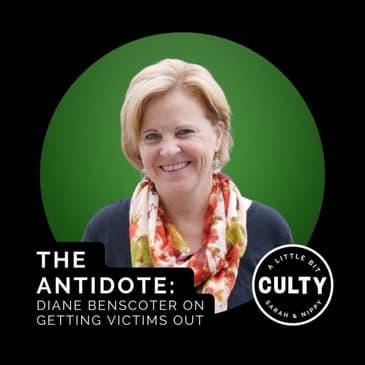
This episode is sponsored by Better Help. It was the early ‘70s and life was weird. War was still going on in Vietnam, and those back in the US of A were struggling with political, societal, and economic changes. One day, Diane Benscoter passed a van where some strangers were giving out bananas. She grabbed a snack and avoided making conversation with the van people. Shortly after, she was on a five-day trek from Omaha to Des Moines with those banana enthusiasts, who were in fact Sun Myung Moon enthusiasts. Next thing you know, Diane’s cut off all of her hair, done some fasting, and has dedicated five years to selling candy and flowers while devoted to the second coming of Christ.
You can read all about this in her memoir, linked out below. But on today's episode, we’re focusing on Diane’s organization, Antidote, which helps people escape from cults, or to get their loved ones out of cults and extremist mentalities such as those shared by QAnon. Having experienced cult life herself, Diane knows that convincing someone that everything they hold true in their life is a vicious lie can be next to impossible. That’s why she became a master at it.
Check out Antidote.ngo
Purchase Shoes of a Servant: My Unconditional Devotion to a Lie
Also…
Hear Ye, Hear Ye:
The views and opinions expressed on A Little Bit Culty do not necessarily reflect the official policy or position of the podcast. Any content provided by our guests, bloggers, sponsors or authors are of their opinion and are not intended to malign any religion, group, club, organization, business individual, anyone or anything. Nobody’s mad at you, just don’t be a culty fuckwad.
Other Links:
Check out our lovely sponsors
Get poppin’ fresh ALBC Swag
Support the pod and smash this link
Cult awareness and recovery resources
CREDITS:
Executive Producers: Sarah Edmondson & Anthony Ames
Production Partner: Citizens of Sound
Producer: Will Retherford
Senior Producer: Jess Tardy
Writer: Mathias Rosenzweig
Theme Song: “Cultivated” by Jon Bryant co-written with Nygel Asselin
Learn more about your ad choices. Visit megaphone.fm/adchoices
See Privacy Policy at https://art19.com/privacy and California Privacy Notice at https://art19.com/privacy#do-not-sell-my-info.
[00:00:00] This winter, take your icon pass north. North to abundant access, to powder skiing legacy, to independent spirit. North where easy to get to, meets worlds away. Go north to Snow Basin. Now on the icon pass.
[00:00:27] The views and opinions expressed by a little bit cultier, those are the hosts. And don't reflect the official policy or position of the podcast.
[00:00:34] Any of the quote, fire content provided by our guest blogger, sponsors, or authors of the opinion and are not intended to malign a religion, a group, a club, an organization, business individual, anyone or anything unless they're... You're a douchebag.
[00:00:48] Yeah. We're not doctor, psychologist, therapist, license counselors, or shamans. Even though you kind of think you are sometimes. I'm like an urban shaman. Okay? Good talk. Hey everybody, Sarah Edmondson here.
[00:01:08] And I'm Anthony Ames, aka Nippy, Sarah's husband, and you're listening to A Little Bit Culty, aka ALBC, a podcast about what happens when devotion goes to the dark side.
[00:01:20] We've been there and back again. A little about us, true story, we met and fell in love in a cult. And then we woke up and got the hell out of dodge. The whole thing was captured in HBO docu-series The Vow, now in its second season.
[00:01:33] I also wrote about our experience in my memoir, Scarred, the true story of how I escaped next to him, the cult that bound my life.
[00:01:40] Look at us. A couple of married podcasters who just happened to have a weekly date night where we interview experts and advocates in things like cult awareness and mind control. Wait, wait, wait. This does not count toward date night, babe. We gotta schedule that. That's separate.
[00:01:53] So it's two days? We gotta hang out? We do this podcast thing because we learned a lot on our exit ramp out of Nexium. Still on that journey. And we want to pay the lessons forward with the help of other cult survivors and whistleblowers.
[00:02:05] We know all too well that culty things happen. It happens to people every day across every walk of life. So join us each week to tackle these culty dynamics everywhere from online dating to mega churches and multi-level market.
[00:02:16] This stuff really is everywhere. The cultiverse just keeps on expanding, and so are we. Welcome to season five of A Little Bit Cultie, serving cult content and word salads weekly on your favorite podcast platforms. Learn more at alittlebitculti.com
[00:02:36] Welcome back, everybody. We have a fabulous episode for you. I think you're going to enjoy it very much. But first, some breaking news from the cultiverse. That's a tick or tape. I feel like this has been an exciting few weeks in terms of holding people accountable.
[00:03:05] There's two people that we have been aware of for quite some time now. One of them was sentenced and one of them has been charged and put in jail. And by the time you hear this, there might be more activity.
[00:03:16] But the main thing to know is that Larry Ray, the predator from the Sarah Lawrence College case, many people have written to us about him. We are going to be doing a full episode. There's a docu-series coming out. Of course there is. Of course there is.
[00:03:31] For those who don't know, well, let me put it this way. The class attorney Damien Williams said at the, as it's called when they announced the results. Hearing? Yes. When did I just call it a hearing? I'm not a lawyer. Yeah.
[00:03:45] Larry Ray is a monster. For years he inflicted brutal and lifelong harm on innocent victims, students who had their lives ahead of them. He groomed them and abused them into submission for his own gain. Through physical and psychological abuse, sound familiar,
[00:03:55] he took control over his victims' minds and bodies and extracted millions of dollars from them. The sentence imposed today will ensure that Ray will never harm victims again. He got 60 years for racketeering conspiracy violent crime and aided racketeering extortion, sex trafficking, forced labor, tax evasion and money laundering.
[00:04:11] How many charges is that? Too many. Keith got seven in 120 years and I think this guy, Larry Ray, may have been a little worse. I think we'll have to have a lawyer on and ask them how these things get decided.
[00:04:20] Either way he will not be out of prison anytime soon and that is a good thing because he is dangerous. Very, very dangerous. That happened. And also we've been hearing about for a long time now, John Derruder from Canada who has a spiritual group
[00:04:34] that apparently he needs to have more women outside of his marriage so that he can do what he does best. Yeah, we've been hearing about him for quite a while. And for those who have been writing to us about him, thank you.
[00:04:45] We are in touch with one of the key whistleblowers and hopefully we'll do an episode with her as soon as she is legally allowed to because there are some legal proceedings happening right now. Is there a docu-series on that one yet?
[00:04:57] I'm sure there will be. I'm sure there will be. Stay tuned. Way to go, Canada. Way to lock him down. Well, Canada, eh? And our guest today is somebody who is an active participant in this space. Somebody who you may recognize from... The VOW.
[00:05:14] Season two. She was the expert deprogrammer who was helping Nancy Salzman. Who Nancy was humoring from perspective. They have noticed Nancy was like, yeah, sure, I'll do this phone call. But clearly didn't respect her at least at first.
[00:05:27] We don't know. We don't know what's going on in her head, but that's what it looked like. This is where our guest today, Diane Benskutter, comes into play. She has an organization called Antidote, which is an NGO aiming to help people across the globe
[00:05:38] in identifying psychological manipulation as a public health problem and something that behooves a public health response. Antidote is currently targeting their efforts towards concerned friends and family members approaching the organization to help loved ones who have fallen down rabbit holes.
[00:05:52] She also draws upon her own experience as a member of a cult and eventually as a deprogrammer in her book, Shoes of a Servant, My Unconditional Devotion to a Lie. Diane is no stranger to psychological manipulation and deceptive tactics herself
[00:06:05] with her organization also aiding those who want to escape cults, street gangs, terrorist groups, and all things extremists as well as people who want to help their loved ones get out of those situations. Antidote is doing important work and we're excited to have Diane on our show today
[00:06:19] to get into the weeds. Without further ado, Diane Benskutter. Diane Benskutter, welcome finally. Yes, thank you. For our audience members out there, our tech episodes were a podcast in itself. Didn't you say? We could have recorded their 20 minutes of trying to get our tech right?
[00:06:48] Oh my God, that was fun. Thanks for your patience with us, but we know that you have a high threshold for patience since you... Nice segue, by the way. Since you were deprogramming ex-Mexian members. That was a good segue. That was a great segue, sir.
[00:07:03] Did you plan that? That was good. I know it just emerged naturally. It emerged naturally. It was good. Because I want to, obviously, I want to hear your personal story with your group that you were in
[00:07:13] and how you got out and how that led to the work that you're doing now, which is very important. Before we get to that, our audience, as you probably know, is vow obsessed. And so we thought we'd share how we connected through the vow.
[00:07:26] So my connection to the VOW is that I met Jahan through another organization that I'm part of that deals with violent extremism. She has a friend who is a part of that group and that person connected us and she was just in the early stages of working
[00:07:47] on the vow and Catherine Ochsenberg was very concerned about her daughter. And so I met with Catherine and we talked a lot about how to set it up so that I could talk with India. And we finally were able to arrange that.
[00:08:02] She agreed to talk with me and I ended up spending 40, 50 hours talking with India about her situation and helping her understand the psychological manipulation that was going on in the organization and helping her see a way to rebuild her life and start over.
[00:08:22] I also helped kind of mediate the relationship between Catherine and India, which had been really harmed in many ways by the whole experience. So that's all part of the healing process, I think. And then I went to the trial, to Keith's trial and was part of the vow.
[00:08:42] I eventually was introduced to Nancy and talked to her. I wish I could talk to her more. There's a lot more work to do regarding that, her healing process and her understanding of what she's been through and the whole thing.
[00:08:57] But anyway, that's kind of my history with the famous VOW. When you were recording with her, did you have a sense of like this is going to be such a like famous cult case and the vow was going to be such a huge deal in the world
[00:09:12] or was it just like, it's another person you're helping to do program? It's not just another person, but it's another person that is in pain. And oftentimes my relationship with people in these high control groups starts with a loved one who is so worried.
[00:09:30] And so I get involved on a heart level, I think, with the loved one and really want so much to help the person understand that they're being taken advantage of. So it starts with building trust and making sure
[00:09:48] that they understand that my goal isn't to try to change their belief system, but to really just talk about psychological manipulation and how that works so that we can kind of go through their entire story beginning with what their life was like when they were first
[00:10:05] introduced to the group to look for vulnerabilities and then look at the different kind of distinguishing features of the organization to see if in fact those characteristics of psychological manipulation are present in the organization. And as we walk through that story, as Indi and I talked
[00:10:24] about her experience, it became clearer and clearer to her that indeed that is what was going on. And of course, no one wants to be in an environment that is basically a lie and that is taking advantage of people. So she made the decision or throughout the conversation
[00:10:43] started moving away from her commitment to that belief system in that organization. We don't have to talk about India per se, but the thing I'm most curious about in your process is nobody wants to sit down with someone and find out that
[00:10:58] they're drastically wrong about something they believe that isn't true. Right. So like had you probably come to me or Sarah at some point to talk about Keith Ranieri before all this blown up, we would have looked at you as not understanding Keith Ranieri and what we believe in.
[00:11:11] Of course. Right? So how do you penetrate that or do you just not try with certain people? Like what do you have to see to recognize, hey, I have a chance here? I think there needs to be some kind of leverage. Like Catherine had some leverage.
[00:11:26] You know, the thing was falling apart. There was a way that I could get India or anyone I'm working with to agree that it's worth talking to that they're willing to for the sake of the relationship with their loved one typically before
[00:11:42] I begin a conversation with someone, I'm always looking for that leverage that will allow us to have an actual conversation. And oftentimes it has to do with the loved one that they do want a better relationship with their loved one.
[00:11:58] And oftentimes what I can say to them is that, hey, maybe psychological manipulation isn't going on. Maybe this is a completely legitimate organization and everything's cool. And if that's true, then I can help you by talking to your loved one and after we have
[00:12:15] this conversation and really explore it, I can have this conversation with your loved one and explain to them that you're making this choice to be with this wholly on your own. There's no manipulation going on and that will reassure them because right now they're just so
[00:12:29] worried about you and that often opens the door. That's great. You don't dismiss their belief system. No, and I don't go into it with assumptions about their situation because everyone is an individual and everyone's relationship with whatever they're involved in is different.
[00:12:47] And so I go into the conversation with an authentic desire to look at the possibility that they're being taken advantage of. And oftentimes from what I've heard, it looks very much like that and chances are that is what's going on and from everything
[00:13:03] I can see that is what's going on. But it's always about unfolding, peeling back the onion and looking at all aspects of their specific relationship with what's going on. That's a great approach. Love that. Did it ever come up either with any of
[00:13:19] the people you've worked with that the word manipulation was altered for us in Nexium? The word manipulation was... Was reframed. Oh, words are always reframed in these grooves. They always have new definitions. It's part of the us versus them goal
[00:13:38] which is always the core of the whole thing. It's always about polarization. Right. When you and I met in person when we went to Los Angeles to do the panel for the final screening of the vow and we talked afterwards about what was good and what was bad
[00:13:53] and we want to ask you about that as well. You said something about like, well, that you were part of something, a manipulative structure. And my first memory came up which was Nancy and her big smile on the video is going, people say we're being manipulative.
[00:14:07] Well, of course I'm being manipulative. All communication is a form of manipulation. So we reframed it as like... That's pretty good. Thank you. Well done. That was my Nancy impersonation. I mean, we saw these videos so many times. It was like so redundant.
[00:14:22] But my thought was, yeah, of course we were manipulative but we were manipulating someone and maneuvering them towards a good ant. Like this is what we believed, right? Obviously we weren't, but we thought that. And so even the word itself,
[00:14:34] I'm imagining being like had you tried to deprogram me. My defenses may have come up being like, well, yes, it's psychological manipulation but like it's like the whole concept of being like, yes, we're brainwashing but we're brainwashing the back parts out. They offered two definitions of manipulation.
[00:14:51] Do you want to say that there? One is to communicate effectively and the other is to lie. Right. Well, I think the thing is you have to agree on definitions from the beginning. Like framing what I see as the problem and so I spend a lot of time
[00:15:09] going into what I see as the problem. And someone is, when techniques are being used to polarize and to create an environment where we're the good ones, we're the right ones, everybody else is wrong. That's one of the main key trademarks of a group that is intentionally
[00:15:30] trying to take advantage of people that people become the assets of the organization and it's all done on a psychological level. So the words that people use I can eventually talk about those from a loading the language perspective. But first we have to agree
[00:15:50] that no one wants to give up their autonomy. No one wants to be taken advantage of on a psychological level and start talking about what that means and how I define that and how experts define that. And it starts making sense eventually. All of those loaded language words
[00:16:10] I try to avoid. In fact, the doctrine of different groups, the teachings are something that I'm not that interested in except to be able to help them look at how they are used in a way that is taking advantage of them on a psychological level.
[00:16:27] You don't need to know the specifics of the group's doctrine. Well, they never hold water. They're just a hodgepodge of thought terminating cliches and universal truths that already exist and a claim to ownership of these truths. They're all the same. You know, we were going to talk about
[00:16:47] my story and how I got into it. I want to tell you a little piece of a story of that that relates to this. Sure. Is that after my deprogramming, I went through a deprogramming and I went to work in a rehab house.
[00:17:00] There aren't any of those right now that I know of. But it was a place where people that were leaving cults came and lived together just stayed there for like a month to kind of figure out what just happened to me
[00:17:13] and how do I move forward with my life. So it was similar to a rehab house for addiction or whatever. Anyway, there were people that were former Hare Krishna's former members of Guru Maharaj. All these different groups, Mooneys, whatever it was, we were all in that same house.
[00:17:30] And I really came to understand during that time that everyone that every one of them had a belief system that they thought was the most important thing, the insight into life and the world and all things good. And none of them held water.
[00:17:48] None of them had any really redeeming values other than they were pulled from universal truths and some of them had good things. But the thing all of us had in common was that all of us were taken advantage of on a psychological level
[00:18:04] and became the assets of that organization or that leader. Question for you, when you hear some of those universal truths, this is something that I've struggled with in my recovery is hearing those things in like a legitimate setting and having my sort of my spidey senses
[00:18:22] or my back, I get defensive or I get skeptical or I get a little bit like, uh-oh. But they're just universal truths that you can find across all realms of spirituality and perhaps not culty organizations, I don't know. But have you found that in your recovery also?
[00:18:38] Like a way to reclaim some of the things that might be good about just healthy ways to live? Yeah, it is hard. You get triggered basically. And I find that I have lived much of my life being highly skeptical of most things, because of what happened to me.
[00:18:56] Once you've been taken advantage of, I think it's kind of like psychological rape. Once that happens to you, you become very wary of anything that smells like, looks like. Absolutely. And I think that there's a balance that you have to find at some point
[00:19:13] of opening your heart a little bit and opening your mind a little bit to let some of those things to realize that not all of them are bad. But for me, the thing that helps me the most is always looking through the lens of psychological manipulation.
[00:19:29] I keep saying that over and over again because it is, I think, the most important thing to understand. What's really the agenda here? How does that work? Why is it so effective? I'm working right now with most of the people
[00:19:42] that come to us for help at my nonprofit are people that have someone who's fallen for political extremism. They've fallen down a rabbit hole of conspiracy theories. Yeah, it's rampant right now. Oh my gosh. In 2022, there were almost a thousand people that came to my organization
[00:20:00] asking for help. And it'll break your heart reading their emails. They're all people who, I don't know how to talk to my father, my grandfather, my son, my husband, my wife anymore. It's the same story you hear from people who've joined your more traditional cults.
[00:20:17] It's exactly the same. It's just that it happened online for them. I want to hear specifically about QAnon and some of the things we were talking about. That I know are your expertise. Before we get to that, will you tell us your story?
[00:20:29] Who you were, what was going on when you got into... I don't even know what the group was. So tell us all. If you're not sick of telling it. That's fine. I also have a book if anyone's interested. It's a memoir of those years. Called?
[00:20:42] It's called Shoes of a Servant, My Unconditional Devotion to a Lie. That will be in the show notes. So I was 17 years old and Vietnam War was going on and the music that I was listening to influenced me a lot. I really felt like I didn't know
[00:20:58] how people were just trying to live a normal life when such a horrendous thing was going on. I had friends whose older siblings were being drafted and it was horrible. So I decided in my very young years, decided that I wanted to do something about that.
[00:21:16] And I quit going to school because I thought that was not going to help me. And my parents of course were completely concerned and worried. I moved to, I was in a tiny little town in Nebraska and I moved to Lincoln which was where my brother lived
[00:21:33] and I was walking down the street trying to decide what I wanted to do. I thought I wanted to be a writer because I thought that could help change the world. And I was going to this interview at this newspaper to see if I could write for them
[00:21:46] and someone jumped out of a van. I was going to see these people with these boxes of bananas that had flyers wrapped around it and it said, Walk for World Peace. And they wanted to talk with me but I just took the banana and went on.
[00:22:00] And when I went then to this interview at this paper, they said, well we're not hiring writers but you could write a story, do you have any ideas? And I pulled out this thing and said, do you know anything about this?
[00:22:13] And they said go on the walk and write about that. So I decided to go on this Walk for World Peace and I was walking through the Moonies. And we were going to hear Sun Myung Moon speak and it was a five day walk
[00:22:24] from Omaha to Des Moines. And there were five guests that decided to go on this Walk and there were two Moonies always with us all the time as we were walking like 20 miles a day. We'd stay in churches along the way and be lectured to.
[00:22:40] Well, the leader in Nebraska was very charismatic and charming and he seemed really smart and all these people were so excited about what they were doing and they were going to change the world. And so when I heard these lectures I realized that, oh my God
[00:22:56] are you telling me the Messiah's on the earth right now? That God has sent his son and I've been chosen to be a disciple of Christ the second coming and that is what their teaching was and that is what I believed. And so I immediately moved
[00:23:13] into the center and I devoted my life to this. I cut off my hair, I had really long hair, I wanted to make a sacrifice. I cut off my hair, I fasted and the next five years I spent selling candy and flowers and devoting myself 100%
[00:23:31] to what I thought was the second coming of Christ. Wow, now that you know what you know what were the initial red flags that you overlooked or didn't know what you were looking at so many. So many. My family, my mom was committed to doing anything
[00:23:51] she could to get me out and she finally found an ex-member that would talk to me a deprogrammer and during those days the way deprogramming worked was that people would hold people against their will you couldn't leave once the deprogramming started and that is not exactly
[00:24:09] what happened to me. I went to this person and she started making sense and the things that she pointed out to me to answer your question eventually started, I started to be able to see that oh my God, yes that is what was going on
[00:24:25] and she went over a lot of doctrine stuff to try to poke holes in the doctrine but I just thought well I need to go to a senior person in the organization who knows more than me I'm sure there's an explanation.
[00:24:39] It worked too well although it planted seeds and I heard stories she had tapes of former members of different groups and I thought well those are cults you know, those other groups those are cults for sure but what really did it for me
[00:24:53] was when she pulled out a book by Robert Lifton called Thought Reform and the Psychology of Totalism famous chapter 22 which defines isn't this just like brainwashing and as she started reading through each one of those and the fact that she was a former money
[00:25:09] she could point out how that was happening in the group and it was like there was a little voice in the back of my mind saying what if this whole thing is a lie and it started out like a whisper what if this whole thing is a lie
[00:25:21] and then it got louder and louder and about .4 or 5 of Lifton's work I remember screaming and just feeling like I thought I heard glass breaking around me it was that dramatic that I really I thought I heard glass breaking it was like my world was crumbling
[00:25:39] and I just knew I just knew at that point this is what happened the whole thing was a lie this guy is not the messiah and all of these years that I've spent in this group were devoted to a lie and I'm proud to be a founding collaborator
[00:26:07] of the hashtag I got out movement learn more at I got out .org this episode is sponsored by better help what are your self-care non-negotiables maybe you never skip leg day or never miss yoga maybe it's getting 8 hours of sleep that's my personal and everyone's dream isn't it
[00:26:32] well I definitely have some non-negotiables like I'm in Vancouver right now and I'm spending literally as much time in nature hashtag cold pools nature is a non-negotiable not enough time in the fresh air and trees around me and I start to feel not great not myself not grounded
[00:26:50] therapy day is a bit like my nature walks I try to not miss it and I know I'm just going to feel so much better all around if I make it a priority I get so much out of it it helps me put my worries and anxieties
[00:27:02] in their rightful place and helps me clear my mind so I can focus on what I really need and I can put it to people you know what I mean thanks therapy thanks for helping me see that and if you're thinking of starting therapy
[00:27:12] give better help or try it's entirely online designed to be convenient flexible and suited to your schedule just fill out a brief questionnaire and get matched with a licensed therapist and switch therapists anytime for no additional charge look even when we know what makes us happy
[00:27:26] it's hard to make time for it but when you feel like you have no time for yourself non-negotiables like therapy are more important than ever never skip therapy day visit betterhelp.com slash culty today to get 10% off your first month that's better help H-E-L-P dot com slash culty
[00:27:42] Meals bring people together but for many families providing their next meal can be a challenge you can help by participating in Macy's annual Feeding the Hungry food drive all proceeds go toward local food banks and families now through January 31st you can purchase an icon in store
[00:28:00] or online or watch out for the blue feeding the hungry shelf tags where a portion of your purchase will be donated to local pantries together we can combat hunger in our local communities at Macy's how long was that deprogramming
[00:28:16] was it like over one session or a couple sessions she spent about three days with me oh wow and did you end up going back and talking to anybody or you were just you just pieced out I didn't really talk to anyone
[00:28:28] I let them know that I wasn't coming back and the thing is that they learned I think most groups learn is that someone who's been deprogrammed who really gets what's going on becomes more of a liability than an asset and it's really easier to
[00:28:44] recruit new members than to pull someone back they did send some people to talk to me and I refused to see them I didn't want to I just wanted to move on with my life and you were 21 at the time correct yeah 21 and that's when I was
[00:29:00] asked to come and work at this rehab house for people that were leaving groups and I think that was one of the most healing things that I did was be part of that house and really see the parallel between different groups so that I wasn't
[00:29:16] just obsessed with that group that I had been in and thinking that's you know you become obsessed with your group and proving it wrong and it can almost be like you become an anti-cult cult member and I think I did that for like five years actually
[00:29:34] when I was going out on deprogramming when I started working at that house you know I'd hear about a family that needed help and if it was a moony I'd go along on the case and I started going out on deprogramming and I spent
[00:29:46] like five years going on these involuntary deprogramming until I was arrested for kidnapping wow what was that well everything went wrong on that case they picked her up off the street with these private investigators and brought her to this safe house
[00:30:04] and they were followed and we had to move and we went to another location and it was just this whole fiasco and then we were also tired when we got to this second location we fell asleep and she went out the bathroom window and went to the police
[00:30:18] and we all ran and I got away and it was because we all used different names before they found me and so I was just in my house and the FBI knocked on my door and took me downtown and arrested me you know and it was
[00:30:36] horrible hearing those jail door slam behind you is not a pleasant experience and I did a plea bargain they really wanted a guilty plea because other people who had been on that case with me were arrested a couple years before I was and they went to trial
[00:30:52] and they got off on a lesser evil charge which is rarely used and rarely won. What does that mean? The jury believed that what they did was a lesser evil than the kidnapping basically and so they really wanted a guilty plea to set a precedent
[00:31:08] that you cannot do this and so when I pled guilty that was kind of the end of those involuntary to programings but I just got two years of unsupervised probation that was the plea bargain and then it was expunged for my record
[00:31:22] That's good because clearly you were trying to help her. Yes we were trying to help her but at the same time you can't hold someone against their will it's just... Well I think hearing that scenario seems to have informed how you do it now
[00:31:40] where you just don't use force right which is why I think your process is make allowance for them, meet them where they are Yeah you have to find a way to get them to agree to talk with you that's what it boils down to and then you have
[00:31:52] to continue to win their trust and continue to help them understand that you're helping them. Right now I'm working with two people that were at the insurrection they're in jail and their attorney is having me talk to them while they're in jail and you know
[00:32:08] it's always a challenge that's a very challenging situation I can only talk to them for a little while on a jail phone but they are starting to see that they were taking advantage of, they were weaponized Yeah you call them assets to the leader. Yeah. Which is
[00:32:26] really how I felt at the end of this I felt like you know when I read Young Yilouch's book, with the moral injury I just felt like I was this dude's asset Just for your trajectory because we always ask our guests who are survivors
[00:32:38] how did you get in and how did you get out and how are you healing so clearly your advocacy and the work that you do now is a big part of your healing. Is there anything else that you can share with their audience
[00:32:48] which is I don't know the percentage but a high percentage of survivors and people who are in the process of healing. What else you can share about getting your life back? One of the things that shifted for me in the process of going from
[00:33:02] being in a cult and then deprogramming people and then forming my nonprofit is that what's important to me now is that I think that psychological manipulation is a public health issue. There will always be people who are addicted to power who realize that they can use psychology
[00:33:26] to gain power for themselves. Power or money or influence and so because we know there will always be people who will do that then the solution has to be to educate the masses to get to that tipping point where more people do not know how to protect themselves
[00:33:46] against that kind of manipulation and realize how that works and so now my goal, my life work is about taking a public health approach to psychological manipulation and working in pillars. You know when you think about public health issues like that have been influenced
[00:34:08] by a public health approach let's say tobacco and smoking cigarettes is something that there used to be all these all the movies had people smoking you could smoke on airplanes and then there was a public health approach that worked in these pillars. One is to influence policy
[00:34:28] so that changes could be made like you can't smoke in public places, you can't smoke on airplanes and then you also have to work in education to teach people the cigarettes cause cancer and so there had to be a huge educational program now it's hard to
[00:34:44] find people that don't realize that and then the third pillar is helping those people that are directly affected like smoking cessation and that's true and tuberculosis or any public health issue, COVID. There's those three pillars and so helping people who've been directly affected
[00:35:00] is one pillar and we need to have services and to help people understand how psychological manipulation works so that they can free themselves or help free their loved one from that are directly affected but you also have to educate the masses about what is psychological
[00:35:18] manipulation and how does it work and then you also have to create policy for instance around transparency with algorithms and how messaging is sometimes manipulative and can take advantage of people's pain, psychological pain so I think that when you look at it that way
[00:35:36] when you kind of take yourself out of the situation and realize that this is a much bigger problem it's not just about me and the group that I was in that human beings are susceptible to being taken advantage of on a psychological level and if you are
[00:35:52] addicted to power and if you want to take advantage of people on a psychological level one of the most important things you have to do is create an us versus them mentality. You have to get people to buy into the we're better than everyone else we know things
[00:36:10] we have like the corner on the market of truth if you are part of us you are part of the cool kids you are part of the ones that really know what's going on you will be a better person if it's self-improvement like you guys were in
[00:36:26] or you will be closer to God if it's a religious one or you will be on the right side of history if it's a political one there is always an arrogance always a we're better than them messaging that goes through that and people are drawn to
[00:36:42] that they want to be part of something they want to be better than the rest of the people. People want to think they are smarter people want to think that they know something really that other people don't and that is such a selling point of any group.
[00:37:00] I can't help but think of advertising companies when you hear that on a lesser level like they do create that chasm there's a documentary called the century of the self it came out in 2003 it's a BBC documentary talks about Edward Benez who
[00:37:14] was Freud's nephew and how he took the concept to get people to purchase not need-based but desire-based that's the essence of it and so you were saying how they manipulate you for power and stuff like that I'd say they manipulate your desires too in a similar way
[00:37:32] would that be something you consider under the umbrella of psychological abuse in a sense. Yeah everything is on a continuum right so like Apple I think did a lot of promoting of that like if you get Apple products you're the cool ones
[00:37:48] That's just true Diane I mean that's not See? I've never owned an Apple product See? Because I won't be held by that Us first them Us first them in real time If people don't own any non-Apple products I'm like who are you how do you live Sorry
[00:38:10] We can't even use this podcast No I have to program you from Apple Sarah Not open to it Sarah you understand that Steve Jobs is no longer with us Steve is perfect Seriously though Marketing is one aspect on the continuum
[00:38:30] and then on the other end of the continuum they want your heart and soul they want to own you and they want you I mean sometimes they want your body but mostly they want to have absolute control over every aspect of your life in the
[00:38:46] extremes that we're talking about here mostly but I think it's important to be like you pointed out is that it is on a continuum and if we're talking about a real and lasting solution to this bigger problem then exposure of how these techniques work
[00:39:04] is really critical and I think that we just are going to be able to protect ourselves if we see the trickery so pointing to Keith Rinnary you know not that he doesn't deserve to be where he is he's a criminal and what he did was deserving of life
[00:39:22] imprisonment but it's not just Keith to point to it's how manipulation works to point to and human vulnerability that we all want to we all are in pain sometimes we feel lost we feel like we don't fit in we maybe feel
[00:39:40] like our life isn't what we thought it would be we're not getting our share of the pie we're angry we're hurt we're lonely whatever that psychological pain that people are experiencing that gets relief and if someone can relieve that pain for people but
[00:39:58] what you need to do is just be devoted to this cause to maintain and to keep this and to be part of this you have to devote yourself to it and that's how it works and that's the part that I think is really important for people to understand
[00:40:14] and what do you see the most right now in terms of the psychological manipulation I know that a lot of your work is with well with antidote well first let's share that when did that come to fruition what's your role in it what's the mission statement
[00:40:28] or whatever you feel comfortable sharing well what happened is that I saw the problem I realized that go big or go home and I felt like if I can just mole whack and help one person at a time and not that that's not
[00:40:44] valuable it is every person is valuable of course but it would never get to the bigger problem I realized that I think the seed of that happened when I was working in that rehab house and realize that it was not just one cult
[00:40:58] and it's not just cults it's a psychological manipulation I think the seed of that happened and so I did this thing called own your brain it was a YouTube channel and I went and I spent a year of my life going around and interviewing people from
[00:41:10] white supremacy groups terrorist groups hate groups various cults of all kinds and hearing their story you know what were you like before what was so compelling about this what was it like when you were in what started creating a crack in your belief system what was it like
[00:41:28] recovering from it and everyone no matter if it was a white supremacy group or a terrorist group or religious cult or whatever all had the very same story from a psychological perspective so that was my proof of concept I thought it's true it's it's the same
[00:41:46] and so a lot of people suggested that it's time to start a nonprofit it's time to you know start looking for a way to scale this and so that became my goal is to find a way to scale this to the point where it can really affect change
[00:42:04] so over time I started to get people who are public health experts who validated this concept and who agreed that this is this is what needs to happen this does need a public health approach and so now it's a matter of scaling our organization and
[00:42:22] we've had more donations recently and so we're able to now hire a fundraiser who can look for funding to be able to hire staff so that we can actually build out the organization right now we're working on a self help self-paced online course that would teach people about
[00:42:40] psychological manipulation using the stories of formers as part of that learning process and empathy questionnaire and really helping people understand what this is and then coaching having coaching sessions and support groups and teaching mental health practitioners about this and so it's an entire program for that pillar
[00:43:02] of how to scale to be able to serve everyone who needs help along this line and then in the middle we would have major education programs and then on the policy side we'd do white papers and work with policy driven issues so that's the non-profit that's antidote
[00:43:20] so the dream would be able to have someone come in and take them through a process online well we think that a lot can be learned in the online self-paced course if it's done really well but that's the first step we want people to have that foundational
[00:43:34] piece of understanding before they have access to these other services so that at least they have that and then the coaching sessions would be that once you've been through that then you can there'd be a once a week we're calling it office hours where once a week
[00:43:50] myself or someone else would be there we'd pick two or three people there could be as many people as want to come there could be a hundred people in the room if you know but I'd talk to two or three people about their situation
[00:44:02] mostly with their loved one or with their situation and kind of do some coaching with them everyone would learn through that and then begin to build a community through support groups that people could also join whether they're leaving a group or they have loved ones who are
[00:44:18] trying to figure out how to talk to them more effectively we'd have additional trainings like on how on cultural conflict resolution which is really what is going on here you're in a different culture than the person ultimately so some of the things that people could learn
[00:44:34] effective communication skills those kind of things so it's an entire program an entire array of services that we could offer but also there's not enough mental health practitioners who are trained properly or even interventionist we want to train interventionist who might be able to go
[00:44:56] in and just get the person to the point where they agree that they need help you know just like an intervention in alcoholism so it's a package of services there's so many people that need help and what they need varies but the idea is to think about
[00:45:14] a complete package of services an array of services that are for no matter where you are in the continuum of the process I think the support groups are something that people really need kind of a peer led support group kind of AA model where people can just
[00:45:36] go talk to each other about their processes and I think that's whether you have a loved one like Alenon type who you don't know what to do with how to go on with your life with your loved one being in a cult or in a controlling group
[00:45:52] so those kind of resources are so important there's just so many people that are affected by this is there something that you since so many people are coming to you now we talked about the beginning of political extremes and we're going to do a whole episode on QAnon
[00:46:08] but will you just speak a little bit to what you see as a the most prevalent challenges in the political extreme world I think when there's a couple of things that are really challenging one is the internet and the lack of any kind of protection or
[00:46:26] transparency people think they're doing research and because the algorithms are pushing more information at them because they know how long their eyes have been on one thing they will push more stuff like that to them and people aren't aware
[00:46:40] they think they're doing research and they're just getting more information and so they're in information silos they're like people end up in these information silos where they're all based on the same information they really do think that what they're seeing is the complete picture
[00:46:56] and they're not I think the other thing that's really important to keep in mind that's a huge problem is that we live in a very complex world with a lot of really big problems and that creates a lot of psychological vulnerability and there's fear
[00:47:12] and feeling like you don't understand the world you live in puts you in a very painful place on a psychological level you really want relief from that pain of feeling like this world I don't understand it and the global warming and who do I blame
[00:47:30] whose fault is this that the world is so messed up people are looking for someone to blame and they're looking for a way to feel and so I think it's very compelling to hear a narrative that says there's someone to blame those guys those guys that have always
[00:47:48] had more power they educated the smart the pretty those are the bad guys now we're the good guys and so that's so compelling to people and if you want to be an authoritarian leader and you want power and you've got to get rid of democracy
[00:48:04] you've got to get rid of a free press hey there listener hope you're enjoying this episode and that you're remembering to hydrate stretch and unclench your jaws sometimes listening to conversations about heavy topics can really make you tighten up you know and remember
[00:48:18] a little bit culty loves you also come hang out with us on Patreon after you finish this episode it's fun over there fun is good and now here's a brief message from our sponsors yoga maybe it's getting eight hours of sleep and that's my personal
[00:48:42] and everyone's dream isn't it well I definitely have some non-negotiables like I'm in Vancouver right now and I'm spending literally as much time as I can outside in nature hashtag cold pools hashtag crushing it nature is a non-negotiable not enough time in the fresh air
[00:48:56] and the trees around me and I start to feel not great not myself not grounded therapy day is a bit like my nature walks I try to not miss it and I know I'm just gonna feel so much better all around
[00:49:06] make it a priority I get so much out of it it helps me put my worries and anxieties in their rightful place and helps me clear my mind so I can focus on what I really need and sometimes what I don't need like I don't need
[00:49:16] to be overbooking myself just because I hate to say no to people you know what I mean thanks therapy thanks for helping me see that and if you're thinking of starting therapy give better help a try it's entirely online designed to be convenient flexible and suited
[00:49:28] to your schedule just fill out a brief questionnaire and get matched with a licensed therapist and switch therapists anytime for no additional charge look even when we know what makes us happy it's hard to make time for it but when you feel like you have
[00:49:40] no time for yourself non-negotiables like therapy are more important than ever never skip therapy day with better help visit better help comm slash culty today to get 10% off your first month that's better help HELP dot com slash culty the frankies were a picture perfect influencer family
[00:49:58] but everything wasn't as it seemed I just had a 12 year old boy so up here asking for help he's emaciated he's got tape around his legs Ruby Frankie is his mom's name infamous is covering Ruby Frankie the world of Mormonism and a secret therapy group that ruined lives
[00:50:18] listen to infamous wherever you get your podcasts Diane you touch on a really good point and this is a there's a book I wanted to get for Christmas called rules for radicals and it talks about the gist of it as I understand it is it it's normally
[00:50:33] a group of people who look out in the world and they have to identify a group as the perpetrators of the problem and 10 times out of 10 that group is a group in our culture that's thriving yeah exactly they have to be and so they victimize
[00:50:49] that themselves to that group and make them make that group the perpetrators of the problems and they feel empowered that this is the mission that they're on instead of looking at the things that are right in front of them that they could dominate and slowly move forward
[00:51:03] what's compelling about your story is that you knew that you had to work with individuals in order to get to a point where you could scale it yeah so that lesson seems to me that's the Sarah and I've done we were like
[00:51:13] what's in front of us what can we make better that's in front of us yeah and I think if people have that perspective a little bit more coming out of schools or whatever because when everyone 1920 looks at the world goes oh my god it's scary
[00:51:25] you're in that position innately coming out of school or wherever you are so many people get cut up in these things at a young age when they're idealistic and wanting to do something what you're saying is I love it and I think a lot of people
[00:51:39] who are undereducated and kind of blue collar they feel like they're being left out and they're really angry and anger they feel like they're not getting enough and that they are paying all these taxes which the tax structure is set up
[00:51:55] so the people who have more pay less and they're angry and they feel like they're not getting enough of what they feel they deserve in life and anger is such a strong primal emotion and I think you know I joined the cult that I joined because of idealism
[00:52:13] I wasn't coming at it from an angry perspective I just wanted to save the world you know and stop war and peace on earth and you know naive as I was at 17 but you know I think people who are coming from anger
[00:52:27] and a lot of the people who are in these you know QAnon type groups are really angry it's easy for them to point to have this sweeping them people who are in college are smartest people people who are in public servants or politicians agencies if you can
[00:52:47] make agencies of all kind the enemy so schools for sure the medical industry they're all you know trying to take advantage of you and there is corruption in government and there is corruption in the pharmaceutical industry and such but they're also saving lives
[00:53:05] you know and there's some of our the smartest people on the planet in these and you know but it's so such a relief for people who feel like they're undereducated they don't really understand what's going on to say we're going to take power we'll go in
[00:53:21] there will storm the capital we'll take over and we'll be in power you know both of us after going through what we went through were definitely the ground was rocky in terms of figuring out what who and what to trust after you know being so you know
[00:53:35] so betrayed for so long do you see a pattern there with people who are in cults due to be not trusting authority after that and to develop other conspiracy theories or is it more case by case one of the most dangerous things I think are scare it's
[00:53:51] a scary thing is that when you finally leave if you don't have a real understanding of how psychological manipulation works but you know that the group you were in was bad for whatever reason then cult hopping is a real thing because now you're even more vulnerable
[00:54:07] you're really in pain now because you were in pain before you join this group that filled your needs you felt like you had found utopia basically or this you know the real truth and then when that's taken away you're really raw and you're really empty
[00:54:23] and so that psychological pain is what vulnerability is about and so it's very easy to either be scared of everything and hide in a little bubble you know and be afraid to interact with anyone basically because they're all you're scared of everyone or
[00:54:41] you jump into something else and find yourself a new cult leader we had a girlfriend who left around the same time that we did but didn't deep program or do any therapy and she ended up joining a yoga group and was about to make a lifetime
[00:54:53] commitment to the leader when we like pulled her out yeah cult hopping is legit another question I thought of and I'm sure that you talk about this all the time at antidote given that we know that there's no system that isn't or no organization that isn't immune
[00:55:09] to abuse as a power how do you keep that structure not culty or not abusive or problematic in any way do you is there a board or what's the structure of it looking for the tactics always being aware of what are the tactics is there something that's
[00:55:23] trying to say that everybody else is wrong we're the only right ones you know looking for those those key things and every since you know everything's on a continuum you know there's some manipulation in everything including apple it's it's you can see the vulnerability
[00:55:41] make your choice about how to protect your autonomy how to protect your agency how to interact take what's good and leave what isn't behind when it's important to point to it and say this is wrong and I'm going to take a stand against it
[00:55:55] I don't know if that answered your question right yeah it's just something that we've we've come across as even in starting a team to make the podcast or but wanting to be part of other organizations just trying to be super aware of like making sure we don't
[00:56:09] repeat any well I mean it doesn't mean don't take chances like you know I mean I think another thing and Diane correct me if I'm wrong a part of the trusting thing is like a lot of people ask me how it hurt my
[00:56:19] trust and I was like you know I'm gonna trust you until you prove you're not trustworthy has been my thing and I'm willing to get burned again so to speak just because I'm confident the world has more trustworthy people in it and I think
[00:56:31] my process has a little bit more wisdom and discernment based on my experience and a lot of ways I feel a bit more confident in my capacity to trust because I know what to look for yeah because of the wisdom when you've gone through this process
[00:56:45] and come out the other side and really worked at understanding you're gonna look through a lens that is a lot sharper as far as your ability to start seeing the signs of someone or some organization that is using these tactics so I
[00:57:03] think that people who've been through this have a level of understanding and wisdom that they have earned the hard way yeah yeah well put yeah that's a good point back to the topic from the beginning to circle back do you feel like
[00:57:19] of course we're not in her head and we can never be in her head but do you feel like truthfully Nancy got the wisdom at the end actually still getting it I think it doesn't happen in one bite and that she has a lot of work to do
[00:57:33] there was so much trauma she was going through with her family, her mother and you know there was just a lot going on for her and her daughter of course Lauren and her role that's a lot to sort out and I think that she hasn't even really
[00:57:47] begun to sort that out in a real thorough way but the thing is getting caught in something like that in a position like she was in or even you know Sarah you were a leader in the organization and I don't think guilt is helpful at all that doesn't
[00:58:07] that's not useful and it's not even appropriate because I think that when someone really believes they're doing good and they really have bought into this concept of course you're going to promote it and of course you're going to kind of get caught up in
[00:58:25] that you're better than most people that's just part of what happens you feel like you're better than most people and I think Nancy took on that role of really believing that she was and maybe Keith did too it's that self-perpetuating nature of psychological manipulation you buy into it
[00:58:45] and depending on what your psychological needs were going in or what is getting fed while you're in there that is reinforcing this unhealthy but very strong identity of being better than the rest of the world having more insight than anyone else you start really believing that and
[00:59:09] that is really a difficult thing to come out of and to own but I think that people who do that like yourself who is now doing this podcast and really trying to help other people understand this is extremely powerful when you've been a leader
[00:59:27] in an organization like that and can own that yeah it fed a part of me that made me feel better about myself false as it was I created harm to others and it wasn't because you become addicted to power in a way just like Keith did
[00:59:45] you do and to own that and say okay I can see how that happened to me and help educate others about it because when you're a cult leader like let's say Keith he was onto something he realized he was onto something early on
[01:00:03] he had these women who were like really giving themselves to him especially these women but men too but predominantly women he knew he was onto something and it was just a matter of scale and so you look for people who have leadership capabilities you need absolute devotion
[01:00:21] from them they need to devote themselves to you completely they need to buy into that but if you see someone with leadership potential you're going to give them special attention and you're going to nurture and grow them because they will bring more people to you
[01:00:37] they will bring more power and influence to you they'll promote you and so you know Keith saw that in you and Keith saw that in Nancy and you also see their weakness because you need to know where their psychological pain is
[01:00:51] because you can always use that as a leverage you can always tell them this sucks about you and I can help you with that you know they certainly tapped into my desire to be special to feel also to prove my family wrong that wasn't making a bad choice
[01:01:09] you know and to belong in a community where I was popular you know that was belonging and connection Nipi and I joined for very different reasons in very different ways but and I'll you can speak to that too Nipi if you want but that's definitely been a huge
[01:01:27] part of our reconciliation reckoning healing is owning owning that and it's guilt was certainly part of at the beginning and then actually it was Dan Shaw who really helped us to let go of that self and that was our reconciliation yeah
[01:01:45] because it's like that was also what we did there right we would beat ourselves up and feel crap about ourselves so that didn't help and it's so brave of you Sarah to say and I wanted to be popular you know because that's
[01:01:57] something that I think a lot of people can't fess up to you know thank you if I had to fess up to some pretty embarrassing things you know yeah the only way to get the wisdom yeah otherwise if you resist it it's just it's like a cancer
[01:02:13] yeah the reward of being brave is wisdom yeah and the ability to help others I mean that's a really meaningful valuable thing I'm so grateful that I feel like I have something that I can use to help others that's just I'm so grateful
[01:02:29] for that well and it does it does help people when you can be honest about your path and they can hear that they can hear it and they can resonate with it and then it's not so hard for them to say me too
[01:02:45] I also have to admit just like in Girl Scouts like you get patches for achieving things I really liked the stripes I was really motivated by that Nippy didn't care Nippy would be like I don't care if I got my next
[01:02:55] hash and I gotta get my next stripe what was it for you Nippy I thought we were changing the world idealism yeah it was like I felt like I found a group an organization that was addressing the problems that I had a problem with I had
[01:03:07] literally just gotten done reading a book called The Death of Outrage by Bill Bennett and it was essentially talking about how people were justifying this is back when Bill Clinton and then in turn was our nation's biggest scandal and it really spoke to me in terms of
[01:03:23] like you know we don't hold our politicians to a standard the guy lied to us and the person who was sharing it with me my dated at high school I had books on you know leaders and stuff and she's like if that's probably
[01:03:37] I'm part of this organization it talks about all the things that you talk about when we were dating blah blah blah and I just figured how bad could it be in addition to wanting to be popular I did have an idealism my parents were hippies and politically
[01:03:51] socially active and I changing the world world peace even though it wasn't the 70s like with you Diane I was raised in that mindset and I also thought this was the way the basis of our relationship of why we were there is the congruency
[01:04:05] Sarah and I share so you know I certainly identified Sarah as someone who's interested in that and hopefully she saw that me and that's you know ultimately what we got together I think. And also you're the quarterback which fortifies my popularity
[01:04:19] I am a nerd like Dan if I showed you pictures of myself in high school I was such a nerd so to Mary Nippy was also part of that deep desire. Yeah but I have an inner nerd. Which I also connected with Nippy is very
[01:04:33] sensitive under the tough jocus exterior. I'm not even that tough that's what I was going to say I'm not even that tough tough but tender tough but tender it's interesting most people even like the guys in jail for instance that I'm working with
[01:04:47] they are good people they care deeply most of people who buy into any kind of kind of psychological manipulation I find that it's because they care deeply. They want something more out of life whether if you want to be a better person or you want to be
[01:05:05] more spiritual or you want to be part of making the world better those are the kind of things that are typically underneath almost all people whether they're QAnon or even white supremacy I mean they're underneath it they really feel like I care about my people I care
[01:05:25] about my family there's something underneath it that is coming from goodness almost always when people are joining these groups. Poisoned by fear you know their goodness has a little bit of fear in it. Yeah fear yeah there's compelling factors you said something in the
[01:05:41] VOW that I really liked I think it was with Mark and he was saying something like the loyalists hate us right now and you said they don't hate you they hate that their world is crumbling right was that the gist of it Sarah
[01:05:53] I think so that was such a good line how would you and I want to take it off of those of the VOW loyalists because I don't think it's proprietary to them but like the doubling down in the face of all that
[01:06:05] what's an approach what's the end game how does it evolve for people that are so dug in have you seen someone who's been that dug in slowly over time kind of take in what's in front of them and pivot to it appropriately
[01:06:19] so that their lives start to thrive as opposed to be sunk I think of it as like this bubble around a person and it's a protection and it's it creates this world that they live in where they can rationalize their life and you can put seeds in
[01:06:37] there and they grow and they can start to crack that bubble but depending on how much someone needs something to be true like how much will their world crumble if they admit that this was a lie and that it wasn't true you know how much did they
[01:06:53] need it you never know until you get really into that deconstructing their life story with them that what why did they need this to be true and those people that are hanging on for dear life they're so afraid
[01:07:11] they're so afraid of who will they be because it becomes so much their identity that the identity crisis that they will face if they admit that this isn't true and the more you dig in your pride and your ego that's all involved too
[01:07:27] like Sarah you said you didn't want your family to be right or whatever you said those are all factors to why people hold on so at some point they needs to be able to visualize a world where they can have a new identity
[01:07:41] where they can build an identity that has more value than hanging on to the one they have and so if you can help them to see that there's a way out with their integrity that's always how I start a conversation I want to help you
[01:07:57] if this is going on I want you to see an exit door where you can exit with your integrity there's nothing to be ashamed of totally agree I don't think any of them have anything to be ashamed of
[01:08:07] I think the behaviors that they're doing right now are the things that they might be ashamed of later on once they will go I think they will and I think the other thing is it feels like everybody in the world is focused on the group they're in
[01:08:23] everyone knows about Maxie and the VOW but they don't and as time goes by it fades and fades and fades it's the beauty of it for me we're starting other things and it's not our life story and that was when we
[01:08:41] started out to do this I was like this isn't going to be my life story or my narrative it's just going to be part of it I felt like one of the reasons I wrote my book was that I felt like if I went to a social gathering
[01:08:55] or something and somebody found out that I was a former moony and a programmer I was like a coffee table book that they could look through you know I like that so now I can just say read the book as long as the questions
[01:09:13] are interesting that we keep getting and people are seeking to understand it I'm always willing to talk about it because here's a person who's curious and I know and I'm curious getting someone who's cooperative and answers deeply and intently is always a valuable conversation
[01:09:31] and we'll always have that that's the upside of the story you always have an opportunity to speak and it's pretty complex and everyone experiences so it's cool you know that's the positive of it and a lot of people say think of it as kind of this
[01:09:45] sensationalized thing and it would never happen to me but it sure is interesting how other people can be taken like this I love that I love those people well that was me that was me at 23-24 what's your response I start with well
[01:10:03] maybe it couldn't happen to you maybe you have such a deep understanding of what psychological manipulation is that you can recognize it everywhere so what do you know about it how does it explain to me how it works and they usually can
[01:10:19] and to be totally transparent we don't feel better than you when we ask those questions to you say that right I just love it when they tell me how it could never happen to them and then they tell me about how they're also like
[01:10:29] they take transcendental meditation courses or like they love to practice kundalini yoga and how they're you know blah blah blah I'm like okay good luck this is from our fan base a number of people wanted to know for family members that are caught up in something
[01:10:47] any tips on how somebody can in a kind manner question someone's beliefs or express disagreement or support someone without enabling them like any little tips for that you tell people for their family if you have a loved one or a high control group or has been radicalized
[01:11:03] the first thing to do is educate yourself as much as you can about the trickery of how this works and try to get to empathy for why this was so compelling to them try to get to understand the person behind this
[01:11:21] not just the stuff coming out of their mouth that you find so repulsive or that seems to be so nonsensical get the person underneath it and think about what was it they needed that this is filling for them and get to empathy
[01:11:37] the most important thing is to understand how psychological manipulation works and get to empathy then it's a matter of good communication skills your goal is to be able to get them to the point where you can have a meaningful conversation with them where they're not defensive
[01:11:53] where they know that you're just concerned about them and that they're okay maybe there's nothing wrong with their belief system but you've got to get to that starting point of a reasonable conversation it will do you no good to argue with them
[01:12:07] and to try to point out how stupid their doctrine is such good points which I think creates more of the extremism it pushes them further it makes them like what you said, the more your family told you you were wrong to be part of this
[01:12:25] and prove to them that you were right which is why I understand the mentality of the people who are still loyal it's just more extreme now anything else you want to share with their audience about where to find you or any final words of wisdom?
[01:12:39] I think that many people in your audience are probably in, they're listening to this maybe because they're just finding it intriguing but a lot of them are either concerned about someone they love or they themselves are trying to heal from an experience they've gone through
[01:12:53] and I think educating yourself and getting the support you need is so important and I just want to say it is painful it's extremely painful and so take good care of yourself and no matter which side of that coin you're on and try really hard
[01:13:09] to really understand what the enemy is it's not necessarily even the cult leader it's the manipulative tactics and that's the most important thing to understand I think I love it and you are a force I'm so glad we got to meet in person and do this
[01:13:25] and I know our audience will love it that was great thank you Diane thank you for all you do wealth of knowledge that Diane and what a treat to have met her in person in Los Angeles that's right you met her in person
[01:13:53] which is so rare these days I know right, we asked her for some salad from the moon himself sun young moon I wish I could hear that guy's voice but here was one of her favorites the time will come without my seeking it
[01:14:11] that my words will almost serve as law if I ask a certain thing it will be done if I don't want something it will not be done golf clap what do you think Sarah? that's pretty good right thanks everybody for listening thank you to everybody
[01:14:30] in law enforcement and the legal system and the DOJ look at you Sarah changing the world one person at a time we are committed to our success bye hope you liked this episode let's keep the conversation going hang out with us on Patreon
[01:15:06] where we keep the tape rolling each week special episodes just for Patreon subscribers and where we get deep into the weeds of unpacking every episode of the vow and if you're looking for our show notes or some sweet sweet swag or official ALBC podcast merch
[01:15:20] or a list of our most recommended cult recovery resources visit our website at alittlebitculti.com and for more background on what brought us here check out Sarah's page turning memoir it's called Scarred it's available on Amazon, Audible narrated by my wife and at most bookstores
[01:15:38] a little bit culty is a talkhouse podcast and a trace 120 production we're executive produced by Sarah Edmondson and Anthony Nipy Ames with writing, research and additional production support by senior producer Jess Tardy we're edited, mixed and mastered by our rocking producer Will Rutherford of Citizens of Sound
[01:15:56] and our amazing theme song Cultivated is by John Bryant and co-written thank you for listening