
This episode is sponsored by Better Help.
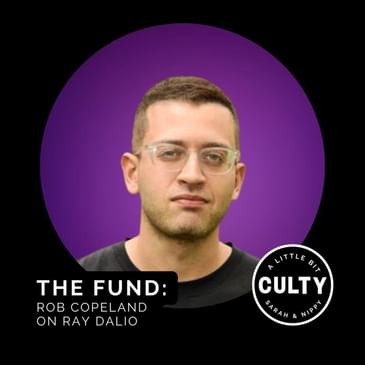
Is the famed hedge fund Bridgewater Associates operating a cult in plain sight? Or is it just a little bit culty? Journalist and author Rob Copeland joins us for a deep dive into Wall Street’s seedy underbelly, and the troubling story of Bridgewater’s founder—the pseudo philosopher-king Ray Dalio. You’ll want to read Rob’s NYT bestseller ‘The Fund’ this summer, if you haven’t already, and then you can decide whether or not you agree with us that Ray Dalio is radiating serious Keith Raniere vibes. Rob joins us to chat about Dalio’s strange world and the uncanny parallels between the planet’s largest hedge fund and NXIVM. About Rob Copeland:
Rob Copeland is a finance reporter for the New York Times. He was previously the longtime hedge-fund beat reporter at the Wall Street Journal, and has also covered Silicon Valley and the hidden worlds of the wealthy and powerful. His front-page investigations into Bridgewater Associates won a New York Press Club award; he was also awarded an honorable mention twice by the Society of American Business Writers (SABEW) and was named a News Media Alliance "Rising Star" (formerly Top 30 Under 30). He has appeared on ABC’s "Good Morning America," NPR and other major news networks. His NYT Bestseller The Fund was published in late 2023, and we get why it topped the charts: We think it is a freakin’ page turner!
Show Notes: Assorted articles about The Fund, and Ray Dalio. (Sorry, but we don’t control paywalls.) NY Post article
NY Mag article with book excerpt
Also…let it be known that:
The views and opinions expressed on A Little Bit Culty do not necessarily reflect the official policy or position of the podcast. Any content provided by our guests, bloggers, sponsors or authors are of their opinion and are not intended to malign any religion, group, club, organization, business individual, anyone or anything. Nobody’s mad at you, just don’t be a culty fuckwad.
Check out our lovely sponsors
Join ‘A Little Bit Culty’ on Patreon
Get poppin’ fresh ALBC Swag
Support the pod and smash this link
Cult awareness and recovery resources
Watch Sarah’s TEDTalk
Credits:
Executive Producers: Sarah Edmondson & Anthony Ames
Production Partner: Citizens of Sound
Producer: Will Retherford
Writer & Co-Creator: Jess Tardy
Theme Song: “Cultivated” by Jon Bryant co-written with Nygel Asselin
See Privacy Policy at https://art19.com/privacy and California Privacy Notice at https://art19.com/privacy#do-not-sell-my-info.
[00:00:00] This podcast is for informational purposes only and should not be considered legal, medical
[00:00:04] or mental health advice. The views and opinions expressed do not necessarily reflect the official
[00:00:08] policy or position of the podcast and are not intended to malign any religion, group,
[00:00:12] club, organization, business, individual, anyone or anything.
[00:00:24] I'm Sarah Edmondson. And I'm Anthony, air quotes Nippy Ames. And this is A Little Bit
[00:00:30] Culty. A podcast about what happens when things that seem like a great thing at first
[00:00:35] go bad. Every week we chat with survivors, experts and whistleblowers for real cult stories
[00:00:40] told directly by the people who live through them. Because we want you to learn a few
[00:00:43] things we've had to learn the hard way. Like if you think you're too smart to get sucked
[00:00:48] into something culty, you're already prime recruitment material. You might even already
[00:00:53] be in a cult. Oops. You better keep listening to find out. Welcome to season six of A Little
[00:00:58] Bit Culty.
[00:01:17] Welcome back everybody to this week's heavy hitting episode on A Little Bit Culty.
[00:01:22] This one is perfect because it's right in line with all my quasi pseudo, what do you
[00:01:28] want to call it? Like what I think is going on in the world amongst billionaires. So it's
[00:01:32] perfect timing. So according to our guest today, the world's biggest hedge fund, Bridgewater
[00:01:37] Associates and it's famed pseudo philosopher, King founder, Ray Dalio are operating a cult
[00:01:43] in plain sight. There I go. I said it. Rob Copeland is the author of the New York Times
[00:01:47] bestseller titled The Fund, which tells all and spares nothing in exposing the dark underbelly
[00:01:53] of a particularly seedy part of Wall Street. To quote a recent New York Times review, most
[00:01:59] of the fund doesn't feel like a book about finance. Instead, it is about how a man of
[00:02:04] surpassing mediocrity use money to control and humiliate and how much people abase themselves
[00:02:10] for it, which come to think of it makes it one of the better books ever written about
[00:02:14] Wall Street. A mediocre man fails up and then uses the money and power he's accrued to control
[00:02:20] and humiliate people. Where have we heard that one before? No clue, sir. You know who is not
[00:02:25] mediocre? Rob freaking Copeland. Can we just brag about him for a second? So check this out. Rob is
[00:02:30] a seasoned finance reporter for the New York Times and was previously the longtime hedge fund beat
[00:02:35] reporter at the Wall Street Journal and has also covered Silicon Valley and the hidden world of
[00:02:41] the wealthy and powerful. His front page investigations into Bridgewater Associates won
[00:02:45] a New York Press Club award. Plus, he was also awarded an honorable mention twice by the Society
[00:02:51] of American Business Writers, SABW, and was named a News Media Alliance Rising Star and has
[00:02:57] appeared on ABC's Good Morning America, NPR, and other major news networks. Pretty impressive
[00:03:02] street cred there, Rob. Let's get this A Little Bit Culty party started. Here's our chat with Rob
[00:03:07] Copeland on his story of the culty world of Bridgewater Associates. Buckle up. Rob Copeland,
[00:03:26] welcome finally to A Little Bit Culty. Thank you for having me. How are you, Rob? Very good. Very
[00:03:31] good. So we've been devouring your book and really had to refrain from texting and emailing
[00:03:37] every two seconds about the bizarre and uncanny similarities between Ray Dalio, Keith Raniere.
[00:03:44] It's nuts. Elizabeth Holmes, Werner Erhardt. But the parallels are staggering. The parallels. Holy
[00:03:50] cow. And the buy-in is the same. Everything's like, we have detailed files over here. We have
[00:03:54] detailed files. So I think also too, one of the things to tell Rob is a couple guys,
[00:04:00] I don't know, five, six years ago, I think one of them gave me Principles as a gift. I read it. I
[00:04:06] felt like that's a book that would have meant more to me in my 20s than it does now as an adult,
[00:04:10] The Principles. But I didn't really have any strong objections to it and really any strong
[00:04:15] objections to Ray Dalio when we got your intake sheet, your jot form. I was kind of like,
[00:04:19] hmm, really, Ray Dalio? Okay. I had no idea because he markets himself so well. He's gone from a hedge
[00:04:29] fund manager to a self-marketer and a self-promoter. A guru, a life principles guru. And reading this,
[00:04:34] it makes sense now in hindsight, but because I never looked underneath the hood of Ray Dalio that-
[00:04:39] Who has time to unless you're on this podcast? Well, unless you're peripheral. So it was
[00:04:43] interesting to see this persona get exposed. Yes. It's funny. I was not super aware of Keith
[00:04:50] Raniere and someone who worked at Bridgewater who was very close to Ray mentioned it to me
[00:04:56] offhand. He said, have you seen this series, The Vow? And my first reaction was, oh, come on. This
[00:05:02] is too on the nose. This guy is like an international criminal. It's like, listen, just because you
[00:05:10] don't like your boss doesn't mean that there's so many similarities here. And then I started
[00:05:15] reading about it. I started watching the series and I was like, oh my gosh, these two men are doing
[00:05:21] the same thing. They have some of the same ideas. People are reacting to them in the same way. And
[00:05:27] so I was very excited too, because I was just like, well, Keith did the whole thing and he
[00:05:33] didn't even have to pay you that much. And so to me, the great fun of Ray and really the darkness
[00:05:39] of it too is what if you had this sort of self enlightenment, everything that I'm doing is
[00:05:46] to help you, et cetera, et cetera, philosophy. And you also paid people actually pretty decently.
[00:05:52] How much further could you get them to go? I've got so many questions. I want to go back
[00:05:56] to the beginning. Obviously you're not a survivor in the normal sense, but you've been through this
[00:06:01] whole rigmarole of a journey with Bridgewater. How did it get on your radar? Tell us your story
[00:06:06] of this debacle expose. Sure. So there's really two beginnings for me. One is that I graduated
[00:06:13] college in 2009 and I had, it was like right at the peak of the financial crisis. And I got a job
[00:06:19] that I didn't really like. And I applied for pretty much every job in the New York area that was
[00:06:25] hiring new college grads. And Bridgewater Associates was just one of the many, many firms that had a
[00:06:31] reputation for hiring young people with no life experience and saying, Hey, come move an hour and
[00:06:38] a half outside the city to the middle of the woods. And we're a big finance firm. So I applied
[00:06:43] there. I did a few interviews. I didn't get the job. I honestly didn't think anything else of it.
[00:06:47] I got very few jobs then. So a few years later, I was really committed to journalism and I was
[00:06:54] working for a hedge fund trade publication, which is just like a magazine that caters to the hedge
[00:06:58] fund industry. And Bridgewater world's biggest hedge fund was a big part of our coverage. And
[00:07:03] that's when I started to hear more about it and hear more about what he calls the principles and
[00:07:09] this sort of like pseudo self-help philosophy that he's got going on. And he just kept getting more
[00:07:15] and more famous. So it went from something that I would have heard of because I was looking for a job
[00:07:21] to something that I would have heard of because I was in finance journalism to then all of a sudden
[00:07:26] something that Nippy is getting a book gifted to him by someone who I imagine didn't work at
[00:07:32] Bridgewater, Ray just became very intentionally super famous figure and wanted to be about more
[00:07:40] than just making money.
[00:07:41] I think one of the things, you know, hearing that part of it, you mentioned they hire people young
[00:07:48] right out of college without experience. To me, that's a very important caveat to the whole thing
[00:07:52] because in one of your interviews you talk about, I think the phrase you use is they attracted people
[00:07:59] who want to give up their belief system and adopt the Bridgewater.
[00:08:04] They're malleable.
[00:08:05] And, you know, I look at my experience of why I was even interested in, you know, taking a training or
[00:08:10] something like that is like, I think that's kind of, I'm not saying I was looking to replace my
[00:08:14] belief system per se, but ultimately, you know, you take that behavior out years, it's loyalty to the
[00:08:19] party, so to speak. And I think that little piece right there, looking for young people without
[00:08:27] experience, I think is what allows him to have that culture right away.
[00:08:31] Exactly.
[00:08:32] I don't know if you came across this.
[00:08:34] Did you notice that was majority of the people that were susceptible to it?
[00:08:39] So there were two major types of people for sure who Ray is able to attract to Bridgewater.
[00:08:45] The majority, most are exactly what you're talking about.
[00:08:48] They are new college graduates.
[00:08:50] And I'm not sure I would agree necessarily by the way that they want to give up their values more than
[00:08:56] that. They can very easily because they don't necessarily have any, they have, you know, what their
[00:09:02] parents would have raised them or their religion or anything else.
[00:09:06] Right. But they haven't yet developed a good sense of what the workplace is and what limitations to put.
[00:09:13] So in many cases, they don't even know they're doing it, which is even more powerful.
[00:09:18] And the other sort of person is it attracts these people who are sort of on the second half of their
[00:09:24] career who are, they're not incompetent by the way in any means, but they're not necessarily on the path to,
[00:09:32] you know, become CEOs of major companies in their own right.
[00:09:35] And those people, I think they have a sense of right and wrong and they are actively putting aside what they
[00:09:41] know to be right for a chance that making a lot of money.
[00:09:45] But even more than that, at this being sort of their last chance to achieve this greater goal.
[00:09:51] I was always struck by how few women, by the way, were in this organization.
[00:09:56] It was so overwhelmingly young men in their twenties, low twenties.
[00:10:02] Frankly, I was once there observing a meeting and I think I put this in the book, but it literally looks like a J.Crew catalog.
[00:10:10] It was just like, oh, you're all the same person.
[00:10:13] I'm not even sure you know you're modeling yourself all the same.
[00:10:16] So it's just so visual to me.
[00:10:18] Kind of a frat house atmosphere.
[00:10:19] Exactly.
[00:10:20] And with the attendant consequences.
[00:10:24] Yeah, including lots of alcohol and adult entertainment.
[00:10:29] Well, a frat house is your first cult, except you graduate from it.
[00:10:33] Right. Yeah.
[00:10:34] And we've covered that here on the show.
[00:10:36] Let me back up for a second.
[00:10:38] I mean, for somebody like myself who doesn't know much about the stock market and hedge funds.
[00:10:42] And by the way, I shall never invest after reading this book because it seems just crazy.
[00:10:47] But anyway, for those people who don't really understand this world, can you give me like a like an elevator pitch of what Bridgewater said that it was?
[00:10:56] Like we always ask our survivors, like, what did you think you were buying into?
[00:11:00] What was the world that the people signing up for to work there?
[00:11:05] What did they think they were engaging in?
[00:11:07] Absolutely. And this, by the way, is something that I thought they were engaging in, too, for a long period of time.
[00:11:12] I didn't walk into this project and say, oh, my gosh, I've got such an expose.
[00:11:16] So Bridgewater is the world's most famous macro economic hedge fund.
[00:11:22] And what that means is that Ray Dalio, the founder and the firm, claim to be able to predict the direction of any market in the world.
[00:11:31] Essentially, they say we're going to make you money no matter.
[00:11:35] Give us your money and we will invest it.
[00:11:37] And we can bet on stock markets anywhere in the world.
[00:11:40] We can tell you that the currency of a country is going to appreciate or depreciate and that because we've studied history and we have this amazing investment system that we are better at this than anyone else.
[00:11:54] So give us your money and we will invest it for you.
[00:11:57] And no matter what happens, you know, in the U.S.
[00:11:59] stock market or with Bitcoin or with something else, you will over a long period of time make money and they will collect, by the way, a fee based on what they they make for you so they can become very
[00:12:10] wealthy. That's not a crazy pitch, by the way.
[00:12:12] There are lots of finance firms that say that they can do that and we could have a whole another podcast talking about whether any of them can.
[00:12:20] But what Bridgewater adds layers on top of that is Ray doesn't just say, oh, I'm really good at this.
[00:12:27] He says, I'm only good at this because over time, over decade, I have come up with these rules and these rules are called the principles.
[00:12:36] And I follow the principles both in my investing life and in my personal life.
[00:12:42] And you, too, can follow these rules.
[00:12:44] And if you do, this is literally what he says.
[00:12:47] He says you will achieve a more meaningful life with meaningful relationships.
[00:12:52] So, yes, he's an incredibly successful investor and that's what he pitches.
[00:12:56] But part of the reason why he's able to keep this going for so long and why so many people are willing to give him money and to buy his book and gift it to people is that he says this isn't just about money.
[00:13:08] Yes, I'm incredibly good at making money.
[00:13:10] He's worth $20 billion.
[00:13:13] He's like, it's not about the money.
[00:13:15] It's about a meaningful life with meaningful relationships.
[00:13:19] And that, I will tell you, is just a completely intoxicating pitch.
[00:13:23] Oh, yeah.
[00:13:24] It sounds very familiar to us.
[00:13:26] Minus the money.
[00:13:27] Well, but who doesn't, whether you're interested in Wall Street or not, who doesn't want to live a more meaningful life?
[00:13:33] Who walks through their life and says, I'm looking for less meaning.
[00:13:37] Right.
[00:13:37] OK, so that's that's the pitch.
[00:13:39] So you didn't go into this going, I'm going to do this big expose.
[00:13:42] What was your journey?
[00:13:43] What were you trying to figure out?
[00:13:45] And what were the first, I guess, red flags that you started to see that there was problems?
[00:13:49] Tell us about your journey as a journalist.
[00:13:51] Well, as a journalist, this is a wonderful place to write about.
[00:13:54] Right.
[00:13:54] Because it can get a little boring sometimes just writing about very successful investor makes money or very successful investor loses money.
[00:14:02] Those are essentially the two main things we write about as finance journalists.
[00:14:06] But in Ray and Bridgewater, you got to write about this whole culture and this whole idea that, oh, there's a firm, a very successful and famous one which happens to be making money.
[00:14:19] But is also sort of creating this whole new cohort of a better person and better, better colleagues.
[00:14:26] So when I first started writing about it, it was honestly pretty ordinary.
[00:14:30] I was talking to Ray Dalio myself.
[00:14:32] I was talking to current and former employees.
[00:14:35] And the first thing that always felt odd to me was that one of the principles, part of the animating principle, Ray's animating philosophy, is that we should all be willing to disagree with one another.
[00:14:47] That if we could just cut through the bowl, you know, if we could just say, hey, this isn't going well or this is what I think you could be doing better.
[00:14:54] If we could remove our ego from it, we can achieve better results.
[00:14:59] Radical transparency, I think that's what it's called.
[00:15:01] Exactly. Radical transparency and truth.
[00:15:04] And part of that is that everything at Bridgewater is recorded so that this conversation, even if it were a private meeting, someone else could pull it up later and listen and they could say, hey, I think like Sarah was really good at this.
[00:15:17] Really. She was really onto something there.
[00:15:19] And Rob and Nikki cut her off.
[00:15:21] That happens all the time.
[00:15:22] Exactly.
[00:15:24] It's a two way street.
[00:15:24] Yeah, there you go.
[00:15:26] It's traffic, a lot of traffic on that.
[00:15:28] But what struck me was that in all of my conversations with Ray and all of my examples of talking to other people, no one ever gave me any examples of someone saying that to Ray.
[00:15:38] It was always Ray saying that to other people.
[00:15:40] One of Ray's famous principles that he loves to talk about is called pain plus reflection equals progress.
[00:15:47] And again, and I'll say this over and over again, these things always sound good.
[00:15:52] Like, of course, we've all been through moments in our lives when we've had pain and then we've reflected and they've helped make us stronger people.
[00:16:00] But I just started collecting examples of Ray being really cruel to people and then claiming that those people had achieved progress.
[00:16:09] But what he never talked about was that the pain wasn't an exogenous pain.
[00:16:13] It was pain that Ray was choosing to inflict on you and that the reflection was sort of forced reflection.
[00:16:19] So it took me years, literally probably started in about 2015.
[00:16:24] And I started reporting around this firm.
[00:16:26] You just sort of collect enough anecdotes where you're saying, hold on, is there something else going on here?
[00:16:33] And it's really hard work.
[00:16:34] It's not just something where you can, where I can just pick up the phone and call five people and then they spill out their life story, you know?
[00:16:41] Especially with the NDAs and the secrecy and the other protective mechanism, which was also, by the way, very much a part of NXIVM, this concept of not speaking behind someone's back, not gossiping.
[00:16:52] They only were to speak to somebody if like in the room directly.
[00:16:56] NXIVM that was called not speaking with honor.
[00:16:59] If you were gossiping, that was being dishonorable, which is, again, a good thing.
[00:17:04] But it protects people from sharing any concerns that then therefore protects the leader from any negative complaint.
[00:17:11] Right. So when did you start to piece together?
[00:17:15] So you collect these anecdotes about Ray basically allegedly being abusive under the guise of creating a possibility for growth.
[00:17:24] You can say a legend.
[00:17:25] I'm allowed to just say he's being abusive.
[00:17:28] Okay.
[00:17:29] I'll say he's being abusive.
[00:17:30] I just wanted to ask that, like, he's still really rich and powerful.
[00:17:34] Like, are we in danger by talking about this?
[00:17:36] Like, you're not.
[00:17:37] You overestimate our podcast.
[00:17:40] Not to go super jingoistic here, but the United States of America is like the greatest place to be a journalist.
[00:17:46] All of my reporting is based on the truth.
[00:17:48] He's welcome to sue me if you'd like.
[00:17:50] God knows he's tried several times, but I am telling the truth.
[00:17:54] It's based on my reporting.
[00:17:55] And, you know, come at me.
[00:17:57] Okay. I'm glad that you feel so safe.
[00:18:00] Are we safe?
[00:18:02] I'm not worried.
[00:18:03] Like I say, if it's the truth, I'll die on that hill.
[00:18:07] Ray, if you're listening, I'd love to have you on our podcast to talk about the principles and why they're not culty.
[00:18:11] I'd love to hear it, honestly.
[00:18:12] I would love to.
[00:18:13] I'm sure he'd love to tell it.
[00:18:15] I would absolutely.
[00:18:16] He would love to tell it in a conversation he curates.
[00:18:18] We could talk about our respective TED Talks.
[00:18:21] And, you know, we have so much to talk about.
[00:18:25] I'm from Vancouver. He did a TED Talk there.
[00:18:27] At the time we were leaving NXIVM.
[00:18:29] I remember that.
[00:18:29] And there's so many full circle things.
[00:18:30] Anyway.
[00:18:31] You brought up a really interesting point, which is this whole don't talk about someone behind their back.
[00:18:35] At Bridgewater, it's called don't be a slimy weasel.
[00:18:38] This is literally a principle.
[00:18:40] If you talk about someone behind their back, you're a slimy weasel.
[00:18:43] And the wonderful thing, of course, is that it forces you to say terrible things about people, even things that frankly might not be necessary to say to their face.
[00:18:54] And then they get to argue with you and tell you why you're wrong.
[00:18:57] And it's just it is an artifice to create argument and tension where, in my opinion, they're in conflict.
[00:19:04] Yeah.
[00:19:04] It ensures constant conflict.
[00:19:07] Yes.
[00:19:09] I don't want to spoil, but halfway through the book, someone very important in the book does actually attempt to call Ray a slimy weasel.
[00:19:16] He does say that, Ray, you're not sticking to your word.
[00:19:19] And Ray, well, as you can imagine, finds a way to turn it against that person who's done nothing but follow the principles and speak his truth.
[00:19:29] That was Mack, right?
[00:19:30] That's Jensen.
[00:19:31] But oh, he does too.
[00:19:33] Jensen.
[00:19:34] Yeah.
[00:19:35] Yeah.
[00:19:35] There are look, the wonderful thing about this story for me.
[00:19:39] And by the way, it's not like I find there'd be like some humor in all of this.
[00:19:43] It's horrible because it's people's real life.
[00:19:45] But there's a history repeating endlessly inside Bridgewater.
[00:19:48] And there is a fun.
[00:19:50] And frankly, I think there's those such horrible things happen to people around NXIVM.
[00:19:54] Something that I always felt and enjoyed about watching the series and everything was like every time you thought someone was just about to figure it out or break through or speak the truth, Keith or someone else would come up with a new reason to sort of push them down.
[00:20:11] And Ray does the exact same thing in frankly super creative ways.
[00:20:16] Oh, yeah.
[00:20:17] Yeah.
[00:20:17] I actually wonder, is there any chance they could have met each other?
[00:20:20] Like were they, were they, were they actually comparing notes like down to the rating and ranking of each other?
[00:20:26] You know that we did that in NXIVM, right?
[00:20:27] I do.
[00:20:28] I saw that.
[00:20:28] That was what the sashes blew my mind.
[00:20:31] The sashes are part of our rules and rituals.
[00:20:33] I don't know if you remember the aspect of rules and rituals.
[00:20:36] That's what the principles are.
[00:20:37] You come in and you immediately are forced to do something that shows, I wouldn't say your obedience per se, but eventually your obedience.
[00:20:47] It shows your compliance.
[00:20:48] If you're not, if you don't like the rules and rituals, you get kicked out.
[00:20:51] Well, you don't get kicked out.
[00:20:53] You are slowly encouraged to until you kind of go, well, you know, what's the big deal?
[00:20:59] Right.
[00:20:59] I think that's the first, some people are all in, some people are okay, well, let's see what it is.
[00:21:04] It's not bad.
[00:21:05] The principles aren't bad.
[00:21:06] Like when you read what he said, in theory, if these are rooted and moored and tethered to the real principles that he's talking about, you could have possibly some possibility.
[00:21:15] And then I'd say, or the sashes in a lot of ways, the rules and rituals are parallel with the principles and the sashes are your paycheck.
[00:21:24] Well, it's also the measurement.
[00:21:25] You get rewarded with a sash.
[00:21:27] Right?
[00:21:27] Like the attempt to make something emotional, scientifically measurable was, I mean, that was his whole thing, right?
[00:21:33] He spent tens of millions of dollars trying to, well, can you explain what the technology was that he was trying to do?
[00:21:39] Because you probably can explain it better than I can.
[00:21:41] Baseball cards.
[00:21:42] Yeah.
[00:21:42] Can you explain, yeah, explain the dotting and the cards and all that?
[00:21:45] So what's funny too is I've written a book, which is I'm very happy with, and which is, it's called a business book, but it's almost, there's almost nothing in this book about a business or Wall Street.
[00:21:56] It's about this man's very successful man's attempt to sort of create a new society off grid and to rank everyone around him.
[00:22:04] So the principles, which start with five or six rules and then grow to be hundreds of rules.
[00:22:10] And by the way, he's still making new ones up literally every day.
[00:22:14] You could follow him on LinkedIn.
[00:22:17] I can't follow him.
[00:22:18] He's blocked me, this paradigm of radical transparency, but I am, I am told.
[00:22:24] So he creates what he calls the baseball cards or he has other people do this.
[00:22:29] And what it is, is he creates all these categories for the ways that he thinks that people are.
[00:22:35] So they're in categories such as, you know, ability to push through to find the truth or listening or investing.
[00:22:42] But a lot of them are a little nebulous and everyone at every point is supposed to be rating each other.
[00:22:49] So even during this conversation, you would be rating me at, you know, pushing through to the hard, the hardness or whatever.
[00:22:56] And under one to 10 scale.
[00:22:58] And then all of our ratings are agglomerated and they're on what is called our baseball card, which is just like a, you know, an MLB player would say their RBI is their home runs, whatever.
[00:23:08] And so that we're able to, at the beginning of a meeting or at any interaction, even in the cafeteria to say, well, Sarah, you're really good at XYZ according to your baseball card.
[00:23:17] You're a 6.7.
[00:23:19] And Rob, you're only a 5.2.
[00:23:21] So Sarah's opinion counts more.
[00:23:23] So, you know, it, it, it takes truth, which I believe to be binary.
[00:23:28] Something is true and something cannot be true.
[00:23:30] And it, it, it totally muddies it because then Sarah's opinion about the truth can count more than mine because she is considered more believable, more credible.
[00:23:40] Okay.
[00:23:41] I just took a very complicated thing.
[00:23:43] I tried to make it distill it for you.
[00:23:45] But I'm not spoiling the book for you here because I actually intentionally put this in the introduction to the book.
[00:23:51] I make sure I show you at the beginning, which is that this whole rating system is rigged from the very start to make sure that Ray Dalio's ratings are the highest, no matter what, and all the most important categories.
[00:24:05] Which means that if we ever have a disagreement and we ever say, Hey, let's be fair about this.
[00:24:10] Let's look at the baseball cards.
[00:24:12] We will always look at the baseball cards and Ray will always win the argument, whether it's true or not, whether he's right or wrong.
[00:24:18] And this took me years to figure out by the way, years.
[00:24:22] How'd you figure it out?
[00:24:24] The embarrassing thing is when I spoke to the right people to figure out, it actually had been actively rigged and Ray had asked for it to be rigged.
[00:24:31] I was almost embarrassed for myself because I was like, Oh, of course it's rigged.
[00:24:35] It's like, how could I ever have not thought of knowing everything else?
[00:24:38] I know.
[00:24:38] How could it not be rigged?
[00:24:40] And then the people I were talking to were just like, yeah, I'm the one who rigged it.
[00:24:44] It was like, Oh yeah, I was told by my boss to go in and just make sure that his rating.
[00:24:49] And then I just tweaked all the other ratings to make sure that no one else could.
[00:24:53] So I tell you that in the book, by the way, I put it in the intro in a sort of fun scene.
[00:24:57] And then I never tell you again, because I don't want to hit you over the head with it.
[00:25:01] It's like the great thing about Bridgewater and about a lot of these organizations is even if you know that it's rigged, you can still sort of forget.
[00:25:10] You can still get caught up in it.
[00:25:11] Right?
[00:25:12] Right.
[00:25:12] To me, there are so many people who at Bridgewater, former Bridgewater spouses were at Bridgewater.
[00:25:18] They say to me, they're like, I couldn't believe it was rigged.
[00:25:22] And I was like, how could you believe it was anything else?
[00:25:24] Did you actually think he had invented a new way of judging human performance?
[00:25:31] From his hedge fund in Westport, Connecticut?
[00:25:34] And then they feel a little silly.
[00:25:37] Oh, yeah.
[00:25:37] We've had those moments.
[00:25:39] I've had years of those moments.
[00:25:41] How do the baseball cards relate to the dot method?
[00:25:45] Sure.
[00:25:46] So and this being endlessly complicated, which is the Bridgewater way, each time that I agree with you or disagree with you, each time I want to rate you in these again, close to 100 categories, I give you a dot.
[00:25:57] I dot you.
[00:25:58] And I say, hey, your dot, you have a six dot or you got a four dot.
[00:26:02] And then it should in theory not average out, but sort of all crunch through the numbers to give you sort of an overarching rating.
[00:26:10] Now, there are a thousand fascinating things about this.
[00:26:13] But what I love most is that you had a minimum number of dots.
[00:26:17] So I couldn't just go through the day and be a nice guy.
[00:26:20] You're forced to lean into discomfort.
[00:26:22] And there is in fact a minimum number of negative dots.
[00:26:25] So I can't go through the day and just say, hey, this was all great.
[00:26:28] And if you don't give enough negative dots, they will pay you less.
[00:26:31] So if you actually go through the debt, you are forced to find sort of like the things that are wrong, even if there is nothing wrong.
[00:26:38] And in many cases, people begin inventing things that are wrong or they begin slides down the waterfall sort of.
[00:26:48] And they start dotting the cafeteria staff.
[00:26:51] They dot the admins.
[00:26:52] People start to say you're bad at your job as a secretary because your boss showed up late.
[00:26:57] So you're incentivized to be a dick.
[00:26:59] Correct. But to them, you are incentivized.
[00:27:01] And this is a principle to find badness in everything around you and the thing that you know most.
[00:27:09] Wow. What a terrible way to live.
[00:27:11] I would tend to agree with you.
[00:27:13] Remember, the thing that you know most is the things that are most close to the things that are around you.
[00:27:18] So it's Ray's way of having everyone investigate everyone around them at any time.
[00:27:23] Like you can't have a true friend because they are incentivized to find the badness around them.
[00:27:29] It kills trust.
[00:27:30] This is the definitive example of why it was a toxic relationship, the toxic workplace.
[00:27:35] I mean, what a terrible place to work.
[00:27:38] The foundation to growing anything is you have to have trust.
[00:27:41] Yeah.
[00:27:41] Right. And this seems to usurp trust, at least, you know, unless you get unless you were someone like, hey, look, I'll keep my negatives away from you if you keep your negatives away from me.
[00:27:55] This podcast wouldn't happen without our amazing, supportive, generous patrons.
[00:27:59] Are you with us?
[00:28:00] Come find us over on Patreon at patreon.com slash a little bit culty for bonus episodes, exclusive content and the occasional zoom with our fan favorites from our past episodes.
[00:28:11] It's a lot of fun over there, people.
[00:28:19] You've heard from our sponsors.
[00:28:21] Now let's get back to a little bit culty, shall we?
[00:28:24] I have three things to tell you about NXIVM that I don't think were in the vow.
[00:28:28] One is that in SOP, we did this exercise.
[00:28:31] Basically they were literally the men and women were divided and the women had numbers on them like cattle.
[00:28:37] Like, and they were, we weren't called by our names.
[00:28:38] We were called like 32 or whatever.
[00:28:40] Like a man would raise her hand and go 32 just got distracted with her Stanley water bottle.
[00:28:46] No, the first would say, sorry, fault, fault on 32, like out loud in real time, fault on 32.
[00:28:53] She's, she's not paying attention to the questions.
[00:28:56] Like calling out in real time, our fault.
[00:28:58] So that just from, I don't think we've ever talked about that on the podcast.
[00:29:01] Secondly, the rating ranking obviously with the sashes, but we also did it in one training.
[00:29:06] This didn't become a thing.
[00:29:07] This is where I think Ray and Keith were maybe buddies.
[00:29:10] It was on paper.
[00:29:11] This would have been 2006 and it was a rating and ranking before we went broke out into discussion groups of who was the most intelligent, who is the most attractive, who is the most honest.
[00:29:22] There's like five or six categories from most to least in the circle.
[00:29:27] So we're in a circle of six.
[00:29:28] So I'd be like, Nippy, I think you're the least honest.
[00:29:32] Rob, I think you're the most honest.
[00:29:34] And then obviously you start to see the repercussions of that in the next round.
[00:29:37] Like you'd get lower marks because people's feelings were hurt.
[00:29:42] I noticed if I wore my glasses, I got more intelligent ratings, et cetera.
[00:29:46] So I've had this little taste of this from, from our time in NXIVM and it was horrific.
[00:29:51] The difference is we could turn that off and go home and have dinner.
[00:29:54] I know this is every day.
[00:29:55] This felt like, you know, also like your paycheck was incentivized.
[00:30:00] So think about that kind of atmosphere, but constantly.
[00:30:02] And I imagine, you know, if you're out in Connecticut, that's your social circuit as well.
[00:30:06] It is.
[00:30:06] And I would add another layer, by the way, to what you're saying, which is, okay, you go around, you say who is the best or who's the worst or et cetera.
[00:30:15] What Ray would do often and others at Bridgewater who are emulating him is if you said, I think that Nippy is doing a great job today at XYZ and they disagree.
[00:30:25] They would look at the baseball card.
[00:30:27] They would say, Nippy's a 4.2 at this.
[00:30:30] Sarah, what's wrong with you?
[00:30:32] They could turn it around on you, Sarah, just for offering a true opinion about it.
[00:30:37] And then they would do what they call a probe.
[00:30:40] They would literally start investigating you with cameras rolling for why you think so highly of Nippy.
[00:30:47] And then it can just, you know, it rolls downhill.
[00:30:50] Someone tries to stick up for you.
[00:30:51] All of a sudden it's an investigation of them.
[00:30:54] So there's really very little incentive to go against the grain.
[00:30:59] And the standard is set by the founder, Ray Dalio, whose ratings are bulletproof.
[00:31:06] So the whole thing is a farce because it looks like we're giving each other feedback, but we're really not.
[00:31:11] We're just trying to stay out of fire ourselves.
[00:31:16] Trying to maintain our own ratings.
[00:31:17] Nippy and I have pages and pages of similarities, but one of the things that I just thought I meant to do this earlier, but looking at the belief system of any particular group, whether we talk about a religion or whatever the group is, there seems like an adherence to a very specific thing right at the beginning
[00:31:35] that kind of protects Ray moving forward specifically that you're there to learn and grow.
[00:31:42] Therefore, anything that comes out at you is part of that.
[00:31:46] That's part of the belief system you're buying into.
[00:31:48] What else do you see people are accepting as the belief system and where does it become problematic or toxic?
[00:31:55] This took me a long time, honestly, to get my head around because there is a principle called that says essentially when you put a frog in boiling water, it'll jump right out.
[00:32:04] But if you put it in cold water and you slowly up the temperature, it will stay in there and die.
[00:32:10] First of all, that's not true.
[00:32:12] That's not how science works.
[00:32:13] Many experiences you could put a frog in cold water and up it and it'll jump right out and it won't die.
[00:32:18] So that's my first great principle is like you didn't even get your.
[00:32:22] Oh, shit. I got to stop using that metaphor.
[00:32:25] We can put that metaphor to rest.
[00:32:28] Yeah, exactly.
[00:32:29] The so first of all, there is an element to that to remember.
[00:32:33] He's telling you when you come in.
[00:32:35] He literally says this is going to be difficult.
[00:32:38] This is like the Navy SEALs.
[00:32:39] You will go through pain.
[00:32:42] You will. But it's for your own good.
[00:32:44] So anything that happens to you can then be justified.
[00:32:47] Pretty much. There are no degrees of pain at Bridgewater.
[00:32:50] It's simply pain.
[00:32:52] And there is.
[00:32:53] And if you leave, he calls it getting through to the other side, just Scientology, by the way.
[00:32:59] It's straight up lifted from L. Ron Hubbard, whether intentionally or not.
[00:33:03] So if you don't get through to the other side, you're basically giving up on this promise.
[00:33:08] But there's there's a third element to this, which is, I think, the most powerful, which is that he starts to layer pseudoscience on top of it.
[00:33:16] He starts to say that your brain is composed of the right side and the left side, the amygdala, which is irrational and the rational side of your brain.
[00:33:26] And the amygdala fights dirty, literally something he says.
[00:33:30] So he says you have to fight your own instinct.
[00:33:33] You have to fight the amygdala.
[00:33:34] It's keeping you back from achieving what you can.
[00:33:38] So he's literally saying ignore your own instincts, ignore your brain.
[00:33:43] Your brain is against you.
[00:33:46] And this is in principles.
[00:33:48] This is in his book.
[00:33:49] This is not something hidden.
[00:33:51] But if you tell people, particularly 22, 23 year olds who are really still developing that this might feel bad, but you won't amount to anything.
[00:34:02] My whole success, my 20 billion dollars comes from me having overcome my amygdala.
[00:34:08] I don't have a counterpoint to that.
[00:34:10] Right.
[00:34:11] What can I say?
[00:34:12] Either I've bought in, either I'm there or I'm not.
[00:34:15] You don't get to say, I don't know.
[00:34:17] I don't really like this anymore because he told you you wouldn't like it.
[00:34:21] By the way, I speak to college students.
[00:34:23] People always ask me why people stay.
[00:34:26] And I'm like, it's not why they stay.
[00:34:27] It's why they joined to begin with.
[00:34:29] They wanted something when they joined and they signed the contract, whether they did it or not.
[00:34:33] Yeah.
[00:34:33] You wrote in our intake form that people ask why you, why people don't leave.
[00:34:37] And you say the episode of Vow season two, where people, it's not just being locked in a room, but about systems that warp your mind that you just don't even try to open the door.
[00:34:46] I bring that up constantly because she's in the room.
[00:34:51] Right.
[00:34:51] And by the way, her whole support system is keeping her there emotionally, if not physically, although there is definitely a physical coercion there too.
[00:34:58] But it's true at Bridgewater, you can quit.
[00:35:01] You can walk out the door, go to your car and leave.
[00:35:04] But in doing so, you're giving up all your friends.
[00:35:06] You're giving up your salary and you're giving up the promise that you will get through to the other side.
[00:35:12] So that's why people, they literally at Bridgewater get sent to the hospital.
[00:35:17] The ambulance has come, people have collapsed and then people come back to work.
[00:35:21] Yeah.
[00:35:21] It's wild.
[00:35:22] I'm going to send you a copy of my book.
[00:35:23] There's a chapter that Keith actually called it.
[00:35:26] We have to create the illusion of hope.
[00:35:28] He told me that the last words he sent to me said to me were make sure that my state is good.
[00:35:32] I was doing a video promoting something.
[00:35:34] Make sure your state is good because we have to give people the illusion of hope.
[00:35:37] Well, at Bridgewater, you have to give them the illusion that they could one day become Ray themselves.
[00:35:43] You know, a big part of the Bridgewater story, not the story that I tell by the way, but literally that the entire history of the firm is people constantly coming in and thinking that they too could be the next Ray Dalio.
[00:35:55] They could get what he has.
[00:35:58] No one ever does.
[00:35:59] Spoiler alert.
[00:36:00] But constantly going, you have to give someone the illusion that they might be the next chosen person.
[00:36:08] One of the things, and this is something that I'm super sensitive to since leaving his language and like terminologies.
[00:36:14] And I was reading in there where he was calling people pieces of equipment.
[00:36:18] Right.
[00:36:18] And it feels like, and the model that he creates there has somewhat of a dystopian state.
[00:36:24] Right.
[00:36:24] Like it has this kind of like you're performing, we're monitoring your performance.
[00:36:28] People are all bought in.
[00:36:29] They don't necessarily know that.
[00:36:32] And it's done with the principles, but none of the things that they're doing embody the principles.
[00:36:36] The transparency is really enslaving them more than it is freeing them.
[00:36:40] And I'm wondering what you think inspires that?
[00:36:43] Because this guy could have pieced out years ago and if he really wanted to do altruistic things, there's ways to do altruistic things and have no one really know about it.
[00:36:50] And he thinks he's kind of likened himself to a philosopher now.
[00:36:54] He's gone from head funge manager to marketing himself as a philosopher.
[00:36:58] What, what do you think's driving that?
[00:36:59] What can you say in your experience?
[00:37:01] Do you notice like what's it about for him?
[00:37:04] Do you think?
[00:37:04] So that to me is sort of the most fascinating question of all, because in when I started writing the book and I started writing it really full time in 2020, I didn't realize something very important, which is that Ray was already a billionaire by around 2005 before the words principles ever come out of his mouth.
[00:37:23] So he's already made more money than he ever could have dreamed of become one of the world's largest hedge fund managers.
[00:37:29] And he's in his fifties at that point.
[00:37:32] And then he starts to search for sort of like an overarching life's meaning that it doesn't have to do with just strictly making more money.
[00:37:41] And this is very different, by the way, from say generations before.
[00:37:45] Think of like the Rockefellers, the early 1900s.
[00:37:48] They did found a university.
[00:37:50] So like, I'm not saying that they didn't love seeing their names places, but, you know, they were sort of like there was a bit of like a braggadocio to it all.
[00:37:57] It wasn't like I'm here to help you.
[00:38:00] Ray and, you know, this sort of Elon Musk, even like a Steve Jobs type figure.
[00:38:06] They seem to have this idea that like just because they're really good at something in business, that they've also cracked something to do with the human condition.
[00:38:15] And more than that, they say that they must have cracked something to do with the human condition if they are this successful in business.
[00:38:23] I think that Ray always enjoyed being sort of like a terror at Bridgewater and always enjoyed pretending that he was helping people.
[00:38:30] But it was so much more satisfying to be able to do that on Charlie Rose on CBS this morning, on interviews with Gwyneth Paltrow and going to these conferences and seeing hundreds of people line up to sign his book.
[00:38:44] Genuinely sought that celebrity.
[00:38:48] And if he ever admitted that the principles had nothing to do with his success, which, by the way, they didn't because he was already wildly successful before he ever made them up.
[00:38:58] It's like he wouldn't have that fame.
[00:39:00] You'd just be another rich guy.
[00:39:02] I would be very interested.
[00:39:03] I would love to see you guys interview like Walter Isaacson, who wrote this book about Elon Musk, because Walter and I and I have a lot of respect for him.
[00:39:10] We have very different views on what makes sort of a successful business person.
[00:39:14] Walter's view in that book is that sort of Elon has to be tortured.
[00:39:20] All of the horrible things that happened, Elon and his youth and the terrible way he treated his wives and his children.
[00:39:26] That was all necessary in order for him to really change the start of Rocket Company, popularize the electric car, that that was all necessary.
[00:39:35] I reject that view.
[00:39:36] I think that it is possible to have both.
[00:39:38] I think what it is is when you become super wealthy, you now have this great justification to act in a way that almost none of us could act.
[00:39:47] And I think that it's fun for Ray.
[00:39:49] I think he genuinely enjoys it and he sees because he's so wealthy, he has almost no consequences to his actions.
[00:39:56] And nobody's saying no.
[00:39:58] There's no one in his life to say no, because his whole life revolves around Bridgewater.
[00:40:03] And even I write about a lot of these hyper successful people.
[00:40:07] They're not all like this, by the way.
[00:40:08] I'm not like someone who just like knee jerk people for being right, right, for being wealthy.
[00:40:13] But when you have, and I would say it starts at about 500 million dollars, doesn't even start at a billion.
[00:40:18] You have virtually no interaction with anyone in your day to day life who isn't working for you in some way.
[00:40:24] Your spouse relies on you for their income.
[00:40:27] Your kids obviously rely on you.
[00:40:29] They're like your personal trainer, your chef.
[00:40:31] It's like even your friends from high school or college are really enjoying going to a private island with you on vacation.
[00:40:39] By the way, I see it with them, with me.
[00:40:41] I'm a reporter, so I'm not their friend and I don't ever pretend to be.
[00:40:45] I'll go out to dinner sometimes with these people and they will order for me.
[00:40:48] And I'll say, hold on, you don't even know what I like.
[00:40:51] You don't know what my dietary restrictions are.
[00:40:54] I'm like, are you just accustomed to everyone just sitting at the table with you and eating what you want to eat for dinner?
[00:40:59] And by the way, usually they're pretty polite about it, but happens all the time.
[00:41:02] Constantly, more than half the time they order for me.
[00:41:05] So it kind of feels like he's made all this money and with all that money comes power that you probably can't anticipate with it.
[00:41:13] If you've always been driven to make the money and you've achieved it, a natural pivot might be to pull the levers you now have access to.
[00:41:21] I mean, I don't know.
[00:41:22] I'm obviously not in that tax bracket, but it seems to me like either you go off into the sunset and you do altruistic things with your money or you have that hole to fill.
[00:41:32] Right?
[00:41:32] It's like I remember reading this quote between, I don't remember who it was, but one person had like, I don't know, a billion dollars.
[00:41:40] Another person had $250 million and he was kind of talking down to the $250 million person and the $250 million person said, I have something you'll never have.
[00:41:49] And he said, what?
[00:41:49] He's like, enough.
[00:41:50] And so for me, it kind of feels like there's just not enough.
[00:41:54] And Ray is inventing this persona, you know, based on a lot of things that, you know, his admiration of Steve Jobs that he wants.
[00:42:02] I can only assess like a legacy to look back on, you know, he wants a university and he wants Dalio halls all over the place.
[00:42:10] I don't know.
[00:42:10] It's very hard to figure out, but he's really willing to invent this persona based on principles and then just abuse the principles in order to maintain it.
[00:42:21] So it's, it'll be interesting to see how it goes out because he seems to be pretty effective.
[00:42:25] I mean, I have had a peripheral relationship with his work, but only because it had gotten so far because he'd put so much time and energy into the marketing of himself.
[00:42:34] And what's great too is he'll claim that actually he spends almost no time marketing himself, that this is just a sort of gift he wants to give the world.
[00:42:42] And that it's just a, obviously people would love to hear from him because it's really worked for him.
[00:42:47] So he hopes it works for you.
[00:42:49] The legacy aspect, he surely wants Bridgewater the hedge fund to succeed because he gets paid money for it.
[00:42:56] But in a way I almost wonder, and a lot of people around Bridgewater wonder if he actually does want it to outlast him because you know, Steve Jobs, Apple is even more successful now than it was when he was around.
[00:43:09] But the really wonderful thing for Ray would be if Bridgewater failed and it is failing, it's way smaller than it was when I even wrote the book because then Ray could say, well, you really needed me all along.
[00:43:20] You didn't follow the principles.
[00:43:22] He would love that.
[00:43:23] He has plenty of money obviously, so it wouldn't affect him too much.
[00:43:27] And then he could continue to, you know, flog a new principle every day.
[00:43:32] There's something that happens in the book I'm going to spoil briefly, which is that at a very difficult moment for Ray, he makes up a new principle.
[00:43:39] That basically turns the principles on their head.
[00:43:42] And to me, that was a shocking moment.
[00:43:46] But I'm going to give you sort of a behind the scenes peek here, which is that I was actually covering that story for The Wall Street Journal.
[00:43:53] We were like the only ones who had any clue what was going on.
[00:43:56] And the person who told me about that new principle was Ray Dahlia in an interview with me.
[00:44:02] So it's like you've so lost the perspective on even your own work and your own pseudo philosophy that you don't even see that this new principle that you've just invented is completely antithetical to the last three years of conversations that we've had.
[00:44:19] And which principle was that?
[00:44:21] That was that only a fraction of the people at Bridgewater can receive true radical transparency, only give it to people you can trust.
[00:44:29] So he's essentially saying now, no longer at Bridgewater will everything be visible to everyone.
[00:44:34] It's straight out of Animal Farm where they say all animals are equal, but some are more equal than others.
[00:44:40] And I just thought like, wow, Ray, you've flipped it for your own.
[00:44:45] But he doesn't see it that way because he sees if I've come up with a new principle, then it must be just.
[00:44:51] And there's nobody saying that's not OK.
[00:44:54] Well, there's 1500 people who...
[00:44:55] He's created it.
[00:44:56] Yeah, exactly.
[00:44:57] And they could all say it's not OK, but he would win the argument because of the baseball cards, because of the dot collector.
[00:45:04] And that to me was just like a breathtaking.
[00:45:05] If I if I made it up, you know, you wouldn't believe it.
[00:45:08] So, yeah, I don't I still think about that, frankly.
[00:45:13] For more background on what brought us here, check out my page turning memoir.
[00:45:17] It's called Scarred, the true story of how I escaped NXIVM, the cult that bound my life.
[00:45:22] It's available on Amazon, Audible and most bookstores.
[00:45:25] And if you want to see that story in streaming form, you can watch both seasons of The Vow on HBO.
[00:45:34] You've heard from our sponsors.
[00:45:35] Now let's get back to a little bit culty, shall we?
[00:45:39] When did you figure out, like in your reporting that this was cult like when did you start making those parallels for yourself?
[00:45:47] So people have often like there are little bits and pieces out there where people say this sounds like a cult, etc..
[00:45:54] But I almost and I hate to say it on this podcast that the word cult has become so watered down at this point.
[00:46:00] It's like soul.
[00:46:01] Oh, yeah.
[00:46:02] So it's like, no, it's not.
[00:46:04] You just you just really like spinning.
[00:46:06] Like I don't think maybe there are aspects of community.
[00:46:09] We would say it's culty.
[00:46:10] There's elements that are culty, but it's not a cult.
[00:46:13] Exactly.
[00:46:13] Like there's there's tactics, you know, there's.
[00:46:16] Exactly.
[00:46:17] So that's how I always thought.
[00:46:19] And then, you know, it really happened when I became involved in in the story, which is that I interviewed Ray and other people at the firm.
[00:46:28] And two major things happen.
[00:46:30] One, I interviewed him at one point for a Wall Street Journal story.
[00:46:34] I was in there and he posted this very long LinkedIn rant about me afterwards.
[00:46:39] That just was just fiction.
[00:46:40] He quoted me saying things I didn't say.
[00:46:43] It isn't what happened.
[00:46:44] And I had the whole thing recorded.
[00:46:45] And I said, OK, he's now he's inventing his own reality.
[00:46:48] And lots of people at Bridgewater know this is not true and no one is standing up for me.
[00:46:53] And the second thing that happened was I wrote a very sort of unimportant in the long run story about a woman at Bridgewater who asked to be paid equal to the men.
[00:47:04] And I had been texting with her about it just for comment.
[00:47:07] You know, it's my job to always reach out to people.
[00:47:09] And we had a perfectly pleasant text message exchange.
[00:47:11] And then Ray posted those messages publicly, but at a press release about me.
[00:47:17] He edited them. But it looked like a real text.
[00:47:20] It looked like iOS, but it was like Photoshopped.
[00:47:22] And I just thought, OK, this is like someone who who is now fully past the Rubicon.
[00:47:29] Now we're making things up.
[00:47:31] She, this woman, is allowing him to.
[00:47:33] She knows it's not true because it's not the messages that we had.
[00:47:36] And I was like, this has never happened to me before in 15 years of covering finance.
[00:47:41] This guy is creating his own his own reality.
[00:47:43] And to me, at least, I think that that's like a core part of a cult is when it like it crosses through the looking glass.
[00:47:50] You know, something actually happens in real life.
[00:47:53] And the leader decides that that can't be what happened and convinces everyone to just say something else happened.
[00:48:00] You know, a lot of what I see coming down from his behaviors, and this is something we got from someone we interviewed literally in our first, I think, two or three weeks of starting our podcast, a guy named Daniel Shaw.
[00:48:10] And he describes the narcissistic personality disorder.
[00:48:13] And it's like they feel entitled to anything they want.
[00:48:16] And that was one of the things that really struck me about A. Ray Dalio is there are certain people that want to say certain things, feel they should be able to say certain things.
[00:48:26] And this guy is willing to come up with a system where he feels like it's OK to go up to say exactly what you're thinking to people.
[00:48:33] And then he's manipulated into thinking it's for their own good so he can scratch that itch.
[00:48:37] Correct.
[00:48:37] And what I would add to it, and I should say I'm not a doctor, I can't diagnose him, etc.
[00:48:42] But a core part of narcissism, too, is that you truly cannot recognize the other person's feelings.
[00:48:50] It's not only that you're choosing to ignore it, it's that you just don't see it.
[00:48:55] And calling them what was it?
[00:48:57] Machines.
[00:48:58] Pieces of equipment certainly helps you from developing that sensitivity.
[00:49:05] And he's unashamed about that, by the way.
[00:49:07] He doesn't see that there's anything wrong with that.
[00:49:11] When he says to people, this happens twice in the book, when someone whatever is arguing with him and he says, well, if you're so smart, why aren't you rich?
[00:49:19] It's like, well, now you're just not even engaging with the argument.
[00:49:23] You're just being cruel.
[00:49:25] Niall Ferguson, where's your model?
[00:49:26] Where's your fucking model?
[00:49:28] Yeah, it's a great scene.
[00:49:29] I love that.
[00:49:29] It's nuts.
[00:49:30] It's nuts.
[00:49:30] I have to bring up a story that Keith told us once, because I think you'll like the parallels.
[00:49:35] He taught us this model of what he called the suppressive, also stolen from Scientology.
[00:49:41] And we did a lot of sort of like thought experiments to understand.
[00:49:44] And he said this thing to try to understand.
[00:49:47] He didn't call us sociopath, but sociopath, suppressive was kind of the same thing.
[00:49:51] Somebody who's willing to lie, steal, cheat and do whatever it takes to win.
[00:49:56] Which if you have a morality, you'd never even consider that these people are operating out there because you can't project into that type of mentality.
[00:50:04] Like this is something we learned in NXIVM to understand how the world works.
[00:50:08] Not ever thinking that maybe that was also him teaching us.
[00:50:11] Right.
[00:50:12] But to understand this type of psychology, he gave us an example of, and I'll just walk you through it.
[00:50:17] So like Rob, imagine that you're in jail, in prison for something that you didn't do.
[00:50:22] And there were guards outside the door.
[00:50:24] And to get out, you'd have to like kill one of the guards.
[00:50:27] And you would imagine, it's like, Rob, how does that feel?
[00:50:29] Like, could you kill somebody to free yourself?
[00:50:32] I don't know what you'd say, but like for me, I'm like, oh, I've never killed anybody.
[00:50:36] Now imagine Rob, that the guard is just a robot that you have to like dismantle their wiring.
[00:50:42] Does that feel better?
[00:50:44] And yeah, you'd be like, sure.
[00:50:45] I just dismantle the robot, like rip their head off and get out.
[00:50:48] So Keith said, that's what it's like for a sociopath.
[00:50:52] The people in their way of getting what they want are just robots to dismantle.
[00:50:56] They're not people that you might hurt.
[00:50:59] And I thought of that a lot when I was reading your book is just that that psychology of people who are like basically robots who are performing or not performing as per his dotting and baseball cards and wanting to even make a, how he spent tens of millions of dollars trying to make a software that would basically be his brain.
[00:51:18] Right.
[00:51:18] That never went anywhere.
[00:51:20] Correct?
[00:51:20] By the way, I have a question for you on that, which is that, do you think that Keith was knew that he was describing himself to you and was sort of curious if you would recognize it?
[00:51:29] I mean, I didn't know that at the time, obviously, but now.
[00:51:32] He knew that and tried to hide it.
[00:51:33] Yeah.
[00:51:34] We've also since learned that sociopaths love to operate in plain sight and, and teach you about what they're doing whilst doing it.
[00:51:42] And he taught, he taught us a lot of different strategies as well that we now know were him.
[00:51:46] I'm not sure Ray's there.
[00:51:48] I don't know.
[00:51:48] I don't know.
[00:51:49] I don't know.
[00:51:49] Yeah.
[00:51:50] It seems like more like he's enjoying, it's just fun.
[00:51:53] It'd be like a game or maybe an experiment.
[00:51:55] He is.
[00:51:55] And I would say if you gave him that same analogy and you said, like, do you recognize any of this?
[00:52:01] He would say no, that I, that actually I've studied people and that I have these hundreds of attributes of humans and that like, I do see them as, as different.
[00:52:11] But he would say he was, he would say that he is different.
[00:52:16] He operates at another level that he can recognize all of these.
[00:52:19] These qualities, again, in a way he wouldn't want to call himself a sociopath because it would be like almost common that he was just like another person who was, who was like this.
[00:52:29] Although I would say there's a lot of aspects and a lot of things that happen in this book and at Bridgewater writ large that require you to ignore the other person's feelings, to treat them as, as a robot.
[00:52:40] It's wild.
[00:52:41] That's a, that's a spooky story.
[00:52:42] I know it is spooky.
[00:52:43] Because that also leads to like the other parallel that I saw throughout in terms of his behavior and how he like publicly humiliated, berated, verbally abusive to people.
[00:52:53] To me, he reminded me a lot of Warner Earhart.
[00:52:55] And I just wondered if you had made the landmark connection in your or the Warner connection in your investigation.
[00:53:02] So I hadn't done this actually connects to something that we talked about earlier, which is that so Ray's worth $20 billion.
[00:53:08] He hired three different law firms, very expensive law firms to threaten me.
[00:53:13] And the, and I'm super grateful by the way, my publisher was amazing.
[00:53:16] My lawyers were amazing.
[00:53:18] The only thing they told me was you cannot make a strong connection or really any connection between Ray and another person.
[00:53:26] Like you, you can't bring the reader there.
[00:53:29] So I want the reader to make those connections, but I can't actually compare him to other, we call them personality based organizations.
[00:53:37] I get asked a fair amount, you know, is, is Bridgewater cult?
[00:53:42] Although I think we'd probably all agree that like the word like it's probably culty.
[00:53:46] What I always say is Bridgewater is a closed organization that operates the charismatic leader according to a strict dogma with harsh punishments to those who fall out of line.
[00:53:57] Does that make it a cult?
[00:53:58] Uh, I had to have someone else answer that question, but it's like we're in an interesting place where it's like you can describe someone as a cult.
[00:54:07] You can say, oh, there's all these similarities between these organizations.
[00:54:12] But the only thing I'm not permitted to do is sort of like take you across that bridge.
[00:54:17] I can walk you to that bridge, but you've got to walk across it yourself.
[00:54:20] Well, I will walk across that bridge with you.
[00:54:22] It's a good segue to kind of what our podcast is about because one of the things that I say in almost every episode, if not every other episode is the abuses of power that go on in cults aren't proprietary to cults.
[00:54:38] They go on everywhere.
[00:54:39] So if you're not in a cult, there are certain things that cults do to abuse power to give them kind of the same feel of a cult.
[00:54:46] So all that being said, what do you think Ray's special brand of abuse of power are?
[00:54:53] How do you think he does it if you were to quantify it?
[00:54:55] Oh, that's an easy one for me.
[00:54:57] Ray tells you he's doing it to help you.
[00:55:00] I am so conscious of people who say that they're helping you while they're hurting you.
[00:55:06] That's a red flag.
[00:55:07] I'm maybe I'm naive by the way, or tell me that I need more life experience.
[00:55:10] I completely, I respect that.
[00:55:12] But I believe that you very rarely if ever need to harm someone to help them.
[00:55:18] I would also say, and this happens in a lot of workplaces, by the way, even ones that are not even a little bit culty.
[00:55:25] Huh?
[00:55:26] There you go.
[00:55:28] When you give away your own values, when you say, no, we here at Netflix, it's a real thing.
[00:55:33] That Netflix has its own dogma that it has its own his own PowerPoint that they say you should act this way.
[00:55:39] Really question whether you are giving up your own, the values that your family or your religion or your friends gave you for an organization.
[00:55:48] Because ultimately Netflix's goal is to sell subscriptions to Netflix.
[00:55:52] Tesla's goal is to sell.
[00:55:53] Tesla's, Bridgewater's goal in theory is to invest your money to make more money.
[00:55:58] I get so freaked out by almost every company now has these like philosophies or 10 rules to live by.
[00:56:05] Again, I think we all know those, we know what is right and what is wrong generally.
[00:56:11] Yep.
[00:56:11] One other caveat I'd add to that and tell me what you think.
[00:56:15] If I've earned my reputation or I've earned my credibility in one field, and then I want to take that credibility, that earned authority in one field and just skip to the authority of another field.
[00:56:31] So, you have hedge fund and now he's, because he's earned that, I think he feels like, oh, I can just be a philosopher now and not have to go through the trials and tribulations of earning what it takes to be in a position to philosophize.
[00:56:43] But it's like he's using the power he's earned in one field and saying, oh, I should be at the same status in another.
[00:56:51] And you should listen to me and I should have an earned authority as a philosopher and tell you how to live your life just because I've been good at, just because I've made a lot of money.
[00:56:58] Absolutely.
[00:56:59] Seems to be a playbook of a lot of people, presidents included.
[00:57:03] Well, the Trump comparison is an interesting one and it comes up a little bit in the book though.
[00:57:09] I do try to avoid it just because I feel like everyone's exhausted of Trump.
[00:57:12] So tired of it.
[00:57:14] No, but it is true this idea that we would elect you president because even if you were a successful real estate developer, the thing that links all these people and the Steve Jobs, et cetera, is they're just really good at making money.
[00:57:27] Like they're and he was really good at making a phone, which changed all of our lives.
[00:57:32] But almost none of them ever credit it to luck circumstance or to the number two person that they hired who actually like did a lot of the work or the family they married.
[00:57:44] Exactly.
[00:57:45] Family they married into.
[00:57:46] I just wish a lot more of these people said, you know, I made 20 billion dollars.
[00:57:50] I'm the most fortunate person on earth and I can't tell you how to do that because I don't even know how I did it.
[00:57:55] Right.
[00:57:56] We just did two episodes on Landmark.
[00:57:58] I do have verified proof from ex-Landmark grads because people have been coming to us and they've been saying, did you know that Ray Dalio did Landmark through Vantos, which is like the VIP section?
[00:58:09] I did not know that.
[00:58:10] Yes.
[00:58:10] That's what I wanted to tell you something new about Ray Dalio.
[00:58:13] So yeah.
[00:58:14] You're a little bit of a sleuth over here.
[00:58:15] I'm a sleuth.
[00:58:16] Yeah.
[00:58:17] So like the things that were similar, just so you know, were specifically like the public.
[00:58:22] I've got some notes here from my spy drilling people in meetings.
[00:58:26] The radical transparency, the principles going back in the past to find the source of the error.
[00:58:32] Like that's all classic Landmark, which I knew already before reading your book because we just prepped for Landmark, which by the way, Landmark Scientology NXIVM.
[00:58:43] It's all like, it's hard to know now what came first, but it's all overlaps of the same principles and actual principles.
[00:58:50] Not like Ray Dalio's principles.
[00:58:51] That's wild.
[00:58:52] I would love to learn more about that offline.
[00:58:54] Yes.
[00:58:54] You know what's so great about that too?
[00:58:56] Part two.
[00:58:56] Exactly.
[00:58:57] Part two.
[00:58:58] Now you guys got a second season.
[00:58:59] I just get a paperback.
[00:59:01] Yeah.
[00:59:02] What I love about too is that because Ray always loves to claim that he came up with it all.
[00:59:07] That this came from out of his study of history and that he started to come up with these rules.
[00:59:11] He would hate to credit that he took other classes or that.
[00:59:15] Well, that's why I was so curious is that because like Vantos apparently is like the private.
[00:59:20] There's like there's so many different things in what we call now the wacky world of Werner Erhardt.
[00:59:24] There's Werner, there's Landmark, there's the forum.
[00:59:27] Now I know about Vantos, which basically was the group where it was for private premium corporate clients.
[00:59:32] So Bridgewater was a client of Vantos.
[00:59:35] Apparently, according to my Landmark insider.
[00:59:38] That's fantastic.
[00:59:39] And you're absolutely right.
[00:59:40] One of his favorite things is root cause is finding the root cause of something.
[00:59:44] And it always winds up being something.
[00:59:45] Same.
[00:59:45] There you go.
[00:59:46] I mean, it's always something about you.
[00:59:48] Right.
[00:59:49] Well, that's the gaslighting.
[00:59:50] The inherent thing in all of these people, whether it's Ray, Landmark, Scientology, the gaslighting is built into the structure of like trying to figure out what caused this in the best way possible for the growth of everybody.
[01:00:00] Sounds really positive.
[01:00:01] It's not.
[01:00:02] It is not.
[01:00:03] Because it also deflects responsibility from the leader, which is like the thing that I thought was so crazy about your book is that all these things that happened, none of it's his fault.
[01:00:13] Can never be his fault.
[01:00:15] Never.
[01:00:15] Not once.
[01:00:16] Well, he takes credit too.
[01:00:17] No.
[01:00:18] It's his fault for hiring you.
[01:00:20] It's one of the great like flips ever.
[01:00:23] If he was like, this is my fault.
[01:00:24] I gave you too much responsibility.
[01:00:27] Sidebar, just to relate it for our audience.
[01:00:30] This is, I don't know if you're following the Dan Schneider case with the Hollywood expose.
[01:00:36] Right.
[01:00:36] So he did a public apology.
[01:00:38] You know, I'm so sorry.
[01:00:39] I never meant to hurt anyone.
[01:00:41] Like that was a different era.
[01:00:42] I would never do that now.
[01:00:42] But I was super, super apologetic.
[01:00:44] And at the end, somebody asked like, what would you do differently?
[01:00:46] He said, well, I'd have a therapist on set.
[01:00:48] I said, great.
[01:00:48] That would have been amazing to have somebody for the kids to talk to.
[01:00:51] No, no.
[01:00:52] The therapist would have been there to ask the kids when they signed up, do they really want to do this?
[01:00:56] Do they understand how hard it's going to be?
[01:00:58] And I was like, you can go fuck yourself.
[01:01:00] Like you were disgusting.
[01:01:01] Do you understand that you're going to be molested?
[01:01:03] Is that what the therapist was supposed to say?
[01:01:05] Yeah, yeah, exactly.
[01:01:06] Yeah.
[01:01:07] That you may or may not be.
[01:01:08] Do you understand that this may be part of the job?
[01:01:10] Fuck off.
[01:01:11] Sorry, I get a little, I get a little riled up.
[01:01:13] It's unchecked power too.
[01:01:15] Yeah.
[01:01:15] But the thing with Landmark brought up this, you know, ongoing conversation we've been having.
[01:01:20] Like when is leadership good?
[01:01:22] When is it bad?
[01:01:23] And when is it, when did these methods become exploitative?
[01:01:26] And when does it go from growth to coercion?
[01:01:29] It's like the ongoing debate in this particular arena.
[01:01:34] So I mean, I just loved your book.
[01:01:37] I did read it or I listened to it on Audible at two times the speed for efficiency.
[01:01:42] So for me, it read like a thriller.
[01:01:44] It's like, and then he did this and then he did that.
[01:01:47] And my heart is racing the whole time because of the speed.
[01:01:50] What I actually love about the book is I left out a lot of stuff about the book because I'm trying to make it a thriller.
[01:01:55] I'm trying to make it like a, like this dark thing where it's surprising and you think you know where it's going to go.
[01:02:01] And you think that someone's going to be a hero, you know, maybe they try or maybe they don't try.
[01:02:06] It's like, it's stranger than fiction for me.
[01:02:09] And it's not easy.
[01:02:10] It's a book that takes place over 50 years.
[01:02:13] And remember, these are real people.
[01:02:14] They're all real people to try to get that past the lawyers.
[01:02:18] And what's remarkable is I love the book as crazy as wild.
[01:02:21] After the book came out just a few months ago, not a single complaint, not a single lawyer letter, no lawsuit.
[01:02:28] It's like, oh, I could have gone even harder.
[01:02:30] Right.
[01:02:31] Well, the truth too, like you have to have, this is the radical transparency that the book is bringing forward and they don't like it.
[01:02:37] So yeah, it makes sense that they don't do that.
[01:02:40] Also draws attention to your book.
[01:02:41] They don't want to, yeah, they don't want to give you your.
[01:02:44] That's fair.
[01:02:44] That's true.
[01:02:45] But it did well.
[01:02:47] My favorite feedback that I get from people occasionally is they'll be like, I didn't really learn anything about finance.
[01:02:54] And I'm like, oh no, yeah, this isn't supposed to be in the how to section.
[01:02:59] Maybe how to escape from a personality based organization.
[01:03:03] Yeah, I learned about finance.
[01:03:04] I felt like I, because I've never understood hedge funds or that world at all.
[01:03:08] So I feel like I have a better understanding and I will not go there.
[01:03:11] I did learn about that.
[01:03:13] It just fortified a lot of my beliefs around these types of personalities.
[01:03:17] Is there anything we didn't ask you that you feel like is important or that you want our listeners to know or that we didn't cover?
[01:03:22] No, this was honestly wonderful.
[01:03:24] I, I feel like we got a good taste of everything.
[01:03:27] I would correct you on one thing I think you said early on, which is something like no one gets physically hurt or something.
[01:03:33] There is some physical coercion.
[01:03:35] Oh yeah.
[01:03:35] Okay.
[01:03:36] Tell me.
[01:03:36] And it is, it is gender based.
[01:03:38] There's one character in particular who she's very low ranking and she becomes involved with the CEO and I won't spoil what happens.
[01:03:46] But to me, there are a lot of examples of this at Bridgewater, but I chose just to have one because I wanted to show the reader what happens when sort of a younger woman gets involved and tries to speak the truth about what is happening between her and the CEO.
[01:04:01] And remember they have different baseball cards, so she's much less credible.
[01:04:05] So this is how, when you apply sort of like vanilla sexual misconduct and you try to put it inside this radical transparency, what, what happens?
[01:04:14] To me, I found that very disturbing just as, as I was writing it.
[01:04:18] Cause it was like, there's so many moments there where you say, just go to the police or just, you know, tell your spouse or tell some, someone outside of Bridgewater.
[01:04:27] But when you're in an organization that forces you to adjudicate these disputes inside based on their quote unquote system, imagine what happens.
[01:04:38] Yes.
[01:04:38] And I feel like it's important to say to our listeners that we barely scratched the surface of some of the horrendous things that you outlined, even now knowing that you didn't even keep the worst part for, for, you know, obvious reasons, but it's a gripping book.
[01:04:52] It is an important book.
[01:04:53] It's definitely more than a little bit culty in my opinion.
[01:04:56] The people that were compliant when the abuse was going on, if people become more brave since the books come out and reached out to you and told the story or.
[01:05:04] Yes.
[01:05:05] Some people have, I get more inbound than I ever did.
[01:05:08] Some people say I didn't even, you know, scratch the surface.
[01:05:12] Almost no one has come in and said, like, people will say, oh, you got this part, you know, exaggerated or whatever.
[01:05:18] That's their perspective.
[01:05:19] That's okay.
[01:05:20] But what's wild to me is that he's still out there.
[01:05:22] He's still recruiting.
[01:05:23] He's still on college campuses.
[01:05:25] He's still on TV networks and he's so sensitive.
[01:05:29] People do ask him about my book and he just seems angry about it.
[01:05:33] It's like, you can't believe that someone actually did the work of following up on these stories.
[01:05:38] So, uh, but no, it's been, it's been wonderful.
[01:05:41] And as a journalist, I would just say like, my goal is not to take down Bridgewater.
[01:05:46] It's not the take down.
[01:05:47] I'm not the FBI.
[01:05:48] No.
[01:05:48] Just to tell like this wild story that I think we could all relate to.
[01:05:53] Well, I will say there was a group of people that attempted to take Keith down before us and it was a very necessary punch for us to get out as well.
[01:06:02] You know?
[01:06:03] So, you know, maybe this is the first one of many to come out.
[01:06:07] So I appreciate your work.
[01:06:09] It opened up my eyes, you know, in particular when people come to you with all the answers.
[01:06:13] And so the book was, was really great and it's a great read and I'm going to recommend it to everyone that gave me principles.
[01:06:20] I have a book for you now.
[01:06:23] Where can people find you?
[01:06:24] Where can people buy the book?
[01:06:25] All that fun stuff.
[01:06:26] Book is everywhere.
[01:06:27] It's on Audible.
[01:06:28] It's on Kindle.
[01:06:29] It's in your bookstore.
[01:06:30] You can find me on Twitter at Real Rob Copeland.
[01:06:33] I'm not a big tweeter.
[01:06:35] I'm on LinkedIn and I write for the New York times so you can keep, uh, you know, reading, reading my work.
[01:06:41] And what's next?
[01:06:42] Do you know yet?
[01:06:42] God, I would love another like wonderful character.
[01:06:46] I will definitely write another book.
[01:06:48] My publisher would love for me to write another book.
[01:06:50] I'm just looking for something I can really dig into.
[01:06:53] And I will say, this is not me.
[01:06:55] There's someone writing a book on the, um, the female orgasm cult.
[01:06:59] Oh, one taste.
[01:07:00] One taste.
[01:07:01] I can't wait for that book.
[01:07:02] I just like to me, that's very different.
[01:07:05] So honestly, the next thing is I'm encouraging her to finish that book because I can't wait to buy it.
[01:07:10] Great.
[01:07:11] Is your book being made into a series or a movie?
[01:07:14] It's been optioned.
[01:07:15] I'm not sure if they're going to make it.
[01:07:16] So we're definitely still open to more people.
[01:07:18] These things take a long time, but we have a lot of interest.
[01:07:21] Yeah.
[01:07:21] I'm sure.
[01:07:22] I'm sure.
[01:07:24] Yeah.
[01:07:24] Make sure Raiden option it and shelve it.
[01:07:26] Listen, I'm in my one bedroom apartment now.
[01:07:28] So there is a price at which he can, uh, he can option it.
[01:07:32] But no, I hope that they, that they made it.
[01:07:34] Ray offered you a million dollars to burn all the books.
[01:07:38] Much more.
[01:07:39] There is someone did ask me once if there was, yeah, if there was a price, I was like, oh, there's a price.
[01:07:45] It's just like, we're nowhere near it.
[01:07:46] Yeah.
[01:07:49] Well, I hope that you get that amount in residuals from your book and thank you for your time and your efforts in this incredible story.
[01:07:58] Thank you.
[01:07:59] Thank you.
[01:07:59] Fun dive.
[01:08:00] Really fun.
[01:08:03] You like what you hear?
[01:08:04] Please do give us a rating and review and subscribe on iTunes or wherever you listen.
[01:08:08] Every little bit helps us get this cult awareness content out there.
[01:08:11] Smash that subscribe button.
[01:08:13] You know what to do.
[01:08:17] Thanks everybody.
[01:08:18] That was our chat with Rob Copeland.
[01:08:20] Please do get his book, The Fund, anywhere books are sold.
[01:08:23] And we'll also have a link in our show notes.
[01:08:25] We'll be talking about this episode over on Patreon at patreon.com slash little bit culty.
[01:08:29] So be sure to join us over there and keep the conversation going and perhaps even get a new silver and black fanny pack.
[01:08:36] Please get this book.
[01:08:37] It reads like a thriller.
[01:08:38] It's very informative.
[01:08:40] And I think it is a great parallel between what I think is going on in all other aspects that billionaires have their fingers in.
[01:08:48] And if you've been in a cult or even just are interested in any of the stories we covered here in a little bit culty, I think you'll be blown away by the parallels of the world that Ray Dalio allegedly created and the world that cult leaders create, especially NXIVM.
[01:09:04] Mind-blowingly similar.
[01:09:06] So enjoy.
[01:09:07] Let us know what you think of the book.
[01:09:08] And until next time, don't sell your soul to a mediocre hedge fund pseudo philosopher king.
[01:09:13] Or any hedge fund for that matter.
[01:09:15] We'll be back soon with all new episodes of a little bit culty.
[01:09:19] Take care.
[01:09:19] Bye bye now.
[01:09:38] Thanks for listening, everyone.
[01:09:40] We're heading over to patreon.com slash a little bit culty now to discuss this episode.
[01:09:45] In the meantime, dear listener, please remember this podcast is solely for general informational, educational and entertainment purposes.
[01:09:53] It's not intended as a substitute for real medical, legal or therapeutic advice for cult recovery resources.
[01:09:59] And to learn more about seeking safely in this culty world.
[01:10:02] Check out a little bit culty dot com slash culty resources.
[01:10:05] And don't miss Sarah's TED talk called How Cult Literate Are You?
[01:10:09] Great stuff.
[01:10:10] A little bit culty is a trace 120 production executive produced by Sarah Edmondson and Anthony Nippy Ames in collaboration with producer Will Rutherford at Citizens of Sound and our co-creator and show chaplain slash bodyguard Jess Temple-Tardy.
[01:10:23] And our theme song Cultivated is by John Bryant.