
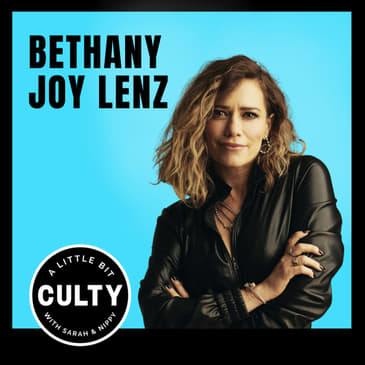
Bethany Joy Lenz became a household face during the meteoric rise of the teen CW soap “One Tree Hill.” However, as she appeared in homes across the country every week, she was leading a double life with her participation in a culty Bible group for a decade.
Lenz found her voice to break free and had the inspiration to write a personal memoir on the experience, “Dinner for Vampires,” sharing for the first time publicly her experience in the group and her struggles to break free. In this episode, Sarah and Nippy talk with Bethany about the surprising connections between her experience and NXIVM, the cult of fame, and their overlapping work in Hallmark movies.
Also… let it be known that:
The views and opinions expressed on A Little Bit Culty do not necessarily reflect the official policy or position of the podcast. Any content provided by our guests, bloggers, sponsors or authors are of their opinion and are not intended to malign any religion, group, club, organization, business individual, anyone or anything. Nobody’s mad at you, just don’t be a culty fuckwad.
Check out our lovely sponsors
Join ‘A Little Bit Culty’ on Patreon
Get poppin’ fresh ALBC Swag
Support the pod and smash this link
Cult awareness and recovery resources
Watch Sarah’s TEDTalk
CREDITS:
Executive Producers: Sarah Edmondson & Anthony Ames
Production Partner: Amphibian.Media
Writer & Co-Creator: Jess Tardy
Associate producers: Emma Diehl and Matt Stroud of Amphibian.Media
Audio production: Red Caiman Studios
Theme Song: “Cultivated” by Jon Bryant co-written with Nygel Asselin
See Privacy Policy at https://art19.com/privacy and California Privacy Notice at https://art19.com/privacy#do-not-sell-my-info.
[00:00:00] [SPEAKER_06]: This podcast is for informational purposes only and should not be considered legal, medical, or mental health advice. The views and opinions expressed do not necessarily reflect the official policy or position of the podcast and are not intended to malign any religion, group, club, organization, business, individual, anyone, or anything.
[00:00:24] [SPEAKER_06]: I'm Sarah Edmondson.
[00:00:25] [SPEAKER_01]: And I'm Anthony Nippy Ames. And this is A Little Bit Culty.
[00:00:30] [SPEAKER_01]: Cults are commonplace now. From fandoms to fads, we're examining them all. We look at what happens when things that seem like a great thing at first go bad.
[00:00:38] [SPEAKER_06]: Every week we chat with survivors, experts, and whistleblowers for real culty stories told directly by the people who lived through them.
[00:00:45] [SPEAKER_06]: Because we want you to learn a few things that we've had to learn the hard way.
[00:00:49] [SPEAKER_01]: For example, if you think you're too smart to get sucked into something culty, you might be prime recruitment material. And who knows? You could already be in a cult.
[00:00:57] [SPEAKER_01]: If you're not aware of your programming, you're probably being programmed. So keep listening to find out.
[00:01:02] [SPEAKER_06]: We'll talk about all sorts of topics on the show, but be aware, this podcast might contain stories that could be alarming to some of our listeners.
[00:01:10] [SPEAKER_06]: So please check our show notes for more detailed descriptions and take care of yourself.
[00:01:14] [SPEAKER_01]: Subscribe to our Patreon for Thursday bonus episodes, Q&A, and all sorts of exclusive content.
[00:01:19] [SPEAKER_01]: That's patreon.com slash a little bit culty.
[00:01:22] [SPEAKER_06]: Welcome to season seven of A Little Bit Culty.
[00:01:39] [SPEAKER_06]: Hi, everybody. Welcome to a fresh new season, season seven of A Little Bit Culty.
[00:01:44] [SPEAKER_01]: That's right. We kind of extended our summer break just a little bit, but today it's back to business with a brand new season, a new look, and a new guest.
[00:01:53] [SPEAKER_06]: We couldn't be more excited to have our special guest join us today.
[00:01:57] [SPEAKER_06]: Look, I missed a lot of really good TV because we were in a cult, and one of those shows was a little show called One Tree Hill.
[00:02:04] [SPEAKER_06]: It has quite a cult following, actually.
[00:02:07] [SPEAKER_01]: Story time.
[00:02:07] [SPEAKER_06]: Here we go.
[00:02:08] [SPEAKER_06]: So when I was still in Vancouver, I was doing a lot of Hallmark movies, and I had a mutual, and I had a friend who was a director of Hallmark movies reach out and ask if I would be willing to put myself on tape for a little cameo.
[00:02:21] [SPEAKER_06]: Because the lead role of this Hallmark movie, whose mother had passed away in the movie, finds a VHS tape of her mother and herself as a little girl, and she gets to see herself in a flashback.
[00:02:31] [SPEAKER_06]: So I was auditioning with Ace at the time, who had long, curly blonde hair, to play Bethany Joy Lenz as a little girl.
[00:02:39] [SPEAKER_06]: And we got the part, and that's how I actually first connected with Bethany Joy Lenz.
[00:02:43] [SPEAKER_06]: We're going to call her Joy.
[00:02:44] [SPEAKER_06]: That's what she goes by.
[00:02:45] [SPEAKER_06]: But then she reached out to me because she had seen The Vow, and it helped her, apparently, understand some of the dynamics that she'd experienced in a group that she is now calling a cult.
[00:02:55] [SPEAKER_01]: I remember Ace researching for that role, too.
[00:02:58] [SPEAKER_01]: He really went deep.
[00:03:00] [SPEAKER_06]: Did he watch all 10 seasons of One Tree Hill?
[00:03:02] [SPEAKER_01]: He went method.
[00:03:02] [SPEAKER_01]: He went method for that one.
[00:03:03] [SPEAKER_06]: Yeah, he's a very committed actor.
[00:03:05] [SPEAKER_06]: He was 18 months at the time.
[00:03:07] [SPEAKER_01]: So Bethany Joy Lenz is a triple threat, actor, musician, and writer.
[00:03:11] [SPEAKER_01]: You may recognize her work, as we mentioned, on One Tree Hill.
[00:03:14] [SPEAKER_01]: She might even be in your regular podcast rotation with Drama Queens, where she rewatches One Tree Hill with her co-stars, Hilary Burton and Sophia Bush.
[00:03:24] [SPEAKER_06]: Most people don't know that during her time on the popular Primetime Soap, Joy was also deeply immersed in a cult.
[00:03:30] [SPEAKER_01]: Correct.
[00:03:30] [SPEAKER_01]: What first appeared as a Bible study group slowly revealed itself to be an abusive, high-demand, dare I say cult?
[00:03:37] [SPEAKER_01]: Swept up in it, Joy relocated to the Pacific Northwest to the Big House family's compound, even marrying one of the leader's sons.
[00:03:46] [SPEAKER_06]: Think the personal development vibes of NXIVM with the focus on growth and group feedback sessions like in Synanon inside an insular Christian community that mostly live together.
[00:03:56] [SPEAKER_01]: Joy just released her memoir, Dinner for Vampires, last week.
[00:04:00] [SPEAKER_01]: It details her time in the cult and finding the courage to break free.
[00:04:03] [SPEAKER_01]: And it's phenomenal.
[00:04:04] [SPEAKER_01]: Well-written, vulnerable and informative.
[00:04:06] [SPEAKER_01]: We're so excited to have her here to talk about her experience.
[00:04:09] [SPEAKER_06]: So without further ado, here is our chat with Bethany Joy Lenz.
[00:04:13] [SPEAKER_06]: Enjoy!
[00:04:29] [SPEAKER_06]: Hi! So good to finally have you on this podcast.
[00:04:31] [SPEAKER_05]: I'm so happy to be here. It's great. I've been waiting to talk with you guys. I mean, you know, you and I have had our separate conversations privately, but to be able to actually have a real serious dialogue here, very serious dialogue here.
[00:04:44] [SPEAKER_05]: Very serious.
[00:04:45] [SPEAKER_05]: It feels great. I'm glad to see you both.
[00:04:48] [SPEAKER_06]: Me too. I was thinking, Libby and I were trying to figure out when we met in Vancouver around the time of that Hallmark movie.
[00:04:53] [SPEAKER_01]: 21.
[00:04:54] [SPEAKER_06]: Was it 21? Like the vow just come out or?
[00:04:57] [SPEAKER_05]: That sounds about right. Because it was just after COVID had the whole, you know, quarantine and all that. And I think we were all kind of-
[00:05:05] [SPEAKER_01]: Yeah. And you were shooting something.
[00:05:07] [SPEAKER_06]: We were on a beach, so it must've been warmish. I think it was the Christmas movie that you starred in and I cameoed in.
[00:05:13] [SPEAKER_05]: Well, yes, that was absolutely it, but I couldn't remember which one it was. I think it was five star.
[00:05:17] [SPEAKER_05]: It was the Christmas movie.
[00:05:17] [SPEAKER_05]: Yeah. Okay. Okay. Now, isn't that so funny though, that before we were any, before we knew that our, our mutual connection around cults, we had no idea. Uh, but you played my mother in a flashback and I was your, was it your son played young?
[00:05:34] [SPEAKER_06]: Yeah. My son, Ace played you as a little baby. And when I look back at those pictures, you look more like Ace and, or Ace looked more like you than I look like Ace. So it was really a great serendipitous casting, I think.
[00:05:49] [SPEAKER_05]: So cute.
[00:05:49] [SPEAKER_05]: And meant to be.
[00:05:50] [SPEAKER_05]: Yeah, I think so.
[00:05:51] [SPEAKER_06]: But we were sitting on the beach and I remember you, you basically saying that the vow had helped you. Um, and we'll get that into more of that and we'll get into like your healing and your wake up, but helped you realize just how bad of a cult you'd been in. But I remember asking like, Oh, what was the group? Like what, what was it? And you're like, well, it was like a, more of a Bible study, uh, group. And you were, I don't know if you were cagey or you just weren't like public about it or just, you were, you were still processing.
[00:06:18] [SPEAKER_06]: But either way, we couldn't talk about it. Like you are now, obviously.
[00:06:23] [SPEAKER_05]: I think I also was a little, I, I read about this in the, on the back of the book, actually. And in the book, this sense of like, people think of cults and they think of things that are really extreme often and extreme, I guess, has various, uh, degrees depending on who you are and what you're used to.
[00:06:42] [SPEAKER_05]: So there's an insecurity around like, well, it wasn't, you know, like a, there weren't crazy sex orgies and there wasn't like, um, anybody drinking anything poison. And there wasn't, you know, so I felt a little insecure about what can I call it a cult? Cause I mean, that's what it was, but I, I guess there's just an insecurity around that.
[00:07:03] [SPEAKER_05]: And so I probably wasn't being really taking ownership over that. I didn't want to diminish what somebody else had been through. Yeah. I was, I was sorting through it.
[00:07:13] [SPEAKER_06]: Yeah. That kind of reminds me of how I hear people talk about trauma when they're like, oh, but like what happened to me wasn't as bad as, as yours. And you know what I mean? Like, and we had a therapist once that says not the trauma Olympics, like it's not the cult. It's not the cult Olympics. Like just because they weren't branding or have a sex harem or whatever, it doesn't mean it wasn't a cult.
[00:07:33] [SPEAKER_06]: And you, because of your platform with One Tree Hill and, you know, a cult classic hit and having, having the platform is so important because you can shine a light on the fact that there are tons of these groups out there that are like yours, which are more benign and are more sensational and do slip under the radar because there isn't a crime that the, you know, the feds are going after. And then therefore they keep going. And guess what? Some of those groups do end up that way.
[00:07:57] [SPEAKER_05]: That's what I was going to say. You never know how far it can go. I mean, I got out before our group disbanded or dispersed, fell apart before it ever got to that super dark stage as far as anything I was involved in. I don't, I don't know about some other people, but, but yeah, a lot of these, all these groups kind of start out the same way. I assume just a group of people that want to make the world a better place and do something meaningful.
[00:08:23] [SPEAKER_05]: And then depending on who's in charge, it just goes really, really, really far.
[00:08:28] [SPEAKER_01]: Well, that's always the question. Did it start malevolent or did it become malevolent as someone got power? And it's often hard to figure out.
[00:08:37] [SPEAKER_05]: Yeah, that is hard to figure out. I think that's even hard to figure out in relationships. And, you know, I think people ask themselves that question in work environments too.
[00:08:49] [SPEAKER_05]: It's somebody starts getting a little bit more power. Somebody starts getting into a position where they have more access and it's human nature. I mean, that's the, that comes down to the little definitions of your character and who you are behind closed doors and who you are when no one's looking.
[00:09:05] [SPEAKER_05]: And eventually I think people just make enough choices to delineate themselves between good and bad. I don't know. I don't know where the barometer is. That's what makes these groups so insidious. It makes it so hard to tell.
[00:09:18] [SPEAKER_06]: For whatever you feel comfortable sharing, if you're not too exhausted, tell us about this group and being in LA and being, you know, a young actress and finding Bible study. Tell us about like how great it felt.
[00:09:31] [SPEAKER_06]: Yeah.
[00:09:31] [SPEAKER_06]: Because I really felt you harness that feeling so well in your book. I feel like people really get it.
[00:09:37] [SPEAKER_05]: Thank you. Yeah. So yes, I was, I was 21. I just moved to LA from New York. When I was in New York, I had a great community in the acting world.
[00:09:48] [SPEAKER_05]: I had grown up as an only child. We moved around a lot and I really craved community. And there was no stable place for me to find that except in theater. And of course the nature of theater is you get really close with people really fast.
[00:10:02] [SPEAKER_05]: And then you move on and go find another group of people. And so there was this transientness in my life that was so repetitive and this huge gaping hole that I needed to fill of a feeling of stable community and family that was never going to go anywhere.
[00:10:18] [SPEAKER_05]: And when I moved to LA, I was invited by my roommate to a Bible study that was just like every other Bible study I'd ever been to growing up in the Protestant charismatic church.
[00:10:31] [SPEAKER_05]: They have this sort of like Wednesday night or Sunday night youth group or whatever it is. It's a small group of people that get together and they read the Bible and they sing songs and try and meditate. And, and it's all very benign in many circumstances.
[00:10:49] [SPEAKER_05]: Just what all of us are trying to do in community and become better people.
[00:10:54] [SPEAKER_05]: And, um, the group was a lot of young entertainment professionals, a lot of people who were just artists and really creative thinkers out of the box thinkers.
[00:11:06] [SPEAKER_05]: So people that weren't doing, weren't living out their Christianity in a way that I had experienced that was very sort of in the box by the checklist, uh, the way that a lot of people who are not artists in their faith, I experienced them living their lives that way.
[00:11:22] [SPEAKER_05]: And so it felt like, oh my gosh, finally, people who think like me, like more liberal minded, more open hearted, more like artistic and seeing God as this storyteller.
[00:11:32] [SPEAKER_05]: And it felt like, um, like a piece of my heart was really coming to life.
[00:11:39] [SPEAKER_05]: And I had all these amazing people around me and we were all just doing life together.
[00:11:44] [SPEAKER_05]: And it went on that way for about a year, lunches and calling each other when there was something to pray for or, uh, connecting over family issues.
[00:11:56] [SPEAKER_05]: You know, it was just sort of what you do when you find a cool group of people.
[00:12:02] [SPEAKER_05]: And one of the brothers who had started opening their home for this Bible study knew a man from another state and his home state back in Idaho, uh, who was a pastor and had been displaced out of his church and was just wanting to, he had heard him speak a few times and thought, well, this guy's really wise.
[00:12:21] [SPEAKER_05]: I really liked his, his vibe, his ideas and invited him to come down and join the group and be a part of, uh, this little Bible study.
[00:12:32] [SPEAKER_05]: And that's when everything really started to shift because he came in and I think he just saw a bunch of young entertainment professionals and got dollar signs in his eyes and started to, started to weave his web, but it did.
[00:12:48] [SPEAKER_05]: It felt so good at the beginning. And even when you, when you were deep in it, it felt like that sense of family that I had always been really longing for people who just aren't going to leave no matter what.
[00:12:59] [SPEAKER_05]: And of course I didn't realize the cost that it was, uh, taking, you know, the toll that it was taking on me that, you know, having this, having this group dynamic, that was like a bunch of friends that were almost married to each other.
[00:13:13] [SPEAKER_05]: Like the, the, the emotional incestuousness of, of the dynamic was so unhealthy, but to me, I didn't have any reference point.
[00:13:22] [SPEAKER_05]: I was like, Oh, I guess this is what real family feels like.
[00:13:25] [SPEAKER_06]: It's like a little bit of a meshment.
[00:13:27] [SPEAKER_05]: Just a little, just a little.
[00:13:30] [SPEAKER_05]: You know, it's so weird.
[00:13:31] [SPEAKER_05]: I was just going, looking through photos.
[00:13:33] [SPEAKER_05]: Cause I have all these photos from my time at the big house.
[00:13:35] [SPEAKER_05]: That's what we called it.
[00:13:36] [SPEAKER_05]: The big house family.
[00:13:37] [SPEAKER_05]: Cause a lot of us lived in a big house, um, was I found all these photos of like less and Marty.
[00:13:46] [SPEAKER_05]: And I found Pam and Ed's wedding photos.
[00:13:50] [SPEAKER_05]: And it was like a family album, like childhood photos of other people in the group.
[00:13:54] [SPEAKER_05]: I was like, this is, I put together like a family photo album of all these people that I
[00:14:01] [SPEAKER_05]: have no blood relation to whatsoever.
[00:14:03] [SPEAKER_05]: And this feeling of like, I missed it.
[00:14:08] [SPEAKER_05]: I missed this sense of community.
[00:14:10] [SPEAKER_05]: I missed like the way that I felt that, that delusional feeling.
[00:14:15] [SPEAKER_05]: I would never go back, but I missed it.
[00:14:18] [SPEAKER_05]: Did you guys ever experience that?
[00:14:22] [SPEAKER_06]: This podcast certainly would not be happening without our amazing, supportive, generous patrons.
[00:14:27] [SPEAKER_06]: Are you with us?
[00:14:28] [SPEAKER_06]: Come find us over on Patreon at patreon.com slash a little bit culty for bonus episodes,
[00:14:33] [SPEAKER_06]: ad free and exclusive content, and the occasional zoom with fan favorites from our past episodes,
[00:14:40] [SPEAKER_06]: Q and A's and all sorts of goodies.
[00:14:41] [SPEAKER_06]: It's fun over there, people.
[00:14:50] [SPEAKER_06]: You've heard from our sponsors.
[00:14:51] [SPEAKER_06]: Now let's get back to a little bit culty, shall we?
[00:14:55] [SPEAKER_06]: Oh yeah.
[00:14:56] [SPEAKER_06]: I think probably more so me than Nippy.
[00:14:58] [SPEAKER_06]: Cause that was, that was more my draw as well.
[00:15:01] [SPEAKER_06]: Similar to you.
[00:15:01] [SPEAKER_06]: Community is more.
[00:15:02] [SPEAKER_06]: Yeah.
[00:15:02] [SPEAKER_06]: Community.
[00:15:03] [SPEAKER_06]: Um, and just a side note on that.
[00:15:05] [SPEAKER_01]: I have a big family.
[00:15:07] [SPEAKER_01]: Okay.
[00:15:07] [SPEAKER_01]: Yeah.
[00:15:07] [SPEAKER_06]: He's got a big family.
[00:15:09] [SPEAKER_06]: I was also an only child till I was nine.
[00:15:11] [SPEAKER_06]: Then my dad remarried and I got a bonus brother, but I was an only child for a long time.
[00:15:15] [SPEAKER_06]: And also my parents were divorced.
[00:15:17] [SPEAKER_06]: And so I, I actually got a lot from reading your book, just sort of like, oh, it wasn't
[00:15:22] [SPEAKER_06]: just community that I was after.
[00:15:24] [SPEAKER_06]: I, even though my parents are still in my life, it was that whole family.
[00:15:27] [SPEAKER_05]: Yeah.
[00:15:28] [SPEAKER_06]: You know, the, the complete family, that wholeness and wellness that you can call it family and
[00:15:32] [SPEAKER_06]: call it community, but there's this thing that fills a spot in the heart.
[00:15:36] [SPEAKER_06]: Right.
[00:15:36] [SPEAKER_06]: Yeah.
[00:15:37] [SPEAKER_05]: Brothers, sisters, aunts, uncles, people, you always get it.
[00:15:40] [SPEAKER_05]: You're going to see them on holidays.
[00:15:41] [SPEAKER_05]: You know, they're there for you.
[00:15:43] [SPEAKER_05]: Yes.
[00:15:43] [SPEAKER_05]: If you're in a fight with your mom, you call your aunt.
[00:15:45] [SPEAKER_05]: I mean, it's all that stuff that I just never had.
[00:15:49] [SPEAKER_06]: Yeah.
[00:15:49] [SPEAKER_06]: And my word for that also, even when I was in it, in fact, I'd get kind of get shit
[00:15:53] [SPEAKER_06]: from the upper ranks for being too, for creating dependencies, they called it, because
[00:15:57] [SPEAKER_06]: I was looking for support.
[00:15:59] [SPEAKER_06]: And so support comes from the family and community.
[00:16:03] [SPEAKER_06]: So when you ask, like, did we miss it?
[00:16:05] [SPEAKER_06]: I did miss.
[00:16:06] [SPEAKER_06]: And, you know, still to this day here, moving to Atlanta and being new here, like, who's my
[00:16:11] [SPEAKER_06]: support system?
[00:16:12] [SPEAKER_06]: Where, if I, in a crisis, my family's back in Vancouver.
[00:16:15] [SPEAKER_06]: Where, where does that, yeah, I miss it all the time.
[00:16:18] [SPEAKER_06]: And also, at the same time, I'm, like, kind of allergic to communities and groups.
[00:16:24] [SPEAKER_06]: Completely.
[00:16:25] [SPEAKER_05]: Completely.
[00:16:25] [SPEAKER_05]: It's the hardest thing to leave that and then try and make new friends and be, I am so,
[00:16:35] [SPEAKER_05]: I feel often guilty.
[00:16:36] [SPEAKER_05]: I feel like I'm a selfish friend.
[00:16:38] [SPEAKER_05]: Like, I, people will have parties or dinners or whatever, and there's this part of me that
[00:16:42] [SPEAKER_05]: is really excited to go be there, but I always, I want to drive myself.
[00:16:46] [SPEAKER_05]: I want to be able to leave at any moment.
[00:16:48] [SPEAKER_05]: I, I feel this sense of, like, I always want to be able to have ownership over myself in
[00:16:54] [SPEAKER_05]: any situation.
[00:16:56] [SPEAKER_05]: And I think I probably enact that in ways that are overdramatic.
[00:17:02] [SPEAKER_05]: I don't know.
[00:17:02] [SPEAKER_05]: You know, it's like, I'm still learning.
[00:17:06] [SPEAKER_05]: I'm still dissecting it and learning how to, how to just know what normal is.
[00:17:11] [SPEAKER_05]: Like, what, how do normal friends just have normal friendships?
[00:17:14] [SPEAKER_06]: I think that we're trying to figure it out.
[00:17:16] [SPEAKER_06]: And maybe this conversation will, we can help each other with some tips, but I do, I do
[00:17:22] [SPEAKER_06]: think that it's so important to do what you just said to like, just, you know, doing what
[00:17:28] [SPEAKER_06]: you want to do for you is a hard thing, especially if you tend to be, I mean, I am certainly a
[00:17:34] [SPEAKER_06]: people pleaser and I want to say yes.
[00:17:36] [SPEAKER_06]: And then I end up going, right.
[00:17:38] [SPEAKER_06]: And then I feel resentful.
[00:17:39] [SPEAKER_06]: I'm like, I don't actually want to be here.
[00:17:40] [SPEAKER_06]: I'm like, ooh.
[00:17:41] [SPEAKER_06]: Yes.
[00:17:42] [SPEAKER_01]: So.
[00:17:43] [SPEAKER_01]: We have a term.
[00:17:44] [SPEAKER_01]: If it's not a hell yes, it's a no.
[00:17:47] [SPEAKER_06]: That's good.
[00:17:48] [SPEAKER_05]: Yeah.
[00:17:49] [SPEAKER_06]: And just for the record, that's a new term for me from the last month from therapy.
[00:17:54] [SPEAKER_06]: That's a new thing.
[00:17:55] [SPEAKER_06]: And it's made me also realize that I'm actually more introverted than I, than I thought.
[00:17:59] [SPEAKER_06]: I thought I was an extrovert, but I actually enjoy not doing everything.
[00:18:02] [SPEAKER_06]: Yeah.
[00:18:02] [SPEAKER_06]: When you're healing, you kind of have to.
[00:18:04] [SPEAKER_06]: And I know you're.
[00:18:04] [SPEAKER_01]: That was news to me.
[00:18:05] [SPEAKER_06]: Yeah.
[00:18:06] [SPEAKER_06]: Nippy.
[00:18:06] [SPEAKER_06]: Yeah.
[00:18:07] [SPEAKER_06]: He thought I was an extrovert.
[00:18:09] [SPEAKER_01]: I thought she was an extrovert.
[00:18:11] [SPEAKER_06]: Anyway, back to you.
[00:18:13] [SPEAKER_06]: That's funny.
[00:18:14] [SPEAKER_01]: It always felt that way.
[00:18:15] [SPEAKER_01]: But that's kind of the, I mean, air quotes around normal too.
[00:18:20] [SPEAKER_01]: I mean.
[00:18:20] [SPEAKER_04]: Right.
[00:18:21] [SPEAKER_01]: Just because you don't feel normal doesn't mean it's not for, you know, I see other people
[00:18:27] [SPEAKER_01]: that have a normal that I don't think is normal.
[00:18:30] [SPEAKER_06]: Yeah.
[00:18:30] [SPEAKER_06]: Absolutely.
[00:18:31] [SPEAKER_06]: Also, there's a lot of normal out there that's totally not healthy.
[00:18:34] [SPEAKER_05]: Yes.
[00:18:35] [SPEAKER_06]: Right?
[00:18:35] [SPEAKER_06]: There's a lot of normal people who have friendships and they've never been in a cult and they
[00:18:39] [SPEAKER_06]: totally obligate themselves to do stuff.
[00:18:41] [SPEAKER_06]: And because I'm making new friends here in Atlanta, right at the top, I'm like, I just
[00:18:45] [SPEAKER_06]: want you to know, if I ask you to do something and you don't want to do it, please tell me.
[00:18:48] [SPEAKER_06]: Yes.
[00:18:49] [SPEAKER_06]: None of this like, oh yeah, I'll be there and then don't show up.
[00:18:51] [SPEAKER_06]: Just like, tell me if you don't want to.
[00:18:52] [SPEAKER_06]: I don't want to have any bullshit friendships.
[00:18:55] [SPEAKER_05]: I value direct communication so highly because it just cuts through all of my triggers.
[00:19:03] [SPEAKER_05]: If I feel like somebody's bullshitting me, it's one of the reasons why living in
[00:19:07] [SPEAKER_05]: LA was so hard for me and I'm really happy to be here now.
[00:19:12] [SPEAKER_05]: I'm in Nashville and there's, I understand the Southern way of communicating in the East
[00:19:17] [SPEAKER_05]: Coast way.
[00:19:18] [SPEAKER_05]: Like I'm a Jersey girl.
[00:19:19] [SPEAKER_05]: I like blunt communication.
[00:19:20] [SPEAKER_05]: I've always liked that.
[00:19:21] [SPEAKER_05]: But even now, I really value that.
[00:19:24] [SPEAKER_05]: Like if you don't want to do something, just say no.
[00:19:27] [SPEAKER_05]: If I did something that hurt your feelings, just tell me.
[00:19:29] [SPEAKER_05]: I can handle it.
[00:19:30] [SPEAKER_05]: But this whole kid gloves thing where I feel like I don't, I feel like something's wrong,
[00:19:35] [SPEAKER_05]: but I don't know.
[00:19:36] [SPEAKER_05]: And you're acting weird, but are you acting weird or is it just me?
[00:19:39] [SPEAKER_05]: And I can't, it's so exhausting.
[00:19:42] [SPEAKER_05]: It's so exhausting.
[00:19:43] [SPEAKER_06]: So exhausting.
[00:19:43] [SPEAKER_06]: Yeah.
[00:19:44] [SPEAKER_06]: Especially after, I think in cult recovery, when people would ask like at the healing,
[00:19:49] [SPEAKER_06]: I'd say the interpersonal stuff is really difficult.
[00:19:53] [SPEAKER_06]: Interpersonal relationships, especially after navigating cult relationships.
[00:19:56] [SPEAKER_06]: Like you just, like you said, you don't, it's exhausting.
[00:19:59] [SPEAKER_06]: I don't have time for it.
[00:20:00] [SPEAKER_06]: Like I just don't have zero capacity.
[00:20:02] [SPEAKER_05]: And I can totally handle having my feelings hurt.
[00:20:05] [SPEAKER_05]: Like I've, I was just talking about this yesterday with somebody about the shame,
[00:20:08] [SPEAKER_05]: shame, you know, how do you handle it?
[00:20:09] [SPEAKER_05]: I'm like, shame is like, it's so easy to handle for me now after like I was in a cult.
[00:20:15] [SPEAKER_05]: That's so embarrassing.
[00:20:18] [SPEAKER_05]: It's like, so I've, I've dealt with so much shame and, and feeling embarrassed or feeling
[00:20:23] [SPEAKER_05]: like I did something wrong that I can totally handle it.
[00:20:27] [SPEAKER_05]: If you tell me I hurt your feelings or having my feelings hurt by you being too direct,
[00:20:31] [SPEAKER_05]: totally, I can handle it.
[00:20:33] [SPEAKER_05]: But I don't know that I can handle somebody pretending like everything's okay when it's
[00:20:37] [SPEAKER_05]: not.
[00:20:38] [SPEAKER_05]: That's, I feel like that's what got me into it in the first place.
[00:20:40] [SPEAKER_05]: It starts making me feel like a little bananas.
[00:20:43] [SPEAKER_06]: Speaking of bananas, I'm going to, and I'm sorry, I feel like I derailed, but it's okay.
[00:20:47] [SPEAKER_06]: That was also very useful.
[00:20:48] [SPEAKER_06]: I'm going to go back.
[00:20:49] [SPEAKER_06]: I'm going to circle back to.
[00:20:50] [SPEAKER_06]: Okay.
[00:20:50] [SPEAKER_00]: I have a loose chronology.
[00:20:51] [SPEAKER_06]: Yeah, I was trying to go like sort of through linear time, but we're going to bop around.
[00:20:56] [SPEAKER_00]: But you cut to shame really quickly, which, well, I, only reason I say is I thought how
[00:21:03] [SPEAKER_00]: you closed your book and how it was.
[00:21:07] [SPEAKER_06]: Let's end there.
[00:21:07] [SPEAKER_06]: Okay.
[00:21:08] [SPEAKER_06]: I'm going to end there.
[00:21:08] [SPEAKER_00]: I'm just saying like.
[00:21:09] [SPEAKER_06]: Can I talk about bio family?
[00:21:10] [SPEAKER_00]: Yeah.
[00:21:10] [SPEAKER_00]: Let's talk about bio family.
[00:21:11] [SPEAKER_06]: So we're, we really like love to talk about the red flags, you know, that we all missed
[00:21:17] [SPEAKER_06]: along the way.
[00:21:19] [SPEAKER_06]: And so that we can.
[00:21:20] [SPEAKER_01]: We totally love talking.
[00:21:22] [SPEAKER_06]: We love doing it.
[00:21:23] [SPEAKER_06]: Isn't it great?
[00:21:24] [SPEAKER_01]: So enjoyable.
[00:21:24] [SPEAKER_06]: Talking about all the things we missed.
[00:21:27] [SPEAKER_06]: But I think it's important because then you can pass those things off to your, you know,
[00:21:31] [SPEAKER_06]: the people who read the book and they go, oh, that's a red flag.
[00:21:34] [SPEAKER_06]: Like, so one of my first red flags reading your book was bio family and having them, A,
[00:21:39] [SPEAKER_06]: change the word and make up their own word.
[00:21:42] [SPEAKER_06]: But what did, how does bio family relate to isolation and love bombing and other culty
[00:21:49] [SPEAKER_06]: things?
[00:21:49] [SPEAKER_05]: I love that.
[00:21:50] [SPEAKER_05]: I love also that you said that's one of your first red flags because that word doesn't
[00:21:54] [SPEAKER_05]: come in until at least halfway through the book.
[00:21:56] [SPEAKER_06]: Oh, there's more.
[00:21:57] [SPEAKER_06]: There's others.
[00:21:58] [SPEAKER_05]: I was going to say, because there are like, and that's the point is like, it's so slow
[00:22:02] [SPEAKER_05]: and insidious, you know, it's like by the time you arrive at that point, I was so far
[00:22:06] [SPEAKER_05]: in, I would, I didn't see it as a red flag.
[00:22:09] [SPEAKER_06]: No.
[00:22:09] [SPEAKER_06]: It probably felt great to have a bio family.
[00:22:11] [SPEAKER_05]: It did.
[00:22:12] [SPEAKER_05]: I mean, to be separate from your bio family.
[00:22:14] [SPEAKER_05]: To be able to have that label.
[00:22:15] [SPEAKER_05]: So it's the typical narcissist tool of isolation of us versus them of the love bombing starts
[00:22:25] [SPEAKER_05]: with here's how great you are.
[00:22:27] [SPEAKER_05]: Here's how much we love you and how valuable you are.
[00:22:31] [SPEAKER_05]: Then there's the moment of tearing you down in a way that is postured as loving.
[00:22:38] [SPEAKER_05]: So you feel like you're actually, somebody's being honest with you and finally telling you
[00:22:45] [SPEAKER_05]: what's what.
[00:22:46] [SPEAKER_05]: Oh my goodness.
[00:22:47] [SPEAKER_05]: I don't have to guess.
[00:22:48] [SPEAKER_05]: You're just straight up telling me these horrible things about myself.
[00:22:52] [SPEAKER_05]: And in some way it's a relief from a bunch of people who are too afraid to tell you, you
[00:22:59] [SPEAKER_05]: know, the truth that you always fear may be true about yourself.
[00:23:03] [SPEAKER_05]: Like having somebody just actually acknowledge it.
[00:23:05] [SPEAKER_05]: You're like, oh, okay, great.
[00:23:05] [SPEAKER_05]: And then from that place, there's more building up and then more tearing down.
[00:23:10] [SPEAKER_05]: And then the cycle continues.
[00:23:12] [SPEAKER_05]: And as that cycle continues, I catch myself talking from a place of like objectivity, but
[00:23:19] [SPEAKER_05]: I really only can speak from my experience.
[00:23:22] [SPEAKER_05]: So I can say that for me, as the cycle continued, I, um, I started really craving clarity on who
[00:23:31] [SPEAKER_05]: I could trust and who I couldn't trust.
[00:23:34] [SPEAKER_05]: And because they were using, started using terms like bio family and illegal questions that they're
[00:23:43] [SPEAKER_05]: like there, there were so many little terms that they started introducing that felt like
[00:23:47] [SPEAKER_05]: I am a part of this.
[00:23:50] [SPEAKER_05]: I'm a part of something.
[00:23:51] [SPEAKER_05]: Bio family is a way of saying the family that you're born into, but not necessarily meant
[00:23:57] [SPEAKER_05]: to live life with.
[00:23:59] [SPEAKER_05]: So it was a way of saying your family who you have no obligation to them because they're
[00:24:04] [SPEAKER_05]: either not connected to your soul, your heart.
[00:24:06] [SPEAKER_05]: This is what we're here for in life is to, is to find our fulfillment and our identities
[00:24:12] [SPEAKER_05]: and make the world a better place.
[00:24:14] [SPEAKER_05]: And those people we are grateful for, and we respect them because they are the vessels by
[00:24:21] [SPEAKER_05]: which you were brought into this world.
[00:24:22] [SPEAKER_05]: But there's no heart connection.
[00:24:24] [SPEAKER_05]: It's just biology.
[00:24:25] [SPEAKER_05]: So it really relieved me of a sense, any sort of sense of duty to, um, communicate with or
[00:24:33] [SPEAKER_05]: respect my parents and my, the rest of my family.
[00:24:37] [SPEAKER_05]: It was like a really easy way to just label them as other and push them away and ignore
[00:24:44] [SPEAKER_05]: their pleas.
[00:24:45] [SPEAKER_05]: Ignore their longing to be in relationship with me.
[00:24:49] [SPEAKER_05]: I, I just, uh, I didn't, I didn't have to because I now had them under a certain label.
[00:24:56] [SPEAKER_01]: How many years was that?
[00:24:58] [SPEAKER_05]: So my dad, I didn't speak to for six years.
[00:25:01] [SPEAKER_05]: My mother was really, my mother was really smart.
[00:25:06] [SPEAKER_05]: My dad's smart, really smart too, but, um, was very emotional about it and couldn't contain
[00:25:10] [SPEAKER_05]: himself.
[00:25:10] [SPEAKER_05]: My mother was, what's the right word?
[00:25:14] [SPEAKER_05]: My mother was wily.
[00:25:19] [SPEAKER_05]: My mother was able to, uh, deduce what was going on.
[00:25:25] [SPEAKER_05]: She knew that if she made any sudden moves, any wrong moves in any direction that I would
[00:25:34] [SPEAKER_05]: probably cut her out too.
[00:25:35] [SPEAKER_05]: And so she, she was dealing with the snake, you know, it's like you just stand there and
[00:25:40] [SPEAKER_05]: you like this, this thing that was ready to pounce at any moment, this ideology that
[00:25:46] [SPEAKER_05]: I was believing in.
[00:25:48] [SPEAKER_05]: So she just kind of stood there slowly and talked nice and soft and managed to do that
[00:25:55] [SPEAKER_05]: for 10 years until, until I was ready to admit that, uh, I was, I was in a bad situation.
[00:26:02] [SPEAKER_02]: Wow.
[00:26:06] [SPEAKER_06]: For more background on what brought us here, check out my page turning memoir.
[00:26:10] [SPEAKER_06]: It's called Scarred, the true story of how I escaped NXIVM, the cult that bound my life.
[00:26:15] [SPEAKER_06]: It's available on Amazon, Audible, and at most bookstores.
[00:26:17] [SPEAKER_06]: And if you want to see that story in streaming form, you can watch both seasons of The Vow
[00:26:22] [SPEAKER_06]: on HBO.
[00:26:28] [SPEAKER_01]: Break time's over people.
[00:26:29] [SPEAKER_01]: Let's get back to this episode of a little bit culty.
[00:26:32] [SPEAKER_01]: It's a good one.
[00:26:33] [SPEAKER_06]: Throughout the book, I was like, oh, I have to introduce Joy's mom to my mom because she
[00:26:37] [SPEAKER_06]: did very much the same thing.
[00:26:39] [SPEAKER_06]: Yeah.
[00:26:39] [SPEAKER_06]: And I think they should have a support group.
[00:26:41] [SPEAKER_06]: I think your mom and my mom need to start a support group of mothers of daughters and
[00:26:45] [SPEAKER_06]: cults and how to, how to handle it.
[00:26:48] [SPEAKER_06]: Cause they, they both did some, my mom did make some comments like, you know, have you
[00:26:54] [SPEAKER_06]: ever thought that there's other personal development methods that you might want to look into?
[00:26:58] [SPEAKER_06]: Like little comments every now and then.
[00:27:00] [SPEAKER_05]: Yes.
[00:27:01] [SPEAKER_05]: Yeah.
[00:27:02] [SPEAKER_05]: My mom did too.
[00:27:02] [SPEAKER_05]: Absolutely.
[00:27:03] [SPEAKER_05]: It was just the little things, but she sensed when I was done with the conversation or somewhere
[00:27:09] [SPEAKER_05]: that I didn't want to go and she just pivoted and turned into something out.
[00:27:13] [SPEAKER_05]: Well, you know, isn't the weather nice today or whatever.
[00:27:16] You know?
[00:27:18] [SPEAKER_06]: Yeah.
[00:27:19] [SPEAKER_06]: Way to go, mom.
[00:27:20] [SPEAKER_06]: And then you had that soft place to land later when you got out, which we will.
[00:27:23] [SPEAKER_06]: Yeah.
[00:27:23] [SPEAKER_06]: We will get to.
[00:27:24] [SPEAKER_06]: Nip, you had a question about the other red flags and you're right.
[00:27:28] [SPEAKER_06]: There were many, many other red flags that happened before that.
[00:27:30] [SPEAKER_06]: That was just one that I thought was such a, a good talking point because the bio family
[00:27:35] [SPEAKER_06]: really did so many of the dynamics in one bundle.
[00:27:39] [SPEAKER_06]: It isolated you.
[00:27:40] [SPEAKER_06]: It created a dependency.
[00:27:41] [SPEAKER_06]: It was love bombing.
[00:27:42] [SPEAKER_01]: Created a language to bond over.
[00:27:43] [SPEAKER_01]: Yeah.
[00:27:43] [SPEAKER_06]: Using language.
[00:27:44] [SPEAKER_06]: It was like really such a.
[00:27:47] [SPEAKER_05]: Yeah.
[00:27:48] [SPEAKER_05]: The language to bond over.
[00:27:50] [SPEAKER_05]: That was one of the first things, the way everybody would start.
[00:27:52] [SPEAKER_05]: It was like this, this tone would come over us and we would just talk like this about
[00:27:57] [SPEAKER_05]: life and our family and God.
[00:27:59] [SPEAKER_05]: And like, oh, I just, I just don't understand why my family does my bio family doesn't really
[00:28:05] [SPEAKER_05]: see the way that, you know, we're living in relationship.
[00:28:09] [SPEAKER_05]: And it's like, oh yeah.
[00:28:12] [SPEAKER_06]: Tell us what living in relationship means.
[00:28:14] [SPEAKER_05]: God.
[00:28:15] [SPEAKER_05]: I, at one point in the book, I had a drinking game associated with the word relationship.
[00:28:20] [SPEAKER_05]: It's like every time you hear the word relationship, take a drink.
[00:28:27] [SPEAKER_05]: Relationship became part of the lingo to bond over relationship versus religion.
[00:28:32] [SPEAKER_05]: We're not religious.
[00:28:34] [SPEAKER_05]: We don't want to be religious people who are living by all of these standards that modern
[00:28:42] [SPEAKER_05]: Christians have, or, or, well, not even modern.
[00:28:44] [SPEAKER_05]: I mean, I guess that goes back for ages, but that, uh, the Christian community lives by all
[00:28:51] [SPEAKER_05]: these strict rules and ideas.
[00:28:53] [SPEAKER_05]: And we, we want to be outside the box.
[00:28:56] [SPEAKER_05]: We want to be the, the, the piece of this faith community that thinks a little wild.
[00:29:05] [SPEAKER_05]: And so we're going to create a space for artists and for out of the box thinkers, but we're still,
[00:29:12] [SPEAKER_05]: we're still Christian.
[00:29:13] [SPEAKER_05]: We're just going to create a, an out of the box space.
[00:29:16] [SPEAKER_05]: And so relationship was the buzzword for, oh no, we don't do religion.
[00:29:21] [SPEAKER_05]: We do relationship.
[00:29:22] [SPEAKER_05]: We're just living life together.
[00:29:23] [SPEAKER_06]: And was that kind of the highest thing is to be in relationship with each other and God?
[00:29:29] [SPEAKER_05]: Yeah.
[00:29:29] [SPEAKER_05]: Yeah.
[00:29:30] [SPEAKER_05]: Because the closer in, in this group ideology, the closer you are with each other, the closer
[00:29:35] [SPEAKER_05]: you are to seeing God and experience it.
[00:29:38] [SPEAKER_05]: Like you need, as, as I'm sure you guys experienced in your group, there are so many things that
[00:29:44] [SPEAKER_05]: are true, but when they're laced with rat poison, um, it becomes all bad.
[00:29:51] [SPEAKER_05]: But, and so the truth of, if you're a person of faith, trying to see a pull, a full picture
[00:29:59] [SPEAKER_05]: of the God of your understanding, let's call it right now.
[00:30:03] [SPEAKER_05]: Like it's great to have community.
[00:30:05] [SPEAKER_05]: It's great to have people around you who think differently than you and see differently
[00:30:09] [SPEAKER_05]: than you and believe differently than you so that you can really get a full picture
[00:30:13] [SPEAKER_05]: of all the great aspects of this cosmic being that's out there.
[00:30:17] [SPEAKER_05]: That's not just all you, you know, we're all so different.
[00:30:20] [SPEAKER_05]: There's so much to learn.
[00:30:21] [SPEAKER_05]: And so that idea in and of itself, I think is healthy and wonderful.
[00:30:25] [SPEAKER_05]: But when you put it in the context of this little group and it's like, these are the
[00:30:30] [SPEAKER_05]: 25 people that we need in order to see the full expression of God.
[00:30:36] [SPEAKER_05]: And we have to be up each other's butt all the time in every possible way.
[00:30:41] [SPEAKER_05]: We have to always be on, on top of each other, asking each other permission, having group
[00:30:45] [SPEAKER_05]: meetings, having constant brainstorming sessions about everything in life.
[00:30:51] [SPEAKER_05]: If I'm going to buy a car, if I want to start a business, if I want it, what am I going
[00:30:54] [SPEAKER_05]: to name my kid?
[00:30:55] [SPEAKER_05]: Like it's all so, so tightly knit and you're told it's for the purpose of being able to
[00:31:01] [SPEAKER_05]: see a full expression of God.
[00:31:02] [SPEAKER_05]: But really you're just lost in this spaghetti bowl of triangulation.
[00:31:06] [SPEAKER_05]: That's all just underneath one person who's in charge of the whole thing, pulling the
[00:31:12] [SPEAKER_05]: strings.
[00:31:13] [SPEAKER_06]: And he's also miraculously the one who's translating these messages from God.
[00:31:19] [SPEAKER_06]: So he's actually, yes.
[00:31:20] [SPEAKER_05]: Oh, yes.
[00:31:21] [SPEAKER_01]: Yes.
[00:31:22] [SPEAKER_01]: The direct line to God.
[00:31:23] [SPEAKER_01]: Yep.
[00:31:24] [SPEAKER_01]: Familiar with it.
[00:31:25] [SPEAKER_05]: He never would have claimed that.
[00:31:27] [SPEAKER_05]: That was one of the charming characteristics was the sort of faux humility of like, I mean,
[00:31:32] [SPEAKER_05]: I don't know.
[00:31:34] [SPEAKER_05]: I just feel like-
[00:31:35] [SPEAKER_06]: Who am I to say?
[00:31:36] [SPEAKER_05]: Yeah, yeah, exactly.
[00:31:38] [SPEAKER_05]: You know what I mean?
[00:31:38] [SPEAKER_05]: I don't know.
[00:31:39] [SPEAKER_05]: Pam, what do you think?
[00:31:40] [SPEAKER_05]: Oh, yeah, yeah, absolutely.
[00:31:41] [SPEAKER_05]: You know?
[00:31:42] It's like-
[00:31:45] [SPEAKER_06]: And I remember when we first met, you said when you watched The Vow that there were so
[00:31:49] [SPEAKER_06]: many similarities.
[00:31:51] [SPEAKER_06]: And I didn't obviously get that until I read your book.
[00:31:54] [SPEAKER_06]: And the first hit of that was when you were getting these feedback sessions.
[00:31:58] [SPEAKER_06]: And one of the lines you said, and you even said like, with a tight lip smile and tilt
[00:32:03] [SPEAKER_06]: of the head, something about that, you know, well, not everyone is cut out for growth or
[00:32:09] [SPEAKER_06]: something like that.
[00:32:10] [SPEAKER_06]: And that was like such a-
[00:32:12] [SPEAKER_06]: So basically leveraging your value of growth.
[00:32:16] [SPEAKER_06]: Like you're there to grow, right?
[00:32:18] [SPEAKER_06]: Like that's really what you're there for, am I right?
[00:32:20] [SPEAKER_05]: Yes, absolutely.
[00:32:21] [SPEAKER_06]: And to have this relationship with God and relationship with others.
[00:32:24] [SPEAKER_06]: And so anytime you're not like cut out for growth, like that's like a sin, right?
[00:32:30] [SPEAKER_06]: Like that's the worst possible thing.
[00:32:32] [SPEAKER_05]: It's the worst.
[00:32:33] [SPEAKER_05]: What an amazingly nefarious thing to say to someone.
[00:32:40] [SPEAKER_05]: Yeah.
[00:32:40] [SPEAKER_05]: Not everyone's cut out for growth.
[00:32:42] [SPEAKER_05]: It's a challenge.
[00:32:42] [SPEAKER_05]: Are you cut out for growth?
[00:32:44] [SPEAKER_05]: Well, yes, of course I am.
[00:32:45] [SPEAKER_05]: It's a very quick identifier that anyone in your life who does not support this or agree
[00:32:53] [SPEAKER_05]: with this must not be cut out for growth.
[00:32:56] [SPEAKER_05]: And the implication is you really can't trust someone.
[00:32:59] [SPEAKER_05]: How are you going to trust someone who's not cut out for growth?
[00:33:03] [SPEAKER_05]: You're going to open up your heart and your mind and listen to the ideas of someone who
[00:33:08] [SPEAKER_05]: isn't willing to grow.
[00:33:09] [SPEAKER_05]: Why would you do that?
[00:33:11] [SPEAKER_05]: No, it's really, it's really sneaky.
[00:33:13] [SPEAKER_06]: I totally get it.
[00:33:14] [SPEAKER_06]: Been there.
[00:33:15] [SPEAKER_06]: We used to say things partly in jest, but then it was also kind of happened for real.
[00:33:19] [SPEAKER_06]: Like if you weren't able to make it to a training, they'd say, well, it's okay.
[00:33:22] [SPEAKER_06]: If, you know, building humanity isn't important to you, then don't worry.
[00:33:27] [SPEAKER_06]: Don't worry about it.
[00:33:28] [SPEAKER_01]: That's passive aggressiveness.
[00:33:30] [SPEAKER_06]: It's okay.
[00:33:30] [SPEAKER_06]: I have, did it, Keith called it the takeaway that say like if somebody wasn't like buying.
[00:33:35] [SPEAKER_06]: Maybe growth isn't for you.
[00:33:36] [SPEAKER_06]: Yeah, it's okay.
[00:33:36] [SPEAKER_06]: If growth isn't for you, that's totally fine.
[00:33:37] [SPEAKER_01]: And the jokes would evolve to like, well, if you know, you want to die vapid and stay
[00:33:44] [SPEAKER_01]: home.
[00:33:46] [SPEAKER_01]: When there was, there was enough wiggle room for us to kind of be meta about it, but still
[00:33:50] [SPEAKER_01]: in it, you know?
[00:33:51] [SPEAKER_06]: But sometimes it was used seriously like it was for you.
[00:33:53] [SPEAKER_06]: Like it was both.
[00:33:54] [SPEAKER_06]: It was both sort of a joke and also very much part of the way.
[00:33:58] [SPEAKER_01]: It got tiresome to be on the other end of like, hey, I get what you're doing.
[00:34:02] [SPEAKER_01]: You're trying to make me complicit.
[00:34:03] [SPEAKER_05]: Yes.
[00:34:04] [SPEAKER_01]: Yeah.
[00:34:05] [SPEAKER_05]: Yeah.
[00:34:05] [SPEAKER_05]: At some point you realize it.
[00:34:07] [SPEAKER_01]: Noted.
[00:34:07] [SPEAKER_01]: And I'm still here.
[00:34:09] [SPEAKER_05]: Yeah, exactly.
[00:34:11] [SPEAKER_05]: Exactly.
[00:34:12] [SPEAKER_01]: Right.
[00:34:13] [SPEAKER_06]: There were so many times in your book that I just wished I could like go back in time
[00:34:17] [SPEAKER_06]: and insert myself into your life.
[00:34:20] [SPEAKER_06]: Into one trail?
[00:34:21] [SPEAKER_06]: Just extract you.
[00:34:23] [SPEAKER_06]: Just extract you.
[00:34:23] [SPEAKER_06]: Be like, don't do that.
[00:34:24] [SPEAKER_06]: Don't do it.
[00:34:25] [SPEAKER_06]: It's like a horror movie.
[00:34:26] [SPEAKER_06]: Like, don't go down the stairs.
[00:34:28] I know.
[00:34:30] [SPEAKER_04]: The whole thing is such a long, slow burn of just the dirty water rising in the room.
[00:34:36] [SPEAKER_04]: It's awful.
[00:34:37] [SPEAKER_06]: It is.
[00:34:40] [SPEAKER_06]: You like what you hear?
[00:34:41] [SPEAKER_06]: Please do give us a rating, a review, and subscribe on iTunes or wherever you listen.
[00:34:46] [SPEAKER_06]: Every little bit helps us get this cult awareness content out there.
[00:34:49] [SPEAKER_06]: Smash that subscribe button.
[00:34:50] [SPEAKER_06]: You know what to do.
[00:34:53] [SPEAKER_06]: Okay, everybody.
[00:34:54] [SPEAKER_06]: That is part one with Bethany Joy Lenz.
[00:34:57] [SPEAKER_06]: Please join us next week for part two.
[00:34:59] [SPEAKER_06]: And in the interim, please do grab a copy of her book, Dinner for Vampires, at your local
[00:35:03] [SPEAKER_06]: bookstore or download the Audible.
[00:35:05] [SPEAKER_06]: She narrates it and I'm sure it is fantastic.
[00:35:26] [SPEAKER_06]: A Little Bit Culti is a Trace 120 production.
[00:35:29] [SPEAKER_06]: Executive produced by Sarah Edmondson and Anthony Nippy Ames in collaboration with Amphibian
[00:35:34] [SPEAKER_06]: Media.
[00:35:34] [SPEAKER_06]: Our co-creator is Jess Temple-Tardy.
[00:35:37] [SPEAKER_06]: Audio engineering by Red Cayman Studios.
[00:35:39] [SPEAKER_06]: And our writing and research is done by Emma Diehl and Kristen Reeder.
[00:35:42] [SPEAKER_06]: Our theme song, Cultivated, is by the artists John Bryant and Nigel Aslan.
[00:35:47] [SPEAKER_06]: We'll be right back.