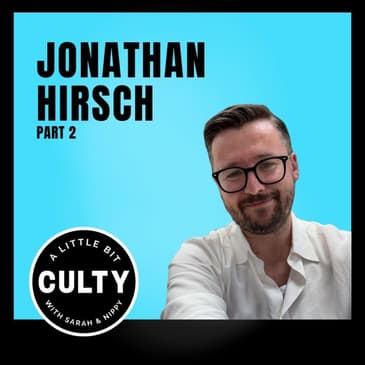
This show/episode is sponsored by BetterHelp. Visit betterhelp.com/CULTY to get started today. This is the second part of a 2 part interview with Jonathan Hirsch. Listen to Part 1 Here.
Jonathan Hirsch is an award-winning podcaster and journalist who grew up in the Adidam hippie cult. His podcast, “Dear Franklin Jones”, is about that experience. Today, he’s here to discuss the less famous—but equally culty—Jones and what it’s like for children who grow up with religious abuse.
And for more of Jonathan's work, Be sure to check out his latest podcast, “Scary Terri”, which unravels the chilling story of Terri Lee Hoffman—a spiritual leader in Dallas whose followers faced a series of mysterious deaths. Listen now: The Binge on Apple Podcasts.
Trigger warning: This episode contains discussions of sexual abuse and may be disturbing to some listeners.
Also… let it be known that:
The views and opinions expressed on A Little Bit Culty do not necessarily reflect the official policy or position of the podcast. Any content provided by our guests, bloggers, sponsors or authors are of their opinion and are not intended to malign any religion, group, club, organization, business individual, anyone or anything. Nobody’s mad at you, just don’t be a culty fuckwad.
Check out our lovely sponsors
Join ‘A Little Bit Culty’ on Patreon
Get poppin’ fresh ALBC Swag
Support the pod and smash this link
Cult awareness and recovery resources
Watch Sarah’s TEDTalk
CREDITS:
Executive Producers: Sarah Edmondson & Anthony Ames
Production Partner: Amphibian.Media
Writer & Co-Creator: Jess Tardy
Associate producers: Emma Diehl, Amanda Zaremba and Matt Stroud of Amphibian.Media
Audio production: Red Caiman Studios
Theme Song: “Cultivated” by Jon Bryant co-written with Nygel Asselin
See Privacy Policy at https://art19.com/privacy and California Privacy Notice at https://art19.com/privacy#do-not-sell-my-info.
[00:00:00] We are Teresa and Nemo and that's why we are to Shopify. The platform, which we used before Shopify, has used regularly updates, which have led to the point that the shop didn't work. Our Nemo Boards shop makes so much more of the mobile devices. The illustrations on the boards come now much clearer, what is important to us and what our brand also means. Start your test today for 1€ per month on shopify.de.
[00:00:29] This podcast is for informational purposes only and should not be considered legal, medical, or mental health advice. The views and opinions expressed do not necessarily reflect the official policy or position of the podcast and are not intended to malign any religion group, club, organization, business, individual, anyone, or anything. I'm Sarah Edmondson. And I'm Anthony Nippy Ames.
[00:00:57] And this is A Little Bit Culty. Cults are commonplace now. From fandoms to fads, we're examining them all. We look at what happens when things that seem like a great thing at first go bad. Every week, we chat with survivors, experts, and whistleblowers for real culty stories told directly by the people who lived through them. Because we want you to learn a few things that we've had to learn the hard way. For example, if you think you're too smart to get sucked into something culty, you might be prime recruitment material. And who knows? You could already be in a cult.
[00:01:28] If you're not aware of your programming, you're probably being programmed. So keep listening to find out. We'll talk about all sorts of topics on the show, but be aware, this podcast might contain stories that could be alarming to some of our listeners. So please check our show notes for more detailed descriptions and take care of yourself. Subscribe to our Patreon for Thursday bonus episodes, Q&A, and all sorts of exclusive content. That's patreon.com slash a little bit culty. Welcome to season seven of A Little Bit Culty.
[00:02:08] Welcome back, everybody, to part two with Jonathan Hirsch. If you missed part one, we recommend skipping this, going back to part one, because this one will not make sense. Do it. Well, welcome back, everybody.
[00:02:34] We're so excited that Jonathan agreed to stay on with us and tell us about so much of the other things he's covered since he did Dear Franklin Jones. And I'm guessing this was very healing for you, because we always ask our guests, like, how have you been healing from this? Yeah. Not the objective. Not the objective, but there is some, you know, what did you say earlier, emergent property? Yeah. How did this become your career and where did it go after Dear Franklin Jones?
[00:03:01] I think the process of doing Dear Franklin Jones was very healing for me. I needed to get that story out. And in a way, even though it definitely created some strain in my relationship with both of my parents, I wanted to live in the light.
[00:03:22] And so having that story out there felt for the first time like I was stepping into a world where my full self was at least, I could kind of see a shadow of it, if you will. There was a part of me that was out there that was, there's no going back when you do a big podcast like that. And I should mention too, that the show hit number one on the charts in this sort of overall Apple charts or whatever.
[00:03:50] So a lot of people heard it really, really quickly. And it was released kind of around the time that the Heaven's Gate podcast was released. And like I mentioned earlier, also Wild Wild Country came out around that time. There was just a lot of conversation around cults. You hit the zeitgeist at the sweet spot. It really was.
[00:04:13] And here was this personal story of somebody being raised in a group and trying to reconcile all the feelings that they had about the group years later. So that part felt very edifying to me that I was out there saying my piece. And by then I was already working in audio. I had started working as a producer and somewhat within journalism in the years kind of leading up to that.
[00:04:36] I had done a little podcast documentary series called Arrivals, which eventually led to me working at a investigative reporting series called Life of the Law and then NPR. And was freelancing and doing various other side projects while working at NPR at the time that I did Dear Franklin Jones.
[00:04:57] And the success of that show really changed everything for me in the sense that I very quickly was getting all these opportunities to work within audio and specifically to work in this emerging form of the limited run narrative documentary podcast series. The sort of stuff that we love listening to the things that serial really put on the map. And I had an aptitude for it. I loved working within that medium and the constraints of that medium.
[00:05:26] And so not long after the release of Dear Franklin Jones, I launched a production company called Neon Hum. And we produced all kinds of limited run narrative series, particularly the stuff that was, you know, big ticket at the time. So true crime, you know, journalism driven projects. So we worked for the Wall Street Journal. We did a bunch of the Dateline podcasts. Some of your listeners may be familiar with Mommy Doomsday, The Thing About Pam.
[00:05:56] We did Bagman, which was Rachel Maddow's sort of investigative history podcast. We became very busy very quickly. And by we, I mean my growing team of producers and engineers and editors. And eventually we went into partnership with Sony Music as they were getting into the podcasting space.
[00:06:19] And, you know, now I, I work there and I make narrative shows as well as all kinds of other programming for the network. And also I'm fortunate enough to continue to report and cover and tell stories about the key things that are interesting to me as a journalist and as a writer. And certainly a huge, huge part of that has been telling stories about cults and various different cult groups.
[00:06:48] Which is why you're here today. Do you get to pick those stories or they approach you? I think stories that end up being narrative series that we produce are things that I've pitched, you know. Got it. Okay. So yeah, I've had the opportunity to do a couple of series that are on that topic and also for other publishers as well. Well, we loved the I Am Rama, which. Thank you. Yeah. That was great. Just wonderful. Yeah.
[00:07:17] Mark's a really great voice for this because I think he, like, I think what's special about Mark's perspective and, you know, he's controversial to some of the people. Who is he for our audience? Can you explain who he is? Sorry, yes. Yeah. So Mark Lakser was a member of Rama's group. He was also very much there in the early days. Rama being the spiritual teacher is the subject of the I Am Rama series. Frederick Lenz, who went by the name Rama. My parents were involved with him as well.
[00:07:47] He's most known for being this kind of, like, hip spiritual teacher with a big head of curly brown hair and wore leather jackets and hired Playboy bunnies to be in his music videos. But then at sort of the dawn of the computer revolution, personal computer revolution, he made many of his followers become software programmers, software developers.
[00:08:06] And some of them even donated large portions of their revenues to him on the backs of their success, sort of with the understanding that he had provided some kind of spiritual empowering of their economic enterprises. So Mark Lakser was involved with Rama well before any of that stuff sort of came to fruition.
[00:08:28] So his experience is like being a young person and traveling across the country to be involved in Rama's group and then eventually defecting from it. So, yeah, he'd be a great person to talk to, I think. One thing I really like about both series is that you're entering both spaces very curiously, not judgmentally.
[00:08:50] How do you think your experience as someone who's born into a group like this affects how you approach the groups as a journalist? I think when I started doing stories about cults and cult-like groups, I felt it was very important to include the perspectives of people who joined these groups and help to explain within the narrative why.
[00:09:17] Because as listeners have probably already surmised my feelings towards my parents' decisions to be involved in the groups that they were involved in is complicated. But it doesn't mean that I don't understand that they were two searching, troubled people looking for an answer.
[00:09:39] And I think sometimes in our haste to dig into the most salacious parts of the details of these groups, we can lose sight of the fact that the people who were involved oftentimes were seeking a better life, something special, community, friendship. And in, you know, more high-minded terms, I guess, some kind of spiritual fulfillment or liberation.
[00:10:09] And so I don't ever want to be in a position where I am making things that dismisses those people out of hand. Because I think that they were earnest in their search, even if what they were seeking didn't provide that for them. And that's where the story is. That's where the wisdom is, I think. So if you can get it out of the subjects.
[00:10:33] And we were fortunate enough to have people extend us dignity, I think, you know, to get our story. And as a result of that, you know, you're here and you're propelling people there. And we're at a point where our stories helped people and we can allow other people to do it as well. You know, I think paying it forward, if you will. Yeah. That's why I appreciate what you guys do.
[00:10:53] Like, I think it is one of the things that's bothered me about narrative series around cults, both in television and in audio, has been this conflation with true crime. Now, I cover crime stories like I would consider myself a crime writer at this point and have done stories that are outside of the cult universe. And many of the stories that my team is across now are not cult stories at all.
[00:11:23] Well, that's a specific interest of mine, you know. But I think when I first did Dear Franklin Jones, there were a lot of people who, you know, out there in the universe of Reddit and, you know, in the comment sections of things. Sort of were very quick to conflate true crime with what I had gone through. And I remember the first time I saw it, I was like, I was literally confused. I didn't know what they meant. I was, it didn't compute for me.
[00:11:51] I was like, wait, why are they calling this a true crime story? Like, it didn't make sense to me. I mean, even like I was listening to that wonderful reporter on your show who did the 7M stuff for Rolling Stone. A lot of these big publications, they bundle scams and con artists, cult leaders and murderers into the same category of a beat.
[00:12:19] And that part's fine, cults, crimes and cons, like I get it. Like those are things that I'm also interested in covering. But they're all distinct in their own way. And having been raised in a group, I feel like it's my responsibility with that unique perspective and experience to not approach communities that are new to me, covering them for various different stories, without at least acknowledging the plight and aspirations of the people who get involved in the groups in the first place. And giving them some dignity.
[00:12:50] Yes. You know? Would you say that's what's missing in the approach of the rest of the media? That doesn't think about the people and their desires and their backgrounds? Yeah. Yes. I think we conflate true crime stories with cult stories.
[00:13:03] And the experience of somebody who has been under the thumb of a coercive control group is very different than the experience of somebody who is the victim of a sociopathic serial killer who, like, follows them home and murders their family. Like, they're not the same. And so narratively, if we follow the same constructs, here's an example. In crime stories, there's an inciting incident. There's the scene of the crime.
[00:13:33] There's the backing into the unraveling of the case. But I think when you look at cult stories, they often follow a very different arc. There's optimism. There's hope. There's belief. There's a person searching for more who gets sucked into something. It's almost the inverse, narratively, of a crime story. And I know I'm painting with really broad brushes, but I've been involved in a lot of these shows over the years.
[00:13:59] And so I start to see patterns of the way that people construct them and also the way that they're pitched in the room for publishers and for film and television and for books. And so that lack of awareness creates versions of stories about cults that are not true to the experience of the people who live them.
[00:14:20] And it also dismisses really meaningful versions of stories about cults that your listeners value and recognize the importance of, that general audiences do when they're given the air to actually explore that.
[00:14:41] So an example to me of a show, and maybe people feel differently, maybe I'm going to get hate for this, but the Mother God series on HBO that just came out last year. Without knowing much about that group, what I immediately gravitated towards was these people were being presented. These followers were being presented in their own words. And so we're unraveling a pretty dark story. And I think they definitely made it clear to us how this all ended.
[00:15:11] But the people who were involved in the group had an opportunity to speak in their own words about what went down. I'm pretty sure a lot of them didn't like the way they were represented. And look, I don't think everybody who was involved in my series on, definitely not on Franklin Jones and certainly on Rama too, especially if they held a candle for these people, felt like I did enough to sort of ingratiate their leader.
[00:15:40] I'm not here to be an apologist for cults, but I think there's a difference between being a cult apologist, which I know is a longstanding dialectic in these discussions, and being somebody who wants to give some breathing room to the people who wanted to be involved in these groups in the first place. Agreed. Hey, culty listeners. As you probably know, Nippy and I are working on a manuscript for our first book together.
[00:16:07] And as you probably also know, maintaining control is important to us. That's why we've decided to produce our book with the Self-Publishing Agency, or TSPA. Unlike traditional publishing, where you're often left waiting for months or even years to get your story out, the Self-Publishing Agency lets you take control of your timeline. You'll have complete creative freedom with insights and guidance from pros in the publishing world.
[00:16:31] So if you're like us and you have a story or a message that's burning to be told, we highly recommend TSPA as your go-to partner. They offer everything you need from expert editing and eye-catching cover design to marketing and distribution strategies that really make a difference. They make the entire process seamless and inspiring so you can focus on what matters most, telling your story. Go to theselfpublishingagency.com.
[00:16:54] That's theselfpublishingagency.com to start your very own publishing journey today. Enjoy. This podcast wouldn't exist without our fantastic, supportive, generous patrons. Come find us over on Patreon. We're at patreon.com slash a littlebitculti.
[00:17:21] Go there for bonus episodes, exclusive content, and the occasional Zoom with our fan favorites from our past episodes. Subscribe now and join us. That's patreon.com slash a littlebitculti. And now, a brief message from our Little Bit Culti sponsors. Remember, when you support our sponsors, you support our podcast. All right, here we are at the start of a brand new year. What do you want your 2025 story to be? Maybe this is the year you're ready for a plot twist.
[00:17:50] Or maybe there's a part of your story that's waiting for a rewrite. Life isn't about resolutions that disappear by February. It's about picking up the pen and being the author of your own life. That's where therapy might be for you. Think of it as your editorial partner, helping you shape the chapters of your life into something meaningful. Therapy isn't just for big, life-changing moments. It's a way to learn positive coping skills, set healthy boundaries, and empower yourself to be the best version of you.
[00:18:17] With BetterHelp, it's never been easier to prioritize your mental health. It's fully online, making it affordable and convenient. No need to rearrange your schedule or commute to an office. BetterHelp has served over 5 million people worldwide, offering access to a diverse network of more than 30,000 credentialed therapists with a wide range of specialties. The process is simple. Fill out a brief questionnaire, get matched with a licensed therapist, and if it's not the right fit, you can easily switch therapists anytime at no extra cost.
[00:18:48] Write your story with BetterHelp. Visit BetterHelp.com slash culty to get 10% off your first month. That's BetterHelp. H-E-L-P dot com slash culty. All right, everybody. You know me. I'm always on the hunt for different ways to make healthy eating easier for us. Because let's be honest. Between work, kids, life, who's got the time to plan and shop and cook the way that we'd like to? If that sounds familiar, I've got some exciting news. I found a solution that works for me.
[00:19:17] It's called Hungry Root. Hungry Root has been a total game changer. It's like having your own personal grocery shopper who knows exactly what you need. When I signed up, I shared my goals. Things like eating more veggies. I'm a little bit, you know, keto-ish. Sticking to high-protein meals. Finding quick, healthy snacks for me and the kids. And Hungry Root took care of everything. My last box? Total win. It had a veggie stir-fry, steak-caesar salad combo, a chicken fajita thing that the kids devoured, and this dreamy almond chickpea cookie dough.
[00:19:46] I didn't even know I needed so desperately in my life. Didn't have to make cookies. I just had to make the cookies out of the dough that came in a little container. It was brilliant. Everything was so easy to prepare and fit perfectly into our busy schedule. And here's the best part. Hungry Roots groceries don't have any bad, weird stuff. No high-fructose corn syrup. Artificial sweeteners. Preservatives. Just high-quality ingredients like meats and seafoods that are free of hormones and antibiotics, like I would look for if I was going to the store, except they come to your house in a box. Easy peasy.
[00:20:15] This has been such a weight off my shoulders. Whether you're looking for smoothie options, salad kits, snacks, supplements, Hungry Root has it covered. It's grocery shopping made simple and guilt-free. You are going to love Hungry Root as much as I do. Take advantage of this exclusive offer. For a limited time, get 40% off your first box, plus a free item in every box for life. For the rest of your life. Go to HungryRoot.com slash CULTI and use code CULTI. That's HungryRoot.com slash CULTI, code CULTI to get 40% off your first box
[00:20:44] and a free item of your choice for life. HungryRoot.com slash CULTI, code CULTI. You got it? Good. You've heard from our sponsors. Now let's get back to a little bit CULTI, shall we? I wouldn't say that your experience is much different than ours. And I would also argue, I mean, tell me what you think. You know, we're going in with these human stories and the incentives to put the attention
[00:21:12] on the perpetrator and the salacious story is something that we're often up against, even to the point where when people approached us, they wanted our story. And when the vow approached us with Nancy Abrams and Lisa Heller, they were more interested in getting the wisdom out of our stories and not the salacious aspect. So the incentives, it seems like, in the industry and even the understandings are somewhat off. And that seems to be where I think we're informing it and you're certainly informing it as well differently. Yeah.
[00:21:40] So as to extract the wisdom so we can move forward and ultimately be something people reference as help and not, oh, did you hear that branding story here? Yeah. Which undermines, I think, what I think we're trying to do. Yeah, same here. Same here. And I am just as much a consumer of true crime and cult stories as I am a creator of them, as I am somebody who survived a group.
[00:22:06] So I can see how there's some contradictions that start to bubble up when you kind of navigate all of that. I still like being entertained by a good documentary. I like creating documentaries that are entertaining. But I have some lines in the sand when covering these groups. And one of them is to give airtime to people who have experienced the group and had an earnest and honest approach to getting involved.
[00:22:36] And I don't ever want to lose that. I don't think the medium deserves to lose that. And yet I think it was the first thing to go when people started saying, oh, I like cult stories.
[00:23:13] I totally agree. I think it's a great thing to go when people are coming over. And I don't think the people are going to be able to do that. Do you know what I mean? Right. I completely do. Yeah. We heal together. And so there's a power to these narratives being understood. And I do think that, you know, that's a responsibility I feel. One of my mentors when I worked at NPR was Kelly McEvers, an investigative reporter, and I worked with her on her show Embedded.
[00:23:39] And one of the things that she always talked about, and she highlighted it in a very particular way, which was meaningful to me, not necessarily completely unique to her, but meaningful to me, which was, you know, there's various different kinds of journalism, right? There's like hard news. There's the fourth estate you're holding like truth, you know, holding power accountable, speaking truth to power. But then there's this other form of journalism that we sometimes don't appreciate, which is for the record, storytelling for the record.
[00:24:09] And I think the latter half of the 20th century in particular, and even to this day, and the story that's happening right now around cults is a different one. And I'm trying to dig into that too, as a reporter and a storyteller, but like the latter half of the 20th century experienced a proliferation of various different cult-like groups. And it came from all kinds of complex, multi-generational, you know, challenges, particularly in American life.
[00:24:35] And we have a responsibility to future generations to tell those stories for the record, you know? I love that. That's very powerful. I was just looking at my notes about Rama because, you know, Nippy and I listened to it and I was texting him and being like, like, did you, I'm almost positive that Keith crossed paths with Rama at some point, especially when he was in Westchester or in New York, White Plains in that area. Like that's when he would have been living there and doing his thing.
[00:25:03] And he was actually, we know that he went to some other. Yeah, he did go somewhere. Like he went to City Yoga, which was in upstate New York as well. And like saw how the guru was being fawned over and was like, I want to, I want that. I would like a little piece of that action. And basically, you know, created NXIVM with the help of Nancy Salzman so that he could be a guru and, you know, have a harem eventually. Do you think it's possible? Did you have any sense of that when you heard about NXIVM?
[00:25:29] You know, I didn't see, I didn't specifically notate any of that, but now I feel like when I get something in my head too about this, like I'm not going to let it go. So I'm going to do, I, like I have these shows that have been out for years and I'm still poking around at parts of the Rama story that I feel like haven't fully been told yet. I'm very preoccupied in particular with one of the people that we covered in the series, Brenda Kerber, who was a follower of Rama's.
[00:25:59] And I guess we can get to her in a second, but yeah, I'll take a look. I feel like we've, the three of us have plenty to talk about over the months and years to come, but I definitely want to take a look and like see if I can see any sort of connections there. There has to be. There has to be. And also strangely enough, and this is something I've had in my mind as like a side project of Unsolved Mysteries of Keith Raniere, there is a woman who disappeared and some also think that she drowned. She went for a kayak trip. Her car was parked in the water. They never found her body.
[00:26:27] And she was an ex-member. There's a couple of stories around him that I want answers to. That are like cold cases in his peripheral that I think need to be addressed. So bookmark on that. Yeah. Sidebar. Maybe there's a whole series in that. Yes, I think there could be. You can go visit him in Tucson. You can visit him in Tucson. You can ask him yourself. I have a message for you to give to him. Yeah. When you hear the word Rama, do you also then say Rama, Lama, ding dong in your head? Because I do. Is that just me?
[00:26:55] I think being around so much, you know, like Hindu mythology and ideas and philosophy over the years, it doesn't, it's not the first thing that comes to mind. I will also say that like there's many pop culture references that I'm completely lost on because I spent most of my childhood in a space that was like encapsulated, you know? So I spent a lot of my 20s like catching up on the 80s.
[00:27:21] Well, get used to it with kids because I'm finding out there's a lot of pop culture references I don't know. And I was not in a cold. I was right next to my kid and he brings him home and I'm like, what is Riz? So two other similarities. Keith Raniere also took a percentage of any business that you started in the company. So if you're using the tech in your company to give him a percentage. The company. The company had 10%. I think it was 10% or 20% depending on the thing. Also, he had people apply.
[00:27:50] They were filling out applications, not just joining. So I think those are the two things he stole from Rama. Yeah. I mean, there are so many threads too like that come from these various different, like these ideas were in the ether, right? Like I think about Franklin Jones too. He was briefly involved with Scientology.
[00:28:09] So you can see a lot of the kind of group session stuff that they were doing, like with the Oedipal and whatnot, as almost having its precedent in things like Est and in Scientology as well. And then kind of morphed into these other worlds. So I feel like Rama was tapping on the vein of that same stuff. Also, it's the same thing in religion. Like there's always someone that's going to come along, see what you're doing and go, I can do that. Maybe better. Yeah. Right. Right.
[00:28:37] It's the same thing with the gurus and the, you know. Yeah. There's an iterativeness to it, you know. And I'm sure for some people who might have aspired towards that, they looked at somebody like Franklin Jones and he had this massive community of people who were like rabid followers of his and, you know, deeply invested in his mission and wanted that. And maybe the island in Fiji. Yeah. So tell us about some of the things you're doing now specifically.
[00:29:04] I'd love to hear about the Scientology that, did you know about the Rick Ross connection with NXIVM? With NXIVM? No, I'm not as familiar with it. I think I did hear that he was sort of involved in, but yeah, I don't know, I don't know a ton about that part of it. Yeah. When we were in, he was the person that was like, you know, we thought he was the devil. Like Rick Ross. He was the first enemy. He was the first enemy. The first enemy. And I think, I want to get this right, but NXIVM was suing him for like a decade. I believe that. Yeah. Yeah. Yeah.
[00:29:31] Well, and I think Rick Ross was very frightening to certain groups. And blunt. Yeah. Yeah. And something that sort of made me curious about him and, you know, he's not an official member of this, but the Cult Awareness Network, which was this like kind of an advocacy organization from the 80s and 90s that provided information around cults, various different cults.
[00:29:56] So if you had a family member that was in one, you could call up the hotline and they would, you know, provide you with information. And in a way, though, many people denied this, they did at times act or at least volunteers of theirs acted effectively as a clearinghouse for deprogrammers.
[00:30:13] So if you were afraid that a member of yours, a member of some group, a family member was in a cult, they would aid you in finding a deprogrammer who could help get your, extract your family member from the group. And I'm very fascinated with the whole history of that organization.
[00:30:36] And I first became exposed to it when doing the Rama series, because kind of back to your earlier point about Rick Ross being this frightening character for people in NXIVM. There was a point at which another sort of infamous deprogrammer, Joe Simhart, was in the tri-state area for a period of time. And Rama's followers were alerted to that.
[00:30:59] And according to accounts that were provided to me, they believed that he posed an imminent threat to members of the group. And like everybody was like trying to get out of New York so that they didn't get chased down by Joe Simhart and the cult awareness network. So there was a fear that these groups were being targeted by the cult awareness network, by people like Rick Ross.
[00:31:25] I'm not sure if those are unfounded fears for cult groups at the time. They were certainly, there was a kind of cult war that was going on at the time. And ultimately, the interesting thing about the cult awareness network is that they didn't survive. They were sued out of existence and their assets were purchased in bankruptcy court by members of the Church of Scientology.
[00:31:52] So when you called the cult awareness network hotline, somebody very different answered the phone than they did. Have you ever called that hotline? A few years ago. I'm not sure if the hotline is in existence anymore. Let's call it right now. I think we should. Give them a ring. From someone else's cell phone. So we don't have Scientology with our phone number. When does that series come out? In the spring. And I wish I could tell more of the details to come.
[00:32:18] But I'm working with an incredible colleague who's in this space as well. And we're just doing a deep dive into that organization. Amazing. More on that to come. I guess this little space, this niche that we're in is pretty small. We probably have lots of- It's pretty small. Maybe. I'm surprised we haven't connected sooner, actually. I know. It's wild. It's wild. And I'm so glad that we have. And just I'm enjoying talking to you guys. I hope other people don't think I'm too sprawling in discussing all this.
[00:32:48] So much to cover. So much to cover. And I had this thought earlier, but I don't want to interrupt you. Yes. And this is a bit out of context. But in part one, you were talking about just sort of the nature of the way that the leaders of these groups prey on desires. And the point I want to make is that I just feel like every generation has different vulnerabilities. But I think now one of the protections, or at least something that's different in our or now, I think not so much for us because we were obviously victims too, but like just
[00:33:15] the conversation around attachments, attachment needs. Like I'm sure as a parent, you're familiar with all that. And your parenting style is probably very different after your whole experience. But there's just, you know, we're more educated now as a culture, I think. Maybe not everybody, but just that's a shift. Well, it started at least in large part in the last, from my perspective, seven, eight, 10 years, like where people aren't dismissive of these kinds of things and more sensitive to the trauma aspect. Yeah.
[00:33:44] I mean, like a friend of my wife, and we've certainly been good acquaintances. I don't want to throw it out there like we're like, oh, it's my friend. But I really appreciate her work. And she's been an incredible journalist for many, many years and worked at This American Life and Snap Judgment and recently wrote a book called What My Bones Know. Her name is Stephanie Fu. I believe it was a New York Times bestseller. It's about CPTSD. And I didn't know this history of hers when I knew her.
[00:34:13] But I remember reading her book and like this light bulb going off in my head that, you know, in a way we're beginning to understand and diagnose trauma that is consistent, low level over a period of years, such that it seeps into the bones. And I think that's sort of the metaphor there, right? Like it enters your nervous system.
[00:34:40] It insinuates its way like some kind of psychological, I don't even know what to describe it. It becomes part of who you are. It's like inextricable from your being. And it can inform your decisions. It can inform how you approach conflict and how you parent and a lot of those things that when I read her book, I immediately just felt like I was being spoken to through her experience.
[00:35:10] And it was an important, you know, coming to the realization that you can't just disentangle yourself from a group physically. This idea that a cult is something that is hard to get into and easy to get out of. Somehow, the way that the people in the group sort of excused the group that I grew up in as not a cult, it flies in the face of my experience of what the impact of being
[00:35:40] in that group was, which is you never really get out. You cope with the pieces of your own body that are imprinted with what you've experienced. But that's different than sort of suggesting that you can sort of get out. You can physically get out. Physically get out of anything, you know, most things, hopefully. Hopefully everybody can physically get out of everything. Have you heard the terms Pimo and Pomi? No, I haven't.
[00:36:09] So there's a lot of like Jehovah's Witness and Mormons and stuff who like wake up and they recognize they want to leave, but they can't because they're like in the community and their whole lives are the community. So that's called physically in, mentally out. And then we have physically out, mentally in. People who leave, but they're not untangled yet or fully woken up yet. But and every, you know, obviously it's not one or the other is like many, you know, spectrum in between.
[00:36:38] For more context on what brought us here, check out my memoir. It's called Scarred, The True Story of How I Escaped NXIVM, The Cult That Bound My Life. I narrate the audio version and it's also available on Amazon, Audible and at most bookstores. And now a brief message from our Little Bit Culty sponsors. And remember, when you support our sponsors, you're supporting this podcast. If you're fascinated by the darker sides of humanity, join us every week on our podcast,
[00:37:06] Serial Killers, where we go deep into notorious true crime cases. With significant research and careful analysis, we examine the psyche of a killer, their motives and targets and law enforcement's pursuit to stop their spree. Follow Serial Killers wherever you get your podcasts and get new episodes every Monday. We're Teresa and Nemo. And that's why we switched to Shopify.
[00:37:36] The platform, the before Shopify used, has used regularly updates, which sometimes led to the shop that didn't work. Our Nemo Boards Shop makes so much more of the mobile devices a good figure. And the illustrations on the boards come now much clearer, what is important to us and what our brand also means. Start your test today for 1€ per month on Shopify. www.shopify.de.
[00:38:07] Break time's over, people. Let's get back to this episode of A Little Bit Culty. It's a good one. Clearly, you've healed tremendously through your reporting and through your investigation and therapy. Is there anything else you think that's important for our listeners to know of what you've gone through to bring you to here? Oh, it's a good question.
[00:38:32] I think it took me maybe too many years to realize that you build a life. You know, there's parts of it that come without effort. You fall in love. You meet somebody. You know, you get married. You have a family. You make friends along the way at work, school, whatever. And then you look back and you're like, wow, I have this life. I live in the city. I have certain interests. I go to certain things, right?
[00:39:00] But when you're raised in an environment where whatever was built is completely shattered, there comes a time where you not only have to reconcile with, at least I did, there came a time where I not only had to reconcile with what had happened to me, but to truly move past it and to have the life that I wanted, I had to build something from scratch in a way. And I had some pieces.
[00:39:29] I had some puzzle pieces there. I have my wife and my two beautiful boys. And I have a career that I love. I've found a discipline that matters, that allows me to put into practice my experience and my passions and to tell stories and to continue to do it and to do it fearlessly. But there's also more to building a life than just that.
[00:39:58] And part of it is not living in the past. And so how do you get to a place where you're building on something rather than running from what's come before? And that's what I would say I'm trying to work on right now as a person. And I don't have all the answers. But it was a subtle distinction, a shift for me, that was really, really important
[00:40:24] in sort of propelling me to a different point of view, right? Like I felt like I was starting something new again rather than running from something old or trying to wrestle good from the bad. Do you know what I mean? Yep. Well put. So I hope that helps. Yeah. Yeah, it does. Yeah. In that process of wrestling the good from the bad, which again, I really want to reiterate that we appreciate and we don't experience that as apologist-ist-nest.
[00:40:54] Yeah. It's really, for us, like part of the giving and lending dignity to understand, you know, why do people stay? Otherwise, we just look like idiots, right? Being a part of something abusive, there's always good stuff. What, if anything, did you pull out that was good and do you attribute it to other things or other thoughts or like where are you now with your spiritual practice, if anything?
[00:41:17] I mean, I think that meditation as a practice has been effectively disentangled by the brilliant scientific community from the spiritual components of meditation. There is a value to it. So I meditate, but I don't meditate for those, maybe the reasons I would have when I was a kid or as a young person.
[00:41:40] I would say back to the point about lending, giving space to people in these stories about cults for their hopes and dreams, their aspirations and what they were seeking. I guess I haven't really thought of it this way before or said this out loud, but I appreciate the fierce heart of my parents.
[00:42:09] Their deep instinct to have a life that was better than what they had, to move past whatever it was that ailed them into something better. And it is very easy when you're that passionate to go the wrong way.
[00:42:30] And all I ever wanted from them for that series, all I ever wanted in Dear Franklin Jones was an acknowledgement that maybe life wasn't this one straight arrow trajectory towards spiritual fulfillment and liberation, but that you can make a wrong turn. And I can take you down a side road. You can stray from the damn plot. And that is fucking okay.
[00:43:00] And if you can't accept that for yourself, your kids aren't going to be able to accept it either. And it's just all I want for my boys is to live a life where they can see me as a flawed person and they can see me building a life from that foundation. And that whatever side roads they find themselves on, they can get back to the path and feel okay about that.
[00:43:29] And I don't think my parents had the ability to see that in their life so far. And maybe they do and maybe I'm selling them short, but certainly my dad and I never had a conversation where that was present. And so I hope for that. When I listened to it, I hadn't thought of that part of your perspective and how hard that must have been and how much I can totally imagine that. Like, just, can you just acknowledge that maybe you took it a little too far? Just say sorry. It was really hard for them.
[00:43:57] It was, I mean, I didn't appreciate how hard it was for them because they had bought into a philosophy that was about their own, like that they were moving in the right direction. I'm like, hey shit, that's part of life in my opinion, that you don't always move in the right direction. And in fact, you can get entangled in a direction that's not working for you for a long time.
[00:44:24] If you believe that the outcome is supposed to be better than what it was before, you know? My parents even went so far as to believe, they had this belief that they're like, if they became more spiritually liberated, that it would be an inheritance to me. And I feel like it was quite the opposite, inheritance. And so then when you come back to them, and I know they don't mean it this way, and I don't mean to use this term so loosely,
[00:44:50] but like, it's a little gaslighty, you know, to have your kids grow up and be like, hey, this was rough, right? And them being like, what are you talking about? He was a spiritual master. That's what we had to accept. And you're like, well, don't you think like maybe the fact that you defected from the group and wanted to write a book called The Vampire's Kiss says something about the fact that maybe you don't think it all worked out well? And they're like, that is not a conversation that we could have, which is unfortunate. Yeah, that is unfortunate. B always teases me that I cry a lot.
[00:45:18] And I didn't expect to be emotional in this episode. I didn't either. I'm tearing up a little bit. I tease you because you announce it. I'm announcing it right now. Not that you're emotional. Speaking about just the fierce heart of really wanting better, it really hit me. And I think that's part of the dignity you lend your yes to, the people you've covered in your work. It's really important. And it's just such a pleasure to be able to do this.
[00:45:45] So I pinch myself and I'm like, we're so lucky. This is the silver lining of the Keith Raniere Next Team Shit Show is that here we are talking to you about these crazy stories. And it is cathartic and healing. And yeah, I appreciate your time. It means a lot to me. Thank you, Jonathan. You lived up to expectations and then something. I always love hearing the journalists talk because they've clearly thought through it a lot more. Well, I appreciate that. And I'm grateful for the opportunity.
[00:46:14] And I hope that we stay in frequent touch from here on out. Yes. Please. Because we're waiting in the same waters. Yeah. Hopefully we have projects then. Yeah. If you ever need a host that's not you, please reach out. I mean, yeah. You guys are doing a really important service to all of us who have been through this. And I'm just grateful to have a chance to meet you both. So thank you very much. Thank you, Jonathan. For doing what you do. Thanks, mutual. Till next time. Yeah. Yeah.
[00:46:44] Till next time. Awesome. If you like the show, please consider supporting us by giving us a rating, a review, and subscribe on iTunes. Cults are commonplace now, and we're looking at them all. And every little bit helps. Hit that subscribe button so you don't miss an episode. Well, that's a wrap on part two, everybody. We hope that y'all enjoyed it as much as we did.
[00:47:10] Do yourself a favor and listen to Franklin Jones, the miniseries that he recorded. It's very informative and very well done. And it's important to remember that the innocent kids trapped in these cults have a whole different story to share. And Jonathan's story is a great example of surviving and thriving, and we appreciate him sharing it with us. So if any listeners want to learn more about his story, check out Dear Franklin Jones. He also has a memoir coming out next year, as well as some other culty series, including Scary Terry on the binge.
[00:47:39] Yes, we are listening. And yes, we will be doing an episode with one of her survivors and possibly even have Jonathan Hirsch back to talk about the making of Scary Terry. Check those out. And you can follow his work on Instagram. At thisisjonathanhirsch. Till next time. Bye.
[00:48:15] A Little Bit Culty is a Trace 120 production. Executive produced by Sarah Edmondson and Anthony Nippy Ames, in collaboration with Amphibian Media. Our co-creator is Jess Temple-Tardy. Audio engineering by Red Cayman Studios. And our writing and research is done by Emma Diehl and Kristen Reeder. Our theme song, Cultivated, is by the artists John Bryant and Nigel Aslan. We'll be right back.