
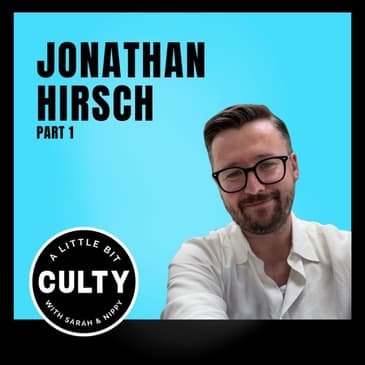
Jonathan Hirsch is an award-winning podcaster and journalist who grew up in the Adidam hippie cult. His podcast, “Dear Franklin Jones”, is about that experience. Today, he’s here to discuss the less famous, but equally culty, Jones and what it’s like for children who grow up with religious abuse.
And for more of Jonathan's work, Be sure to check out his latest podcast, “Scary Terri”, which unravels the chilling story of Terri Lee Hoffman—a spiritual leader in Dallas whose followers faced a series of mysterious deaths. Listen now: The Binge on Apple Podcasts.
Trigger warning: This episode contains discussions of sexual abuse and may be disturbing to some listeners.
Also… let it be known that:
The views and opinions expressed on A Little Bit Culty do not necessarily reflect the official policy or position of the podcast. Any content provided by our guests, bloggers, sponsors or authors are of their opinion and are not intended to malign any religion, group, club, organization, business individual, anyone or anything. Nobody’s mad at you, just don’t be a culty fuckwad.
Check out our lovely sponsors
Join ‘A Little Bit Culty’ on Patreon
Get poppin’ fresh ALBC Swag
Support the pod and smash this link
Cult awareness and recovery resources
Watch Sarah’s TEDTalk
CREDITS:
Executive Producers: Sarah Edmondson & Anthony Ames
Production Partner: Amphibian.Media
Writer & Co-Creator: Jess Tardy
Associate producers: Emma Diehl, Amanda Zaremba and Matt Stroud of Amphibian.Media
Audio production: Red Caiman Studios
Theme Song: “Cultivated” by Jon Bryant co-written with Nygel Asselin
See Privacy Policy at https://art19.com/privacy and California Privacy Notice at https://art19.com/privacy#do-not-sell-my-info.
[00:00:00] We are Teresa and Nemo and that's why we switched to Shopify.
[00:00:04] The platform, which we used before Shopify, has used regularly updates, which have led to the shop that didn't work.
[00:00:11] Our Nemo Boards shop makes so much on mobile devices a good figure and the illustrations on the boards come now much clearer,
[00:00:18] what is important to us and what our brand also makes.
[00:00:22] Start your test today for 1€ per month on shopify.de.
[00:00:29] This podcast is for informational purposes only and should not be considered legal, medical or mental health advice.
[00:00:35] The views and opinions expressed do not necessarily reflect the official policy or position of the podcast
[00:00:39] and are not intended to malign any religion group, club, organization, business, individual, anyone or anything.
[00:00:54] I'm Sarah Edmondson.
[00:00:56] And I'm Anthony Nippy Ames.
[00:00:57] And this is A Little Bit Culty.
[00:01:00] Cults are commonplace now. From fandoms to fads, we're examining them all.
[00:01:04] We look at what happens when things that seem like a great thing at first go bad.
[00:01:08] Every week we chat with survivors, experts and whistleblowers for real culty stories told directly by the people who lived through them.
[00:01:15] Because we want you to learn a few things that we've had to learn the hard way.
[00:01:19] For example, if you think you're too smart to get sucked into something culty, you might be prime recruitment material.
[00:01:25] And who knows? You could already be in a cult.
[00:01:27] If you're not aware of your programming, you're probably being programmed.
[00:01:31] So keep listening to find out.
[00:01:33] We'll talk about all sorts of topics on the show, but be aware, this podcast might contain stories that could be alarming to some of our listeners.
[00:01:40] So please check our show notes for more detailed descriptions and take care of yourself.
[00:01:45] Subscribe to our Patreon for Thursday bonus episodes, Q&A and all sorts of exclusive content.
[00:01:50] That's patreon.com slash a little bit culty.
[00:01:52] Welcome to season seven of A Little Bit Culty.
[00:02:01] Hey everyone, and welcome back to another episode of A Little Bit Culty.
[00:02:12] Today's guest is Jonathan Hirsch, a journalist and award-winning podcast producer.
[00:02:17] He wrote and hosted Dear Franklin Jones, a podcast which we loved about his childhood in the Adidam cult.
[00:02:24] If you're not familiar, which we weren't, Franklin Jones founded Adidam in the 1970s.
[00:02:29] He drew from Eastern religion and pop psychology, both big in the counterculture movement at the time.
[00:02:34] Basically, he was a hippie guru.
[00:02:36] But over the years, Jones went from guru to something a little more radical.
[00:02:40] He believed he was the only path to enlightenment, a literal God.
[00:02:44] His people were convinced he had a supernatural effect on world events.
[00:02:48] Oh, and he used their money to buy a private island in Fiji.
[00:02:52] Sound familiar?
[00:02:52] Lots of themes.
[00:02:54] As his ego grew, so did the cultiness.
[00:02:56] Jones isolated his followers and treated them like servants.
[00:02:59] He controlled what they ate and who they had sex with.
[00:03:03] There were also reports of physical imprisonment on his island.
[00:03:06] Jones abused people in just about every way you can think of.
[00:03:09] Also, the sexual practices in Adidam ranged from bizarre to inhumane.
[00:03:13] So big trigger warning.
[00:03:15] Jones died on his island in 2008.
[00:03:18] He never became a household name like a certain other Jones, but he does have followers to this day.
[00:03:23] Our guest, Jonathan, was raised in Adidam.
[00:03:26] He had a chaotic childhood with guru chasing parents and overcoming that wasn't easy.
[00:03:30] In his podcast, Dear Franklin Jones, he grappled with his past and the man who had such a hand in shaping it.
[00:03:37] Jonathan's here to tell us what it's like for children growing up in cults.
[00:03:40] His story is fascinating.
[00:03:42] So let's welcome him to the show.
[00:03:59] Honestly, I'm so appreciative for the opportunity and thank you both for inviting me on.
[00:04:05] It's really, really a pleasure.
[00:04:06] So thank you.
[00:04:07] It is such a pleasure for us too.
[00:04:08] There's so much to talk about.
[00:04:10] Well, I'm really happy to hear that.
[00:04:12] We're in watch and learn mode too.
[00:04:13] So I appreciate that so much.
[00:04:15] I think I can really relate to the sense that you're navigating very intense and sometimes dark places that people went to in their lives, that people go to when they join groups that use coercive control, cult-like groups.
[00:04:32] And many of us survive those things and try to build a life.
[00:04:38] And there's, at least for me, a lot of pain and heartache that went into finding what that life was going to be for me.
[00:04:46] But it doesn't mean I want to live in a state of desperation and sadness and pain forever.
[00:04:54] I would like to move on and have a healthy, happy life.
[00:04:58] I appreciate what you just said because it's very true.
[00:05:01] Yes.
[00:05:01] I mean, there's just so much crazy cult crossover in listening to some of your projects.
[00:05:06] I was like, oh God, I was just taking furious notes.
[00:05:09] But do you know how we originally heard about you?
[00:05:12] No.
[00:05:13] No.
[00:05:13] Okay.
[00:05:14] So.
[00:05:15] I was like, uh-oh.
[00:05:17] It's been on my wrist.
[00:05:17] No, I'm so fascinated.
[00:05:19] Yeah.
[00:05:19] Two things is that one, I was part of a cult recovery organization that no longer exists.
[00:05:24] Okay.
[00:05:25] And Mark Lakser was on that board.
[00:05:28] Mark Lakser.
[00:05:29] From Rama.
[00:05:29] I know Mark Lakser.
[00:05:30] Yes.
[00:05:30] So that's crazy.
[00:05:32] Secondly, when we were, we had a new project and I was telling my friend, Josh Block from Escaping NXIVM, right, about it.
[00:05:42] And he's like, you should talk to Jonathan Hirsch from Neon Hum.
[00:05:45] So that's when I started looking into your work and that's when I like made the Rama connection.
[00:05:49] But I didn't know anything about Franklin Jones.
[00:05:52] And it's weird because I feel like we know every single cult or cult-like or cultish figure that's ever existed.
[00:05:59] So.
[00:06:00] Particularly the ones that rhyme with Keith Raniere in practice.
[00:06:02] Yeah.
[00:06:03] Like, especially ones that are so similar or crossed over in the same time period.
[00:06:06] So I was really kind of excited to find a new person, Franklin Jones, through you and Josh.
[00:06:11] So there you go.
[00:06:12] That's why we're here.
[00:06:13] Wow.
[00:06:13] Yeah.
[00:06:14] I mean, these groups do have so much overlap too.
[00:06:17] I was thinking about that the other day.
[00:06:18] Of course, Mark Vicente was the director on.
[00:06:23] Yes.
[00:06:23] You know.
[00:06:24] What the Bleep.
[00:06:24] What the Bleep, which of course was co-created by a member of Rama's group.
[00:06:30] Yes.
[00:06:31] Then that was my other crazy crossover story.
[00:06:33] When you mentioned Will Arndt's name in the Rama, I am Rama, which is fantastic, by the way, our listeners are going to love it.
[00:06:39] Thank you.
[00:06:39] More on that in part two.
[00:06:41] Yes.
[00:06:42] I thought, wait, Will Arndt, that's such a familiar name.
[00:06:45] Will Arndt, Will Arndt.
[00:06:46] And they're like, oh, with the bleep.
[00:06:47] Of course, which is, as you probably know, my foray into NXIVM is through Mark Vicente and with the bleep.
[00:06:52] Right.
[00:06:52] Right.
[00:06:52] What a weird little small culty.
[00:06:54] It really is.
[00:06:55] Ex-culti world.
[00:06:56] I thought at some point it would be useful.
[00:07:00] I think part of my career now as a journalist and as a storyteller in this space is tracing some of the histories here that are unknown.
[00:07:10] I'm working on a project that we can get into as we discussed that kind of tries to trace some of that history.
[00:07:17] But I've also always thought, and maybe I will write this book someday, that there's a book in there about an era of charismatic spiritual teachers that sort of touched on this kind of post-hippie era zeitgeist among boomers in particular.
[00:07:38] Mm-hmm.
[00:07:39] Who were looking for something more than the Eisenhower era white picket fence, who saw in the 1970s after a decade of Vietnam, the sort of rise and fall, if you will, of the hippie movement, a professionalizing of a generation of people, many of whom were doing all sorts of crazy shit in the 60s and 70s.
[00:08:02] Yes.
[00:08:26] Into the 80s.
[00:08:32] Which really gained steam in the 80s.
[00:08:34] Was, I think, a kind of searching for reconciliation from a movement that they saw starting in the 60s that started to lose steam.
[00:08:44] And they're middle-aged by then.
[00:08:46] And it doesn't seem coincidental to me that by the early 80s, there was a proliferation of groups and teachers that kind of fit that profile, that fit the profile of Franklin Jones, that fit the profile of Rama.
[00:09:06] And, of course, there's traditions that sort of spin out from there, Ramtha and all of that, right?
[00:09:13] There's Rajneesh, who my parents were also involved with.
[00:09:17] Little known story that hasn't made it into any of my projects yet.
[00:09:21] I've talked about it.
[00:09:23] Ironically, when I was doing Dear Franklin Jones, I was trying to detail my parents' spiritual history.
[00:09:29] And we got to Rajneesh.
[00:09:31] My dad was corresponding with him.
[00:09:34] They had gone up to Rajneeshpuram in Oregon and had been there right around the time that they started to arm themselves.
[00:09:41] And it freaked them out and they left.
[00:09:42] And that was kind of it.
[00:09:44] But Rajneesh gave my dad a spiritual name, Swami Anand Rama.
[00:09:49] He saw himself as having some kind of special relationship with Rajneesh.
[00:09:52] Rajneesh did this with a lot of people, but he definitely did it with my parents.
[00:09:57] And we didn't mention it in the documentary podcast on my life because it was before Wild Wild Country.
[00:10:05] And I remember thinking as I was writing it, there's like too many gurus.
[00:10:08] Like no one can keep track.
[00:10:10] Nobody knows who these people are.
[00:10:11] This is 2017, right?
[00:10:14] Nobody knows who these people are.
[00:10:16] Like too many gurus, too many gurus.
[00:10:17] We just cut Rajneesh.
[00:10:19] And then literally the show came out.
[00:10:21] And I believe it was a handful of days later, 10 days later, that Wild Wild Country came out.
[00:10:27] And I was like, oh my God, now everybody knows who Rajneesh is.
[00:10:30] And I just cut the whole scene about my parents being involved with him.
[00:10:34] Well, I wear this dress in honor of them then since the audience can't see him wearing orange and pink and purple.
[00:10:40] I just thought it was a good vibe for your whole story.
[00:10:42] It really is.
[00:10:43] And we could talk about the color orange because it had like a very specific meaning for them too.
[00:10:47] I was just going to ask, would you say that late 80s, early 90s is kind of like the New Testament versus the Old Testament kind of movements?
[00:10:55] It didn't work the first time.
[00:10:57] People got succumbed into yuppies because that's the joke growing up.
[00:11:00] My dad said all the hippies that he knew grew up to be yuppies.
[00:11:02] Yeah.
[00:11:04] I mean, it's such a common, like that's so edifying to hear, right?
[00:11:07] Because I really do think of a certain generation.
[00:11:10] We've missed that part of the history culturally.
[00:11:14] Like what excited people.
[00:11:16] The counterculture movement in the 60s was so dominant.
[00:11:22] Like we, culture is so fragmented by comparison today.
[00:11:25] I don't think we appreciate how many people were all listening to the same music and doing the same drugs and experimenting with the same kinds of life.
[00:11:37] Like it's not the same now as it was then.
[00:11:40] And that was a perception people had.
[00:11:42] Like everybody's growing up and getting jobs and becoming suits while an increasingly smaller group of people were still, in my parents' eyes at least, in search of the truth.
[00:11:54] Right?
[00:11:55] That they were like going to find something that other people had lost.
[00:12:00] Also feels like a little bit of a doubling down.
[00:12:02] Yeah.
[00:12:03] Right.
[00:12:03] Yeah.
[00:12:04] And speaking of that, we always start with like, you know, what did you sign up for?
[00:12:08] What did you think you were getting into?
[00:12:09] And obviously you were born into it.
[00:12:10] So your parents were looking for the truth.
[00:12:12] They were on this spiritual journey.
[00:12:14] Tell us a little bit about what was going on for them and the precursors to meeting.
[00:12:18] Should we call him Franklin Jones versus Adidas?
[00:12:21] Yeah.
[00:12:21] Yeah.
[00:12:22] I'm happy to lay out the names.
[00:12:23] I've made a choice over the years to call him Franklin Jones.
[00:12:26] Call him by the name that he was given, not the name that he chose to present himself to his followers as.
[00:12:31] His founding father name.
[00:12:33] Yeah.
[00:12:34] His founding father name.
[00:12:34] Sounds like a founding father.
[00:12:35] Sounds like that he does.
[00:12:37] The constitution.
[00:12:38] I think using his name, his given name, also is a conscious choice to not disambiguate his personal history from the spiritual history that his group has created around him.
[00:12:52] So, yeah, I think this is another place where I have, in a way, kind of unwittingly assigned myself the beat of doing, have feel the responsibility as a journalist and a storyteller to cover over the course of my life, which is the experience of people who are raised in cults.
[00:13:11] I did not choose to be a part of Franklin Jones's group.
[00:13:17] I inherited that spiritual journey from my parents.
[00:13:23] And so when I was a little kid, my parents were very much interested in Franklin Jones.
[00:13:31] When I was a really little kid, you know, when I was two, three, four, five, six, it wasn't until my sort of preteen years that they became very active members.
[00:13:42] But as a kid, I saw iconography of Franklin Jones everywhere.
[00:13:49] Franklin Jones was born in Jamaica, Queens, New York in the mid-century, mid-20th century, and went to Western colleges in the 60s and 70s.
[00:14:02] So he graduated from Columbia and he spent a stint at the Stegner Fellowship at Stanford.
[00:14:08] And after that, he went east in the late 60s, I believe, early 70s, and began to embrace various different forms of alternative spirituality, Eastern philosophy.
[00:14:23] He found a guru and then came back to California and opened up a bookstore on Melrose Avenue in the early 1970s in Los Angeles and began teaching out of that bookstore.
[00:14:38] Metaphysical bookstores, New Age bookstores in the 70s were these like places of culture and where you could get access to a lot of these different ideas about metaphysics and spirituality that you didn't see in other places.
[00:14:54] It's not as easy as Googling it the way it is today.
[00:14:57] People really did have to seek out these things.
[00:15:00] And so this bookstore became kind of a cultural hub, but also a place for him to market himself as a spiritual teacher.
[00:15:10] By the late 1970s, he had built quite a following for himself, probably in the thousands, though they were very guarded about what the numbers were and what it meant to be a member at any one time over the years.
[00:15:24] There were some estimates that it was all the way up to 10,000 worldwide at different points.
[00:15:29] My parents became exposed to Franklin Jones's teachings in the early 1980s and then eventually they became followers really formally in the mid-80s, like around 1986.
[00:15:42] And I was born in 1984, last day in 1984.
[00:15:45] So they joined shortly after I was born, but they didn't, like I said, they didn't really become entrenched members in the group.
[00:15:54] And that meant like always paying their tithe, which was, I believe, at least 10% of their salary.
[00:16:01] That meant living or cohabitating with other members of the group, which a lot of people did.
[00:16:06] And ultimately for them, it meant becoming involved in Franklin Jones's inner circle, which happened when I was a teenager.
[00:16:15] So when I was little, there were photographs of him around.
[00:16:18] There were, you know, there was a giant cardboard cutout of Franklin Jones that was life size, that was sitting on our couch when he opened the door to our house in San Francisco when I was a kid.
[00:16:31] Not creepy at all.
[00:16:32] Not creepy at all.
[00:16:33] Needless to say, not a lot of people were invited over to our house that weren't members of the group.
[00:16:37] But to me, I didn't really know anything different.
[00:16:39] So when we were driving from one place to the other and my parents popped in an audio cassette of Franklin Jones, that was just our teacher.
[00:16:48] That was the soundtrack of our lives, was his voice and his words.
[00:16:55] And so as I grew older, I became increasingly aware of what his ideas and his group was doing to my family and the impact that it had on their worldview and on my life as a young person.
[00:17:15] When did you start to first piece that together?
[00:17:18] I think it was probably when I was about 10 or 11 years old.
[00:17:23] You know, there's a lot of complicated histories here.
[00:17:27] And I think I can confidently say this, like I'm working on my memoir right now, which will be coming out soon.
[00:17:36] And, you know, my dad had a very specific history on how he came to these spiritual ideas, as did my mom.
[00:17:44] But my dad wasn't really involved in my life.
[00:17:49] We were not close.
[00:17:50] He didn't really have much of a responsibility as a parent for reasons that, you know, are not surprising.
[00:17:58] But they're specific to him.
[00:18:00] Don't want to have to bore you guys with those details.
[00:18:03] But the fact of the matter is, is that we were not particularly close.
[00:18:06] And as I started to become a little bit older, I got involved in various different activities.
[00:18:13] I was really into basketball.
[00:18:14] Still am.
[00:18:16] And...
[00:18:17] I still play.
[00:18:18] Yeah.
[00:18:18] A couple times a week.
[00:18:19] If you're out here in LA, anytime.
[00:18:21] For sure.
[00:18:23] But once a hooper, always a hooper.
[00:18:25] But at the time, my parents were becoming increasingly involved with Jones.
[00:18:28] So they were acupuncturists.
[00:18:31] And Franklin Jones had commissioned them to be his personal acupuncturists.
[00:18:36] And so what that meant was, they had to be near him at all times.
[00:18:41] They had to be around him.
[00:18:44] And that created quite a bit of a problem for them as I was going to tournaments and things like that.
[00:18:51] And eventually it came to a head.
[00:18:53] My dad and I started a fight.
[00:18:55] And he told me that I would either have to give up basketball or find another place to live.
[00:19:02] I was 11 when he said that.
[00:19:05] And so I made the choice at that point to try my best to embrace what my parents were involved in.
[00:19:13] And I think as I became older, I became more aware of how distant their ideas were from my friends in middle school.
[00:19:21] I went to public school.
[00:19:22] So I saw a lot of that.
[00:19:25] And when that came to a head, I felt like I had to make a choice between being a good son and having what I started to feel was the semblance of a life as a young person.
[00:19:39] And making friends, having social groups, having something to do, activities, etc.
[00:19:44] And so it was in that summer, really.
[00:19:46] It was like the summer that I turned between 7th and 8th grade, I believe, or between 8th and 9th grade, sort of around then,
[00:19:53] that I started reading the books that my dad had on his shelf, like Franklin Jones' memoir, The Knee of Listening, or The Gospel of Sri Ramakrishna, or these various different books, and talking to him about those books.
[00:20:06] And it was, I think, through those conversations that we built something of a relationship with one another.
[00:20:14] Because he wasn't really capable of having a relationship with his son without it being about his particular interests.
[00:20:26] Hey, Calti listeners.
[00:20:27] As you probably know, Nippy and I are working on a manuscript for our first book together.
[00:20:31] And as you probably also know, maintaining control is important to us.
[00:20:35] That's why we've decided to produce our book with the Self-Publishing Agency, or TSPA.
[00:20:42] Unlike traditional publishing, where you're often left waiting for months or even years to get your story out,
[00:20:47] the Self-Publishing Agency lets you take control of your timeline.
[00:20:50] You'll have complete creative freedom with insights and guidance from pros in the publishing world.
[00:20:55] So if you're like us, and you have a story or a message that's burning to be told,
[00:20:59] we highly recommend TSPA as your go-to partner.
[00:21:03] They offer everything you need, from expert editing and eye-catching cover design,
[00:21:07] to marketing and distribution strategies that really make a difference.
[00:21:10] They make the entire process seamless and inspiring, so you can focus on what matters most, telling your story.
[00:21:16] Go to theselfpublishingagency.com.
[00:21:18] That's theselfpublishingagency.com to start your very own publishing journey today.
[00:21:26] Enjoy.
[00:21:34] This podcast wouldn't even exist without our amazing, supportive, generous patrons.
[00:21:40] Come find us on Patreon.
[00:21:41] We are at patreon.com slash a littlebitculti.
[00:21:44] Go there for bonus episodes, live Q&As with past guests, exclusive content, and lots of other goodies.
[00:21:50] Subscribe now and help us keep this podcast going.
[00:21:53] That's patreon.com slash a littlebitculti.
[00:21:56] And now, a brief message from our Little Bit Culti sponsors.
[00:21:59] And remember, when you support our sponsors, you're supporting this podcast.
[00:22:07] Okay, everybody.
[00:22:08] I know that you know that I am super into all things health, and it's been a journey trying all the different pre-made and pre-packaged and services that provide healthy food.
[00:22:21] And I think I found the solution for me because I think for everybody with grocery shopping, we all want healthier.
[00:22:27] And between work and life and everything else, we don't have the time or energy to plan and shop and cook the way that we want to.
[00:22:35] We are not all expert chefs or Martha Stewart or whatever.
[00:22:39] Sound familiar?
[00:22:40] Well, this has finally changed.
[00:22:41] When we found our newest sponsor, Hungry Root.
[00:22:45] Hungry Root.
[00:22:46] It's amazing.
[00:22:47] It's the easiest way to eat healthy without the stress.
[00:22:50] Hungry Root is like having your own personal grocery shopper who knows exactly what you need.
[00:22:53] I typed in all my preferences, and then they handle the weekly shopping, recommending groceries tailored to my taste and health goals, whether that's anti-inflammatory, gluten-free, high protein.
[00:23:04] In my case, definitely high protein.
[00:23:07] And just eating more vegetables.
[00:23:08] Whatever it is that you're trying to do, they can tailor it to you.
[00:23:11] So this has been a total game changer.
[00:23:13] I told them I was looking for quick, healthy meals and snacks, and they nailed it.
[00:23:18] My last box included a delicious veggie stir fry, a steak, and Caesar salad combo, chicken fajitas for the kids that everyone just hoovered, pre-cooked chicken.
[00:23:28] I just had to heat it up.
[00:23:29] And this dreamy almond chickpea cookie dough I didn't even know that I needed in my life.
[00:23:34] Everything is so easy to prepare, and it fits into my busy schedule without compromising on quality.
[00:23:39] I even have a special section in my fridge now for all the snacks that I have ready to go when it's time to pack the kids' lunches.
[00:23:46] This has been such a weight off my shoulders.
[00:23:49] And here's the best part.
[00:23:50] Hungry Roots groceries don't have any high fructose corn syrup, no artificial sweeteners, or preservatives.
[00:23:55] They only deliver high-quality ingredients like meats and seafood, free from hormones and antibiotics,
[00:24:01] and their selections get smarter as they learn more about what you love.
[00:24:05] It's kind of like AI for grocery shopping.
[00:24:07] I don't know.
[00:24:08] I'm just loving it.
[00:24:09] So whether you need healthy snacks for kids or smoothie options, salad kits, or even supplements, Hungry Root has got you covered.
[00:24:16] It's grocery shopping made simple and guilt-free.
[00:24:19] So you are going to love Hungry Root as much as I do.
[00:24:21] Take advantage of this exclusive offer.
[00:24:24] For a limited time, get 40% off your first box, plus get a free item in every box for life.
[00:24:30] Go to HungryRoot.com slash culty and use code culty.
[00:24:34] That's HungryRoot.com slash culty.
[00:24:36] Code culty to get 40% off your first box.
[00:24:40] And a free item of your choice for life.
[00:24:42] HungryRoot.com slash culty.
[00:24:44] Code culty.
[00:24:45] Enjoy!
[00:24:47] Need a break from the holiday chaos?
[00:24:49] The endless gift list, crowded stores, and non-stop hustle can take a toll.
[00:24:54] This season, let Via Hemp help you find some peace with their premium hemp-based products that are perfect for relaxation,
[00:25:01] focused, and even just a little fun.
[00:25:04] I've been using Via Hemp for a while now.
[00:25:06] And let me tell you, their gummies have been a game changer.
[00:25:09] Whether it's the THC gummies that help me unwind after a long day or get me going before a lift.
[00:25:14] Yes, I do this before working out.
[00:25:16] Or THC-free options that keep me calm and centered during a busy week.
[00:25:22] There's something about their products that just works.
[00:25:24] They also have zero THC products.
[00:25:27] If THC isn't for you, you can still take advantage of their CBD line.
[00:25:30] With products designed for sleep, focus, and energy that will keep you glowing all year long.
[00:25:36] That's what I love most about Via.
[00:25:38] The versatility.
[00:25:39] They've got options for whatever mood or vibe you're going for.
[00:25:42] Want to chill?
[00:25:43] Try their calming drops.
[00:25:45] Need a better sleep?
[00:25:45] Their CBD line has you covered.
[00:25:47] And if you're in the mood for something stronger, they've got products that range from microdosing to 100 mg THC per serving.
[00:25:54] And it's not just about the quality.
[00:25:56] It's about accessibility too.
[00:25:58] Via legally ships to almost every state in the U.S. in discreet packaging.
[00:26:01] No medical card required.
[00:26:03] Everything is lab-tested, vegan, and sourced from trusted American farms.
[00:26:06] This holiday season, gift yourself some peace of mind.
[00:26:09] If you're 21 plus, head to viahemp.com to shop their huge holiday sale.
[00:26:14] For a limited time, Via is offering 25% off site-wide plus up to 50% off select items in bundle.
[00:26:21] And if you're hearing this ad post-sale, you can still save by using code CULTI for 15% off.
[00:26:27] That's V-I-I-A hemp.com.
[00:26:31] Please support our show and tell them we sent you.
[00:26:33] This holiday season, enhance your everyday with Via.
[00:26:38] You've heard from our sponsors.
[00:26:40] Now let's get back to a little bit CULTI, shall we?
[00:26:44] Your parents, from your series, your parents definitely were very committed.
[00:26:48] What was like, if you can kind of encapsulate the main pillar or pillars of his teachings?
[00:26:54] How would you describe that?
[00:26:56] What was he trying to impart?
[00:26:58] It's always a challenge to talk about my personal history in the context of Franklin Jones because
[00:27:03] they're interwoven histories, right?
[00:27:05] Right.
[00:27:05] But so, yeah, forgive me, listeners, for not getting right to the point with what Franklin
[00:27:10] Jones believed and taught.
[00:27:12] But in the early 1970s, he was espousing a form of Eastern philosophy sort of inspired by
[00:27:20] Hindu traditions and Buddhist traditions that some people will be familiar with.
[00:27:27] It sounds vaguely familiar, like non-dualism.
[00:27:30] This idea that you, like, through meditation and various different spiritual practices, you
[00:27:36] can come to see the world as, like, inherently interdependent.
[00:27:40] That all the people and molecules and minds and things that are part of the world that we
[00:27:46] live in are part of also, like, what he would say is sort of abide within a universal consciousness.
[00:27:55] Keith Feneri says what?
[00:27:58] Yes, right?
[00:27:59] This is not a new idea.
[00:28:01] And in many ways, yeah, in many ways, the soup of these ideas that sort of began to foment in the 60s and 70s
[00:28:11] sprung out into various different branches of the same tree, which was this idea that, like,
[00:28:16] there's a universal being or consciousness and that there's some way to access that.
[00:28:21] And by accessing that, embodying that universal consciousness, the sense of oneness that you
[00:28:28] might experience in meditation or whatever, you become, quote unquote, enlightened.
[00:28:33] Now, there was one very, very important distinguishing factor with Franklin Jones and that tradition
[00:28:39] that he borrowed from, which was this notion that somebody could help you get there.
[00:28:48] That if you focused on a person, specifically your guru, they became a mirror for who you were.
[00:28:57] And eventually, if you focused on that person long enough, that practice would result in a form of spiritual liberation.
[00:29:06] That's what it started as, this idea that you have this spiritual friend that maybe you meditate with or on,
[00:29:13] but he's not different than you.
[00:29:17] You are the same, you are walking alongside him, as it were.
[00:29:20] What progressed over time in Franklin Jones's cosmology was this notion that he, in fact, was the spiritual center,
[00:29:35] not just philosophically or in some kind of theoretical practice,
[00:29:40] that he literally, his physical body was a spiritual being descended down to earth,
[00:29:48] an avatar, as they called it, to liberate the world from the dark times.
[00:29:54] Or, you know, they borrowed from more Hindu, Indian ideology, the Kali Yuga,
[00:30:01] this sort of, that we're in this era of dark times.
[00:30:05] And this teacher, if you meditated on him, if you were in his presence, if you allowed him to touch you,
[00:30:11] if you drank mineral bath water that he waved his hand over,
[00:30:16] you had the opportunity to potentially become enlightened.
[00:30:19] Now, nobody in his group became enlightened.
[00:30:22] In fact, he had seven stages of life that he talked about in his group.
[00:30:27] Always seven.
[00:30:28] It's a great number.
[00:30:30] And nobody, as far as I understood in the time that I was involved, made it past 1.2.
[00:30:35] Oh, geez.
[00:30:36] Like, there's just such an irony to that, right?
[00:30:38] There's this idea that you're always like, you know, you're in this multiple lifetime quest to be liberated.
[00:30:45] And that this person had the thing you didn't.
[00:30:48] And I will tell you that the words of Franklin Jones, and they appear in the podcast,
[00:30:55] that stuck with me that I could never get past.
[00:31:00] Even when I embraced that philosophy with my parents.
[00:31:03] Even when I started going up to their compound in Northern California.
[00:31:07] Even when for a period of time I lived on that compound and was like a servant to the grounds
[00:31:14] and did all this stuff around where Franklin Jones lived on this compound.
[00:31:19] Went to all the meditations.
[00:31:21] Woke up at 4.30 in the morning and meditated.
[00:31:22] Did the things.
[00:31:24] Tried to be the good spiritual practitioner for my parents.
[00:31:29] Despite all of that, there was one notion that I could never quite get past.
[00:31:33] And I remember it was in a talk that he gave.
[00:31:37] I mean, he said it in many different ways.
[00:31:38] But the one that stuck out to me was this talk called The Baptism of Immortal Happiness.
[00:31:42] And he said, I know it and you do not.
[00:31:49] Absolutely.
[00:31:50] And all miracles are potent in my heart.
[00:31:53] And so I have come here to give you everything.
[00:31:57] And that phrase still to this day gives me chills every time I say it.
[00:32:01] Like it bounced around in my mind for years.
[00:32:04] I was like, how can somebody know this?
[00:32:09] What is it?
[00:32:10] How it's in him.
[00:32:12] It's not in me.
[00:32:12] I'm supposed to get it.
[00:32:14] And you know, there was this complex gymnastic routine that we all went through
[00:32:21] to believe that we were moving towards whatever it is he was offering.
[00:32:26] But every time you kind of took a step in one direction, it was like a maze.
[00:32:30] You just get like blocked off and then you move to the other direction and then another
[00:32:33] one and then another one before it.
[00:32:35] You spend a lifetime trying to achieve this thing he's promising that he'll give you.
[00:32:40] I have a question about when you move forward in a direction of something and it's blocked
[00:32:46] off.
[00:32:46] Was the blocking off something that was explicit and overt you could tell?
[00:32:51] Or was it sometimes like a hidden force where something caused whatever you were doing
[00:32:57] to derail and you couldn't quite quantify what that was?
[00:33:00] Like how was it done?
[00:33:02] I think it was just always that his bar was changing and he established that.
[00:33:07] So he would do things like he would have a group of followers who were chosen as being
[00:33:13] like slightly above the other followers.
[00:33:15] They had like gone into some advanced spiritual training.
[00:33:18] Then he would disband it.
[00:33:20] And then he would like do it again and then disband it.
[00:33:23] And towards the end, as he became increasingly marginalized as a spiritual figure in the New
[00:33:30] Age community, in the world at large, after multiple controversies played out in the press
[00:33:35] about him, including sexual abuse allegations and all of the accusations of being a cult, he
[00:33:43] became increasingly frustrated with the few people who remained who were around him because
[00:33:48] he saw them as like spiritually inferior.
[00:33:51] In fact, he used to say that only the worst of mankind come to me.
[00:33:58] That's what he used to say.
[00:34:00] And yet these people...
[00:34:01] What a blow to your self-esteem.
[00:34:02] It's not a sales pitch.
[00:34:04] My experience of being a part of that group is that those ideas about spiritual inferiority,
[00:34:11] those ideas about how far from the truth we all were and how necessary he was to answering
[00:34:19] those questions about what our life is for and enlightenment and all that stuff was very damaging
[00:34:27] to me.
[00:34:29] And specifically, I'm imagining the level of like your own self-worth that you'd have to
[00:34:35] feel to A, stay there because you're believing that what he's saying is true and that you are
[00:34:42] less than and then also that he provides the path to be better.
[00:34:46] Right.
[00:34:47] Right.
[00:34:47] I am the way to me.
[00:34:48] Yes.
[00:34:49] Oh my God.
[00:34:50] Which I think is kind of like, I mean, it's horrific and also a template that all these
[00:34:55] leaders do in some way.
[00:34:57] Yeah.
[00:34:58] With Keith as well.
[00:34:59] Like, you know, you're broken and you're...
[00:35:01] And I have the path.
[00:35:03] Keith has the caveat where he doesn't claim he's the guru.
[00:35:06] Yeah.
[00:35:07] He had this whole faux humble thing.
[00:35:09] Like, I'm not a guru.
[00:35:10] I don't...
[00:35:10] I'm just, you know, sharing these things I've learned.
[00:35:13] People would ask him questions about integration and what it's like to be integrated and he
[00:35:16] would do like a faux...
[00:35:17] Well, I don't want to be the person you see as someone who's integrated.
[00:35:21] However, he would do a lot of word salad, but he would basically do a faux humble routine
[00:35:26] where don't see me that way, you know?
[00:35:30] Right.
[00:35:30] Like, he would claim to not be...
[00:35:33] Doing it while pretending not to do it.
[00:35:35] Because a true guru wouldn't have the ego to say they were the...
[00:35:38] Right.
[00:35:38] Like, I think he may have learned from some of these people, like, what works and what
[00:35:42] didn't.
[00:35:42] I don't know.
[00:35:43] It's like...
[00:35:43] Well, it's an inherent objection, you know?
[00:35:45] I mean, I think you saw his inconsistency.
[00:35:47] And then...
[00:35:47] So I think that allows him to have inconsistencies in front of you by claiming not to be the
[00:35:53] example.
[00:35:54] 100%.
[00:35:54] And I think Franklin Jones ideologically doubled down on this idea that he was a transparent
[00:36:00] conduit for the spiritual divinity that was within all of us, right?
[00:36:05] So, like, after that line about I know it and you do not, he sort of stumbles around
[00:36:10] a little bit.
[00:36:11] And then he kind of, like...
[00:36:12] And this was something he was quite good at.
[00:36:14] And he was very charismatic.
[00:36:16] And he had the ability to sort of really compel people through the way that he talked.
[00:36:20] And you can hear his voice on the series and get a sense of, like, this booming discussion
[00:36:27] he's having with you about your life.
[00:36:29] And people are like, whoa.
[00:36:31] And there's this moment right after he says that where he goes, like...
[00:36:34] He starts to kind of, like, ramp up into this almost this kind of, like, exclamatory, almost
[00:36:38] like sing-songy voice where he talks about what a wonder this great one is.
[00:36:43] What a marvel.
[00:36:45] And I am here to give you everything.
[00:36:47] And there's nobody here, he says.
[00:36:50] There's nobody here.
[00:36:50] There's no person here that you can affix yourself to.
[00:36:53] No Franklin Jones.
[00:36:55] Nobody like you, you see?
[00:36:57] Not here anymore.
[00:36:58] Totally absent.
[00:36:59] Those are the direct quote.
[00:37:00] What a miracle.
[00:37:01] What a wonder.
[00:37:02] I am he.
[00:37:03] I am God.
[00:37:04] I am the adept for our generation.
[00:37:06] So he's presenting this version of himself as completely non-existent, while also telling
[00:37:14] you that you are not the thing that he possesses.
[00:37:19] Which, by the way, is total word salad.
[00:37:21] Right?
[00:37:22] Yes.
[00:37:23] I'm sure it sounds like complete madness to listeners who weren't a part of this group,
[00:37:28] but to people who were believing it, you're like, oh, yeah, he's not that, but he's this
[00:37:34] thing that's going to give to me, right?
[00:37:36] Like, there's a...
[00:37:37] Believers fall into that hypnotic.
[00:37:40] It's enough to cling to.
[00:37:41] It's enough to cling to.
[00:37:42] That's what I'm saying about the word salad.
[00:37:43] Like, you can make it make sense, but it doesn't actually make sense.
[00:37:46] In fact, it's a complete contradiction.
[00:37:48] Right.
[00:37:49] And if you're especially like a little kid, but even anyone who's seeking and believing
[00:37:53] and trusting, you're like, wow, everyone's having this experience listening to this guy
[00:37:57] talk.
[00:37:57] I'm going to make it make sense in my head because otherwise I don't get it.
[00:38:00] That's how I felt like through 80% of Keith's forums, like all the time.
[00:38:04] Yeah.
[00:38:04] So many contradictions.
[00:38:05] As a child, I wanted the love and affection of my dad, which I did not receive often.
[00:38:13] And this was a way to receive that.
[00:38:15] I was seen by him.
[00:38:17] The only time I remember being in a group setting where my dad was proud of me is when
[00:38:22] I went to one of these group meditations with Franklin Jones and placed a flower at Franklin
[00:38:29] Jones's feet, which was the sort of customary practice in these like group meditations.
[00:38:35] And I went back and there were tears streaming down my dad's face because he saw me with his
[00:38:41] guru.
[00:38:42] So I, as a kid, and I think any kid raised in these kinds of environments, and I've been
[00:38:49] fortunate enough to meet quite a few over the years, our calculus for participating and
[00:38:56] our understanding of what it means to participate can be vastly different, but it is definitely
[00:39:00] different than the people who seek out gurus like this.
[00:39:04] And it was a major blind spot for my parents, a major blind spot.
[00:39:09] They did not think about what it was going to be like for the young person who inherited
[00:39:15] these ideas.
[00:39:16] And so the controversies, the complexities of Franklin Jones's philosophy was just not something
[00:39:25] that they seriously considered at the time.
[00:39:28] No, it sounds like, and one of the things I really liked about your series is that I feel
[00:39:33] like it really showed their initial hook and what was so good about it in the beginning
[00:39:38] in terms of the community and a place to raise children together and support each other
[00:39:42] and, you know, quest or seek together.
[00:39:45] Like that's really beautiful.
[00:39:47] Our listeners are sick of me talking about how much I love community and would jump into
[00:39:50] any of them, including that one or Rajneesh Kauram and all these things.
[00:39:55] I'm just like a junkie for this stuff.
[00:39:57] And that good often outweighs the bad, especially when there's controversy around abuse and you
[00:40:03] haven't experienced the abuse.
[00:40:04] Can you touch on that a little bit?
[00:40:05] Like what was said and did you know about at the time?
[00:40:09] You found out later, right?
[00:40:10] The group was so paranoid about how they were viewed that these conversations percolated
[00:40:17] over the years in ways that you look back at it, you're like, wow, if you didn't want
[00:40:22] people to think you were in a cult, maybe you shouldn't like explain your talking points
[00:40:28] to an eight year old.
[00:40:30] But like, I remember being at group settings.
[00:40:32] One guy came up to us at one point and was like, you know, sometimes they say that our
[00:40:36] group is a cult.
[00:40:37] But, you know, if you look at the definition of cults that the FBI uses, it's a group that's
[00:40:43] easy to get into and hard to get out of.
[00:40:44] And it's really hard to join Jones's group, which was true.
[00:40:48] You had to go through all these hoops to get in officially, but you can leave whenever
[00:40:52] you want.
[00:40:53] I'm like, can you really leave whenever you want?
[00:40:55] Yeah.
[00:40:55] Can you really?
[00:40:56] Is that truly how you see this?
[00:40:58] I think it was funny for them to say it at the time.
[00:41:02] But yes, there were those kinds of conversations that were always kind of in the background
[00:41:05] of people like wanting to justify that this was a misunderstood group.
[00:41:11] There's a lot of messiness around what children saw or were permitted to see within the group.
[00:41:18] But the allegations against Jones, the ones that really bubbled up, happened in the mid
[00:41:24] 80s, right around when my parents joined.
[00:41:25] So there were allegations of sexual abuse, of coercion, and then a lot of conversation around
[00:41:33] that time about Jones being a cult leader and the head of a cult.
[00:41:39] So what I will say is that behind the scenes and because my parents got closer to Jones by
[00:41:48] being his personal acupuncturist, they became part of his inner circle.
[00:41:52] So anybody who was close to Jones, anybody who was doing things for him, whether it was
[00:41:57] his doctor or his acupuncturist or his personal chef, he had a whole team of people around him.
[00:42:06] They saw a version of him that was very different, I think, than the version that the larger group
[00:42:12] saw.
[00:42:13] And anything Jones did was documented.
[00:42:16] There would be notes.
[00:42:17] They would call them he gives notes, right?
[00:42:19] And so if you were listed in the notes, you would receive bits and pieces of things in
[00:42:23] which he sort of talked about you.
[00:42:25] They all do this.
[00:42:26] You know that Keith did that too, right?
[00:42:27] He documented everything.
[00:42:28] I didn't know that.
[00:42:30] Why do they all do this?
[00:42:31] That's why the vow had so much historical footage because he demanded everything be recorded.
[00:42:36] And if you had a one-on-one chat with him, you always would pull out your voice memo to
[00:42:40] record it to make sure you could remember what he said and refer back to it and get what
[00:42:44] they called class one data versus just like your memory, which was not reliable.
[00:42:49] Class two.
[00:42:50] Sometimes class three, depending on the person.
[00:42:53] A lot of similarities between these two.
[00:42:55] I think they were friends.
[00:42:57] I could see it.
[00:43:01] For more background on what brought us here, check out Sarah's page-turning memoir.
[00:43:05] It's called Scarred, The True Story of How I Escaved NXIVM, The Cult That Bound My Life.
[00:43:09] It's available on Amazon, Audible, and at most bookstores.
[00:43:12] Highly recommend, of course, because she's my wife.
[00:43:15] And now, a brief message from our Little Bit Cult-y sponsors.
[00:43:18] Remember, when you support our sponsors, you support our podcast.
[00:43:24] Need a break from the holiday chaos?
[00:43:27] The endless gift list, crowded stores, and non-stop hustle can take a toll.
[00:43:31] So, this season, let Via Hemp help you find some peace with their premium hemp-based products
[00:43:36] that are perfect for relaxation, focused, and even just a little fun.
[00:43:41] I've been using Via Hemp for a while now, and let me tell you, their gummies have been
[00:43:45] a game changer.
[00:43:46] Whether it's the THC gummies that help me unwind after a long day, or get me going before
[00:43:51] a lift.
[00:43:52] Yes, I do this before working out.
[00:43:54] Or THC-free options that keep me calm and centered during a busy week.
[00:43:59] There's something about their products that just works.
[00:44:02] They also have zero THC products.
[00:44:04] If THC isn't for you, you can still take advantage of their CBD line.
[00:44:08] With products designed for sleep, focus, and energy that will keep you glowing all year
[00:44:13] long.
[00:44:14] That's what I love most about Via, the versatility.
[00:44:17] They've got options for whatever mood or vibe you're going for.
[00:44:20] Want to chill?
[00:44:20] Try their calming drops.
[00:44:22] Need a better sleep?
[00:44:23] Their CBD line has you covered.
[00:44:24] And if you're in the mood for something stronger, they've got products that range from microdosing
[00:44:28] to 100 mg THC per serving.
[00:44:31] And it's not just about the quality.
[00:44:33] It's about accessibility too.
[00:44:35] Via legally ships to almost every state in the U.S. in discreet packaging.
[00:44:39] No medical card required.
[00:44:40] Everything is lab tested, vegan, and sourced from trusted American farms.
[00:44:44] This holiday season, gift yourself some peace of mind.
[00:44:47] If you're 21 plus, head to viahemp.com to shop their huge holiday sale.
[00:44:51] For a limited time, Via is offering 25% off site-wide plus up to 50% off select items
[00:44:57] in bundle.
[00:44:59] And if you're hearing this ad post-sale, you can still save by using code CULTI for 15%
[00:45:04] off.
[00:45:05] That's V-I-I-A hemp.com.
[00:45:08] Please support our show and tell them we sent you.
[00:45:10] This holiday season enhance your everyday with Via.
[00:45:14] We're Teresa and Nemo.
[00:45:16] And that's why we switched to Shopify.
[00:45:18] The platform, which we used before Shopify, has used regularly updates, which have sometimes
[00:45:23] brought to the shop that didn't work.
[00:45:25] Our Nemo Boards shop is finally making a good figure on mobile devices.
[00:45:29] And the illustrations on the boards come now much clearer, what is important to us and what
[00:45:34] our brand also makes it out.
[00:45:36] Starte dein Testen heute für 1 Euro pro Monat auf shopify.de slash radio.
[00:45:47] Break time's over, people.
[00:45:48] Let's get back to this episode of A Little Bit CULTI.
[00:45:51] It's a good one.
[00:45:53] But the other sort of through line that we see is the response.
[00:45:57] And this is like textbook.
[00:45:58] We should put this in the book.
[00:45:59] Wynipi and I are writing a book about everything we've learned since starting the podcast so
[00:46:03] we can give it to people who've just come out.
[00:46:05] Like the book we didn't have when we were newly fresh out in the real world.
[00:46:09] But one of the things we notice is that all of the claims are responded to with the leader
[00:46:14] or the leadership or the Greek chorus around the leader saying, well, that was just a woman
[00:46:19] scorned or that she's bipolar or they are not reliable sources because they went crazy
[00:46:26] or they had a, you know, it's never that something that the leader did.
[00:46:30] Had you heard that when you were a kid or is that later when you did the series?
[00:46:33] Yeah, it was when I did the series later that I became sort of familiar with that idea.
[00:46:38] I think people were very quick to dismiss anybody who wasn't a part of the group.
[00:46:43] They were called, you know, and I mentioned this in the series too, that, you know, it was
[00:46:48] very common to sort of have the world divided into two camps.
[00:46:51] There was the community, which is the word we use to refer to ourselves, members of Jones's
[00:46:57] group and the world.
[00:46:59] So anything that was of the world was worldly.
[00:47:02] It was not part of the community.
[00:47:05] It was separate from it.
[00:47:07] Us versus them.
[00:47:08] Us versus them.
[00:47:09] Yeah.
[00:47:10] And community and world I know is not unique to them either, to Franklin Jones's group.
[00:47:15] Like it was a common enough way in which some of these groups characterized the way that
[00:47:20] they wanted to divide the world.
[00:47:22] So people who left the group, people who spoke out about the group, they were considered worldly
[00:47:28] and they couldn't possibly understand what Jones's teachings were offering because they
[00:47:35] were motivated by the superficial, material, impermanent world of the world.
[00:47:44] That was like what the world was.
[00:47:46] Like somehow we were impervious to those things inside the walls of the group, even if Franklin
[00:47:52] Jones was wearing the most expensive suits that he could find, even if he owned an island
[00:48:00] in Fiji, even if there was a team of people around him day and night to do his every bidding.
[00:48:07] That was a way to show reverence and devotion to the spiritual source that you were focused
[00:48:16] on.
[00:48:16] That was not hypocritical in any way.
[00:48:20] Did you, I'm going to blow your mind here.
[00:48:22] Did you know that Keith also had an island in Fiji?
[00:48:25] No.
[00:48:26] Yeah.
[00:48:26] You gotta be kidding me.
[00:48:27] No.
[00:48:31] What's up with the islands in Fiji?
[00:48:32] They're remote.
[00:48:33] Do you know the name of it?
[00:48:34] I just wonder if it's the same one by any chance because there's not that many islands,
[00:48:37] are there?
[00:48:37] It was off of Taviuni.
[00:48:39] They called it Naitumba.
[00:48:41] Okay.
[00:48:41] This is Wakaya.
[00:48:42] I think the Fijian name was Naitauba, but yeah.
[00:48:46] All right.
[00:48:46] This is Wakaya.
[00:48:47] Wakaya.
[00:48:47] There's no extradition in Fiji too.
[00:48:49] Yeah.
[00:48:50] So that's why he was a flight risk and it couldn't be out on bail, but they, yeah, Claire Bronfman
[00:48:54] bought him this island just in the last few years of our existence there.
[00:48:58] And we got to go actually.
[00:49:00] We got to go because by then we were inner circle.
[00:49:02] It was very pretty, but it was also very weird.
[00:49:04] So we were inner circle.
[00:49:05] Well, we were inner circle-ish enough.
[00:49:07] Enough to be invited to Fiji, but not inner circle enough to be part of the late night
[00:49:13] activities.
[00:49:14] Yeah.
[00:49:14] Well, Franklin Jones purchased his from, the group purchased it from Raymond Burr, the actor.
[00:49:21] The actor.
[00:49:21] Oh, no way.
[00:49:22] Yes.
[00:49:23] Really?
[00:49:23] Yes.
[00:49:24] Yeah.
[00:49:24] Raymond Burr owned the island and maybe it was his estate at that point that was selling
[00:49:29] it off, but they purchased it from him.
[00:49:31] And the group still owns it to this day.
[00:49:33] What were some of the things, and we've talked a lot about them already.
[00:49:36] There's allegations and there's these inconsistencies and these things you're bouncing around in
[00:49:40] your head.
[00:49:41] Tell us also, and maybe this wasn't a red flag, but it certainly was for me listening.
[00:49:45] Tell us about the Oedipal Sessions, the EM equivalent of this group.
[00:49:50] Oh, the Oedipal Sessions.
[00:49:52] So there was this idea in the group that we were programmed to behave a certain way based
[00:50:00] on childhood conditioning.
[00:50:02] And that childhood conditioning fell neatly within a behavioral dynamic that was inspired by Freud's
[00:50:13] concept of the Oedipal or the Oedipal complex.
[00:50:17] So psychologists out there, forgive me for the broad brushstrokes, I'm not a professional.
[00:50:23] But the way it translated in the group was you had to, quote, do your Oedipal when you joined,
[00:50:32] which meant you went through these kind of group therapy sessions in which you determined
[00:50:37] how the Oedipal complex was playing out in your life, how childhood experiences compelled
[00:50:45] you to behave a certain way.
[00:50:47] And so for those who aren't familiar with the Oedipal complex, it's this idea that every
[00:50:52] individual seeks an attachment, a sexual relationship with their opposite sex partner.
[00:51:01] And alternately, also that you wish to eliminate the same sex parent in order to be with your
[00:51:09] opposite sex parent.
[00:51:11] Okay.
[00:51:11] So to simplify that, that meant that every boy growing up wants to sleep with his mother
[00:51:16] and kill his father.
[00:51:18] And so part of what the group required everyone to do was to sort of unearth that storyline
[00:51:26] and use it as a definitional tool to understanding your own psychology.
[00:51:31] If you behaved a certain way, if you had challenges in your relationship, if you were struggling
[00:51:35] with the guru, blah, blah, blah.
[00:51:36] It was always kind of back to that point.
[00:51:39] There were various other different ideas, but that one particularly sticks out and sticks
[00:51:43] out for me because at one point when I was about 11 or 12, my parents compelled me to
[00:51:49] have a discussion with them about my own Oedipal and my desire to be sexually involved with
[00:51:56] my mother and how that was creating interpersonal challenges within our family unit.
[00:52:02] So you can imagine how mortified I was when they tried to apply that philosophy literally
[00:52:09] to me.
[00:52:10] As a child of therapists, it's also just horrendously inappropriate and offensive of like so many
[00:52:15] things at once.
[00:52:16] I'm sorry.
[00:52:17] So sorry that you went through that.
[00:52:18] That sounds very traumatic.
[00:52:21] Yeah.
[00:52:21] I think my parents struggled not only to be a part of mainstream society, they struggled
[00:52:27] to be a part of this group.
[00:52:29] Like they are complex people.
[00:52:31] And, you know, my dad was kind of guru light in a way like he could be verbally abusive.
[00:52:36] He was very unkind to me at many, many times over the course of my life.
[00:52:41] And ironically, I ended up sort of being the only person around when he became sick later
[00:52:48] in his life.
[00:52:49] And so I've had to over the years come to reconcile with that.
[00:52:53] But when it comes to the ideas of the group, I don't want to necessarily suggest that everybody
[00:52:59] applied it in the same way that he did.
[00:53:02] You know what I mean?
[00:53:02] He kind of fashioned himself his own little mini Franklin Jones, even had little meditation
[00:53:08] sessions when he defected from the group that included various different people, including
[00:53:13] multiple people that he was having affairs with that apparently my mother wasn't aware
[00:53:19] of.
[00:53:19] So, yes, it's complicated.
[00:53:21] It is.
[00:53:22] And, you know, I've spilled a lot of ink and in recent years we'll be sharing more about
[00:53:27] kind of how all of those histories interwove with one another.
[00:53:32] But back to the point about kind of some of the ideas that were behind this group, it was
[00:53:37] a very rigid idea of like how people behave.
[00:53:40] And people would sort of apply that to one another then, you know, oh, it's your Oedipal
[00:53:44] because you must think blah, blah, blah, you know, that kind of thing.
[00:53:47] Weaponized.
[00:53:49] Weaponized.
[00:53:49] Yeah.
[00:53:50] Tell us briefly how your whole family ended up leaving and what that part of the journey
[00:53:54] was like.
[00:53:55] Yeah.
[00:53:55] So unsurprisingly, Franklin Jones kind of had people come in and out of his circle over
[00:54:01] the years.
[00:54:03] And he would sort of have these shiny objects for a while and then he would kick them out
[00:54:08] of the inner circle, the Dacia Mandala, that's what they called it, witchman's inner
[00:54:12] circle.
[00:54:13] But he at one point began a sexual relationship with another acupuncturist and that acupuncturist
[00:54:21] was a friend of my parents and that set my dad off.
[00:54:26] And I'm not sure if my mom would have left.
[00:54:28] I'm not sure if she would have left so quickly.
[00:54:30] I'm really not sure if she would have stayed in it all those years, if not for my dad's
[00:54:34] insistence on it.
[00:54:35] He really was the person in our life who was focused, obsessed, completely consumed by
[00:54:43] this idea that he was going to find spiritual liberation in life.
[00:54:47] But he really unraveled when Franklin Jones took a liking to another acupuncturist who
[00:54:54] then became his personal acupuncturist.
[00:54:57] And my parents were out.
[00:54:58] And that is sort of the reason that he chose to leave.
[00:55:01] And I get into it a little bit in the podcast.
[00:55:04] But at that time, I wasn't sure if I wanted to leave.
[00:55:08] Because now for the first time in my life, for reasons that have to do with being raised
[00:55:12] in a cult, but also for reasons that have to do with being raised by the parents that
[00:55:16] I was raised by, I had something of a community.
[00:55:20] You were talking about community earlier.
[00:55:22] I think especially when you have complicated, narcissistic parents, having other people around
[00:55:29] you who can help bring some support to your life and guidance is really, really valuable.
[00:55:35] And I felt that at that time, I had some of that with the kids that I grew up around
[00:55:42] who were in the group, with the activities that were sort of natural to the group.
[00:55:48] And I didn't know what it was going to mean if I left.
[00:55:52] You know, I didn't know what that meant for me.
[00:55:54] I was 15, 16 years old.
[00:55:57] You know, my parents had moved by that point 15 or 16 times in my childhood.
[00:56:04] And we were living in Northern California on a 250 acre farm, 15 miles from the closest
[00:56:10] gas station, 40 minutes from the group's compound.
[00:56:14] What was I supposed to do with my life?
[00:56:16] I was very lost.
[00:56:17] And my dad was sitting here raging, talking about how he wanted to write a book about
[00:56:22] the guru called The Vampire's Kiss, which sounds like an Anne Rice novel.
[00:56:27] But he was pretty convinced it was going to be his tell-all expose.
[00:56:31] And he never wrote it.
[00:56:32] Started many things he never finished.
[00:56:34] But it really took me, I feel like, a good six months to a year to kind of unravel from
[00:56:39] that.
[00:56:40] And then I tested out of high school and I went to junior college and just tried to move
[00:56:44] on with my life and honestly did not think or purposefully kept the whole thing out of
[00:56:52] my mind for as long as possible.
[00:56:54] You know, I would occasionally write things here or there and I would, you know, feel compelled
[00:56:59] to maybe try to write a book about my experiences.
[00:57:02] But then it all just was not something I wanted to bring into the surface until I did the documentary.
[00:57:08] And I think I anticipated that there would come a time in the middle of making the show,
[00:57:12] that time came where I might be a parent.
[00:57:14] And I could not let the jumble of that experience, the messy coil of that stay locked within me
[00:57:22] and be a parent.
[00:57:24] I just was not going to make that part of the generational tradition of trauma that had been
[00:57:32] passed down from my dad to me and beyond, from his dad to him to me.
[00:57:37] And so that was what Dear Franklin Jones was about, was doing that.
[00:57:40] Do you feel like mission accomplished for you?
[00:57:42] Did you entangle it all?
[00:57:45] I entangled the spiritual part of it and in the process found a discipline in documentary
[00:57:51] and found a beat as a journalist in covering these stories and have done many since.
[00:57:57] So I do feel like I found myself in that way, but there was still a lot of things around my
[00:58:02] relationship to my father that were fraught and difficult and are largely the subject of the new book.
[00:58:08] I'm so curious to see if you felt seen again with the documentary.
[00:58:13] Like, were you seeking his approval at all in that or was it?
[00:58:16] Yes.
[00:58:16] Yeah.
[00:58:17] Yeah.
[00:58:17] And we were officially estranged after that documentary was made.
[00:58:21] And sold to this day?
[00:58:23] He has dementia.
[00:58:25] So, you know, and we've been responsible now for his care for almost six, seven years.
[00:58:31] He's still alive, but, you know, he has dementia.
[00:58:35] So we never really had a chance to come full circle on all of those things.
[00:58:39] And so that was a journey that I've been on for the last few years to try to come full circle.
[00:58:45] But I do think that there is a thread, and not to get us too far afield here, but I hope some of your listeners,
[00:58:53] especially those who've been raised in these groups, can appreciate this.
[00:58:57] When I first heard that there was studies that were corroborating the idea that there was like almost a cellular impact of trauma
[00:59:04] that moved generationally, something resonated in me when I heard that.
[00:59:10] Because I recognized, really for the first time, that it was more than just an idea or an experience
[00:59:16] or one experience passed down to another, but a sense that, like, I had inherited a certain degree of burden
[00:59:25] from one male in my life to the next.
[00:59:29] I mean, from my dad, who grew up in wartime, to his father, who was raising kids in the middle of a war in Hungary in the 1940s,
[00:59:39] to his search for truth and liberation and freedom and happiness, which was fraught with all the things that he couldn't resolve for himself.
[00:59:49] And then me inheriting that relationship with him and trying to be a good dad in the middle of that to two boys.
[00:59:58] And so, yes, I think there's a thread there that is a part of what we inherit from our parents.
[01:00:04] I believe that.
[01:00:06] I think your experience and your book will help a lot of people, cult survivors or not.
[01:00:10] Just, I feel like that's such a, I don't want to say common because I don't want to, I'm not trying to, like, make it not what it is.
[01:00:17] I just mean, like, I think a lot of people will be able to relate to that in terms of wanting the approval.
[01:00:21] You can make a case that the perpetrators of these cults and everything bank on that knowledge and know how to manipulate it and keep you working on it superficially until you recognize that, you know, your trauma has probably been leveraged.
[01:00:35] I couldn't possibly have done a survey of this, but it's my belief that there were many fatherless men in that group who sought out Franklin Jones.
[01:00:45] And there were similarly just as many women who joined that group who were seeking to fill some kind of parental absence.
[01:00:58] I really do believe that.
[01:01:00] I do believe that.
[01:01:01] And I think the philosophy absolutely caters to that.
[01:01:05] It allows for that kind of, when you're a kid and you're seeking the affection of the parents that are right there and you're listening to this man tell you he has everything you've ever needed that you don't have.
[01:01:19] It's puzzling.
[01:01:20] But when you don't have so many things and you go out into the world as an adult in search of them, when Franklin Jones says to you, I know it and you do not, and all miracles are potent in my heart, the perception of that experience is principally different than it is for your children.
[01:01:40] You know, I think for them, they saw the man who would give them the thing they were missing.
[01:01:46] And I saw somebody who said he had a thing I didn't have.
[01:01:50] And I do feel like it's an underreported part of the story of cults and their impact is the kids and their experience of those groups.
[01:01:59] I wish I had had an opportunity to meet Tim Guest, the author of My Life in Orange.
[01:02:04] I don't know if you guys have ever read that memoir.
[01:02:06] It came out about 15 years ago, and it's about growing up in Rajneesh's group.
[01:02:10] And when I read that, I was like, oh, my God, I'm not alone.
[01:02:15] There's somebody else who has gone through this.
[01:02:17] And in the years since, I've certainly met quite a few different people from different groups who have been able to help reflect that back that, you know, being raised within a cult is different than those who seek out those groups.
[01:02:30] And it comes with all kinds of other complex challenges.
[01:02:33] It seems that the Oedipal exercise is something that if you have a secure relationship with your parents, that's something that would seek to destroy it.
[01:02:43] I imagine the emergent property of a lot of those exercises was a chasm between kids and their relationships with their parents.
[01:02:50] 100%.
[01:02:50] It's completely misguided, right?
[01:02:54] Like, no awareness of the state of mind or the experience that your kid is.
[01:03:00] So I think, you know, to try to give, to be generous to them, I think they were so full of need for resolution, for spiritual fulfillment,
[01:03:15] that they didn't have space in their head to think about sort of what those actions would result in.
[01:03:24] And boy, do I wish they did, but it just was not the case for them.
[01:03:29] Well, Jonathan, thank you so much for sharing your story.
[01:03:32] I know there's so much more to it and people can listen to the series.
[01:03:36] Can you just share what it's called and where to find it?
[01:03:38] Yeah, yeah.
[01:03:40] Thank you both so much for having me on the show.
[01:03:43] And yeah, the name of the podcast series is Dear Franklin Jones, and you can find it wherever you listen to podcasts.
[01:03:55] Do you like what you hear on A Little Bit Culty?
[01:03:57] Then please do give us a rating, a review, and subscribe on iTunes, Spotify, or wherever you listen.
[01:04:02] Or even better, share this episode with someone who you think needs to hear it.
[01:04:06] Maybe they're in a cult.
[01:04:08] Maybe they're a little bit susceptible.
[01:04:10] Just share the love.
[01:04:11] Thanks.
[01:04:16] That's the end of part one of our interview with Jonathan Hirsch.
[01:04:19] Stay tuned for part two, coming soon to A Little Bit Culty.
[01:04:24] Sinking down to the depths of the ocean.
[01:04:41] A Little Bit Culty is a Trace 120 production.
[01:04:44] Executive produced by Sarah Edmondson and Anthony Nippy Ames, in collaboration with Amphibian Media.
[01:04:50] Our co-creator is Jess Templtardi.
[01:04:52] Audio engineering by Red Cayman Studios.
[01:04:54] And our writing and research is done by Emma Diehl and Kristen Reeder.
[01:04:57] Our theme song, Cultivated, is by the artists John Bryant and Nigel Aslan.
[01:05:02] We'll see you next time.
[01:05:02] Our theme song, we'll see you next time.
[01:05:02] Across the line.
[01:05:02] There's a story we can do.
[01:05:02] We'll see you next time.
[01:05:02] Take care.
[01:05:03] We'll see you next time.
[01:05:03] We'll see you next time.