
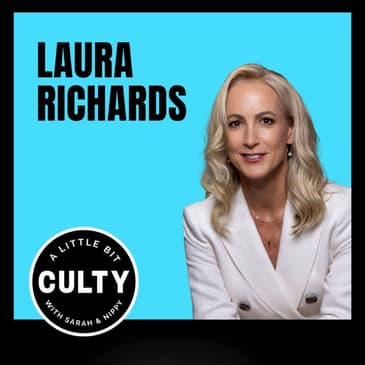
This episode is sponsored in part by Betterhelp. What do serial killers, cult leaders, and domestic abusers have in common? According to criminal behavior analyst Laura Richards, quite a lot. In this powerful conversation, Laura explains the concept of coercive control—the psychological abuse tactic often at the core of these crimes—and how it plays out across intimate relationships, cults, and high-profile cases.
Laura spent a decade at New Scotland Yard investigating rape, murder, and abduction. She went on to found the Homicide Prevention Unit and Paladin, the world’s first national stalking advocacy service. Her work helped reduce the murder rate in the UK by 58 percent and led to coercive control being criminalized there. Now, she’s fighting for similar legal reforms in the U.S.
In Part 1 of our conversation, Laura offers insight into the behaviors and warning signs she sees in the cases of Gabby Petito, Sean "P. Diddy" Combs, “Dirty” John Meehan, British serial killer Peter Sutcliffe, Larry Ray (of the Sarah Lawrence cult case), and NXIVM’s Keith Raniere.
This episode gives you a new lens for spotting red flags—and a deeper understanding of how abusers manipulate power and control, so major trigger warning for sexual assault, murder, and domestic violence this week.
For more, check out Laura’s podcasts Crime Analyst and Real Crime Profile, find her on IG @laurarichards999 or visit thelaurarichards.com. Also… let it be known that:
The views and opinions expressed on A Little Bit Culty do not necessarily reflect the official policy or position of the podcast. Any content provided by our guests, bloggers, sponsors or authors are of their opinion and are not intended to malign any religion, group, club, organization, business individual, anyone or anything. Nobody’s mad at you, just don’t be a culty fuckwad.
Check out our lovely sponsors
Join ‘A Little Bit Culty’ on Patreon
Get poppin’ fresh ALBC Swag
Support the pod and smash this link
Cult awareness and recovery resources
Watch Sarah’s TEDTalk
CREDITS:
Executive Producers: Sarah Edmondson & Anthony Ames
Production Partner: Amphibian.Media
Writer & Co-Creator: Jess Tardy
Associate producers: Amanda Zaremba and Matt Stroud of Amphibian.Media
Audio production: Red Caiman Studios
Theme Song: “Cultivated” by Jon Bryant co-written with Nygel Asselin
See Privacy Policy at https://art19.com/privacy and California Privacy Notice at https://art19.com/privacy#do-not-sell-my-info.
[00:00:00] This podcast is for informational purposes only and should not be considered legal, medical, or mental health advice. The views and opinions expressed do not necessarily reflect the official policy or position of the podcast and are not intended to malign any religion, group, club, organization, business, individual, anyone, or anything. I'm Sarah Edmondson.
[00:00:25] And I'm Anthony Nippy Ames. And this is A Little Bit Culty. Cults are commonplace now. From fandoms to fads, we're examining them all. We look at what happens when things that seem like a great thing at first go bad. Every week we chat with survivors, experts, and whistleblowers for real culty stories told directly by the people who lived through them. Because we want you to learn a few things that we've had to learn the hard way.
[00:00:49] For example, if you think you're too smart to get sucked into something culty, you might be prime recruitment material. And who knows? You could already be in a cult. If you're not aware of your programming, you're probably being programmed. So keep listening to find out. We'll talk about all sorts of topics on the show, but be aware, this podcast might contain stories that could be alarming to some of our listeners. So please check our show notes for more detailed descriptions and take care of yourself.
[00:01:15] Subscribe to our Patreon for Thursday bonus episodes, Q&A, and all sorts of exclusive content. That's patreon.com slash a little bit culty. Welcome to season seven of A Little Bit Culty. Welcome back to A Little Bit Culty.
[00:01:40] This one's for you, all you true crime junkies and cult curious folks. Get ready for a wild ride because today's guest is the real deal. We finally got Laura Richards on the show, a criminal behavior analyst who spent 10 years at the New Scotland Yard profiling some of the most dangerous criminals out there. As with all episodes, trigger warning on the following content. Laura's early focus was on stranger rape, murder, and abduction cases. Then she shifted to domestic abusers and stalkers.
[00:02:08] Studying their behavior patterns led to the development of New Scotland Yard's Homicide Prevention Unit. Turns out there's a huge connection between coercive control and violence. Laura's a major advocate for victims. She founded Paladin, the world's first stalking advocacy service. She was instrumental in getting laws against stalking and coercive control passed in the UK. On top of all of this, she somehow found the time to create two podcasts, Crime Analyst and Real Crime Profile. She also co-authored the book called Policing Domestic Violence.
[00:02:37] This barely scratches the surface of her work. We'll drop her episode in the show notes if you want to find out more. On this episode, Laura will explain how she analyzes and helps prevent violent crime. We'll talk about coercive control and its connection to cult leaders, serial killers, and domestic abusers. Laura will also be giving us her thoughts on some high-profile cases like Gabby Petito, Dirty John Meeham, Sean Combs, and of course, Vanguard. That's P. Diddy and Keith Raniere.
[00:03:04] Fair warning, this episode does include topics like sexual assault, murder, and domestic violence. If you're sensitive to these topics, you might want to skip this one. Also, we had so much to talk about with Laura, the conversation went longer than usual, so we'll be breaking it up into two episodes. So let's get right on it. Enjoy.
[00:03:37] Welcome, Laura, to A Little Bit Culty. Thank you. I'm so happy to be here and to see you both again. Right. When we met at CrimeCon, Nippy and I were immediately on the same page that we would have to have you on A Little Bit Culty at some point. And I'm so glad that day is finally here because we have so much to talk to you about. Me too. And thank you very much for inviting me. Of course. Absolutely. So you have such an extensive background.
[00:04:02] And for the people who are just learning about you now, who've been living under a rock, if you could... Or who haven't been to CrimeCon. Or haven't been to CrimeCon or just are focused on cults. Tell us briefly about your career and how you became an expert in this space. So the cliff note version is my first 10 years, I worked at New Scotland Yard. And my background was in forensic and legal psychology.
[00:04:27] I got my master's whilst I was working in the sexual offences section at New Scotland Yard, which was set up as a mini behavioural analysis unit at the FBI. So we mirrored their unit. Right. And the mandate for the unit was stranger, rape, murder and abduction cases. So that was my first five years. And it was set up in response to a serial killer case that was very high profile in the UK, a man called Peter Sutcliffe who was targeting women.
[00:04:55] And unfortunately, the police had him before them at least 14 times. And they never thought it was him because of the way that he behaved and because they had given... The media and the police gave him a moniker. And that moniker, I'll say it once and once only, was the Yorkshire Ripper. So in people's minds, this guy was a big scary guy. And the man who they had before them, at least 14 times, was quite small, of petite build and stature,
[00:05:25] had quite a reedy, squeaky voice. And they just couldn't make that leap that that was him. So my unit was set up to make sure that we make the links, that we link stranger-related crime and we stop serial killers and serial rapists. And after five years of working those types of cases, I realised that the majority of men, once they had raped and killed, and I had looked at their backgrounds backwards, I call it a psychological autopsy, most of them had a history of domestic abuse, coercive control.
[00:05:55] I'll just let that sink in for a minute. I wondered whether those cases that I had worked on was just an anomaly, as in they were just the ones that I had come across. So I started to look far deeper at many more cases. And that was sort of the second wave of my work, which was profiling domestic violence perpetrators. And I wanted to track them backwards and see what other things are they doing. And I already knew that they were most likely to kill, right,
[00:06:24] in terms of domestic violence murders. They were the largest number of murders that we had in London. And what I just kept finding was this link between domestic violence and stranger-related rape and murder. They were the same offenders. But the problem was that people would discount domestic violence and say, well, it's just a domestic. He's just doing this to his wife and his children. Not serious. And when I talked to frontline officers, that's what they would tell me.
[00:06:52] So, you know, how did my career start? It was really about asking questions and looking at psychology and behaviour of the criminal mind, criminal actions, the victimology, who were the targets. And I kept coming back to this domestic violence and what we now know as coercive control. And having profiled domestic violence offenders, 450 offenders are looking backwards in their past. I saw domestic violence in their childhoods,
[00:07:19] and I saw them then behave and act out in their relationships. And some went on to rape and murder outside the home. In fact, in my data, one in eight of them who were domestic violence offenders went to escalate their behaviour outside the home, then we would pay attention. So looking at these 450 and looking at the murders, the domestic violence murders, I started to see patterns. And then because you can't just look at patterns
[00:07:44] within the most serious of cases, murders and rapes, I took the one years of reports of domestic violence victims, them calling the police, and I looked at all this data. It was about 114,000 reports in 2001. And I looked at the patterns within those reports. I mapped them against the near misses, the 450 offenders who were raping their partners or committing serious crime against some serious violence.
[00:08:11] And I looked at the murders, and I saw patterns repeat. The main thread of that was coercive control. But I ended up creating a risk assessment model called the DASH to prevent the murders to pick up these men before they escalated their behaviour to rape and kill inside and outside the home. So that was the next chapter of getting into prevention. And really, that's where my work has remained. Not just the, these are the awful cases that happen
[00:08:40] and let's catch the offender. It's about how do we identify them earlier on? So I spent the next five or six years advising the chief police officers. It was called ACPO, the Association of Chief Police Officers. I was their violence advisor trying to join up the behaviour so that we don't think in terms of crime type. So we don't think this is just domestic violence. This is just child abuse. I say just as in it happens in this nice, neat category and box.
[00:09:08] Well, we know offenders don't behave like that. They offend against lots of different types of people. So the risk work I was doing led to the Homicide Prevention Unit at New Scotland Yard. And that's really, you know, the MET, the Metropolitan Police Service in New Scotland Yard, backed my unit, the Homicide Prevention Unit, which we created from scratch, having worked in the domestic violence area with risk assessment toolkits like the DASH,
[00:09:35] and we prevented 58% of murders every year of domestic violence for 13 years using the toolkit. That's 33 people less dead every year. So having done that in London, I got a commissioner's commendation and I was asked, would I head up a new unit? And I agreed if I could create it with the commander. And that was the birth of the Homicide Prevention Unit where we proved concept through domestic violence. My reward was another 14 portfolios because that's how you reward people in the police.
[00:10:04] So the answer to your question is it's been very organic, my career, asking questions, writing the book that sat behind me called Policing Domestic Violence, which was all the good practice of how do you prevent cases escalating to murder. We put it all into a book, myself and two police officers, and then I started training police officers and other law, well, all sorts of agency professionals who work with victims. And that's how we prevented those murders
[00:10:33] and setting up the Homicide Prevention Unit led to me working in the FBI for three months. And it really went from there. Now I have the podcast Crime Analyst, Real Crime Profile, where I'm mainstreaming all of that learning and all of those lessons. But coercive control and stalking are the two most dangerous types of behaviours. So the more I kept reviewing different types of murders, I was the person that was called in whenever a police force was in the headlines. And the victim failed.
[00:11:03] She called police and he murdered her. The Met Police were told that she was scared, that he had abused her, and they did nothing. These kinds of headlines kept happening. And I was the person that went behind the scenes to try and help the police force or the agencies using the risk model so that we could get upstream and into intervention and prevention. And changing the law on stalking came from a very high-profile case in the UK, the murder of a young woman called Claire Bunnell,
[00:11:33] who was stalked. But before she was stalked, she was being coercively controlled by a security guard who also worked in the store. They'd had a couple of dates and he was trying to control everything from her clothing to who she spoke to, even after date number two. And he told her he was in love with her and she was scared by his behaviour. And she told him to leave her alone. She didn't want to date him anymore after date number three.
[00:12:00] And he said date number three was their anniversary date. The horrific thing about Claire's case was that she did report to the police after he had made the threat to kill her. If you report to the police, I'll kill you. And if I can't have you, no one can. And he made good on that promise and he killed her. So that was another horrific case for me that changed the trajectory of my career as I was called in as one of the experts to review what happened, Laura.
[00:12:28] What did we know as the Metropolitan Police? And I said, well, she's reported multiple times. She told us that she was terrified of him. In essence, she told us that she was being stalked, that he had made a threat to kill. And we had arrested him, but he did get bailed. Multiple times we'd arrested him and he killed her whilst he was on bail. So this caught the news headlines because it was in Harvey Nichols, a flagship store in Knightsbridge. I was one of the reviewing officers, although I was never warranted.
[00:12:58] I never carried a warrant card, but my background was in forensic and legal psychology, running the homicide prevention unit. And then I met her mother and her mother told me all sorts of things that we didn't know in the police. And I realized that we had also really let Claire down. And that's when I started the stalking law reform campaign, listening to a number of mothers whose daughters had been firstly coercively controlled. And then when they separated from that abuser,
[00:13:27] they were then stalked and then they were killed. We didn't have a stalking law. And that Claire's case took me on a different trajectory because I wanted to ensure that we understood stalking. We changed the law on stalking in 2012 and the new law came in through a parliamentary campaign. And because so many victims then contacted me, I kept saying, I can't do this on my own, as in advise every victim coming forward. There's no service for victims of stalking
[00:13:54] and they're high risk when certain behaviors happen. So I set up Paladin, the National Stalking Advocacy Service. And as the founder, I ran that service as the CEO, had to fundraise, do everything. It wasn't government funded. But the more cases that came in, with all my caseworkers, we saw coercive control happening in all of them before the separation. And the irony was in England and Wales was that we had to wait for separation to occur
[00:14:23] and the risk increases. Then we would call it stalking and that's the crime. But everything that happened before it, if there was nothing physical, the Crown Prosecution Service and others would tell us there's no crime. So the thousand cuts, as I call it, that were happening, the financial abuse, the psychological, the emotional, the entrapment was totally ignored by the criminal justice system. And so the coercive control law reform, we started it in 2014
[00:14:51] and the law came in in 2015. It's the shortest campaign in Parliament's history because myself as head of a grassroots organization that helped victims and two other female-led organizations. We were the ones that were campaigning, talking to victims, talking to professionals. And unanimously, 98% of victims, 98% of professionals said we needed a coercive control law. And that's where the law came from.
[00:15:20] We were the first in the world to change the law. And I was the first in the world. Through my charity, Paladin, we ran all the training on coercive control that the charity funded because the state, the government, wouldn't put any money into the funding, wouldn't make it mandatory. So I've continued training. So lots of the work I've continued with as a podcaster, on crime analyst, and on Real Crime Profile because I'm trying to mainstream all the knowledge that I've accumulated throughout my career.
[00:15:47] And it's not just about what the police do or what the criminal justice system do. It's about what all of us can do. It's about, you know, the mothers, the fathers, the dads, the sisters, the best friends, because victims will tell us about it first before they even call the police. So that's a very long answer because it's been such an organic career. It was never, this is where I'm heading. I want to achieve this rank and go in this direction to the frustration of a lot of senior officers
[00:16:16] who kept saying, you should join the job. You need a 10-year plan. And I kept saying, no, I'm following the work that interests me. And my background in forensic and legal psychology means I ask a lot of questions and I try and problem solve. If we need a new law, you know, how do we fix this? And 10 new laws have come in because of the work that I've been doing with survivors in England and Wales, in the UK, Scotland, Northern Ireland, Ireland, Wales, and England
[00:16:45] all have a coercive control law now. Australia, I've lobbied there for coercive control laws and here in America. So I've continued because I believe that that can make the biggest change to victims having that light bulb moment where they realize they're being coercively controlled and it is abuse and you don't have to wait for the physical thing to happen, that there is an intervention and a preventative aspect to the law. That's what I've been trying to achieve. I literally have goosebumps as you're talking
[00:17:15] because I feel like you're the glue to so many of the topics we've covered in a little bit culty. Like, and I really want this episode to connect the dots for our listeners. If anyone's been paying attention, they know about coercive control already, but when did you first hear about it? And you said that the laws were changed in 2012, so you've been using the term for much longer than most people. How did it come on your radar? Well, I have to think back to that when it came onto my radar because it was quite early on in my career
[00:17:44] of being alert to stalking, bearing in mind stalking wasn't a criminal offense, but when Claire Bunnell's case happened, it was very clear that the insidious behaviors when she said, I don't want to date you anymore, that he was stalking her. Okay, following her, using the cameras in the store, using other people to go up and speak to her and using technology, turning up at her home address. So that part of stalking, when you have the lens of stalking, was clear,
[00:18:14] but the stuff that he was doing to her before, i.e. making her fearful, first of all, it was dressed up as love, right? The love bombing, making her feel special. And then it became very insidious, the fear element of saying things and the creepiness that goes with it, right? These kind of behaviors where the hair on the back of your neck goes up, but it's not a crime. But even when he threatened to her, she was on a tube
[00:18:41] and he stepped towards her to block her exit and he was nose to nose with her and he stroked her cheek and smiled as she's saying, get off me, leave me alone. But to other people, it looked like a romantic gesture, right? Two people, he's nose to nose with her, but he strokes her face, smiles, and she's saying, leave me alone or I'll call the police. And he says, if you call the police, I will kill you. And if I can't have you, no one can. This insidious behavior that when I read that
[00:19:10] in New Scotland Yard, the hairs on the back of my neck went up, the threat, but the things that he said before, date number two was the anniversary date and him saying that he loved her and he couldn't imagine his life without her, writing her this poetry, this kind of insidious type of behavior where your creepometer starts to, I call it a creepometer, right? It can get buried and anesthetized, but where you have a visceral reaction to something. So I started to see that with Claire's case and then another case happened,
[00:19:39] a woman called Julia Pemberton who was shot dead by her partner, Alan Pemberton, but first he shot dead the 15-year-old son who was on the driveway trying to protect his mom. And when I reviewed that case, because the brother, Frank Mullane, had contacted me at New Scotland Yard and asked me to look at his sister's case and he was really angry and upset at that point because she'd reported many times to Thames Valley Police. And I look at the case
[00:20:06] and I realize it's the same type of insidious behaviors, although they'd been married for 22 years. 22 years versus three dates, but the men are behaving in quite similar ways. I mean, things like with Julia's case, he super glued the locks on the windows of the house and the doors. He put her in abject fear, but the start of their relationship, there's all this charm and the love bombing. So once I started to unthread the behaviors, I could see this is more than
[00:20:36] what people would call domestic abuse, power and control. This was about entrapping the victim so that they feel they have nowhere to go. They cannot escape. It's much more than someone just wanting to have power and control over them. This is about utter domination. And this element, if I can't have you, no one can. I must win at all costs. This psychopathology was something quite different. And I remember Professor Liz, I'm just trying to think of her surname. It's gone totally out of my head. It will come back to me though.
[00:21:05] But one of the professors who I was working with, Professor Liz Kelly, I remembered her talking about coercive control is where it limits someone's space for action. And I remember Dr. Judith Herman's work. She started writing about coercive control in 1992. And listening to Liz and various other people, and then I read Evan Stark's book, Coercive Control, I realized that this was what I was seeing in all these cases.
[00:21:35] And after changing the law on stalking, I felt that the elephant in the room was this coercive control that we had no law for and it was invisible. So it was really around, I mean, I would say it was 2003, 2004. And Professor Evan Stark's book really popularized the term, but he didn't create it. The term was actually created by Dr. Judith Herman, who was working with trauma survivors, particularly domestic violence victims.
[00:22:05] And she said they're like hostage survivors. It's like a mind control, a liberty crime. And she coined the term and then Evan Stark wrote the book. And so after we changed the law on stalking, I worked with, as I mentioned, the other charities, Sarah Charlton Foundation and also Women's Aid. And we decided we needed to tackle this elephant in the room, coercive control. And I went to a round table with Evan Stark and he said to me, I'm glad you're here, Laura. I know you changed the law on stalking. You should really think about coercive control.
[00:22:35] I said, Evan, I'm one step ahead of you. I'm here with my colleague from Sarah Charlton Foundation. We've started a campaign and we want you to become an advisor on it. And at the time, lots of people said it's never going to be possible. And I kept saying, we changed the law on stalking. A lot of those behaviours are psychologically rooted. If we can change the law on stalking, we can change the law on coercive control. And I don't accept that it's impossible. And the more we talk to survivors and victims, the more we were convinced
[00:23:05] that we needed to close this criminalisation gap. And that's what we called it, a criminalisation gap. We needed to modernise the law to reflect the reality of victims' experiences of abuse. And nine times out of ten, it's non-physical when it begins. And that drip, drip, drip, the thousand cuts could happen for 22 years. And it's on the point where Julia says, I'm done. I've had enough. I'm leaving you. And that's the point
[00:23:34] that Alan Pemberton decides he's going to kill her because if he can't have her, no one can. So it is a very specific type of patterned behaviour and often it is, as we've talked about before, it's invisible to everybody else. And my goal and my aim is to talk to as many people as possible, legislators, you know, and on the podcast to make these behaviours visible. Hey, Calti listeners. As you probably know,
[00:24:04] Nippy and I are working on a manuscript for our first book together. And as you probably also know, maintaining control is important to us. That's why we've decided to produce our book with the Self-Publishing Agency or TSPA. Unlike traditional publishing, where you're often left waiting for months or even years to get your story out, the Self-Publishing Agency lets you take control of your timeline. You'll have complete creative freedom with insights and guidance from pros in the publishing world. So if you're like us and you have a story or a message
[00:24:34] that's burning to be told, we highly recommend TSPA as your go-to partner. They offer everything you need from expert editing and eye-catching cover design to marketing and distribution strategies that really make a difference. They make the entire process seamless and inspiring so you can focus on what matters most, telling your story. Go to theselfpublishingagency.com That's the S-E-L-F publishingagency.com to start your very own publishing journey today. Enjoy!
[00:25:13] This podcast wouldn't exist without our fantastic, supportive, generous patrons. Come find us over on Patreon. We're at patreon.com slash a little bit culty. Go there for bonus episodes, exclusive content, and the occasional Zoom with our fan favorites from our past episodes. Subscribe now and join us. That's patreon.com slash a little bit culty. And now, a brief message from our Little Bit Culty sponsors. Remember, when you support our sponsors, you support our podcast.
[00:25:44] You've heard from our sponsors. Now let's get back to a little bit culty. Shall we? I was going to ask, have you been able to have any sort of psychological profiles on the people that use coercive control to ensnare their victims? Is there a specific profile to these kinds of people like trauma in their own childhood so you can nip it earlier in the bud like maybe you can recognize it when they're 10, 15 years old? I don't know. Is there any work in that direction? Yeah, good question,
[00:26:14] Nippy. I'm going to start at the most serious end of serial killers and cult leaders. Okay. Those who have mastered their tradecraft, every serial killer case I've worked and looked backwards at in terms of the psychological autopsy, there's coercive control. In fact, their ultimate aim is domination and power and control. So you think about any serial killer case and you will find
[00:26:43] that history, them being victimized quite often as children or being abandoned by their father or an emotional immaturity aspect and that power and control and need, need driven to have power and control going forward. you see it with psychopaths. So the psychopathy work that I've been digging into more recently and even when I went to the FBI I was really curious about how many serial killers
[00:27:12] asking every agent there in the behavioral analysis units about every case that ever worked going back to when they had relationships did they abuse their partner because many of them do have relationships and it was always there of them using that coercive control, that power and control in significant relationships and when they select a target and they go to kill. With other cases and bearing in mind there isn't a study as yet on coercive controllers a group
[00:27:42] that they might be cult leaders there's a whole cross section of them right we've looked at domestic violence perpetrators but even then you're talking about subsets. The men that I looked at those who committed murder and those who raped inside and outside the home many of them are psychopaths undiagnosed and why they're undiagnosed is because the psychopathy checklist which was created by Dr. Hare is rarely used and there's a
[00:28:11] statistic that's put out in the ether that it's probably 1% of the population who's a psychopath and all of them use coercive control but it's far higher than 1% and some estimate it, some of the new researchers say it's around 10% but what I do know is that you see them in the domestic violence arena i.e. they have partners and they abuse them and they all want to seek that power and control over and when you look at them let's say you take Gabby Petito and Brian Laundrie
[00:28:41] was he a psychopath? Well I can't tell you that but I can tell you that he felt his needs mattered more than Gabby's and that's why he killed her because it was all about him and he was very emotionally immature and he used that power and control his need base it was all about what he wanted and if you listen to my 24 episodes of drilling you know into what was really going on for Gabby what was really going on for Brian behind the facade of social media
[00:29:11] it was all about him isolating Gabby and trying to control her because and he proposed to her I think to try and keep her because he felt unworthy really deep down so different offenders you really have to look at what's going on for them because you do have young boys and young men using coercive control and seeing it and believing that jealousy is about love and you need to untangle those kinds of things because they're not all going to be psychopaths right
[00:29:41] the patriarchy you know the P word which reinforces often boys and men to have power over to have dominance dominant masculinity it's wrapped up in all of that so you can't just harnish everybody or label everybody they're all psychopaths so they're all they all have personality disorders because I think a lot of it is wrapped up in young boys and men and how and what it means to be a man a healthy relationship isn't about power over it's not about dominating but there's
[00:30:10] a lot of boys and men who think that that's what it means to be the man of the house you know that you have to have power and control over so there's no easy answer every case you have to take on its own merit but you do tend to see across all the cases this male entitlement this belief that men must dominate and I am just performing my role dominating because that's what men do in relationships and then you've got the more serious end of psychopaths who very serious patterned behaviour where they're raping and
[00:30:40] killing or even the cult leaders like Keith Raniere very clear that he's a psychopath he has no moral code everything's about him low empathy low compassion everything's about having people meet his needs at all costs that was actually one of our questions I just did an interview about a month ago with a guy named Ian Bick in New York and we were talking about this and there was a component to what I believe I think Keith enjoyed doing it I think there was an
[00:31:10] aspect because I don't think he was interested in necessarily terminating people maybe he is since we've kind of been finding out peripherally but there seemed to be an element of him just enjoying dimming people's lights if that makes sense and how does that relate to the psychopath and that kind of sadistic element of the cat and mouse the long game with some people the shorter game with others
[00:31:40] but really he's the puppet master and he's pulling all the strings and I agree with you he enjoyed it this was the whole DOS thing which Sarah and I have talked about he didn't just do things for one singular reason there were multiple reasons that fulfilled his needs let's have an altar sacrifice and saying things like that out loud which other people didn't even question when he said these things and that gives him a secondary kick you know
[00:32:10] not using anaesthetic getting girls and women to ask to be branded all of these things are over and beyond what's required low empathy low compassion no moral code so nothing on no one's off limits and this element of sadism where sex and violence can be confused and merge together but even for Keith Raniere if he cannot control and dominate using his
[00:32:39] usual tactics and what he's learned nothing is off limits to him nothing and the thing with psychopaths is that they have so many more options than your normal person who's bound by morality ethics things that stop us from doing that thing that might serve our need but actually hurt or harm someone else in the process the psychopath just doesn't have that so there's nothing that is off limits to them and that's what's the frightening element when you've got someone who mixes sadism
[00:33:09] because you only know what you know right and the more you dig into someone it's like when we looked at John Meehan Dirty John even when we did the podcast Dirty John and the show Dirty John which was a scripted show with Eric Banner and Connie Britton we had a documentary that I co-produced called Dirty John the Dirty Truth and I remember his first wife of 10 years Tonya saying to me right at the start gosh Debra is having to process all of this in real time
[00:33:39] the final victim she said I'm so glad I've done therapy and I've worked through everything and I said Tonya what you know is only a small fraction of what John has met her but after she saw the documentary of all the women coming forward she realised she was married for 10 years she actually knew nothing about him because of the way he managed himself always lived away so never
[00:34:09] really spent much time with her but nothing was off limits to him either and the things that he did what we uncovered through another investigation of looking right back to his childhood you know just blew Tonya away even to the point of her processing that even when he proposed to her he was having sex with multiple other women one of whom got pregnant and there was a child as a consequence of that so nothing for her was real and that's why I say nothing is off limits to the
[00:34:39] psychopath and if there's a sadistic or sexual component there will be many more victims and that's why you really do have to look very thoroughly at every contact they've had and for those who don't know the Dirty John case we will do an episode on it but can you summarize just like cliff notes again like he was a serial killer who well we suspect he was Sarah and you know when I
[00:35:10] was at what people said about him when he was studying to be a lawyer to be a male anesthetist as well he wanted to go in Tanya's footsteps work wise but what most people know about Dirty John Meehan is from the podcast Dirty John and Dirty John The Scripted
[00:35:36] show. And it's really the last chapter of his life where he targeted Deborah Newell in Orange County online, had a relationship with her. And there were things that were off. She's a very well put together woman, really lovely person, very kind, very generous, a beautiful soul and very successful, millionaire, self-made. And he targeted her, matched her, mirrored her,
[00:36:04] socially engineered everything, that he was religious and going to the same church as her, all of these things that he found out about her from the first few dates. And he, whirlwind relationship, they got married very quickly. And then lots of things start to happen that Deborah's children, daughters aren't happy with. And they don't believe he is who he says he is. He was saying he was a doctor, but he always had dirty fingernails, wore dirty scrubs all the time.
[00:36:30] They put a private investigator onto him, realised he didn't have all these houses around the world. He didn't have all these cars. In fact, he was staying at home, driving Deborah's cars, you know, basically using her. And things then escalate when Deborah said she wants out of the relationship. But not before a therapist tells her to work hard at the relationship and don't let her daughters drive a wedge between her and John. All the things you should never say as a therapist
[00:36:58] without understanding, is this person being coercively controlled and abused before you say things like that? And Deborah took this therapist's advice, but then things got pretty bad. And the short version of it is that Deborah had to go into hiding for six months. And when he couldn't get to Deborah because she'd ended the relationship, he targeted her children. So he went after her daughter,
[00:37:23] Sir Jacqueline, first of all. She was already on the lookout for him because she always thought that he was a risk and a danger. She was the one that really understood who John was. But she saw him one night. She called up her sister, Tara, and said, be on the lookout for John. And Tara, thank goodness, was on red alert. And she had been looking after dogs in the day. John had called up where she worked,
[00:37:48] found out what time she got off and then had waited for her where she parked her car and approached her. He had a knife on her. He had a kidnap gear or kit in his vehicle. And there they wrestle because thank goodness Tara knew never go to a second location ever. Have your fight where it happens because wherever they're going to take you is a whole lot worse. And this five foot two, incredibly strong,
[00:38:18] strong and smart young woman, ended up fighting him and winning. And she put a knife through his eye and it saved her life. So she wasn't charged with killing him. It was a self-defense act, quite rightly too. And then the whole story came out because the DA, deputy DA, who had to make a decision about whether to charge Tara, he spoke to Chris Goffard at the LA Times about the case. And
[00:38:43] that's how the podcast was born. And most people know that case through that, those last months, years of John's life. But I was always interested, as I've already told you, I always like to look way back, the psychological autopsy of when did it begin and who knew what. And we uncovered all these things that even the few friends that he had would say about him and how he treated women. Hence, they called
[00:39:07] him Dirty John because he used and abused women all the time. You know, so that's where that nickname came from, why they called it Dirty John. Because even when Tonya was getting married at the wedding, one man who had known John said, oh, his nickname's Filthy John because of the way he's always behaved. And Tonya didn't really question that at the time. So we were joining all these dots together and looking at this very dangerous man. We suspect that he did kill multiple people.
[00:39:34] And if you ever went against him, he was scorched the earth mentality and he would want revenge. He would want blind loyalty, but he would want revenge. And so he went after many people. He even put a contract kill out when he was arrested by Detective Julia Bowman. He put a kill contract out on her and on Tonya and another detective from prison. That's how dangerous this man was.
[00:40:03] Speaking of connecting the dots, and if you don't know this, but Tara Newell and I are in touch about, I think, me coming on her podcast. But we have not deep dived into this story. So we'll have to watch the documentary you produced and circle back when we're ready. But obviously, you have so many incredible connections to these different groups and people. And our paths have crossed many times with our respective guests like Amanda Knox and now cult leaders. When did the term cult,
[00:40:32] or when did you make the connection between coercive control and cults in specific? I don't need a date if you can't remember, but how do you make that correlation? I'm thinking that it's from looking at lots of different cases. The Sarah Lawrence case in New York. I don't know if you remember that case with- Yes, we did an episode with Daniel Levin.
[00:40:55] Yeah. So looking at what, his name was Ray Lawrence, wasn't it? What he did and how he did it. But, or Lawrence Ray, wasn't he? His full name. Yeah. So the Sarah Lawrence cult, having looked at that and realized that his behaviors were all about coercive control and getting people to service his needs and having relationships with young girls and women and, you know, the takeover of their lives and
[00:41:23] isolating them from family members. The tactics that he used were exactly the same, only there were multiple people that he targeted, right? So you could see that, is it a cult or is it not? And yes, it is. But what are the tactics that he's using? And the more cases that we were doing on Real Crime Profile and people reaching out to me, I've had multiple victims, survivors reach out to me.
[00:41:49] And when I've talked to them and they've explained what happened to them, reading your book, Sarah, you know, the behaviors you can map across, even looking at Charles Manson and what happened in that case and the brainwashing. So I looked at lots of different cases, you know, of course there was Tiger King and, you know, on Real Crime Profile, we've talked about many cases involving cults. And I felt that it was exactly the same types of behavior. And when you break it all down and you look at
[00:42:19] what the perpetrator is seeking to achieve, it's exactly the same thing, exactly the same. And they use the same tactics, the same manipulations, the same revenge, the rewards and punishments as the coercive controller in the intimate relationship. And so that has been an organic journey of looking at it. In fact, when we were changing the law on coercive control,
[00:42:45] Theresa May, who was the Home Secretary, she and her advisor said to me, you know, coercive control, what do you think? Do you think it's outside of intimate relationships? And I said, yes, I see it in the workplace. I see it elsewhere. And we should broaden the law to take account of those cases. But I was also advised that if we look at those situations as well, it would delay the law coming in. We'd have to do another massive consultation and that would delay the law coming
[00:43:13] in. So my advice was let's continue, change the law and then let's look at that. And so, you know, organically from listening to victims, looking at cases, speaking to people like you, I've joined those dots together. The challenge is, I think it's very confusing for lay people with all these different terms like narcissist, you know, psychopath. It kind of disconnects dots
[00:43:38] rather than connects dots. Yeah. It hasn't been amalgamated into something that's soundbites we can all kind of digest. Would you say that there's a spectrum of coercive control that people can maybe get on board with? I would. There's a degree of it, I guess. Yeah, I would. And, you know, to a lesser degree, the teenager who's in a relationship exhibiting jealous and controlling behaviors,
[00:44:05] we've just had a case in the UK, Holly Newton, a 15 year old was killed by the guy who she had dated and said she didn't want to date anymore. And he was coercively controlling her. And then she said, enough finality, separation, then he killed her. You know, there's an opportunity to get in earlier in those cases and educate young boys and young girls about what a healthy relationship is.
[00:44:31] And the earlier we get in, not just teaching them mechanics of sex, but everything about emotional hygiene, what's a healthy relationship. And then you've got, you know, the most serious ends, the Keith Raniere's, the Charles Manson's, that those who've really studied and learned their tradecraft and are very attuned at tapping into people and controlling multiple people simultaneously
[00:44:57] and being worshipped and idolized and put on a pedestal. And people are too in it or too fearful because of the revenge element to call them out. And there is that continuum. So the earlier you get in to off ramp, the better, but in amongst them, there are the psychopaths. And far too often, I think we allow the behaviors to continue and escalate. And then when they kill,
[00:45:23] it's no surprise to me when they do something heinous, it's no surprise because many people were reporting them and nothing was done. So you can off ramp some of them. But I think the Keith Raniere's who are very adept, they talk a good game. They have their defenders, right? The flying monkeys and everyone around that protect them. They're very hard to tackle. Yeah, they are.
[00:45:51] For more context on what brought us here, check out my memoir. It's called Scarred, the true story of how I escaped NXIVM, the cult that bound my life. I narrate the audio version, and it's also available on Amazon, Audible, and at most bookstores. And now a brief message from our Little Bit Culti sponsors. And remember, when you support our sponsors, you're supporting this podcast. Break time's over, people. Let's get back to this episode of A Little Bit Culti. It's a good one.
[00:46:22] Speaking of which, can we put Sean Combs at that end of the spectrum? From everything I've seen, I believe so. You have to watch your language, I guess, right, at this stage? Yeah, I mean, from everything I've seen. And when I do an assessment, like with John Meehan, I did an indirect assessment, having been trained in psychopathy and assessments, you can do an indirect assessment using the people who knew that person the best, right? So the first
[00:46:47] wife, all the people who knew John. And through that indirect assessment, John Meehan scored 40 out of 40. Now, I haven't done that sort of assessment with Sean Combs, so that's my caveat. But what I will say is from everything that I've seen, he almost was acting like a cult leader, right? Using his business empire, which was the mechanism to keep people controlled. Those going along with him,
[00:47:11] his attorneys, everybody getting Cassie back, back into the relationship. He signed her for 10 years, she was 19, he was 37. He used his power advantage at every level. And his behaviours, you know, low empathy, low compassion, all about his needs and his needs only, no moral code. These freak-offs and the deaths which absolutely need to be looked at. Because Nippy, even if we take
[00:47:38] the nightclub shooting in 1999, he was the one that had the gun in his hand, said the female victim who he shot in the face. And that was her evidence. She said that right from the start. Natanya Rubin, I think was her name. But yet he was arrested and it ended up being the teenage protege, Shine, who went to prison for 10 years. And he was trying to get Sean Combs, his driver, to take the rap for
[00:48:04] it as well. I'll give you 50 grand if you say the gun was yours. So he used and he paid off lots of different people. So that was in 1999, that shooting. He had no qualms about taking a firearm, using Jennifer Lopez, so the story goes, to put the gun in her purse, which is what he did with Cassie. She had to put firearms in her purse. So yes, the short answer, Sarah, because I never like to say,
[00:48:30] I don't diagnose people from a distance. If I do an indirect assessment, it's through sitting down with all the people who know them best. If you watch The Fall of Diddy on Discovery or Max, you hear a lot of people who knew him best give their testimony about his behaviour through the years. And so yes, through that testimony, I believe that there are characteristics. He would score highly around low
[00:48:55] empathy, no responsibility taking, pathological lies, no moral code, using other people, using them up and then spitting them out. Even through his music, hip hop, that's what he did, right? He took bits of other people's musics and rhymes, inserted himself into every cultural area from music to drinks to clothing brands everywhere. It was all about him. So you can see he's a narcissist right from the
[00:49:22] start in the way that he behaves and his male entitlement. But I think what takes him into psychopathy is this no moral code, you know, morally bankrupt. There's no checks or balances on him. Nothing's off limits and no empathy. Sorry, I was going to ask what his fate is in your opinion. I don't think it looks good, Nippy. I mean, the trial comes up in May and I would suspect,
[00:49:47] based on what his senior assistant said and what others have said, he would video a lot of the times when he was forcing Cassie to do sex acts, forcing her, you know, and the trafficking, the rapes, he would video it. And I suspect there's a lot of digital evidence. It's not just about he said, she said, there's actually a lot of digital evidence. And I would hope the prosecutors have
[00:50:12] learned a lot from the Ranieri case, right? And the Sarah Lawrence case, you know, he ended up getting 60 years. So you would hope that they know what they're doing when it comes to racketeering, when it comes to trafficking, when it comes to prostitution. But I still think there's a gap around coercive control, that if there were a law there, it would be very clear it's that, plus you have to do all the other things in terms of racketeering and all the other serious
[00:50:40] offenses too, that they should be charged for. What's the missing, what's the bridge between what the UK has done and what the United States still needs to do? And how can we help change the laws? Do you think? Yeah, it's a good question. You know, what we did in the UK and from talking to lots of survivors and professionals, 98% said we should criminalize and close that gap. Here in America, there's a lot
[00:51:07] more concern about how it might be used against victims, that there isn't a strong feminist sector and voice, and there's a lack of accountability and transparency, because you have so many different law enforcement agencies. And so here, and certainly in Connecticut, in California, there's been a move to include and codify coercive control in the Family Law Act, right? So you codify it. So it's within the
[00:51:33] legislation, but on the family law side rather than the criminal side. And here in California, after Dirty John, when Deborah Newell and I were pushing for criminalization, a lot of the advocacy services said, we're not ready for it yet. We're not ready. We see too many victims being criminalized because of the Davo effect. You know, we know with coercive controllers, they will Davo. So when you said, Nippy, what's the profile? If they're a coercive controller, you have to expect Davo
[00:52:01] to attack the victim and flip the script to confuse people. You have to expect the empathy. You have to expect poor me syndrome. And if you expect that, then you know what to look for. And you don't allow that controlling the narrative. So that's more of a challenge here. Hawaii have criminalized it, but that's the only state so far. And now under the current political party, I'm not sure in the
[00:52:28] next four years, we're going to have too much success around the criminalization of coercive control. But it would make it so much clearer in cases like Sean Combs and any cult leader or any domestic violence perpetrator, if you're looking for coercive control and you have professionals trained in it, because that's the other big gap, to train people and ensure they know what they're looking for when they see it. And therefore ensure that you are arresting the perpetrator and not the
[00:52:57] victim. And the best example of that is Gabby Petito. Two Moab City police officers, two park rangers, four of them at the scene, all getting the case completely wrong. Even though for someone like me to look at it, I can see right from the start of Gabby dysregulated, upset, she's the victim. Because that's the trauma response. Right. If you could sit down with the head of all the chiefs of police or everyone who would need this
[00:53:22] information and train everybody, what would you need them to know? What would be the tells or the signs? Well, you would want them to understand trauma, first off, you know, how someone behaves. Like Gabby, if you can't see that, that's a huge problem. And Officer Robbins, I believe, did see it. And he was trying to do the right thing. Then a senior officer came in or someone more experienced and took over. But how a victim behaves, often a victim would talk about what's gone on.
[00:53:51] They would talk about how it's impacted them and they will take responsibility for things and protect the perpetrator. So when you hear Gabby immediately tick, tick, tick, she's done those things versus the perpetrator who will do the opposite. He will be calm. He may apologize to the officers to get them to see that he is logical, but he would throw the victim under the bus and he
[00:54:17] would spend his time discrediting her and throwing her under the bus that she's responsible. So if you listen to the track of both the victim or the two people before you and you hear those things, you have to ask more questions. And if you've got someone like Brian Laundrie, who even at the age of 23 is charming and manipulative, you have to go into these situations knowing that's what
[00:54:42] you're going to find. The perpetrator will be charming. They will have possibly plausible explanations for things and they will want to stand you down. And most times law enforcement will come away and say, he seemed like a great guy to me. And that's what they did with Brian Laundrie, right? Somehow they end up putting him in the refuge that's for victims. They're fist bumping with him. There's all
[00:55:06] this bro kind of culture. There's no room for that when you're attending domestic violence call-outs for you to bro it up with the guy. Because all that Gabby was hearing was that laughter and fist bumping and everything else in the car, most likely. So it's looking for those signs, looking for does the victim have agency, autonomy? Do they feel safe? I would have been asking Gabby in the back of the car,
[00:55:33] bearing in mind that one park ranger, Melissa Hulls, spent time with her. Do you feel safe? I hear that you're very upset. Do you feel safe? Why are you so upset? What's happening for you? But every opportunity that Melissa had, she squandered. She didn't know how to have that conversation, even though her heart was good and her will was good. She just didn't know how to have that conversation with Gabby to unravel it. That when Gabby was saying, we'll spend five hours on a hike
[00:56:01] and then I come back and I want to write it up. And he's annoyed with me. He's telling me to stop. He's on me all the time. And I just want, this is what she's saying to Melissa. I just, if we spend five hours on the hike, why doesn't he just accept that I'm going to spend some time writing it up? That is controlling her space for action. That's limiting what Gabby wants to do. And it's very nuanced and idiosyncratic and it might seem unremarkable. Big deal. But it's the fact
[00:56:29] that he gets to choose. They go on a hike for five hours. He's choosing and calling the shots, but he's limiting her choices, what she wants to do. He's devaluing her, even to the officers. Liberty crime. He's saying things like her little website. Oh, she's crazy. You've got to listen out for those things. Right. Liberty crime, as you said earlier, calling a woman crazy is such a visceral trigger for me because it happened in NXIVM when people left. They were called crazy. I was called crazy when I
[00:56:58] left. Unhinged. Possibly a little bit unhinged. Well, it's because legitimate reasons. I have a question. It's somewhat tangential. It might not be applicable to your work, but the rapes that were going on in the UK, and I kind of have cursory knowledge of it, but there was an Islamic group going around raping young women in the UK. And it seemed that there was something in,
[00:57:25] they knew about it and weren't doing anything about it. How does that relate to this and what was going on there? And I don't, my knowledge is cursory, so I don't really know the details of it. Do you know what I'm referring to? Is that the grooming gangs that's been in the media recently? Yes. Okay. I'll come, I'll come back to that piece in a minute, because that's something that's been going on for a very long time. But I just wanted to comment on Sarah's use of the word unhinged and it being attributed to you, because that often happens with victims and survivors.
[00:57:52] And of course your trauma response is that you're going to be acting in a way. That's why we must educate people about what trauma looks like. And the easiest trope that an abuser can use, crazy woman. Hey bro, you know what it's like. These crazy women are unhinged. And that is the thing that can also prevent a victim from leaving, that crazy trope or any kind of mental health issue,
[00:58:17] any attempt at suicide. But the abuse is crazy making. And that's why that training is so important on what's the impact on trauma, like how will someone present? And people are all different, right? So there's not going to be one size fits all. And to Nippy's question, so the grooming gangs has been a problem for a long time, as far as I can remember in policing. The Asian gangs specifically,
[00:58:45] that many have reported, but in the wake of Stephen Lawrence, which was a murder that was very high profile, it was race related. And the police were called institutionally racist after an inquiry, a public inquiry. And I worked in the racial and violent crime task force after that case happened. And there was this cooling in law enforcement where they didn't want to be seen to be racist
[00:59:10] at all. So when the statistics were showing that there were these Asian men who were doing things to young white girls, it's my belief from my time in policing that they didn't want to tackle it because of the race issue or to be seen to be racist. And unfortunately, you've seen many victims, some who've been killed, some who've been raped. Many of them now have their power and they're speaking
[00:59:39] out and they're requesting a public inquiry, although there have been formal inquiries before. And the grooming gangs work in a similar way, right? They're organised crime. It's a pyramid and it's a structure and it's about coercive control. But girls and women are the commodity that's being passed around. So yes, that's been in the news headlines more recently in the UK. And really,
[01:00:03] there's been no grip on the problem. And I think that race has played a part there of why it wasn't tackled when it was originally, I mean, this is going back a couple of decades when it was originally raised as a problem by many survivors reporting it, reporting the rapes. If you like the show, please consider supporting us by giving us a rating, a review and subscribe on
[01:00:29] iTunes. Cults are commonplace now and we're looking at them all and every little bit helps. Hit that subscribe button so you don't miss an episode. All right, guys, like we said, this conversation went a little longer than usual. So we're going to pause here and we'll pick it up where we left off in the next episode. In part two, Laura talks about cases that have been in the news lately, like Kanye West and the debacle between Blake Lively and Justin Baldoni. By the way, my opinion about that has
[01:00:57] changed about 12 times since that whole thing started. Back and forth on that one. I think both of them have to consult with their parents. Yes. And she'll also tell us about another new term, sexsomnia as a defense in rape trials. It's some serious bullshit. Make sure to continue on with part two when we drop it. See you then.
[01:01:34] A Little Bit Culti is a Trace 120 production, executive produced by Sarah Edmondson and Anthony Nippy Ames in collaboration with Amphibian Media. Our co-creator is Jess Temple-Tardy, audio engineering by Red Cayman Studios, and our writing and research is done by Emma Diehl and Kristen Reeder. Our theme song, Cultivated, is by the artists John Bryant and Nigel Aslan.