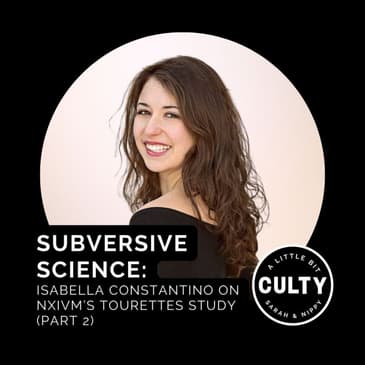
This episode is sponsored by BetterHelp. Of the many subplots within the NXIVM story, one of the most unusual (and that says a lot) was the cult’s dance with Tourettes Syndrome and research surrounding it. TS for short, the syndrome involves involuntary tics and has no known cure.
On today’s episode, which is a continuation from last week, our guest Isabella Constantino discusses the final punctuation to her time with NXIVM after being brought in hoping that they cult could help with her TS—a claim NXIVM was boasting about without a ton of empirical scientific evidence to back it. This time, we’re focusing more on Constantino’s departure and the half-decade she’s spent recovering her “sense of self” and navigating life post-NXIVM.
For more about Isabella Constanto, check out her site, Instagram, and Facebook:
Please note, this series includes details of sexual abuse. Listener discretion is strongly advised. If you, or someone who know, is a survivor of sexual assault, abuse, grooming, child abuse, or human trafficking, RAINN’s National Sexual Assault Hotline offers support at 800.656.HOPE (4673).
Also…
Hear Ye, Hear Ye:
The views and opinions expressed on A Little Bit Culty do not necessarily reflect the official policy or position of the podcast. Any content provided by our guests, bloggers, sponsors or authors are of their opinion and are not intended to malign any religion, group, club, organization, business individual, anyone or anything. Nobody’s mad at you, just don’t be a culty fuckwad.
Other Links:
Check out our lovely sponsors
Join ‘A Little Bit Culty’ on Patreon
Get poppin’ fresh ALBC Swag
Support the pod and smash this link
Cult awareness and recovery resources
CREDITS:
Executive Producers: Sarah Edmondson & Anthony Ames
Production Partner: Citizens of Sound
Producer: Will Retherford
Senior Producer: Jess Tardy
Writer: Mathias Rosenzweig
Theme Song: “Cultivated” by Jon Bryant co-written with Nygel Asselin
See Privacy Policy at https://art19.com/privacy and California Privacy Notice at https://art19.com/privacy#do-not-sell-my-info.
[00:00:00] The views and opinions expressed by a little bit cultier, those are the hosts. And don't reflect the official policy or position of the podcast. Any of the quote, fire content provided by our guests, bloggers, sponsors or authors of the opinion
[00:00:12] and are not intended to malign a religion, a group, a club, an organization, business individual, anyone or anything unless Sarah. You're a douchebag. Yeah. We're not doctor, psychologist, therapist, licensed counselors or shamans, even though you kind of think you are sometimes. I'm like an urban shaman. Okay.
[00:00:29] Good talk. Hey everybody, Sarah Edmondson here. And I'm Anthony Ames, aka Nippy, Sarah's husband and you're listening to A Little Bit Culty, aka ALBC, a podcast about what happens when devotion goes to the dark side. We've been there and back again. A little about us, true story.
[00:00:56] We met and fell in love in a cult. And then we woke up and got the hell out of dodge. And the whole thing was captured in HBO docu-series, The Vow now in its second season.
[00:01:07] I also wrote about our experience in my memoir, Scarred, the true story of how I escaped next to him, the cult that bound my life. Look at us, couple of married podcasters who just happened to have a weekly date night
[00:01:18] where we interview experts and advocates and things like cult awareness and mind control. Oh, wait, wait, this does not count toward date night, babe. We got to schedule that that's separate. So it's two days we gotta hang out?
[00:01:28] We do this podcast thing because we learned a lot on our exit ramp out of Nexium, still on that journey. And we want to pay the lessons forward with the help of other cult survivors and whistleblowers. We know all too well that culty things happen.
[00:01:40] It happens to people every day across every walk of life. So join us each week to tackle these culty dynamics everywhere from online dating to mega churches and multi-level market. This stuff really is everywhere. The cultiverse just keeps on expanding and so are we.
[00:01:55] Welcome to season five of A Little Bit Cultie, serving cult content and word salads weekly on your favorite podcast platforms. Learn more at alittlebitculti.com. Welcome back to part two with Isabella Constantino.
[00:02:24] If you didn't listen to part one, please press pause and go back because it won't make sense. Enjoy part two with Isabella Constantino. Well, you said something about how you were too young to see the red flags, which I think is the case for all of us.
[00:02:47] But now looking back and doing the healing that you've done, what were some of the red flags along the way that had you known what you know now, you would have gotten the fuck out?
[00:02:56] I mean, I think for all of us having been manipulated in those specific ways, it's easier to see those specific ways of manipulation. So knowing what I know now, I would have seen them. I don't know. Well, you had a lot of buy-in.
[00:03:13] You had Mark who's pretty trustworthy as a salesperson, your parents who are buying in. So there's a lot of ways you are trusting the people around you, it sounds like more so than considering red flags.
[00:03:26] Yeah, I think my parents are more of the red flags than I did, but you really want to do it. Yeah. And I mean, we were all desperate. I mean, Tourette's and OCD had affected all of our lives for a very long time.
[00:03:38] And my parents are amazing and always trying to help me find effective treatments and find things that would help me and help me do that. I mean, it was so much a part of all of our lives that I think the idea of it getting better was,
[00:03:54] you know, I think they were going in with their eyes wide open, knowing, having read the articles and more aware of that than I was. What was the timeframe from when you joined? What year did you join? I joined the end of 2014.
[00:04:08] Okay, so you were there for three years. Yeah, I was there for basically, so I basically, I enrolled the day after I turned 21. I left the week I turned 24. And a lot of our questions from our audience on Patreon, they wanted to know things about that time period.
[00:04:26] Like how did you first hear about what was going on and what was your, reaction? So, yeah. So I was pretty diehard. I was a lot of the stuff that came out. I didn't believe the stuff in the papers, you know,
[00:04:41] basically after you and Nippy left and Mark left and Bonnie and everyone, there's kind of a mass exodus. A lot of people were gone. And the abuse and the control tactics really doubled down. And it felt very dark. Well, the light was leaving the building. Yeah. Yeah.
[00:04:59] But they were doing more and more to create narratives around whatever was coming out against them. Like literally the curriculum was changing around what was happening in the outside world. Like whether it's hearing about branding, hearing about the women's group,
[00:05:15] hearing about whatever, it would just morph to benefit the company at any point in time, even if that meant the story completely contradicted the one before, but it just, they made it make sense somehow and you just had to ignore any inconsistencies. You filled them in yourself.
[00:05:32] So it was very hard to know, is like at the root of it, if you trusted the company, you still believed them. What was the tipping point? Because you trusted them, you didn't believe what was being said.
[00:05:45] How did you decide to leave in the middle of the night? I think enough things had happened. There's a few things. So they, at the end, enough had come out that people knew on some level what was happening.
[00:05:57] But I think everyone on some level didn't trust each other. It seemed like everyone was very on guard, everyone was very on the edge. And no one knew how to kind of maybe it was just me, but I don't think it was
[00:06:10] interact, at least in the Albany area, because that was where a lot of it was happening. Like anyone you looked at, you're like, what do they know? What's going on? So basically, just in a nutshell, I guess, how I left was they were asking us to
[00:06:26] keep everything inside the community. I remember there was a community meeting once that basically compared us to the Amish. Like even if someone can do a better job outside of the community, stay loyal to the community, hire within the community. But no one had money.
[00:06:40] Everyone was drained of their resources, of their time with everything. So like no one had money to give. Everyone was constantly, it was just, it was like an empty well that we're all trying to draw from, from each other and everything.
[00:06:53] And I think I had finally gotten to the point, like I'd started eating a bit more again. I got a car. I had a little bit more autonomy in that way. And I was like, I have to find a job.
[00:07:05] I have to find some version of a normal life so that I can stay here and be a part of this community. I have to do other things. And I think the universe kind of just like heard that and was like, here you go.
[00:07:17] Because I was actually trying to apply for a job that day. And I got a call from a friend who had left like six months earlier during the like exodus. And she was basically like, hey, I hope you're doing well. I'm here getting stuff from storage.
[00:07:33] Don't tell anyone I'm here, but I'd love to see you. Do you want to catch up? And I was like, absolutely. You know, don't worry. I didn't know what was going on. But you know, I just obviously like I won't say anything.
[00:07:44] And I actually, I had been asked to commit to like two coaching courses or Ethos courses a week by Nancy because I couldn't afford to pay for it. So they sponsored me to do it. And so I was having like an ethical dilemma.
[00:07:59] Like, do I go to this course or do I see my friend? And I literally walked into the center and just walked back out again. And I went to the diner where we met.
[00:08:13] And basically she comes in and she says, Isabella, like, I don't know what you know. I don't know, you know, what you've been told. And if you don't want to talk about it, it's fine. We'll just catch up about other things.
[00:08:27] But if you have any questions, I'm an open book. And I was like, I don't know what the hell is going on. And she filled in some things that were kind of the final puzzle pieces that made the other little red flags along the way click.
[00:08:41] And I was like, oh, shit, like, I get it. Like this was not good. There was deception. They knew what was happening. You know, and actually while she was involved with the vow and that's how I got involved and she since, you know, had dropped out.
[00:08:55] But that's how we got the footage of me moving out in the middle of the night and everything. Basically she was like, you know, come with us now. We have the van. You know, you can come to New York and see so and so who's left
[00:09:05] and so and so will be there. And I was like, I have to work tomorrow. I don't know if I can get any room to cover because I was working at a gas station full or like part time. And basically I was like, OK, this is important.
[00:09:17] I need to find out more of what's going on. So the next day I drove to Brooklyn, ended up spending a couple of days with her and with other people defected and found out more. And I was like, basically, I didn't realize how bad it was.
[00:09:34] And I was like, well, you know what? Like I'm in the Detroit study. They're holding that up. Maybe that gives me some leverage. Maybe we can still save it. And she's like, yeah, maybe. And our other friend was like, fuck no, you have to get out now.
[00:09:46] And I was like, oh, OK. So basically we took the van that she'd used a couple of days prior and just went back in the middle of the night. I lived with like four or five women in DOS at one point
[00:09:57] and then like three and I had no idea what was going on. So I don't know. That's just, you know, we're trying to be careful. And there was an ethical movie night that night. So we just went at like almost at midnight just because we were running late.
[00:10:11] It happened to be the middle of the night through everything in a van with me, her another friend and a camera guy. And Race Beck to Brooklyn got there at like five and that's kind of just how everything started. Wow. Yeah, that's how I got out.
[00:10:27] That's when we started talking, right? Yeah. Yeah. Like a day later or something. I do remember that conversation well and I remember the conversation, I don't know if you want to talk about it, where there was a conversation, not the one that was in the vow
[00:10:38] that everyone watched and was like cheering your steadfastness against Marx gaslighting. But there was another one earlier days than that, if I recall. I don't know the timeline, but it was a call where you were like,
[00:10:50] I can't talk to him because he is head fucking me or something. And I was like, I'll get on the call. So we did a three way call. Oh, that was a few months after. Just two months after.
[00:10:59] Okay. So that was like, I remember being on a call with you and him, he didn't know that I was on the call. And I'm like, You're like fuck him. He's gaslighting you to hell. Yeah. He's flipping it back on you, say no, tell him no.
[00:11:14] But I don't know how effective that was. It's hard to concentrate on a lot of things at once. Yeah. For anybody. You figured it out pretty quickly when you had the missing information, if I recall. I did. Honestly, it just there was enough things.
[00:11:27] When your New York Times article came out, that was actually one of the things that was a red flag. At that point, I just remember, I never go on Facebook. I never went on social media.
[00:11:37] I was in such a state of just hyperdrive doing things at all times. I had no version of social media or anything relaxing in my life. So I don't know what made me go on there, but that was when the Me Too movement came, you know, was happening.
[00:11:51] And yours post was like the first or second one that popped up. I just remember seeing that and opening it and being like, what the fuck is this? And like just remember reading it and having just like honestly,
[00:12:05] like very deep sadness and very strong relief thinking we tried, but it's over. And just feeling very like good about that, honestly. And that's when I called Mark and I was like, Mark, there's branding going on. That's not good.
[00:12:25] And, you know, he basically justified it to me the way it was probably justified to him. And I was like, okay, I guess so. And I like, and I said what I didn't think was okay about it. And he had responses.
[00:12:37] So I went with it, but it didn't feel right. And that among a few other things, I think were the red flags for me. So when I finally got that piece of information, after hearing all the ways DOS was justified or this or that,
[00:12:54] you know, everything clicked and I was like, I get it. And then I just, you know, was just processing that for the next year. So we extended our question making decisions to our Patreon audience. And they had many questions.
[00:13:09] And I sent you some screenshots of some of them. Yeah, I saw this. And a lot of them were just like no questions, but there's just things like she's a rock star, she's amazing, she's an inspiration. Sabrina says give her a hug. You've got some fans.
[00:13:25] Yeah, you got a lot of fans on our Patreon. Elizabeth Adam says I'm 57. I want to be like Isabella when I grow up. We said that was so sweet. Yeah, that was a difficult conversation with Mark, honestly.
[00:13:39] I was surprised at how calm I looked on screen because in my brain, like I had literally been out only a few days. I was hyper-drive. My body, my brain was just going crazy. I got in a concussion, I think a couple months before
[00:13:51] from getting hit by a car at V-week. I was told to EM it so I didn't get treated. It was a crazy fucking time. I saw that in your statement. You got hit by a car and they told you to get an EM.
[00:14:02] I was doing the triathlon at V-week, right? And it was very poorly marked, I think maybe, but it's part of it. But I was going very fast down a very steep hill and a car didn't see me and kind of just very, very slowly like
[00:14:15] turned in front of me. And at the very last minute, I realized I'm not gonna get out of this guy's way. And I just hit the back of his car and flipped over and all that.
[00:14:25] And I don't know how someone was looking out for me because I was absolutely fine. I get up thinking my arm's gonna be broken. And it was, I was okay. A couple people riding the triathlon got up to help me. And I remember at that point thinking like,
[00:14:39] okay, I'm gonna have to keep going then. And then like, you know what? Maybe I won't finish. And they were like, yeah, no, don't finish. But at that point we were all pushing so much you know that I was like, is it bad if I don't finish?
[00:14:50] Like am I indulging my body? Oh my God. Luckily I was wearing a helmet. But the guy who I collided with drove me back to the camp and dropped me off. He seemed really worried. But basically, yeah, one of the doctors actually, I asked
[00:15:07] like a couple days later because I was not feeling well. I asked him what the symptoms of the concussion were. And he said, I don't think you're having concussion. And suggested that I EM it instead. That's very confused about what that even meant. So negligent.
[00:15:26] Mine over matter got taken to a very dangerous level. Yeah, absolutely. This is the golden age of cult recovery. The more we speak up and share our stories, the more we realize we are not alone. Your voice and your story can empower others.
[00:15:44] This is Sarah and I'm proud to be a founding collaborator of the hashtag I got out movement. Learn more at I got out.org. Jenny Ellison from our Patreon has a question. Who was your biggest support as you left? How are you now?
[00:16:08] And do you think Mark will ever leave? Oh, and I love your art. I'd say at different phases of me leaving, I had different people that were there for me that I don't think I could have done without. They were all instrumental.
[00:16:22] Like my friend who got me out, I stayed with her for two weeks. She made the effort to see me while I was there, gave me information despite probably maybe being worried on some level that I would turn around and tell Nancy, tell whoever.
[00:16:40] Keith was in Mexico at this time. It was pretty crazy. And actually, Karim was with them at the time and the film crew. She had basically this conversation with her happened and like five people in a camera crew
[00:16:52] that were just all eating at the end of a long day of shooting. But you know, one of them said, you know, how do you know she's not a bad guy? And she was like, no, she's not. How can you, I don't even put that in my brain.
[00:17:06] And I'm so, that was without her, I don't know how much longer it would have been there. I don't know if I would have seen what was going on so clearly. And she was amazing. She was instrumental and getting me out
[00:17:20] and making sure that I was okay being a voice of reason and being supportive. And just, you know, she had a lot going on in her life also between work and projects and the fact that she was dealing with all of this herself, only being recently out also.
[00:17:38] And she was amazing. My sister helped me move out, you know, drove me back to Albany, like right before New Year's because my mom was like, get the rest of your shit out now. You have to go. So my sister just, you know, helped me
[00:17:50] and she's been really amazing and understanding when I think a lot of people haven't understood. And everyone else who is able to wake up and get out and you guys and Mark and Bonnie, I talked with, you know, after leaving and you shared resources,
[00:18:09] you provided support and clarity about what was going on. And as I brought up things that they said or the ways that they said them, you were able to point out, that doesn't correlate or that's not okay or that's gaslighting.
[00:18:26] And I wasn't able to see that, you know, some of those things being so close to it, so in the bubble of it still. And it's just, I think it takes a village sometimes and I was very lucky in that transition out
[00:18:39] and back into just, you know, normal life, I guess. It wasn't normal at the time, but having a mix of people who were there for me in different ways and filled in those gaps that I wasn't able to fill in myself. And then honestly, the vow people,
[00:18:57] I think it was very empowering to be able to talk about things after being so gaslit, being in such a state of self-doubt for so long. Someone asked me like, you got in through a documentary, you dealt with all this there.
[00:19:10] Why would you want to do another one? And I honestly just fell into it, but doing that and having people who understood the situation and were empathetic to it and knowledgeable about it was so validating and so, I think, critical to my healing at that time.
[00:19:27] And we spoke at the trial when I saw you, when I, I think I, when I saw you in person and it seemed like a pretty healthy group of people that understood what they were looking at. And part of the reason I went to the trial
[00:19:39] was just to make sure people were being tended to properly. Did you approve? Yeah, well, I mean, you know, I knew a lot of people were going to come out of the woodwork and then, you know, I also knew that some of those people
[00:19:53] that came out of the woodwork were at odds with each other. And it was kind of some petty stuff going on. In terms of people who were still... People who had left, who had left and were still traumatized and had an axe to grind with Keith,
[00:20:06] but they weren't getting along and disapproving of our people or leaving and criticizing each other. And I just didn't want, well, you and a few other people to be in the crossfire. There's a lot of drama even on the other side, Isabelle.
[00:20:19] I'm not sure how much of that you're privy to, but we could do a whole podcast on that, but we won't. Yeah, I don't think so. That's good. High ground. Just leave that alone. Yes, we'll definitely leave that one alone.
[00:20:29] Oh yes. I mean, a lot of people ask what your healing journey and your art and what you've been doing and how you're doing. Yeah, right now I'm doing okay. It's been a really long few years. Yeah, I don't know. I mean, I don't know how you guys...
[00:20:45] I mean, you had other things going on, I think when you left too and you had something to focus on and you had the kid Troy, but I don't know. I mean, getting out was difficult. I was very isolated and I had gone off meds.
[00:20:59] I mean, I was just in a constant state of disassociation and I've learned a lot more about different parts of my neurological system other than Tourette's since being in a cult and dealing with all of the effects of that and how intertwined everything is. But just physically, mentally.
[00:21:19] I was sleeping four hours a night. I was working out six hours a day. I was not eating nearly enough for most of the time I'd been there. I just started eating again, but was still dealing with very disordered nature of it.
[00:21:33] Thinking I was being indulgent anytime I ate anything and also acknowledging that my body was breaking down. Like I wasn't doing well. I was just in such a severe state of fight or flight all the time that I couldn't think straight. I literally couldn't see straight.
[00:21:48] So much of my mind and body had been affected and being in such a state of survival mode just physically, let alone mentally, it really makes it difficult. It affects every part of your life. It affected every part of mine. So after that first year
[00:22:06] of just intellectually processing everything, being at home where I think my parents are amazing, love me very much and care very much, but didn't have the tools to care for me during that time, it was very difficult. And once I moved out,
[00:22:22] I took much more of a somatic approach and was just trying to honor what my body needed at any given time. And that was very difficult also. But that was the thing that I think made the biggest difference. I'm still working on that. Yeah, I don't know.
[00:22:37] I'm still dealing with the effects of all of that on a daily basis. I'm trying to keep myself out of fight or flight. It takes a lot just to make sure I stay regulated. It's a constant conscious and subconscious effort
[00:22:55] to just get through the day, get through tasks. Being on the go all the time in Nexium left its triggers with me and driving anywhere. Honestly, I would just be having panic attacks up until like a year ago just from being on the go.
[00:23:15] There's a lot of Nexium left residual issues in my life that I didn't deal with before that have kind of intertwined with all of the ones I had previously. So I'm dealing with that. And I feel like I'm doing a lot better than it was,
[00:23:31] but it's still an effort. And I'm working through it. What's your self-care routine? It varies. I think it was hard to have a clear head being in Albany. So constantly seeking any kind of growth in extremes made it hard to have a grounded approach
[00:23:51] to healing and growth on the other side of it. So I would try all these different things. Think I needed to go all or nothing. Be very confused about how to go about it. So at this point, I'm just trying to on a daily basis
[00:24:04] just meet myself where I'm at and just be kinder to myself about not meeting goals and objectives. And I think it looks different every day. I'm just trying to trust the process because for so long, I judged it and tried to fix it
[00:24:23] or tried to change it or assumed it shouldn't be like that. And it was very counterproductive. So if sometimes healing looks like staying up late and just allowing that in myself because I'm still trying to get, learn to get to bed earlier,
[00:24:39] you know, that's okay, stay up late. That's not the thing I need to worry about right now. Or if it's something else, it's something else and just learn to be flexible with myself after such extreme structure and, you know,
[00:24:52] kind of a false discipline, more of a just controlled and rigid approach to everything that was not helpful. I'd say just trying to be adaptive in any given day and listen to my body, whatever that means is my approach to healing right now.
[00:25:41] My relationship with art changed a lot in Nexium. It was always something that I was always involved in it but some way my parents were very creative. I grew up drawing and painting and went to school for it. But being in survival mode, being in fight or flight
[00:26:00] makes it hard to be in a creative place in a creative state of mind. So I think in the file I mentioned, I held up some paintings and said, these are the ones I made when I stopped finishing paintings around that time.
[00:26:15] I used to spend hours just finding the right tone of paint and the right texture on the canvas. And I think when you're in a state of doing, doing, doing and more and function and it's hard to just be and it's hard to be in a creative place.
[00:26:33] And I think a lot of people when I was there didn't understand that. I was in the art schools lab and everything and I would keep telling people like, I don't feel connected to this. I don't want to be doing this. I just, I feel very conflicted.
[00:26:48] I don't want to be doing art. And then they would convince me to stay and then I would leave again with her like, well you keep coming back. Clearly it's something you want to be doing. And it was very difficult to wrap my head around
[00:26:58] what was going on because I didn't understand the nature of the abuse. And I thought it was just me because I'm going crazy whatever is happening. And art became very triggering and that's hard being something that I connected with so, so much. It was a form of expression,
[00:27:11] a form of something I identified with so deeply. I still don't feel connected to it in the way that I did though I love everything I've made. So that's been difficult trying to re kind of assess my identity almost because you're not who you were before
[00:27:28] but you don't necessarily feel whole now. So whoever that person is after you've left a situation like this, it takes a lot of introspection and kind of a lot of work to understand how you relate to things in a healthy way again or in any way again.
[00:27:47] And I think that with the OCD being so entwined in my experience in nexium and so affected by like, my OCD got a lot worse, which I've heard is common in cults that a lot of people have more obsessive or compulsive tendencies or develop it.
[00:28:06] It made it very bad. So I think working in art became very triggering and also became like this, like it felt more compulsive than creative. So I actually found a lot of kind of joy and I found a really great community in actually swing dancing.
[00:28:26] Like open mics and yeah, like more performance based things that were more ephemeral kind of arts that you don't have to obsess over because the moment's over, and I think moving my body and really healthy, like expressive, like not super structured
[00:28:42] and like ESP related like XOSO kind of ways was so healthy. And it just, it was social because I was doing that so much. I thought it was helpful. It wasn't, it was probably because it was so intertwined with all the ideology also but I'm still working through
[00:29:01] trying to figure out how I relate to my art. Like I love everything I've made but I think part of being an artist is recognizing the ebbs and flows of it. And an artist isn't painting 24 hours a day. That doesn't mean they're not an artist.
[00:29:16] So what's a few years sometimes if it has to come back to what you need? Well, I would imagine also and I don't do art in that way but it's such an expression of yourself and if yourself's been kind of fucked with and tampered with and fragmented
[00:29:32] it's going to take a minute to put those pieces back together and that is a process. It does take work and unfortunately that's what we thought we were doing in Exium. So I think for a lot of us on the other side
[00:29:45] the process of healing can be also little triggering so we don't always don't know what to do. You know what I mean? Yeah, well because if you're taking the same approach you've been in it's not always a kind one after a group like that.
[00:29:56] So you can't mean yourself into doing art. Yes. You can't punish yourself into... I guess some people can but it didn't work for me. Well, I have a very close friend that I've known since way before Exium now I'm going to cry because she's been so supportive.
[00:30:11] Maya Soos who also listens to all the podcasts. So hi Maya and thank you and she heard something I forget which episode but she texted me afterwards. She's like please go eat some cake and don't feel guilty. I'm like can it be gluten free? Please.
[00:30:27] And she like you know gave me permission to... You know because I never did the calorie counting thing I just that wasn't my thing but I definitely was obsessed with being thin. That was you know part of the culture for sure.
[00:30:36] Next year and she was like just enjoy it. I wanted to share that with you to say like I give you permission like Maya gave me permission to you know do the things that would definitely have been indulgent if Nancy found out like taking a hot bath
[00:30:49] and going for long walks and you know just doing all the self... You could do self-care all day and it's totally fine. You can. My opinion. Man it might be a little bit indulgent. You get it. My response was totally different.
[00:31:03] I felt I need to find a structure and a discipline that I knew that previously worked for me. Yeah you went to the gym hard. Yeah I do I can't even fit into my suits. But it's different. It's case by case. It's case by case right?
[00:31:16] Yeah I mean my first few years out I needed flexibility after such extreme structure. That makes total sense. It makes total sense yeah. And now I feel like I need structure again so I'm trying to figure out how to do that without throwing myself like backwards in progress.
[00:31:33] Well you're closer to the epicenter of abuse which was structured abuse. I was disheartened by the organization because it wasn't achieving any of things that it professed to achieve. There was no applicable results to the world that I could see in my life.
[00:31:49] The only thing that actually I felt like I could cite was the Tourette's was helping people with their Tourette's ironically but it was abusive and it wasn't doing that. So for me I need something that was related to the culture of our society that was tangible.
[00:32:02] You were like I'm done with this structure because it's abusive and structures when they go wrong get abusive right? Yeah yeah I just literally couldn't do it anymore if I didn't have a home to come back to I don't know what I would have done.
[00:32:16] Well that's ultimately what happens the structures fail because they are abusive. That's a good point. I meant to say that earlier Nip like the way you described what happened with Nancy like in many ways even though you were there a shorter period of time than Nippy and I
[00:32:29] you definitely got your head messed with more than Nippy and I. You got a concentrated dose of the abuse ours was trickled out over 10 years because we were peripheral. Yeah yeah yeah well I mean I remember working with Nancy the first time I worked with her
[00:32:43] and I would think I was thinking the first session I was like I know I'm Mark Caldera bitch. This is just terrible. Yeah because you're so like rude and so like direct in ways that I like thought afterwards okay was that direct
[00:32:59] but in the moment it's just like you're being a dick right now. And she was like yeah and she just stopped and she was like you know what I was like like crying and like with a fucking EKG thing on my head or whatever and she's just like
[00:33:12] you know what you need curriculum and like leaves the room I'm just like what is going on right now. And then we just did modules like to a day and then I would work with her like that was day one day one.
[00:33:27] And the way you described her hot cold thing I totally get that like you know how much how many times she'd be like no no you do this and I'll walk I'll work with you like I'll I'm there for you and then she just was never available.
[00:33:37] Oh yeah well as soon as my symptoms stopped being so obvious she just refused to work with me and she would keep me in a carrot like she asked me at 1.1 when people were leaving can you you know can you find out
[00:33:48] about this person or what they're doing like you know study wise. Kind of she seemed like she was concerned it's just like one person at the time just see how they're doing are they back on meds or whatever she says if you do that I'll work with you.
[00:34:01] What and I was like okay and then she never worked with me it was just yeah it was constant carrot on a stick kind of thing like in public she would tell people I remember she was working with someone with Crohn's disease towards the end
[00:34:13] and she likes we're in the genus room and she's sitting down and she goes you know she's talking to this young girl she's just starting to work with and she's like you know what Isabella was one of the first people I worked with with medical stuff and OCD
[00:34:25] and blah blah blah and you know I've learned so much from her and she's being so sweet and I'm like what is going on because like I was embarrassed I felt like ashamed to be you know I don't know what I don't know what's going on
[00:34:34] and she was like yeah you know you just like Isabella like Isabella knows anytime she needs to she wants to work with me I'm at her disposal I'm available I'm like how did I mess this up because I'm never able to get a hold of her
[00:34:47] what am I doing wrong yeah of course you thought that must be your fault not that she over promises nope uh well we are so grateful that you decided to do your first post vow interview with us it's a real honor I've never seen our our
[00:35:07] patreon listeners get so excited about a guest they were over it they somewhat of buy your art they want to know if it's for sale oh yeah so let us know oh yeah it let us know we'll put a we'll put a blank on it
[00:35:19] we'll put it in the show notes show notes show notes anything that we didn't cover that you want people to know before we wrap it up oh I could talk about this for hours there's so much but very very healing it is
[00:35:32] good good that's what most people have said but especially ex-next team members Karen and Terriners episode with us with one of our favorites for sure and I think for her too is healing so it's always good especially especially for so many years of like
[00:35:46] not being allowed to speak freely you know yeah it's like you're finding your bearings again yeah and you don't have to worry about speaking honorably yeah that was a shit show to work through I'm so figuring that one out sometimes I'm like I'm like how do we
[00:35:59] how do you get your personality back and all the like the feisty things that that were a part of you I'm still trying to get that no you gotta let rip listen to our podcast that's what I gotta do that's true I should go to the
[00:36:10] extreme with that one and then yeah and ask for forgiveness later if you go too far is there people that you have you have Tourette's right that's true I forgive you already sorry it's the Tourette's it's my Tourette you're forgiven already yeah you have an easy out
[00:36:26] well you look great and you sound great and it it just such a joy to reconnect I forgot that you guys saw each other in person so I want to be next please come visit us in Atlanta we have a guest room yeah and until then
[00:36:39] thank you guys thank you Isabella you're awesome thank you Isabella well that was a long one so we will save our debrief and perhaps even a live Q&A with Isabella over on our Patreon feed yeah she's doing great we're really proud of her Isabella
[00:37:28] thank you for being so brave enough to talk with us thank you to our lawyers for permitting it it's the story that has been turned into wisdom so thank you Isabella please check out her art and life in various links in our show notes follow her on Instagram
[00:37:43] and don't forget to leave us a voicemail if you have any questions or write comments about this episode and hope you're having a great summer bye for now hope you liked this episode let's keep the conversation going and come hang out with us on Patreon
[00:38:15] where we keep the tape rolling each week special episodes just for Patreon subscribers and where we get deep into the weeds of unpacking every episode of the vow and if you're looking for our show notes or some sweet sweet swag or official ALBC podcast march
[00:38:28] or a list of our most recommended cult recovery resources visit our website at alittlebitculti.com and for more background on what brought us here check out Sarah's page-turning memoir it's called Scarred the true story of how I escaped Nexium the cult that found my life
[00:38:42] it's available on amazon, audible, narrated by my wife and at most bookstores A Little Bit Cultie is a talkhouse podcast and a Trace 120 production we're executive produced by Sarah Edmondson and Anthony Nippy Ames with writing, research, and additional production support by senior producer Jess Tardy
[00:38:59] we're edited, mixed, and mastered by our rocking producer Will Rutherford of Citizens of Sound and our amazing theme song Cultivated is by John Bryant and co-written by Nigel Asselin thank you for listening